Showing posts with label comedy. Show all posts

Wednesday, June 23, 2021

Her Husband's Affairs (1947)

Her Husband's Affairs. Source: my collection

1947 was Franchot's year for marriage-related comedies. He starred in Lost Honeymoon with Ann Richards and Tom Conway, Honeymoon with Shirley Temple and Guy Madison, and Her Husband's Affairs with Lucille Ball. Her Husband's Affairs was directed by S. Sylvan Simon, who would direct Franchot again in the film noir I Love Trouble the following year.

In Her Husband's Affairs, Franchot plays Bill Weldon, an advertising man looking for his big shot at wealth and fame by latching on to the hare-brained schemes of inventor Emil Glinka (Mikhail Rasumny). Bill is clever and creative, but his wife Margaret (Lucille Ball) is the real innovative problem solver in the marriage—a fact that irks Bill and causes a great deal of marital tension throughout the film, which is currently available to watch on Youtube.

Franchot, Lucy, and director S. Sylvan Simon
clown around in this on set candid. 
Source: my collection

The comedy received mixed reviews when it was released in the fall of 1947. Bosley Crowthers, New York Times reviewer and never a big Franchot fan, called the movie a "featherweight farce" and wrote:

To try to make any sense of it would be the most arrant foolishness, for it plainly was not intended to follow a coherent line. It is simply a lot of nonsense about a husband, his buttinsky wife and a thoroughly eccentric inventor...Except for occasional incidents which are good for explosive yaks—and in most of which, significantly, Mikhail Rasumny is involved—the humor is pretty labored, the going pretty rough. Lucille Ball, an able comedienne, works hard and adroitly as the wife, and Franchot Tone springs about as the husband, but they labor to little avail.

Independent Exhibitors reviewers gave the film a mere two stars and called it "an insult to audience's intelligence" and said it was "based on a premise that might have been considered funny in the days of silent two-reel comedies." But The Film Daily disagreed. Film Daily praised the film:

Tone and Ball have a field day in this wild and merry farce which rates plugging by wise exhibitors. This is one of the wildest, merriest farces to come to the screen in many moons. In addition to its laugh-provoking zany capers, it has a love story, with one or two near-censorable situations. In all, it adds up to an attraction that deserves plugging by wise exhibitors. 


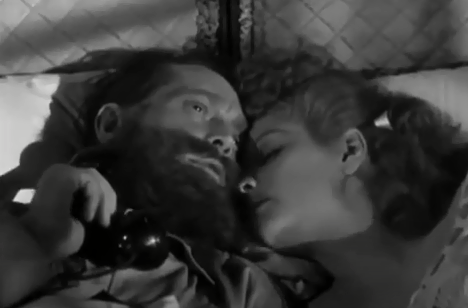
The "near-censorable situations" that Film Daily refer to are many sweet, cuddling scenes in the Weldons' bed—definitely occurring more frequently than in other films of its time, and Franchot and Lucy look and act fabulous together. However, as forward as these scenes may seem in retrospect, the premise of the film—concerning a man jealous of his wife's creative ideas and not wanting her opinions, only her approval—is certainly of its time. Let's just say that the character Bill Weldon will never be upheld as an early feminist. 

 Bill (Tone) comes up with advertising ideas in the middle of the night, looking for the next big craze. He tells Margaret (Ball) that he is sick and tired of hats being sold for their durability, because what men require is a lightweight hat. As he weighs and tries on the hat and fires off possible slogans, Margaret responds with great feedback and suggestions for improvement. Bill replies:

I love you very much, but these are my slogans. Let's not collaborate...Learn to respect my ability. I don't need any creative help from you, just your approval.

Bill's so preoccupied with his work that he's postponed their honeymoon cruise to Bermuda four—soon to be five—times! With his latest lightweight hat notion, Bill knows he must stage a stunt for publicity. He aims to convince the mayor to wear the hat at the ball game and have a cameraman ready for the perfect shot. But the mayor refuses and without consulting her husband, Margaret decides to place the hat on the mayor's head during the national anthem. People grow angry with the mayor for keeping a hat on during the anthem and he responds, "I didn't know I was wearing one," exactly as Bill wanted, and all thanks to Margaret's quick thinking.


 As Bill's colleagues and supervisors praise Margaret, Bill grows jealous and embarrassed. He loses his temper and questions her, "You keep thinking I'm not able to handle my own affairs?" Margaret makes peace by calling him a genius and kissing him.


Later, Bill meets with professor Emil Glinka, who has invented an embalming fluid that "converts people into glass...Every man will serve as his own headstone." Bill is smart enough to turn this new fluid down, but is swayed by Glinka's other new formula that removes hair effortlessly and destroys the gland extract. Bill convinces his company to move quickly on the product which he has named Off Again and Mr. Winterbottom (Gene Lockhart) shuts down his shaving cream plant immediately and plans a gala that very evening, inviting 750 prominent guests and requesting that they arrive unshaven.

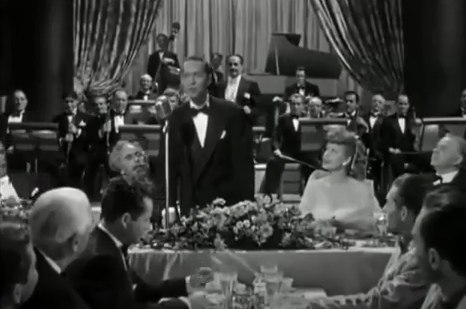
At the event, everyone applies the cream to their faces and is smitten with the results. Faces are soft, supple, and hairless across the room. Off Again is a success and Bill is a hero!


Bill and Margaret stay up all night dreaming of the money, maids, butlers, and trips they will soon have. But morning brings chaos. Every person who applied the cream the night before now has a full, bushy beard! One that grows back instantaneously when shaven or cut. 


Winterbottom grows angry when he realizes that he will have to compensate every single person who tried the balm and threatens to throw Weldon in jail. Margaret, as always, saves the day. She suggests that Winterbottom simply change Off Again to On Again and use it as a hair growth balm for bald men. Everyone applauds the idea except Bill, who is embarrassed that he's been rescued by his wife once more. The men laugh and tell Bill he should just go home and knit while his wife takes care of business, which causes Bill to threaten divorce. Winterbottom cautions him, "Instead of standing here bellowing like an ape you ought to go down on your knees to your wife for what she’s done.”

Film still. Source: my collection.

Soon, men all over town have full manes of hair, but Margaret's plan quickly hits a far-fetched snag. Because the formula is made of embalming fluid, it begins turning scalps into glass! Bill hides out with Professor Glinka and lets Margaret face the backlash this time.


Instead of giving up on Professor Glinka's embalming fluid inventions entirely, Bill is enthralled by the inventor's latest revelation—an unbreakable rose. Glinka may not be able to preserve human life, but he can preserve plant life! Bill enthuses, "A perpetual flower...wait! I've got a name for it. The Forever Flower!"

More outlandish hijinks ensue leading to a murder trial and more necessary meddling by Margaret.


About her husband, who is so loving and devoted at home but terribly jealous of her successes in the office, Margaret explains:
He’s really a brilliant man, Mr. Brewster, but like so many brilliant men he just runs off the track. He gets hold of an idea and it gets bigger than he is. I know he’s working on something very brilliant right now but, you see, when a man’s a genius you can’t trust him…

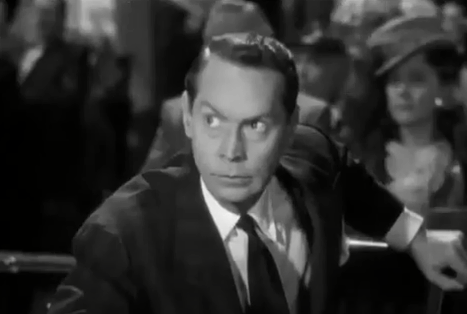


 As long as you can suspend reality for 84 minutes, you'll enjoy Her Husband's Affairs.  Always a skilled comedian in my eyes, Franchot is very funny in his role as Bill and does some humorous bits imitating a horse, losing his cool, and performing physical comedy. It's a silly romp that includes a lot of sweet moments and great screwball collaboration between Franchot and Lucy. The pressbook for Her Husband's Affairs had some clever ways to entice viewers and build up the film. It suggested that local radio stations hold a contest for "the most helpful wife" in which a husband submit a 50-word essay on a time his wife helped him out of a jam. Beauty parlors were encouraged to hold a contest for the married couple with the most beautiful hair. Since the film focuses on the misadventures of an advertising man, it was suggested that cinemas stage special screenings for their local advertising clubs.

Film still. Source: my collection.


Sources:
 Crowthers, Bosley. "Her Husband's Affairs' Has Its Premiere at Capitol -- 'Heaven Only Knows' Opens at Broadway." New York Times. November 14, 1947.
"'Her Husband's Affairs' Insult to Audience's Intelligence." Independent Exhibitors. 1947.
"Her Husband’s Affairs." The Film Daily. July 22, 1947. 
"The Selling Approach on New Product." Motion Picture Herald. November 1947.

Sunday, September 29, 2019

Here Comes the Groom (1951)

Directed by Frank Capra, Here Comes the Groom is a 1951 musical romantic comedy starring Bing Crosby, Jane Wyman, and Franchot Tone. It is a fun romp about two men competing over a woman with some great Bing tunes thrown in for good measure. Be forewarned that you'll be singing and dancing around your house to "In the Cool, Cool, Cool of the Evening" for days after you watch it.

Franchot in Here Comes the Groom, 1951. Scan from my collection.

The Film

Peter Garvey (Bing Crosby) is a news reporter stationed in a Parisian orphanage. He is fond of all the children there and takes pride in placing them in perfect homes, but itching for a new traveling assignment. In a neat little special effects scene, his abandoned fiancée Emmadel Jones (Jane Wyman) comes to him in the form of a hologram atop a spinning record. Emmadel lets him know that she is sick of waiting for him after three long years. She is ready for marriage and motherhood and realizes that Pete will never give up his traveling assignments for her.

Not wanting to lose Emmadel, Pete writes to her immediately, decides to adopt orphans Bobby and Suzi and fly back to America. Documentation issues delay the trip and Emmadel gives up on Pete altogether. (Louis Armstrong, Dorothy Lamour, Phil Harris, and Cass Daley make cameo appearances during the flight's musical number.)

Pete arrives in his hometown, but must marry and find permanent residence immediately in order to maintain guardianship of the children. He assumes he will sweep Emmadel right off her feet, but she reveals that she is engaged to be married to the wealthy Wilbur Stanley (Franchot Tone).

We learn that Pete and Emmadel grew up with similar modest backgrounds and have always known how to enjoy life without money and status. Pete plays up that angle as he tries to convince Emmadel that marriage to a wealthy man is all wrong for her. Pete assumes Wilbur Stanley is an elderly, unattractive man who has nothing to offer but a life of comfort. This vision of Wilbur (whom we've not seen yet in the film) is supported by Emmadel's father's comment that Wilbur is "not even a man. He's a tradition. He's a mummy."

Franchot in Here Comes the Groom, 1951. Scan from my collection.
During the "In the Cool, Cool, Cool of the Evening" scene, Pete and Emmadel dance around the Stanley building and are clearly a good match for each other. Knowing he has to get permanent residence to keep Bobby and Suzi, Pete changes a housing file (owned by Wilbur's company) from rented to vacant.

When Pete and the true renter fight over the house, Wilbur Stanley arrives on the scene. This bad publicity could potentially ruin his reputation, but a younger, more handsome, more generous Wilbur than Pete expected takes it all in stride. Wilbur agrees to let Pete and the children stay in his gatehouse. I uploaded my favorite scene from the movie to Youtube. Franchot and Bing's characters face off in the car and agree to let the best man win. If you cannot see the embedded video below, click here.


Once he settles in the gatehouse, Pete Garvey does everything he can to prevent Wilbur's wedding to Emmadel.

Franchot is delightful as the charming Wilbur Stanley and turns in a solid performance. His delivery of the final line is fabulous. Alexis Smith plays Wilbur's distant cousin Winifred Stanley (and does so perfectly!) and there are some hilarious scenes between her and Bing and her and Jane. If you like  romantic musical comedies, Here Comes the Groom is a must-see. It has a strong director and cast as well as an enjoyable story and pleasant songs.

The Backstory


Here Comes the Groom had its big premiere in Elko, Nevada with festivities being held July 29-31, 1951. The cast traveled to Elko (a place with close ties for Bing. Read more here) to introduce the film and entertain citizens. Franchot was not part of the festivities as he had business obligations in New York.

By the time the film had its New York premiere on September 20th, Franchot was recuperating from plastic surgery to fix the shattered cheekbone, fractured upper jaw, and broken nose he had sustained in the September 13th fight with Tom Neal, lover of his fiancée Barbara Payton. This high-profile incident would lead to a reckless year of marriage, separation, and divorce with Payton, lawsuits, and bad publicity (details here.)

Sadly, audiences wouldn't see Franchot in a film again for six years, when he adapted the stage play Uncle Vanya for the screen in 1957. He wasn't to be seen in another major motion picture until 1962 when he starred as the president in Otto Preminger's Advise and Consent. Of course, Franchot continued to work diligently and prosperously in theater and television productions while working to regain his privacy during this time.

You can watch the Franchot-less footage of the Elko visit (from the Bing Crosby Archives and originally posted by www.bingcrosby.com on Youtube) here:

Saturday, March 17, 2018

She Knew All the Answers (1941)

She Knew All the Answers is a lighthearted romantic comedy starring Franchot Tone and Joan Bennett. Released in 1941, the film is directed by Richard Wallace, who would team up with Tone and Bennett again a year later for the war comedy The Wife Takes a Flyer. Neither film has been released commercially on DVD and I'm not sure if that will ever be something slated for the future at all, but I would love to see a Bennett/Tone double feature DVD one day. In addition to these two early 40's films, Franchot and Joan would go on to costar in a 1957 episode of Playhouse 90 entitled The Thundering Wave.

In She Knew All the Answers, we are first introduced to playboy Randy Bradford (John Hubbard) and chorus girl Gloria Winters (Joan Bennett), both eager to elope. There's just one problem standing in their way and that problem's name is Mark Willows. Willows (Franchot Tone) was Randy's father's partner in a lucrative financial firm on Wall Street, and was appointed Randy's guardian when his father died. As guardian, Mark gets approval over the woman Randy marries and if he doesn't approve, Randy loses his millions. Mark is a mild-mannered, conventional man who doesn't approve of Gloria's chorus girl status and nixes their plans.


Gloria knows that Randy will never make it as a working class man and she's not willing to be a working class wife, so she hatches a plan. She will get a job—under the name of a roommate—as the switchboard operator at Willows' office long enough for him to sign a letter of recommendation for her, then she will use that signed letter to marry Randy without consequence. Expecting an older, unattractive guardian, Gloria is surprised to find that Mark Willows is a young, attractive man—albeit, a reserved, bespectacled one. Although focused on stocks and investments, Mark is clearly befuddled by his blossoming attraction to Catherine Long (Gloria's assumed name.)


Beginning to feel confident with the switchboard and around her coworkers, Gloria—unaware of Wall Street lingo—accidentally spreads false news about the firm causing Mark to lose a large amount of investments. Mark fires her, then, after her suggestion for a solution is successful, visits her apartment to ask her to return to the firm. This is the scene where many men would've caught on to Gloria's tricks, but Mark is gullible. Randy is hiding in the kitchen while the real Catherine Long, Gloria's roommate played by the infallible Eve Arden, feigns a disability to substantiate Gloria's lies.


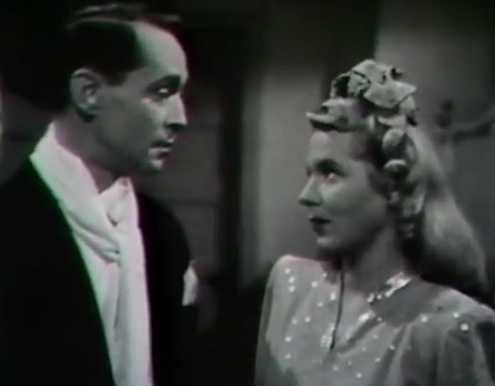
Randy sees that his guardian is falling for Gloria and has a prank call placed to the restaurant where Mark and Gloria are dining one evening. Mark decides to get revenge and talks Randy into staying in the office all night in order to "save the business." Gloria's eyes light up when she realizes that the typically straight-laced Mark, whom she's convinced to ditch the glasses, is up to mischief. As Randy waits by the phone all night, Mark and Gloria go to Coney Island and act like total goofballs. This is my favorite part of the film! They pose for silly pictures, ride the Tunnel of Love, eat cotton candy, and both Franchot and Joan are really adorable in these scenes. They fall for each other, but then Mark learns the truth about Gloria and her scheme. In the final scenes, an unusual dream sequence for all three main characters follows leading to a wedding in which those dream alter egos call the shots.


The film was lukewarm with critics. Bosley Crowther warned audiences that it was an "inconsequential little comedy," which was actually much kinder than he'd be a year later when he deemed The Wife Takes a Flyer a "painfully labored comedy." She Knew All the Answers would be neither Franchot nor Joan's most successful comedy, but they, as evidenced in their incredibly expressive faces throughout, embrace the lightness of the picture. It's a joy to watch from start to finish and the two stars are very well-matched in their comedic timing. I hate to call it a "cute movie," but it just is. I watched it again this week when I was ill with a virus, and—even though the quality of my old copy leaves much to be desired—it proved to be the fantastic spoonful of sugar I required.


Franchot and Joan shared not only these films, but also the same birthday. As I wrote about a few weeks ago, Franchot and Joan celebrated their birthdays together two years in a row—with surprise cakes for each other on the set of this film in '41 and by cohosting a massive party for servicemen with Feb. 27 birthdays a year later in '42.

Finally, a pal who has been a kind supporter of my Franchot efforts (and antics) happens to be an out-of-this-world knowledgeable and passionate expert on all things Joan Bennett (as well as some other fantastic film ladies) and recently devoted a website to Joan B. at http://www.joanbennettfan.com. Check it out!


Sources:
Crowther, Bosley. "The Screen in Review." The New York Times. June 20, 1941.
Crowther, Bosley. "The Screen." The New York Times. .June 19, 1942.

Friday, February 16, 2018

That Night With You (1945)

That Night with You is a 1945 romantic comedy with some dream fantasy thrown in for good measure. The film stars Franchot Tone, Susanna Foster, Louise Allbritton, David Bruce, and Jacqueline de Wit. It also includes an odd, too-brief part played by Buster Keaton.

I've not watched That Night With You nearly as much as other Franchot films. To be honest, the first time I saw it I thought it was not a strong performance of Franchot's and didn't really go for all the dream sequences. I recently rewatched it and realize I've missed the mark in a lot of ways. Franchot's performance is a bit hammy (the first time I watched it I felt he overplayed it), but it's actually quite in line with the character he plays. As Paul Renoit, he winks and smirks and flirts his way through the picture. But Paul's a self-described cad who promises women stage parts in exchange for romantic interludes, cares only about himself, and thinks he's God's gift to women. The way Franchot plays it absolutely makes sense and is, frankly, a pretty adorable performance. He's lovely to look at and more goofy than debonair throughout the film.  I found myself giggling at him by the end of each scene.


Penny (Susanna Foster) dreams (literally) of becoming a singing sensation for Paul Renoit. When she sleeps, she finds herself on expansive musical stages headlining a Renoit production. Penny is certain these dreams will become reality and doesn't hesitate to forge her own path to Paul's stage door. Penny's boyfriend Johnny (David Bruce) owns the diner where Penny works (and where Buster Keaton serves customers from behind the counter) and thinks Penny's dreams are just wishful thinking and aims to make Penny a housewife and mother.


Sneaking into the theater, Penny witnesses star Clarissa quit the show on opening night—just as her dream had foretold. We learn that Clarissa gave up a big Hollywood contract in order to be Mrs. Paul Renoit, but Paul has been stringing her along. A well-meaning wardrobe mistress advises Penny to stay as far away from Paul as possible. He's a serial womanizer. He even abandoned a wife, annulling the marriage as a very young man. Penny realizes she's young enough to convince Paul that a daughter was born following the brief marriage and that she is said daughter.


Paul's wise-cracking, Eve Arden-type secretary Prudence (Louise Allbritton, a comedic revelation to me) is on to Penny's scheme at once. Paul is, too, but decides to play along. But when his friends begin to joke that Penny really does favor Paul quite a bit in bone structure, Paul begins to worry that he is a father after all. And when his long-forgotten first wife Blossom (Jacqueline de Wit) reappears and vouches for Penny's story, every character becomes confused until the truth finally reveals itself. The film is hard-to-find, but is an engaging, cute story showing Franchot's knack for romantic comedy.


Criticisms:
-Although Franchot is the lead, there are a lot of musical numbers that he's not involved in, so he's not given as much screentime as he could've handled.
-Susanna Foster is lovely and an amazing singer, but I couldn't help but wish Deanna Durbin (her studio-imposed rival at Universal, apparently) was in the role instead. I'm crazy about Durbin-Tone pairings and would've liked to see them in this film together.
-I wish this film had been shot in Technicolor. It would've lent a more magical quality to the dream sequences.

Bosley Crowther (never much of a fan of Franchot's) reviewed the film for the New York Times dated November 9, 1945 and called it a "mild musical" and "romantic nonsense of an innocent and thoroughly foolish sort." He said, "Mr. Tone's coyness as a foster father is not precisely on the scintillating side."  I, however, think the innocence and foolishness of the romance is what makes this movie so delightful.