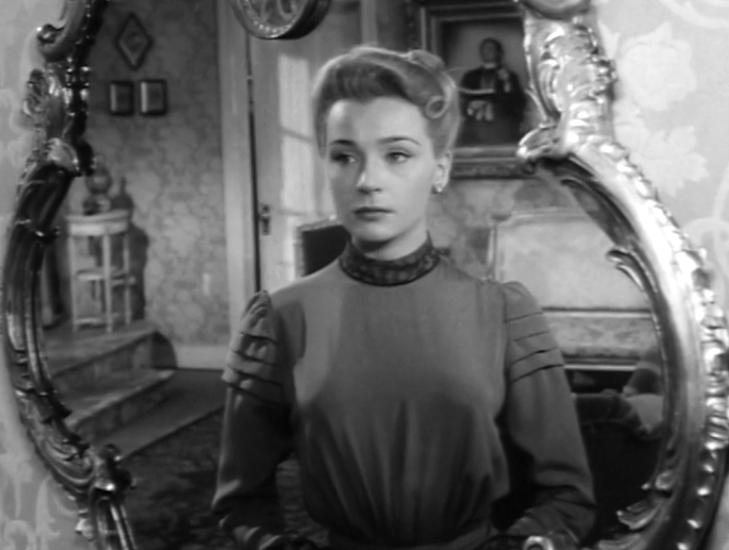
Some time ago, I read Dolores Dorn's short e-book Letters from a Hollywood Starlet. Dolores was Franchot's costar in Uncle Vanya as well as his fourth and final wife. I've wanted to write about Dolores' memories of their marriage and my own reflections on this time in Franchot's life for a while now.
First Impressions and First Date
Actress Dolores Dorn first met Franchot Tone when she read for the part of Elena's understudy in Uncle Vanya. Dolores met Franchot and director David Ross for the audition at Franchot's Warwick Hotel penthouse. Dolores was immediately struck by Franchot:
I'd met a lot of sophisticated, attractive men in London and Hollywood but none with the presence and savoir-faire of this man. And did I mention he was handsome with a twinkle in his eye too?...True, he was older, but I'd never met anyone like him in my life. Now I had another reason for wanting the part.
Franchot and David were impressed with Dolores and she won the understudy part. When Signe Hasso left the play, Dolores took over the role of Elena and entered into a relationship with Franchot:
After playing the role a few weeks Franchot asked me to have something to eat after the show. I didn't hesitate. The attraction between us on stage was obvious to everyone. The attraction I felt for him offstage I could barely conceal...Franchot and I went out almost every night after the show. For my birthday, he gave me a beautiful heavy gold bracelet with two dolphins going in the opposite directions supposed to symbolize my astrological sign of Pisces from Van Cleef & Arpels.
Despite Dolores' mother persistently vocalizing her dislike of the 29-year age gap in the relationship, Dolores and Franchot were undeterred by the difference and remained very much in love. It's apparent that Dolores was enchanted by Franchot as she can still recall all of the conversation covered in their first date. In her memoir, Dolores remembers that
over a quiet French dinner, Franchot shared much about himself. He told Dolores of his family history. He was proud that his dad had worked his way up from a teacher's son to the president of a company. Franchot grew up with all the perks of wealth yet revealed that he struggled with his classification in the upper class. He shared the experience of producing The Man on the Eiffel Tower and working with his best friends, Charles Laughton and Burgess Meredith. He agreed with Dolores in her dislike of the studio system and love of the theater and was eager to hear all about her experiences and aspirations. Franchot expressed his goal of owning his own theater where he could produce plays that included real-life issues (reminiscent of his Group Theatre days).
A "Secret" Wedding and Private Marriage
On May 14, 1956, Franchot and Dolores held a private wedding at the Montreal mayor's house and honeymooned at Franchot's Canadian home, which he called a "summer camp." Dolores described it as:
two rustic houses nestled in the woods between two fresh water lakes. The main house had two bedrooms, a kitchen, a dining room, a living room with a large stone fireplace and a large screened-in porch with a view of "Thirty-One Mile Lake." The other house was larger and was used as a guest house. They stood on an acre of woods.
Attending their wedding were Franchot's friends Jean Paul and Libby Dejordins, who celebrated with champagne, before driving Franchot and Dolores to the cabin. There, housekeeper and cook Donalda and her husband John, had a meal and a cozy fire prepared for the newlyweds. (Note: I'll be adding Dolores' description of the cabin and wedding to the post on Franchot's ties to Canada that I did last week.) After a long weekend, the Tones returned to New York and quietly resumed work on Uncle Vanya.
Although their close friends all knew, Franchot and Dolores managed to keep their marriage a secret for 2 more years! It wasn't until someone overheard Dolores answer to the name Mrs. Tone in a restaurant that Franchot and Dolores confirmed their marriage in 1958. Although Dolores doesn't say in her memoir and Franchot never spoke of it, I assume that their marriage was kept secret for two reasons:
1. They were happy in their relationship and didn't need public confirmation of it to remain content.
2. Franchot had such a horrible publicity experience in his very public relationship and brief, tempestuous marriage to Barbara Payton. I imagine he wanted to keep this new relationship and marriage a secret to maintain its authenticity and avoid public scrutiny.
 |
| Franchot and Dolores in their library in 1958 following confirmation of their 1956 marriage. |
The Undoing Over Uncle Vanya and Franchot's Increasing Unpredictability
Franchot was so proud of Uncle Vanya (a play he had starred in even before he became a film star) and the positive response to its current run that he decided to produce it on film. Dolores and the rest of the cast were excited about the project as well and agreed to shoot the film during the day and perform the play on stage each night. Franchot first encountered difficulty finding an American distributor and later a European one. Certain of the film's success and eager to produce the type of film he'd always hoped to do, Franchot ended up using $250,000 of his own money to ensure the film was completed. (According to
www.measuringworth.com, that's the equivalent of a little over 2 million dollars today.
) Although the film received good reviews, it did not do well enough commercially to earn Franchot his money back.
Franchot submitted the film to the first San Francisco International Film Festival and even emceed the festival's opening night on December 4, 1957. The film was well-received there, but didn't garner the award for best film or for best actor. Disappointed that his own performance went unnoticed, Franchot was not congratulatory when a surprised but absolutely deserving Dolores was announced the winner of the Best Actress Award. He had been so supportive of her career up until this point, but that night, Dolores writes, a depressed Franchot became "very drunk and verbally abusive."
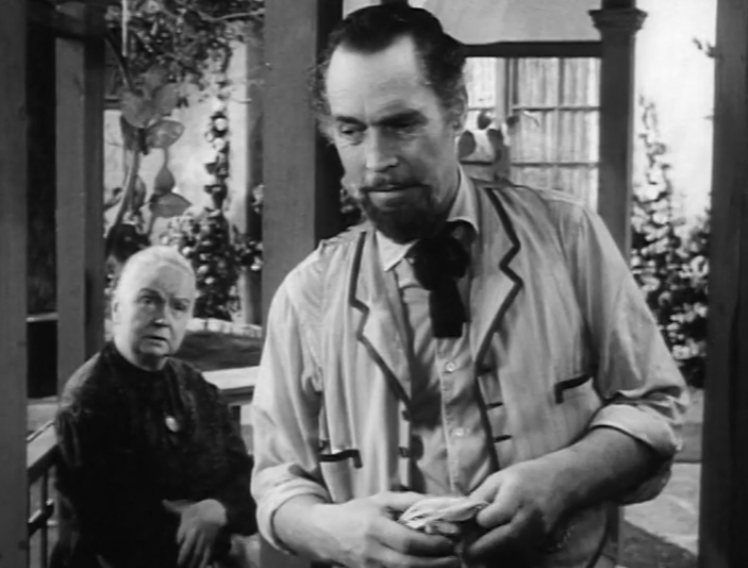
The film was out of sight from that night until it was released on DVD a few years ago, but the disappointment associated with it lingered with Franchot for some time. It's a shame that the film didn't gain more of a following, because Franchot had put so much time and work and poured so much of himself into it and that is all visible in the final product. Uncle Vanya is one of my favorite films and although I have a hard time naming just one favorite Franchot performance, his portrayal of Astroff may top the list. He's not just playing Astroff. In many ways, Franchot
is Astroff. Elena Gonzalvo wrote a fantastic article on the similarities between Astroff and Franchot that you can read
here.
Dolores writes:
He became more and more depressed when nothing worked out. He began to drink and became more and more verbally abusive...His drinking behavior was getting me down. I felt badly for him and badly for myself.
In most of my research of Franchot in the 50's and 60's, many of those who knew him mention that he was brilliant, kind, gentle, and had a serious drinking problem. From what I've read, he would start off the day hopeful and charming but by the end of the night, he was full of melancholy and seeking comfort in a bottle of Scotch. It's sad to me that he had an inner pain so great that he felt the need to dull it with alcohol. Certainly, he drank before the 50's (it's hard to recall a film star who didn't), but it really seemed to become noticeable to those around him in the last two decades of his life. For the most part, Franchot was able to control the effects of drinking. Except the visible aging of his face, his heavy drinking was not apparent in the quality performances he turned out night after night on stage and on television. However, his drinking seemed to be the cause of the dissolution of his marriage to Dolores. She writes of a man who was unpredictable. When sober, Franchot was deeply supportive of her career. He advised her of good parts to accept and encouraged her to take lessons with Strasberg. Drunk, he was resentful of her quick success and possibly, her youth. Dolores even heard rumors that Franchot may have asked the Actor's Studio
not to pass her audition. This rumor was never proven and Dolores did pass her audition, but Dolores says she always wondered if it was true. In her memoir, Dolores reflects:
At first it seemed like a betrayal to me but then I thought that Franchot didn't seem to want me to work as an actress. Did he want a more traditional marriage? It was beginning to look like that from the call and some subtle and not so subtle message he'd been giving me. Could I do that? I loved him, yes, but could I do that? Should I do that?
Following her miscarriage and peritonitis, a loving Franchot took good care of Dolores in the hospital. Shortly after, Dolores decided that she needed to move on. They separated and divorced in 1959. Dolores did not expect to see much of Franchot after the divorce, but as it turned out, they actually became good friends and remained that way until his death in 1968.
My Reflection
Dolores Dorn's short memoir only covers a brief time in her life and seems to suggest that she plans to write more later. I hope she does as I'd like to learn more about her life and career after Franchot. She comes across as a sweet, determined woman who truly loved Franchot. They had similar career interests and seemed to get along well in the beginning. I wonder if the marriage could've lasted had they not had that 29-year age gap. It seems to me that they were a good match. If Franchot had been younger, was just starting out in the theater like Dolores, had not experienced so many disappointments already, and had not turned to alcohol to cope with those disappointments, I believe Franchot and Dolores may have experienced a long-lasting marriage. I think it's important to note that there was still enough respect between the two of them to warrant a friendship that survived their divorce.
As an admirer of Franchot or any classic film star, it can be difficult when you uncover less-than-great things they did. I wish he had been happy for Dolores when she won Best Actress at the festival. I wish he hadn't let his own disappointments in life negatively affect his relationship with her. But Franchot, like all of us, was human. If you're really interested in a person and want to have a full picture of him, you can't ignore the flaws in his character. You can't deny that these flaws exist and I am frustrated when I see other devoted fans of the classic Hollywood era flat-out deny that their favorite star ever made any mistakes.
For the most part, I've found that Franchot was a thoughtful, hard-working, compassionate man who made others feel special and respected. That's the Franchot the majority of my posts focus on, because those qualities truly made up the majority of who he was. But I can't deny that he drank heavily and that habit affected his actions and in this particular case, his marriage to Dolores Dorn. We are all complicated beings, even my favorite Mr. Tone.




 I
I