Showing posts with label man on the eiffel tower. Show all posts

Tuesday, June 16, 2020

Franchot Visits Birmingham, Alabama

Photo of Franchot that
accompanied the article.

In February 1950 Franchot traveled to Birmingham, Alabama to promote The Man on the Eiffel Tower. It was a whirlwind one-day press tour of the city including multiple newspaper and radio interviews, a special luncheon at the Downtown Club, a cocktail party at Tutwiler Hotel where his suite was located and ended the evening by making a personal appearance at the Linley Heflin Unit Mardi Gras Ball which was held in the Municipal Auditorium. By midnight, Franchot was on a plane to New York where he was slated for business meetings with friend and TMotET director Burgess Meredith.

With Birmingham press, Franchot shared that he felt his youngest son Jeff might become an actor. Franchot added that Jeff enjoyed "mugging" and always put on a great show every Christmas that his aunt Karol (Jean Wallace's younger sister and only a child herself) would direct in front of the family Christmas tree.

On producing The Man on the Eiffel Tower, Franchot said:

Production, I like, because a producer can assure himself of more interesting parts. You'll like Man on the Eiffel Tower. It's not a mystery but a suspense picture. And Charles Laughton's not the villain. I am!

Interestingly, Franchot shared that his business meetings with Burgess Meredith in New York were to plan for their next film. Burgess was set to direct and Franchot would produce and act in a film version of the novel The Song of the Flea. They planned to begin filming it in London within a year or two. A film adaptation of The Song of the Flea never happened (perhaps due to the Payton love affair and the events that it caused.)  I have a special fondness for Franchot's work as a producer (The Man on the Eiffel Tower, Uncle Vanya) and co-director (Uncle Vanya) so it is a shame this other opportunity never came to fruition. It not only would've been a creative venture for Franchot, but he would've also enjoyed working with best friend Burgess Meredith on it. The Song of the Flea was written by British novelist Gerald Kersh whose most famous work Night and the City was made into a 1950 film starring Richard Widmark and again as a 1992 film starring Robert de Niro. I cannot find any proof that The Song of the Flea, which focused on a writer struggling to succeed, was ever adapted for film.

You can read more about The Man on the Eiffel Tower here .

Source:
Caldwell, Lily May. "Franchot Tone Visits Here, Talks of Kindness." The Birmingham News. February 18, 1950.

Sunday, January 13, 2019

The Making of the Man on the Eiffel Tower


The Man on the Eiffel Tower, produced by Franchot and often noted as one of his favorite films, was the first feature film shot entirely in color in France. Director of photography Stanley Cortez spoke with American Cinematographer about how shooting only in Ansco Color following the war created challenges:
The two studios which we used Billancourt and Joinville had been occupied by the Germans during the war. When they retreated, they sacked both studios of every available piece of equipment, leaving only the bare walls. It has been a heartbreaking job ever since for the gallant French technicians who are trying to refurnish their studios with the modern equipment necessary to full scale motion picture production.
Because there were no Ansco labs in Europe at the time and sending film to the United States for development would've been too costly, The Man on The Eiffel Tower was shot—with a Debrie Super Parvo camera—without lighting and makeup tests.

The cast and crew encountered additional issues. A coal shortage in France meant that there were days spent without electricity. Cortez elaborated:
Happily, the two days that Billancourt studios were without power, Joinville studios, several miles distant, had it; so on those days we would transport our camera, lighting equipment, and any necessary props or sets to Joinville and work there—returning to Billancourt when the rationing edict darkened the stages at Joinville.
Despite the setbacks, Cortez said that Franchot and coproducer Irving Allen "were most cooperative and considerate at all times."

Cortez was pleased with the final results:
I feel that we have given Ansco Color film the acid test, having put it through a major production under all sorts of conditions. It is safe to predict that Ansco Color film will really come into its own as a medium for feature film production once The Man on the Eiffel Tower is released.
Watching the film, you'll be struck by the numerous French locations that are captured in each scene. The mystery plays out in cafes, streets, flats, and, of course, the Eiffel Tower. The city is a major part of the plot and as American Cinematographer stated, the film can also be considered a "travelogue type of documentation of Paris." The city is even listed in the film's cast of characters.

The New York Times felt that the film was "largely composed of subdued excitements" and did not praise its actors:
...City of Light was never lovelier than as the Ansco-colored background for this manhunt and, what is more pertinent, it very often makes the other principals look like spear carriers. In losing their hearts to the Eiffel Tower, the Seine, the boulevards and Montparnasse, the producers and the director have given some distinction to an otherwise routine adventure...Although this short tour is, by and large, a delight, the same cannot be said for the rest of the cast. They don't seem to be straining, but their efforts can't be counted as outstanding. 
Franchot made The Man on the Eiffel Tower with some of his favorite people. Franchot's close friends Charles Laughton and Burgess Meredith were the principal actors along with Franchot. Meredith directed the film. Though their marriage was ending at the time, Franchot's wife Jean Wallace also starred.

I do agree that some of the scenes are subdued, but it's an interesting film, a different role for Franchot, with enough thrilling elements to keep me entertained. It has fallen into the public domain, and here it is in its entirety:


Sources:
 "Filming the Man on the Eiffel Tower." American Cinematographer. February 1949. p 46

"The Screen in Review; 'The Man on the Eiffel Tower,' From Novel by Simenon, Opens at the Criterion." The New York Times. January 30, 1950.

Wednesday, November 16, 2016

Franchot on French Film Finances

When reporter Harmon W. Nichols interviewed Franchot about the production of The Man on the Eiffel Tower, Franchot tried to explain the film’s financial situation. Nichols said a patient Franchot “hemmed and hawed and he drew pictures on the tablecloth,” and finally, Nichols asked Franchot himself to write the article. Here’s what Franchot wrote:
The interesting thing about the financing of The Man on the Eiffel Tower is that because of making it in Paris with a French co-producer, a large part of the cost of the production was paid for in French francs instead of American dollars. These francs could be recouped from almost all countries where American motion picture earnings are blocked. The French have trade agreements with almost every country in the world, which permit them to repatriate to France the foreign earnings of any picture made in France.
The advantage of this picture is that all these countries which will not permit conversion of picture earnings into dollars, will permit the earnings of this one (because it was made in France) to be converted into Francs. The French co-producer of the picture will recoup his investment from countries that an American producer cannot look to at the present time. And the result will be that a large part of the cost of making the picture will be for receipts in countries from which a Hollywood production cannot expect to receive the benefits of his earnings.
Source:
Nichols, Harmon W. "Franchot Tone Gives Lessons about Finance." Star News. February 13, 1950.

Wednesday, August 5, 2015

The Man on the Eiffel Tower (1949)


The Man on the Eiffel Tower stands out among Franchot's filmography for many reasons. First, it is a film that Franchot cited as one of his favorites. Second, it is the only film of his in color. Third, it features his second wife and mother of his children, Jean Wallace (yet they were either separated or divorced at the time of filming). Fourth, it was filmed with his pals Burgess Meredith and Charles Laughton. And fifth, it gave Franchot the opportunity to play a disheveled, quietly plotting killer.
Jean Wallace
Truthfully, I did not appreciate this movie the first time I watched it. I had come off a string of Franchot's 40s light romantic comedies and the plot of Eiffel Tower was a bit more complicated to follow. Also, I first watched a spotty quality copy with bad audio on Youtube, so I struggled to make out all the dialogue and was distracted by the rough cut. Later, I found a better version on Moving Image Archive and watched the film over in its entirety. (Just a note, because this film now falls under public domain, there really is no pristine copy. I've included links to the ones available online at the end of this post). On my second viewing, I enjoyed the The Man on the Eiffel Tower for the unique thriller that it is. My advice to you is don't write it off just because it hasn't been restored and it's not your typical glossy Hollywood mystery. The film has a clever plot, great cast, and amazing color views of Paris in the late 1940s.


In the movie, Bill Kirby (Robert Hutton) and his girlfriend Edna (played by Jean Wallace) confess to Bill's wife that they have been having an affair. In a cafe, Bill talks about his wealthy aunt and how her death could benefit his and Edna's future.

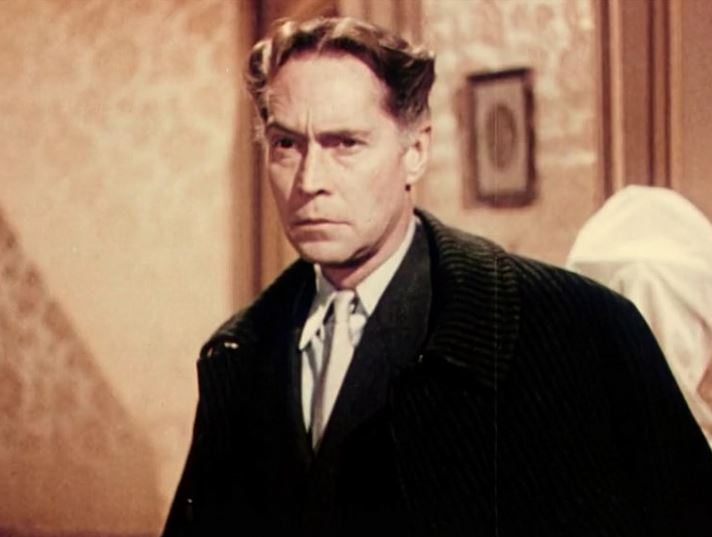
Johann Radek (Franchot Tone) is a sly, kooky character dining across the cafe. Radek passes a note to Mr. Kirby, offering to murder the wealthy aunt.
Meanwhile, the film's director Burgess Meredith stars as Joseph Heurtin, a quiet, hard-working man whose wife does nothing but belittle him. Heurtin decides to break in to and steal from Kirby's aunt's house, and unwittingly walks into a murder scene. When Heurtin loses his thick glasses (very similar to Meredith's Twilight Zone "Time Enough at Last" spectacles), the murderer Radek helps him home.

Because his glasses are left at the scene, Heurtin is first implicated in the murder. Heurtin helps the police identify Radek, but Radek is so sneaky and clever that he is able to taunt the police. Charles Laughton is brilliant as the lead inspector working to bait and catch Radek.
             
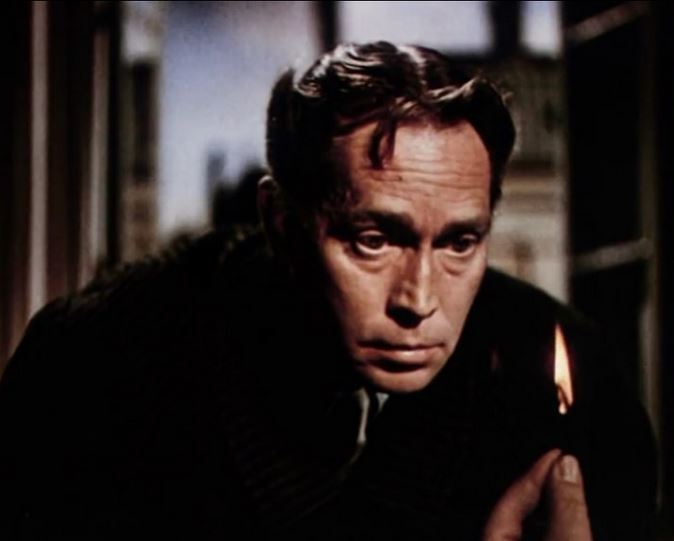
Franchot was 44 years old when The Man on the Eiffel Tower was filmed and the film, in my eyes, is his transition from romantic lead to interesting character actor. Although Franchot had played a killer once before in 1944's Phantom Lady, Eiffel Tower is where we first see Franchot's face (a bit more lined with wrinkles and wisdom) taking on the characteristics that he would display in his television work. His hair and clothes are somewhat disheveled and his eyes are full of mischief.
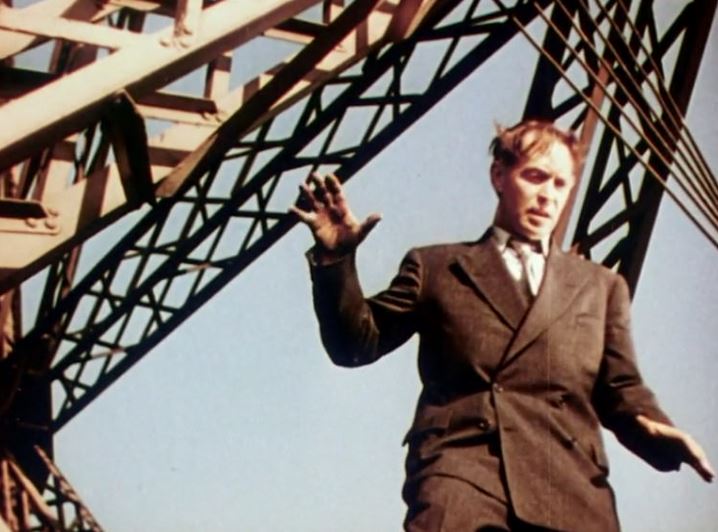
One of my favorite scenes is the exciting Eiffel Tower climb at the end of the film. Radek attempts to resist arrest by climbing the Tower, but Heurtin and the Inspector are close behind. The cityscape is visually stunning and the scene itself will have you on the edge of your seat!


You can watch The Man on the Eiffel Tower on Youtube or at the Moving Image Archive. There is also a DVD available on Amazon.

Wednesday, June 3, 2015

Franchot's Favorite Films

In a 1964 interview with Ward Morehouse, Franchot said that of all his films, the films that he liked best were The Lives of a Bengal Lancer (1935 adventure/drama), Mutiny on the Bounty (another 1935 adventure/drama), and The Man on the Eiffel Tower (1949 mystery/thriller). Having watched all three of these. I can understand why he chose them. They are all more serious dramatic films and give Franchot an opportunity to portray characters in more challenging situations. Another shared aspect of these three films are the strong male casts and the camaraderie that must have been felt by them.

Thursday, April 23, 2015

Burgess Meredith on Franchot Tone

"I don't know how good Franchot's influence was on me or mine on him. Aside from The Man on the Eiffel Tower, a movie we made together in Paris, most of our coventures were in pursuit of pleasure. We shared many a bottle and many a girl, both in New York and Hollywood, in our bachelor days. There were also some quiet times in Canada at his hunting lodge."

"Tone had a secret side to him. It was his love of the Canadian woods. He was a fine woodsman. Most people knew him only as a playboy, a friend of Howard Hughes and De Cicco and all the other high rollers. He was the chief charge-account customer at "21" and Ciro's and the Stork Club. Every place he went he was the chosen playboy-elegantly dressed, handsome, towing an array of lovely women."

"His career never reached the height his ex-wife's [Joan Crawford] did, because, I think, he seemed to have had too much given to him. Wealth, for example. His father was the president of the Carborundum Company. Brains. Phi Beta Kappa from Cornell. Talent. A superstar. Problems. Lack of discipline. But he enjoyed life to the end, loving and being loved by an army of fans and friends...Franchot and I remained close friends from that first meeting with his bride until I spoke at his funeral."

Source:
Meredith, Burgess. So Far, so Good: A Memoir. Boston: Little, Brown, 1994. 72-76. Print.