Showing posts with label friendships. Show all posts

Friday, April 26, 2019

The Strasbergs Remember Franchot

A friend of Lee and Paula Strasberg, Franchot also created lasting friendships with their children, Susan and John. Both went on to relate the details of Franchot's influence in their books.

Susan Strasberg on Franchot Tone
In her memoir Bittersweet, Susan recalled that her very first memories were being a toddler crawling around famous feet under the dining table. Those guests included Luise Rainier, John Garfield, Tallulah Bankhead, and Franchot Tone (whom she lovingly referred to as "Uncle".) Uncle Franchot was a "tender, aesthetic, scholarly gentleman" who often held young Susan, and Susan found it hard to reconcile his naturally kind, quiet nature with the version he presented one night when he arrived "drunk and bloody from a battle over some woman."

A close friend of the family, Franchot often visited the house to consult with Lee Strasberg—who was at times very tender (embracing Franchot with a heartfelt hug) yet frequently standoffish (blaring music and not making eye contact with Franchot despite his patiently waiting.)

Franchot and Susan read reviews of "The Diary of Anne Frank."
Source: Bittersweet

Franchot was present for many celebrations. When Susan performed in "The Diary of Anne Frank", Franchot (along with Marilyn Monroe and Joshua Logan) was waiting to congratulate her in the dressing room. At a party at Sardi's following her performance, Franchot "raised his glass. 'Little Susan, you have been launched on a long and glittering career. I drink to you.' As they waited for the reviews, everyone ate and drank champagne. Franchot ordered pizza—for inquiring minds, Franchot once told a reporter that his favorite pizza topping was "plain mozzarella."

Franchot with Burton, Fonda, and Ustinov at Susan's surprise party.
Source: scan from my collection

Franchot was also on hand for Susan's surprise 20th birthday party. The party was inside a dark theater and also present were Henry Fonda, Peter Ustinov, Laurence Olivier, Lena Horne, Julie Harris, Tony Perkins, and Richard Burton (whom Susan was dating at the time.) In her book, Susan also recalls attending Franchot's own small parties hosted at Don the Beachcomber's, and counts him as a person she "cared about and respected" when she saw him at a 1960's New Year's Eve party.
Franchot and Susan in rehearsal for The Time of Your Life, 1958.
Source: scan from my collection
Franchot and Susan had the pleasure to act together on several projects. They both appeared in a 1956 television production of J.M. Barrie's play "Dear Brutus" on Omnibus, an educational television program that aired on CBS. In 1958, they traveled—and actually financed the entire trip on their own dime after funding fell through— to the Brussels World's Fair to perform "The Time of Your Life." You can read more about that production here. In 1959, they toured together for the play "Caesar and Cleopatra." Getty Images has a great photo of them in costume for that production, which you can view here.

Franchot and Susan in a publicity photo for Caesar and Cleopatra in 1959.
Source: scan from my collection.
When Franchot realized Susan was struggling with her role as Camille in Franco Zeffirelli's "The Lady of the Camellias" in 1963, he came to her aid. "He described his mother, who had died of tuberculosis, Camille's disease, detailing for me her flushes, her fevers, and high gaiety followed by her complete collapses..."

John Strasberg on Franchot Tone
Susan's brother John also devoted space to Franchot in his own memoir. He wrote:
I don't remember feeling any peace or harmony from the moment we moved back to New York in 1947 until I began spending summers in Canada with Franchot Tone when I was twelve. We hunted and fished, camping in Quebec's wilderness country.
Franchot's wealthy industrialist family owned three houses that sat on a ridge of land between two lakes that were part of the Gatineau Fish and Game Club, near Gracefield, Quebec. We portaged deep into land that he owned, smearing honey under the canoes of poachers so that the bears would destroy them. Franchot became one of my heroes, once I realized that heroes could be human...Normally quiet and reflective, he could be very temperamental. He was a movie star, but to me, above all, he was a Renaissance man. He thought about more than just the theater. He gave me books he loved, like the writings of the Comte de Rochechouart and Walt Whitman's Leaves of Grass, and a Marlin .22 lever action rifle, the gift of which startled my parents and endeared Franchot to me even more.
He exposed me to a world that I loved and felt at home in, and that my parents knew nothing about. He loved women, smoked two packs of unfiltered Camel cigarettes a day, and drank double vodkas. So did I, but some years later. He was definitely more of what I wanted to be than was my own father, and I often wonder what kind of father he was to his own children. Franchot's humanity touched me deeply. It was due in part to his influence that I learned to define success on my own terms. Above all, he taught me that work is part of one's natural respect and love of human life, but it is not a way to ignore or dominate it.

Sources: 
  • Roach, Janet. "Perfectionist Franchot Tone 'Sacrifices' Own Shirt for Play." The Day. New London, Connecticut. August 5, 1966. Page 12. 
  • Strasberg, John. Accidentally on Purpose: Reflections on Life, Acting, and the Nine Natural Laws of Creativity. New York: Applause, 1996. Print. 8-9.
  • Strasberg, Susan. Bittersweet. New York:, Putnam, 1980. Print.

Monday, April 8, 2019

"Pandemonium" at 470 Layton Drive

When I was browsing fan magazine articles about Franchot and Carole Landis' relationship earlier this year, I stumbled upon this article about Franchot living at the Layton Drive address with photographs! This is the home listed on Franchot's World War II draft card (here) that I did a brief post on last year (here.) When Bubbles Schinasi and actor Wayne Morris called it quits leaving their home vacant and open to tenants, Franchot and his pal Burgess Meredith ("as gay a brace of bachelors as ever haunted the sleep of the countless impressionable co-eds throughout our wonderful democracy") moved in. Hollywood was surprised that two bachelors would take on a large, elegant property. Jimmy Durante even asked, "Those guys and that house—what have they got in common?"


How did they end up living in such style? Burgess settled into the extra room at Jimmy Stewart's Santa Monica house when he arrived in Hollywood for film work. Soon, photographer John Swope became Jimmy and Burgess' housemate as well. All men enjoying and being popular with the ladies, the house grew crowded fast. Buzz (as Burgess was known to friends) found a beach house in need of repairs to reside in, but Jimmy and John didn't want to break up the gang. It was decided that the beach house would just be for Buzz to sleep in, but the guys would all hang out at Jimmy's house during waking hours.

Then, Franchot arrived from New York and needed a place to stay. Franchot and Buzz were roommates in New York shortly after Franchot's divorce from Joan Crawford and remained lifelong friends. Both Franchot and Buzz were acting in plays at the time and found they shared equal passion for acting and being fixtures at the hottest nightspots. Buzz and Franchot decided to lease the Morrises' chateau, now nicknamed Pandemonium. Their neighbors included Nelson Eddy, Anna Sten, and Frank Capra. Franchot felt the place was perfect for his return to Hollywood as a bachelor.

Franchot and Buzz threw a cocktail party after getting settled in and locating domestic servants. In the article, the descriptions of the rooms are pretty exaggerated in comparison to the photographs. Yes, they are beautiful, large nice rooms, but Screenland refers to their living room as "Dali-esque." Their living room was described as a "surrealistic masterpiece...The walls were a pale blue set off by a gray carpet. Two disconsolate love seats done in yellow leather hugged the fireplace, over which a mural by Lee Blair (a South American cockfight framed in blue mirror) looked down..."
The living room.

Buzz's room was decorated in red and white walls ("calculated to woo sleep"), a sea green carpeted floor, and "flaming" draperies.
The bedroom of Burgess Meredith.

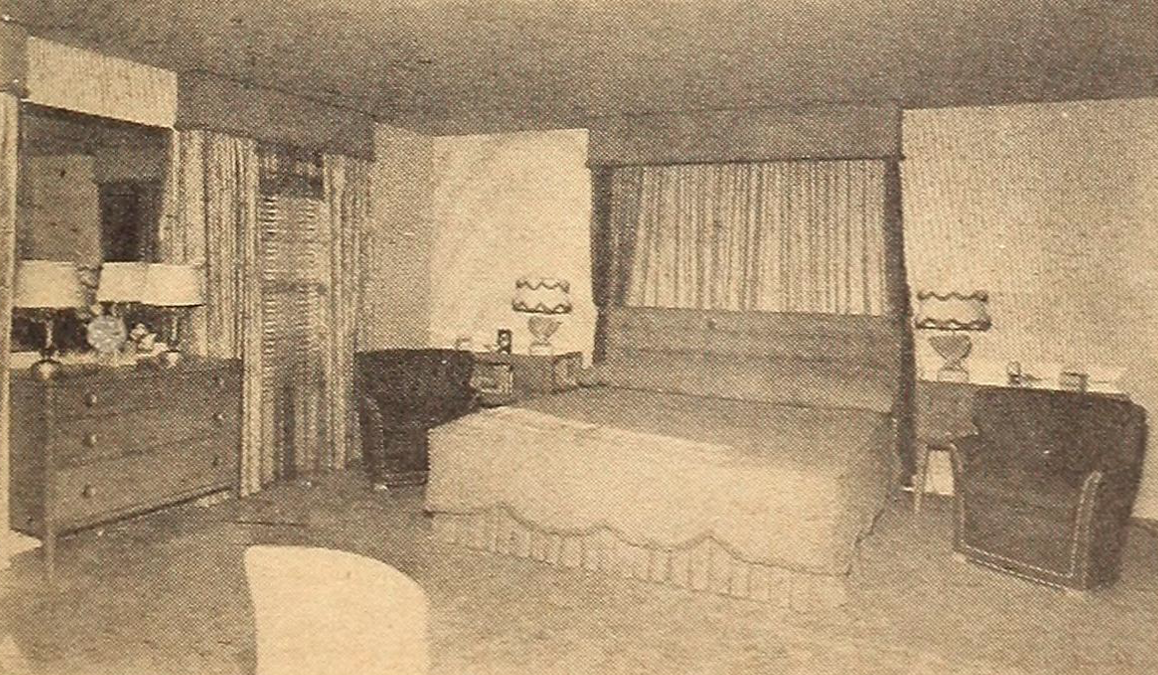
Franchot shared his room with a Great Dane named Bad Boy (pictured with Buzz and Franchot in the top photo), who used the former outdoor tennis court as his play area. Franchot's room would "stand up as the most sexy and glamorous bedroom in Hollywood...it houses the biggest bed in California—a little number measuring exactly ten feet long, ensconced on a pale grey rug and sporting a half-canopy of coral fish net...the walls are pale blue...the lights are soft and harem-like."
The bedroom of Franchot Tone.

Burgess would recall in his biography and he and Franchot "shared many a bottle and many a girl, both in New York and Hollywood, in our bachelor days. There were also some quiet times in Canada at his hunting lodge...But he enjoyed life to the end, loving and being loved by an army of fans and friends..."

Sources:
Franchey, John R. Hollywood's Gayest Bachelors! Screenland. May 1941. p. 28-29, 88. 
Meredith, Burgess. So Far, so Good: A Memoir. Boston: Little, Brown, 1994. 72-76. 

Friday, March 3, 2017

John Garfield Blogathon

I am happy to be participating in Phyllis Loves Classic Movies' John Garfield Blogathon since John and Franchot were good friends with similar career interests. Garfield has been a favorite of mine ever since he stole my fourteen-year-old heart when I first watched Four Daughters.

The Group Theatre

Franchot and John both got their start on the New York stage and honed their skills in the Group Theatre. Franchot was one of the Group's original members when Harold Clurman, Cheryl Crawford, and Lee Strasberg formed the Group Theatre with the hope of presenting plays that featured believable characters who spread important real-world messages through their thought-provoking scripts. Franchot actually starred in the group's very first production The House of Connelly in 1931 and the plays that followed that year and in 1932. Franchot used his own money to finance much of the group's work and was a firm believer in its essentiality to modern theater. In fact, when Franchot first pursued a film career in Hollywood in 1933, his main intent was to earn a lot of money quickly and eventually return to the Group with the additional funds. But he immediately fell in love with Joan and—despite sporadic statements that he may permanently return to a solely theatrical career—Franchot never fully abandoned Hollywood.

John joined the Group after Franchot physically left it (I say this because Franchot always morally and financially supported the Theatre.) John was a student of method acting at the American Laboratory Theatre, which included Group Theatre founders Strasberg, Crawford, and Clurman. John gained critical success in Lost Boy in 1932. After an apprenticeship, John was accepted as a member of the newly named "The Group," but, like Franchot, was drawn to Hollywood. Unlike Franchot, John's first film Four Daughters garnered him immediate acclaim and an Oscar nomination. Despite his obvious talent, John, like Franchot, was soon relegated to quickly churned out, pleasant films. But John fought back against the studios much harder than Franchot ever did. While Franchot was never able to recapture the early critical success of his mid-1930's work, John's lasting success came in the 40's with films like Destination Tokyo, The Postman Always Rings Twice, Humoresque, and Gentlemen's Agreement. I went through a period where I watched every single one of Garfield's films, and I cannot think of one performance that did not impress me.

In spite of their success, some Group members made both John and Franchot feel guilty for leaving to pursue opportunities in Hollywood. In later interviews, some group members shared that they felt that Hollywood had put John and Franchot’s focus on money, women, and alcohol, and interfered with their ability to produce quality work. (In my opinion, the two actors were able to balance their dedication to the craft with their extracurricular pleasures quite successfully.) This frustration with Franchot and John for pursuing film careers makes better sense when you realize that one of the Group's main objectives was to be a cooperative ensemble and an emphasis was placed on the good of the group, not the pursuit of fame by one individual.

For more information on the Group Theatre and both actors' involvement, I highly recommend the full-length American Masters documentary on the Group Theatre that the Stella Adler Studio of Acting posted on Youtube:

Friendship in the 1940's

In the early 40's, Franchot and John were involved in many of the same wartime support efforts. They both worked hard to support their fellow men overseas by serving on multiple war effort committees, making public appearances, and selling war bonds.

In Hollywood, John and Franchot were prominent board members of the Screen Actors Guild and participated in meetings until September 15, 1946 when they had to resign due to a new “conflict of interest” by-law. Also resigning were Robert Montgomery, James Cagney, Dick Powell, Harpo Marx, and Dennis O’Keefe.

Another connection I find interesting is that John's 1941 film Out of the Fog was based on Franchot's 1939 play The Gentle People and, in these productions, John and Franchot played the same role.

In 1945, Franchot and John returned to New York to discuss future theatre plans
with their former Group Theatre leaders. Film Daily. November 12, 1945.

Variety. November 1945.

Their similar career beginnings, current involvement in important causes, and enjoyment of a good time brought Franchot and John together as friends. They were frequently seen out together in bars and restaurants with a drink in one hand and a pretty lady not far from reach. Sherry Davis recalled that her grandfather, actor Robert Davis named his son Franchot because of his friendship with Tone. Robert Davis, Franchot, and John would gallivant around the nightspots drinking heavily, until young Franchot Davis was sent by his mother Myra to fetch them home.

John and Franchot on the set of Jigsaw, 1949.

In 1949, John made a cameo in his pal Franchot's noir Jigsaw. That film (a good one, in my opinion!) is in the public domain and can be viewed in full on Youtube here.


The Blacklist

The promise of the 30's and fun of the 40's were no match for the HUAAC who attacked John and Franchot—both public about their liberal beliefs—in the late 40's and early 50's. Although Franchot was publicly cleared by the Dies committee early on, he was softly but purposely blacklisted throughout the 50's. (You can read a more in-depth post on Franchot's blacklisting here.) Obviously, John was more publicly and viciously attacked by the House Committee. John refused to name names when he was forced to testify and as a result, was blacklisted by the major studios. But the blacklist damaged more than his career. It destroyed his health and led to his tragic death of a heart attack at only 39 years old.

Thank you Phyllis for hosting the John Garfield Blogathon! For some great Garfield reading, please head over to Phyllis Loves Classic Movies for the full roster.

Sources:
  • Kramer, Joan, David Heeley, Joanne Woodward, Steve Lawson, Stella Adler, Harold Clurmaan, Cheryl Crawford, and Lee Strasberg. Broadway's Dreamers: The Legacy of the Group Theatre. New York, N.Y: PDR Productions, 1994.
  • Gelman, Howard. The Films of John Garfield. Citadel Press, 1975.
  • Hirsch, Foster. A Method to their Madness: The History of the Actors Studio. Da Capo Press, 2001.
  • Kazan, Elia. Elia Kazan: A Life. New York: Knopf, 1988.
  • Lasseter, Don. Body Double. Kensington, 2002.
  • Media Lantern Digital History Project: http://lantern.mediahist.org/
  • SAG: www.sagaftra.org
  • Smith, Wendy. Real Life Drama: The Group Theatre and America, 1931-1940; New York: Knopf, 1990.

Monday, March 14, 2016

Horton Foote Centennial

Today marks what would've been the 100th birthday of Pulitzer Prize-winning playwright and Academy Award-winning screenwriter Horton Foote. Foote wrote the teleplay for The Shape of the River, in which Franchot Tone played Mark Twain in 1960.

On page 208 of his memoir titled Beginnings, Foote talked about how his feelings for Franchot evolved from an initial disliking to a lasting friendship:

Franchot Tone I avoided like the plague, because he seemed moody and imperious. Many, many years later Franchot played Mark Twain in The Shape of the River, a television play I wrote for Playhouse 90. I had seen his brilliant work as Astroff in Stark Young's translation of Chekhov's Uncle Vanya and I knew Stark Young regarded him as one of our finest actors. I was impressed at how hard he worked during rehearsals of The Shape of the River and how anxious he was to get it all right, and splendid he was, too. During rehearsals we became fast friends and unlike so many friendships developed in rehearsals ours contininued until his death.