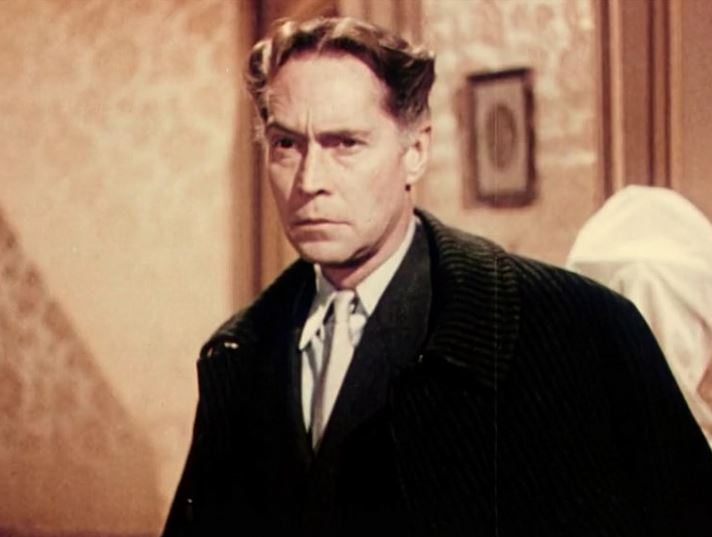
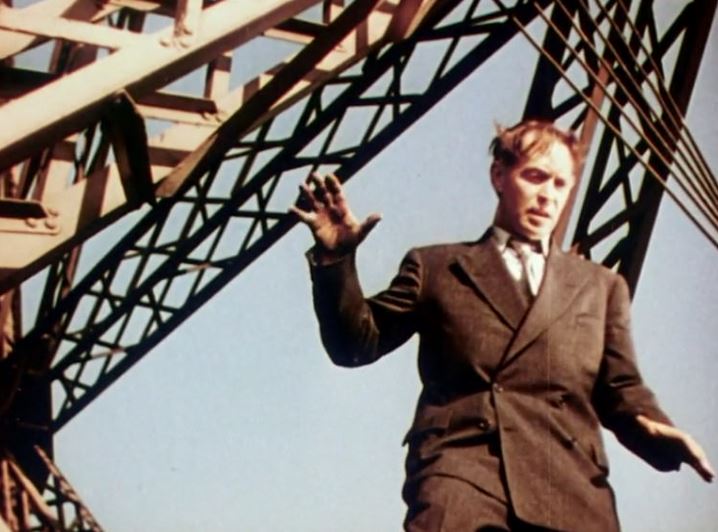
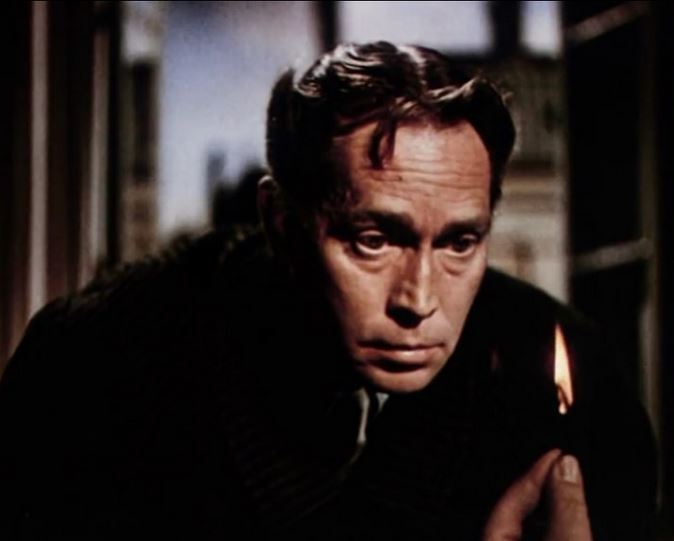
The Man on the Eiffel Tower, produced by Franchot and often noted as one of his favorite films, was the first feature film shot entirely in color in France. Director of photography Stanley Cortez spoke with American Cinematographer about how shooting only in Ansco Color following the war created challenges:
The two studios which we used Billancourt and Joinville had been occupied by the Germans during the war. When they retreated, they sacked both studios of every available piece of equipment, leaving only the bare walls. It has been a heartbreaking job ever since for the gallant French technicians who are trying to refurnish their studios with the modern equipment necessary to full scale motion picture production.Because there were no Ansco labs in Europe at the time and sending film to the United States for development would've been too costly, The Man on The Eiffel Tower was shot—with a Debrie Super Parvo camera—without lighting and makeup tests.
The cast and crew encountered additional issues. A coal shortage in France meant that there were days spent without electricity. Cortez elaborated:
Happily, the two days that Billancourt studios were without power, Joinville studios, several miles distant, had it; so on those days we would transport our camera, lighting equipment, and any necessary props or sets to Joinville and work there—returning to Billancourt when the rationing edict darkened the stages at Joinville.Despite the setbacks, Cortez said that Franchot and coproducer Irving Allen "were most cooperative and considerate at all times."
Cortez was pleased with the final results:
I feel that we have given Ansco Color film the acid test, having put it through a major production under all sorts of conditions. It is safe to predict that Ansco Color film will really come into its own as a medium for feature film production once The Man on the Eiffel Tower is released.Watching the film, you'll be struck by the numerous French locations that are captured in each scene. The mystery plays out in cafes, streets, flats, and, of course, the Eiffel Tower. The city is a major part of the plot and as American Cinematographer stated, the film can also be considered a "travelogue type of documentation of Paris." The city is even listed in the film's cast of characters.
The New York Times felt that the film was "largely composed of subdued excitements" and did not praise its actors:
...City of Light was never lovelier than as the Ansco-colored background for this manhunt and, what is more pertinent, it very often makes the other principals look like spear carriers. In losing their hearts to the Eiffel Tower, the Seine, the boulevards and Montparnasse, the producers and the director have given some distinction to an otherwise routine adventure...Although this short tour is, by and large, a delight, the same cannot be said for the rest of the cast. They don't seem to be straining, but their efforts can't be counted as outstanding.Franchot made The Man on the Eiffel Tower with some of his favorite people. Franchot's close friends Charles Laughton and Burgess Meredith were the principal actors along with Franchot. Meredith directed the film. Though their marriage was ending at the time, Franchot's wife Jean Wallace also starred.
I do agree that some of the scenes are subdued, but it's an interesting film, a different role for Franchot, with enough thrilling elements to keep me entertained. It has fallen into the public domain, and here it is in its entirety:
Sources:
"Filming the Man on the Eiffel Tower." American Cinematographer. February 1949. p 46
"The Screen in Review; 'The Man on the Eiffel Tower,' From Novel by Simenon, Opens at the Criterion." The New York Times. January 30, 1950.