Showing posts with label western. Show all posts

Wednesday, June 30, 2021

Trail of the Vigilantes (1940)

Warren William and Franchot Tone. Scan from my collection.

Franchot starred in the western comedy Trail of the Vigilantes in 1940. I love this movie for many reasons. It allowed Franchot to take on a role in a genre not offered to him in the previous decade. It paired Franchot with my other favorite actor of 1930s films, Warren William. Finally, it's a fun movie full of physical comedy and Franchot shines in it. Unfortunately, a high quality print of it is not available to watch, but you can view the movie in its entirety on Youtube (click here.)

Author George Fenin, in his 1962 book The Westerns, wrote that the film:

happily disposed of its somewhat witless lampooning in the first four reels, and thereafter got down to the serious business at hand. Much of the action was admittedly tongue-in-cheek, but it was so well-staged with all the customary Universal zip, that no one really minded.

The 1940 publication The Movies...And the People Who Make Them deemed the picture a:

delightful comedy-action western...wild brawls, hectic pursuits and forthright romance handled with a light farcical touch lift the proceedings far above the conventional level.

Even reviewer Bosley Crowther, notorious Franchot detractor, seemed to enjoy Trail of the Vigilantes. He wrote:

And now it seems to be getting so any one who sits long enough in a movie theatre will see every actor he ever knew appear up there on the screen in a Western. This time it is Franchot Tone, that erstwhile Group Theatre hopeful and star in many a super-soigné Eastern, who is playing the rootin' tootin' hero in Universal's "Trail of the Vigilantes," which pulled up yesterday at the Rialto. And, believe it or not, he's okay...The story is pretty routine, but performance is better than average. Mr. Tone wins his spurs in a good, fast Western. 

At the moment splitting his time between the stage and the screen, Franchot told reporter George Benjamin that he was enjoying being back on a studio lot and appreciative that he was being offered different roles this time around. He said:

I enjoyed immensely playing in my first Western, Trail of the Vigilantes. Why didn't someone tell me about the horse operas before?
Franchot Tone and Peggy Moran. Scan from my collection.


Franchot's leading lady Peggy Moran, in an interview with Mike Fitzgerald for Western Clippings, shared that she was surprised to find Franchot was not a known entity at conventions in which she participated. Peggy recalled:
It was a spoof and of course a big picture—much bigger than the Bs I usually did. A few years ago, I went to Knoxville to a film festival. The late Robert Shayne had told me about stills—getting my best shots reproduced and all. I took some from each of the westerns. The scenes with Gene Autry and Roy Rogers were big sellers. But when it came to the shots of me with Franchot Tone, the fans would ask ‘Who’s that!?’ At first I was so taken aback, because he was a big star, much more so than Gene or Roy, at least at the time. But these fans know who they like—it’s Gene and Roy, not Franchot! But in its day, ‘Vigilantes’ did very well, especially in New York and the sophisticated areas. It was funny, with jokes. A real farce. Franchot would fall off a horse every time he tried to get on it. The dialogue was cute and the metropolitan areas ate it up. But at the festival, I could see what the other westerns meant in that part of the country. Franchot Tone and I dated for a while, but that was before I started going with my future husband.

I think the fact that this was a western convention had something to do with Franchot not being recognized. If it had been a pre-code or 30s-related convention, I think Franchot would've received more love. Also, had the stills been of Franchot's television work in the 1950s and 60s, convention attendees would have surely recognized the older gentleman who starred in episodes of Bonanza, Wagon Train, The Virginian, and Bitter Heritage.

The Film

After a newspaperman is murdered, special investigator Tim Mason, known as Kansas, is assigned to the case. Kansas (Franchot Tone) is required to trade in his tuxedo and city life for western wear and a horse. When Kansas arrives in the western town, it is in complete chaos. Horses, wagons and men run wild in the streets and there seem to be gunshots coming from every direction—the sheriff is even handcuffed to a building! Within minutes of arriving, Kansas finds himself strung from the ceiling of the saloon. Ill-prepared for battle, Kansas fends off the posse in a mixture of pushing, quips, and occasional punches. 

Franchot in Trial of the Vigilantes. Scan from my collection.

During the squabble, ranch hands Meadows (Andy Devine) and Swanee (Broderick Crawford) befriend Kansas and get him a job as a ranch hand on Mr. Thornton’s farm. When Mark Dawson (Warren William) arrives on the scene, it is clear to Kansas that Dawson’s word is law and his influence important. He learns that Dawson is the head of the Cattlemen’s Protective Association and receives a payment from every single rancher in town in order to keep in his good graces. But Thornton, Kansas’s new employer, has refused to join the CPA and faces regular vandalism on his property from Dawson’s gang. 

While learning the ropes (literally!) on the ranch, Kansas falls for the ranchman’s daughter Barbara (Peggy Moran). Investigating a hunch, Kansas breaks into Dawson’s office and is arrested—but not before he discovers that Dawson has been stealing money from the Cattlemen’s Protective Association. Soon, the other cowboys learn that Kansas is an undercover investigator and help him take the Association’s money (a whopping $20,000) before Dawson can steal it for himself. When Dawson attempts to paint him as the bad guy, cowboys vouch for Kansas's character and testify on his behalf.

As the movie progresses, the local sheriff becomes wise to Dawson's devious ways and Kansas must make an important decision: whether to return to the city life he's always known or remain a cowboy with Barbara by his side.

Source: The Movies and The People Who Make Them (1940)

Sources:

Benjamin, George. "Smoothie!" Modern Screen. June 1941
Crowther, Bosley. "The Screen." New York Times. December 6, 1940.
Fenin, George N. The Westerns: From Silent to Cinerama. Orion Press. 1962.
Interview with Mike Fitzgerald: Peggy Moran. http://www.westernclippings.com/interview/peggymoran_interview.shtml
Trail of the Vigilantes. The Movies and The People Who Make Them. 1940.

Sunday, November 4, 2018

The Virginian: The Old Cowboy (1965)

On March 31, 1965, the 28th episode of the 3rd season of The Virginian aired. "Old Cowboy" starred Franchot Tone and Billy Mumy and featured The Virginian's regular cast, including Doug McClure and James Drury (who had worked alongside Franchot in 1958's Bitter Heritage.)

Franchot is Murdock, the old cowboy who struggles to come to terms with his age and limitations. Billy Mumy (who you will recognize from Twilight Zone episodes among many other things) is Willy, Murdock's grandson and under his care. Murdock and Willy set out to find the biggest ranch because they need money and according to his stories, Murdock is the best cowboy and ranch hand that ever lived. Grandson Willy is his grandfather's biggest fan and proud of his grandpa's past. Willy sees that Murdock has trouble keeping up and doesn't make the smartest decisions with their money, but he still adores him.

Murdock's stories always make him out to be the hero and come back to the Double Eagle $20 coin that he was rewarded and keeps in his boot at all times.


When they reach town, Murdock quickly gambles away their money. Trampas (Doug McClure) feels sorry for the old man and his grandson and offers him a job at Shiloh.


At the ranch, Murdock doesn't fit in. He expects to be the top ranch hand and given the most important jobs, but the young cowboys view him as weak. Murdock's boastful ways alienate him from his coworkers and Willy begins to look up to Trampas. Trampas is Murdock's biggest supporter on the ranch, but Murdock only views him as competition.


Murdock is an enthusiastic, hard worker but continues to make mistake after mistake at Shiloh. He brands the wrong cattle, causes a dangerous stampede, and accidentally burns down the barn. But when he is needed on an important mission to move cow herds in a treacherous storm, Murdock proves what he's been telling everyone all along: that he is the most reliable, brave cowboy and will stop at nothing to get the job done. 

Franchot is the star of this 1.25 hour-length episode and he shines as the aging cowboy struggling to prove his worth to a changing generation.  This is some of his best television work (I truly believe that all his television work is really great) and I highly recommend it, especially if you enjoyed his performances in Bonanza and Wagon Train.


 Old Cowboy is available on The Virginian Season 3 dvd. It's also currently playing On Demand if you have DISH as your provider.

Monday, December 11, 2017

Bitter Heritage (1958)

Franchot starred as Frank James, the brother of outlaw Jesse James in Bitter Heritage, a 1958 television production featuring a young Elizabeth Montgomery. Airing on August 7, 1958, Bitter Heritage was a 90 minute western drama focused on Jesse James, Jr. coming to terms with his family's notorious legacy. Warning: there are plot spoilers in this summary.

Jesse Jr. (James Drury) has nightmares about his father's death. He has been raised by his uncle Frank James (Franchot Tone), a man who has desperately tried to escape his former life of crime by living far away from the James homestead. Frank hasn't been home in 15 years, but there's good land there and a brood mare sale that lands him back in Kearney. (There's a funny scene in which Jr. asks his uncle if he remembered to bring money. Franchot, as Frank, grabs his belly—he's hidden the money under his shirt—shakes it, and smirks, "That's not belly fat, boy!")

As they ride closer and the town comes into view, Jesse Jr. asks his uncle what he sees. Frank replies:
Ghosts!...Some things you can't forget. People don't letcha...things don't change if people stay the same.
Jesse Jr. thinks that his uncle and grandmother (Eva Le Gallienne) are living in the past and making too big a deal of the events that transpired here before. He's optimistic and naïve and fails to face who his father really was. As Frank says over breakfast with his mother:
We lived those times. We understand them. He don't.


Although fifteen years have passed, Frank's instantly recognized in town. Colonel Brecker sees Frank checking in at the hotel and refuses to shake his hand. The colonel's young and fearless daughter Mary (Elizabeth Montgomery) invites Frank and Jesse Jr. to a party at their house while the colonel complains to the town sheriff about their presence.

Frank is already doubting his decision to come back to Kearney under any circumstances when old gangmates spot him. Luke (Robert Middleton) has been waiting to kill Frank James ever since Frank ran out and Luke narrowly escaped death at a hanging. Now, Luke assumes that Frank is back to step on Luke's toes and start trouble. Luke and his pals bombard Frank's hotel room, punch and threaten him.

Frank wants to leave immediately. He says that he's been tried and acquitted twice cause no witnesses ever came forward, and he doesn't plan on causing a stir now. Jesse Jr. thinks Frank's a coward. Frank responds:
There's a difference between running and stepping outta something you've got no control over.
We learn that when Jesse Jr. was a boy, Frank saved him from being a sideshow attraction. Frank rescued him and gave him a normal life. He doesn't want it ruined now.


Jesse Jr. refuses to leave. He's smitten with Mary and plans to attend her party. Frank becomes drunk at the bar and is telling lively stories. Luke's posse comes in, bully Frank, introduce a mentally ill homeless man who claims he is the real Jesse James, and taunt Frank by singing a song about his brother.

Frank is beaten by the men outside of the bar and his gun is stolen from him on the first night he's carried it in 15 years.


Frank recovers at the James homestead and Grandma criticizes Jesse Jr. for attending the Brecker party and says that Jesse Jr. is denying his birthright.

While Frank and Jesse are at home, masked men calling themselves Frank and Jesse rob the local bank. They kill the banker and leave behind a gun marked with the initials FJ. Mary is in the bank when it happens and swears that it wasn't Frank and Jesse. But the townspeople are eager to persecute the James family and a posse rides out to impose their own justice.


Grandma walks out front with a gun while Frank abandons the house from the backdoor. Jesse Jr. (and some viewers) assume Frank, desperate to escape the past, is running out. In truth, Frank gets on a horse and purposely leads the posse away to protect Grandma and Jesse Jr. As the men chase Frank, Jesse Jr. rides to the sheriff and asserts himself. With a loaded gun, Jesse Jr. threatens to shoot if he is not heard. The mentally ill man who believes he is the original Jesse James tells Jesse Jr. that the bank robbers are in a cave. The posse (with Frank) and Jesse Jr. ride to the cave to discover Luke and his gang hiding inside with the stolen money. Finally, Frank and Jesse Jr. are vindicated and welcomed back to their home.

 
Bitter Heritage is an engrossing tale of embracing the future while never forgetting the past. The telefilm is full of accomplished actors providing meaningful performances. Franchot is touching as the ex-outlaw eager to live a regular life away from scandal. Franchot starred in a handful of western roles in television and he seems right at home in that genre. It's a wonder that Franchot never starred in a western film after the 1940 western-comedy Trail of the Vigilantes. He was able to easily embody the good guy, bad guy, and especially, the man in-between in his western characters.

Wednesday, April 29, 2015

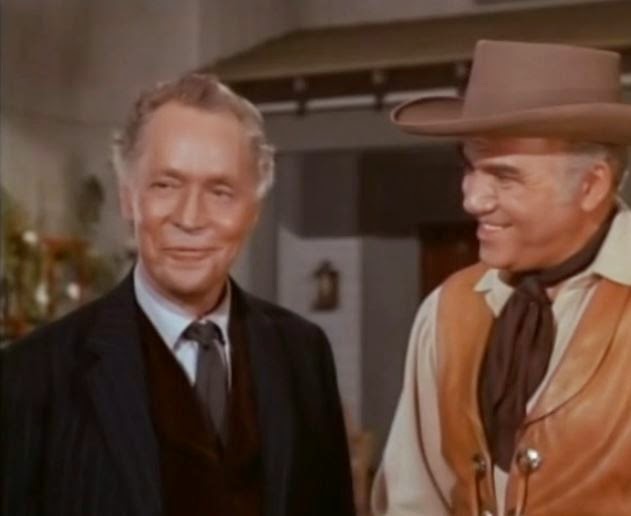
Bonanza: Denver McKee (1960)

Franchot Tone made a guest starring appearance as Denver McKee in the episode of the same name that aired on October 15, 1960. 

Denver McKee is a United States Deputy Marshall who is looking forward to the return of his daughter, Connie, who has been away at school in the East.


While Denver dotes on his daughter and enjoys her homecoming, crimes are being committed more and more frequently around the Ponderosa. Denver leads a posse to track down the suspects. Although he's always liked Mr. McKee, Ben Cartwright begins to suspect that the old Deputy Marshall may not be exactly who the townspeople believe him to be.


I enjoyed Franchot's portrayal of Denver McKee. Although audiences often think of Franchot as a suave, tuxedo-ed, New York-bred gentleman, he fits right in with the other folks at the Ponderosa and gives an outstanding performance.


The Denver McKee episode is #6 on Season 2 of Bonanza. The DVD of Bonanza Season 2 can be purchased at:


At the time of this writing, Bonanza is also available to stream online at HuluPlus.