Showing posts with label joan crawford. Show all posts

Saturday, August 8, 2020

Today We Live (1933)

Today We Live is Franchot's second film (the first being The Wiser Sex) and his first film with Joan Crawford. With an all-star cast of Joan, Franchot, Robert Young and Gary Cooper, the World War I melodrama is directed by Howard Hawks and is based on a story by William Faulkner. As is the case with many movies of this era, the fashion is more 1933 and not so much 1916. Also, the majority of the characters are English and the film is set in England, but the accents are decidedly American despite the use of common English phrases. Again, a pretty common practice in films of the day but I know some viewers who really dislike this.

Franchot and Joan play brother and sister yet their chemistry onscreen already speaks volumes. Joan's character looks at Franchot's character just as lovingly and longingly as she does her actual two love interests. Franchot's character is the confidante and protector, the one steadfast thing in the unsteady life of Joan's character.

Film Summary

American Richard Bogard (Gary Cooper) arrives in England in 1916 and visits the Smith house just as Diana (Joan Crawford) receives news that her father has died in action. Distraught, Diana says she is without hope or faith and fears for her brother's safety as her brother Ronnie (Franchot Tone) and her neighbor Claude (Robert Young) reminisce about Mr. Smith and announce that they have just five more hours until they must report for duty. 

Ronnie confides in his sister that their childhood friend and neighbor Claude plans to propose to Diana. The three of them have a rationed dinner where Diana agrees to marry Claude with Ronnie's blessing.


While her loved ones are fighting in the war, the family's American guest Bogard spends more time with Diana and they realize that they have fallen in love with each other. Bogard decides to enlist in the war to fight for England and honor the woman he loves. A distraught Diana has now lost her father and has to contend with the fact that the lives of the three men she cares for are all now in danger.


Ronnie comes back injured but on the mend and Claude returns as in love with Diana as ever. Not wanting to hurt a soldier, Diana asks her brother for advice and understanding in a tender, lovely scene between Joan and Franchot. In an equally tender scene, Ronnie must share that Diana's true love Bogard has died in action.

Joan is wonderfully effective as a woman left lonely and bereaved by war. Despite this, she puts on a brave face and soldiers through it all, putting her own emotions aside and aiding the war effort. She is the beacon of strength for her brother and her fiancee. Before Claude is sent off on a dangerous assignment, Diana marries him. After he survives the mission, Claude and Diana break the news to Ronnie, who has long suspected and supported it.


And the next scene is a shock. Bogard, reported to have been deceased, is on the family's doorstep. I will not spoil the remainder of the film for you. The rest of the film is full of love, heartbreak, death and hope as well as some quite lengthy battle scenes.

Franchot's character Ronnie is the binding force and voice of reason for all characters and with the skills he applies to the role, it is easy to see why both Gary Cooper and Joan Crawford would praise him as the most talented, underrated actor for the rest of their lives.

Publicity

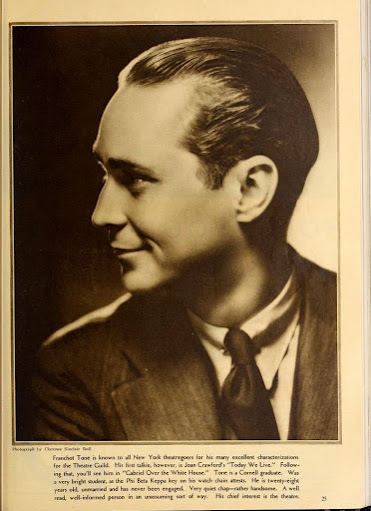
Franchot received a good amount of publicity build-up in fan magazines for his early role in Today We Live. Although Franchot's first film The Wiser Sex is the only film I've not seen, it is still available at the Library of Congress and reportedly his role is very small. Today We Live was his real break into the business it seems and, of course, the film that introduced him to Joan, a woman whom he would love for the rest of his life. Here are just a few of the various photos and publicity pieces that accompanied the film's release.

Modern Screen, 1933.

Photoplay, 1933
Photoplay, 1933.


Modern Screen, 1933.


The New Movie Magazine reviewed the film stating:
Joan belongs in pictures of this type; that's what you're going to say when you see her. She can do all that a star is asked to do, and she does; but when she has a real story, with clever character actors around her, shading her role with the sympathy and humor that it needs—then Miss Crawford can supply some of the finest entertainment that is available in motion picture theaters today.

Today We Live is on DVD from Warner Archive and can be purchased through most online DVD retailers. 


Saturday, March 25, 2017

Franchot & Bette: 2nd Annual Bette Davis Blogathon

Earlier this week, I shared a conversation on Joan that Franchot had with a reporter in 1933. During the conversation, he praised Joan for her talent, warmth, humor, and power. In that way that Joan Crawford and Bette Davis always seem to be connected to one another in print, film, and new television shows, it happens that In the Good Old Days of Classic Hollywood's Bette Davis Blogathon falls on this week, too. And as much as he adored Joan, Franchot also happened to admire Bette.

Franchot and Bette only made one film together, 1935's Dangerous. I actually wrote about Dangerous in detail for Crystal's Bette Davis Blogathon last year (read here) as well as their almost-second pairing in Old Acquaintance (post here), so I thought I'd focus on their personal relationship this time around.

Source: Modern Screen, 1937.


Dangerous and the Bette-Franchot Attraction

Source: Hollywood Magazine, 1936.

During the filming of Dangerous, Franchot was seriously dating Joan. Bette was immediately smitten with Franchot upon meeting him and said:
When I was filming Dangerous in 1935, I had a crush on my costar, Franchot Tone. Everything about him reflected his elegance, from his name to his manners. He had a great deal going for him, including Miss Joan Crawford. He was madly in love with her. They met each day for lunch. After lunch, he would return to the set, his face covered with lipstick. He made sure we all knew it was Crawford's lipstick. I was jealous, of course.
Harry Joe Brown claimed that he once walked in on Franchot and Bette in a compromising situation in her dressing room and this act is what many cite as the catalyst for a lifelong Davis-Crawford feud. According to legend, she was so worried that Franchot was falling for Bette that Joan quickly started planning to wed him herself. I don't know how valid any of these statements are, but it's not hard at all for me to believe that Franchot would've been attracted and intrigued by Bette, or acted on these feelings. To me, it's probable that he was and did.  But it is hard for me to believe that Joan would've married Franchot purely out of film set jealousy. After all, Franchot was a frequent costar to another high-profile, glamorous, and intriguing actress, Jean Harlow. If Joan's marital decisions had been ruled by jealousy, she would've been wed to Franchot as early as 1933 or 1934.


Source: Screenland Magazine, 1936.
It's clear that Bette fell for Franchot hard and hoped he felt the same way. Actress Joan Blondell recalled:
I was on the lot doing a picture when Bette came to see me, all soft and dewy-eyed, which was not her usual manner, believe me. She was in love, she told me, with her leading man Franchot Tone. I was amused. I thought she was kidding. After all, she was married to that sweet guy, Ham, the musician. And, furthermore, I didn't think she went in for that sort of thing—for soundstage romances. It's not that she was a Holy Mary; she wasn't. Her career always came first. So I kidded with her, saying that we all get crushes on our leading men from time to time and they passed...Bette got very angry with me. She said, 'Joan! I am not a schoolgirl. I don't get crushes. I am in love with Franchot, and I think he's in love with me.' I said something lame, like 'Give it time, honey,' although I was really thinking, 'Boy! If Joan Crawford gets wind of this, there is going to be war.'
Friends Bette and Joan Blondell with Dick Powell and Arthur Farnsworth in 1941. Source: Hollywood Magazine.

I think that it is telling that a 79-year-old Bette devoted a paragraph to Franchot in her 1987 memoir, This n' That. That memoir was a sparse one, so to take the time to address how she felt about him during that brief time leads me to think that her feelings for Franchot were not briefly felt at all, but perhaps still being felt 50 years later.

I have not watched Feud yet, so I'm curious how the writers of that show incorporate the Franchot link between Joan and Bette, if at all. Often Franchot is cited as the reason Joan and Bette feuded, but there's always more to a complex relationship than one moment in time.

At the end of Dangerous, Joan walked away with Franchot and Bette walked away with a famous little man named Oscar at the 1936 Academy Awards. According to reports, at the ceremony Franchot jumped up out of his seat, applauded loudly and beamed with pride at his former leading lady.

For more great posts on Bette Davis, head over to In the Good Old Days of Classic Hollywood!

Sources:
  • Considine, Shaun. Bette and Joan: The Divine Feud. New York: Sphere, 1990.602402
  • Davis, Bette, and Mickey Herskowitz. This 'n That. New York: Putnam's, 1987.

Tuesday, March 21, 2017

Franchot on Joan's Humor, Talent, and Feminist Example

Joan. Dancing Lady, 1933.
Franchot continues his conversation with Jack Jamison on his love for Joan:
And then, of course, there's her sense of humor. You can always tell if a person really has a sense of humor by his willingness to let himself seem ridiculous. Joan loves to be caught looking 'silly,' so that people will laugh.
Sometimes at the end of a scene, while the cameras are still turning, she makes a face or lets her mouth hang open. Then when she goes into the projection room to see the rushes, she too laughs at the foolish picture of herself. It isn't loud, insincere laughter—the kind of laughter so many people use to cover a situation which embarrasses them. Nor is it the kind of laughter that seems to say, 'See what a good sport I am?' It's more a snicker, like a youngster's, but very real. She honestly loves to kid herself.
She loves to kid other people, too, but never cruelly—always gently. Once when we were making a picture together, I was supposed to do a swimming scene. Joan went to the director and asked anxiously, 'The tank isn't deep, is it?'
'Sure! Ten feet or so.' The director replied. 'Why?'
'Mr. Tone can't swim.'
'Can't he swim at all?'
'Well,' she said. 'He can do the breast-stroke a little.'
She had them nearly crazy, explaining that I'd look silly if I couldn't do a crawl stroke, wondering if they could get a shallow tank so I could just wade, arranging for me to stay up all night and learn strokes. Then after they were all wild, she broke down and told them that I really could swim, after all.
But there is something even more important than a sense of humor—especially in a woman. And that is good taste. Joan's taste is exquisite. Like her intelligence, it is instinctive. While William Haines gets the credit for decorating her beautiful home, Joan, as a matter of fact, did a great deal of the actual choosing.
And her taste is as creative as it is discriminating. I've even heard her make suggestions to Adrian when he was planning clothes for her. They must have been good suggestions, because Adrian followed them.
Incidentally, Joan's wardrobe is stunning because she has good taste and not because she spends large sums of money on clothes. Undoubtedly one of the best-dressed girls in pictures, she spends far less for clothes than many another feminine stars. Recently, when complimented on a lovely new outfit, Joan winked and said, 'Last year's suit. New scarf and new hat, that's all.'
Most important is her taste in people. I have never, and there is not a single exception, found a soul she liked whom I didn't like, too. In choosing her friends, accomplishment—what they've done—means nothing to her. She's interested in what they are. If what they are helped them to do something, that is another matter. But popular acclaim, fame, popularity—they mean nothing to her. They two qualities Joan looks for in a person are sincerity and self-reliance.
And then, last but not least, there is Joan's talent. She has temperament. Her emotions are quick and full. She's angry when she's angry, gay when she's gay. I think she is one of the most vivid personalities on the screen or stage today. And I think that, with her determination, she is going to become one of the greatest artists America has ever produced. She herself believes she is only beginning now.
I believe Joan Crawford would have achieved outstanding success in any profession she chose for herself. She is the perfect example for feminists to point to in maintaining that the sexes are capable of equal achievement. With her shrewd, clear, quick thinking, she would make a marvelous business woman. With her executive powers and ability at handling people, she could go far in politics. With her sympathy and intelligent understanding for other people's troubles, she would be ideal for social service. Every child she meets falls in love with her—she ought to be a wonderful teacher. That girl could do anything!
Part One: Franchot on Joan's Intelligence and Beauty

Source:
Jamison, Jack. "'I'd Rather Know Joan Than Anybody Else' says Franchot Tone." Photoplay Magazine. November 1933.

Monday, March 20, 2017

Franchot on Joan's Intelligence and Beauty

In 1933, in the very early days of their relationship, Franchot talked to a reporter about the reasons Joan fascinated him:
I'd rather know Joan Crawford than anybody else I know. And I have any number of reasons. In the first place, Joan is more intelligent than most people. Joan has what the French call l'intelligence de coeur, or intelligence of the heart. It is a human and sympathetic intelligence, the power of learning by putting herself in the other person's place. But it is more than that, too. It is the power of giving meaning to every new experience by relating it to a past experience. When Joan comes in contact with something new, she instantly coordinates it with the rest of her knowledge. Therefore, Joan is intelligent in a deep and understanding way.
She is receptive to every new idea. There are some people who make a pose of being receptive and brag about being 'open-minded.' Not so with Joan. She never accepts anything just because it is new, or because she wants to prove she is broad-minded. But she examines everything with an open mind, then chooses that which she considers worthwhile. And she has an instinctive mental judgment which helps her pick the wheat from the chaff. For example, Joan honestly believes that she knows nothing about acting, and is just beginning to learn. And yet, when we talk about the stage, when I tell her things that happened to me when I was on the New York stage, little tricks of technique that I saw actors use there—she can pick the good ones from the bad ones instantly. She knows at once what would be right for pictures and what would be wrong.
Then there is Joan Crawford's beauty. I hardly need mention that. But a fascinating thing about her beauty—and a thing you don't realize until you know her personally—is that she is beautiful in two distinct and different ways. One the screen her beauty is formal. It gives you the impression of a classic statue. It might be sculptured, that head of hers. But you don't really appreciate her beauty until you see her without her make-up. Sometimes when you're traveling in a foreign country you suddenly come across a woman who literally makes you catch your breath. If you're in Bavaria you find yourself saying, 'Here is the perfect type of Bavarian beauty.' Well, seeing Joan as she really is, so fresh-looking, with that clean-scrubbed look of hers, you say: 'Here is the perfect type of American beauty.' And her freckles are a part of it.
I think the first time I became aware of her great beauty was once when I had been asked to her house for lunch. She was in the back yard taking a sun bath. She came in, her hair rumpled, and oil all over her face and arms. And she was beautiful! Beauty like hers is a real thing. You can't mistake it!
Part two on Joan's humor, talent, and business sense coming tomorrow!

Source:
Jamison, Jack. "'I'd Rather Know Joan Than Anybody Else' says Franchot Tone." Photoplay Magazine. November 1933.

Monday, November 7, 2016

The Gorgeous Hussy: Franchot & Politics

I'll conclude my Franchot & Politics series with a look at the 1936 film The Gorgeous Hussy. Directed by Clarence Brown and based on the 1934 novel by Samuel Hopkins Adams, The Gorgeous Hussy was a period piece designed for Joan Crawford in the part of Peggy Eaton. In addition to Crawford, the film starred Lionel Barrymore, Robert Taylor, Beulah Bondi, Melvyn Douglas, Franchot Tone, and James Stewart.


A warning should anyone be watching solely for Franchot's part: I would not consider this a "Franchot Tone film." He doesn't appear in the first 45 minutes and although his scenes are good, they are certainly not abundant. However, this is an ensemble drama, so no actor apart from Joan is really present for the majority of the film.
 
The Gorgeous Hussy is a fictional account of the life of Peggy O'Neill Eaton, the beautiful, flirtatious daughter of a hotel proprietor who faces criticism as a senator's wife and friend to President Andrew Jackson. In the film, Joan is flirtatious, but much more than that, comes across as extremely kindhearted and lovely (not nearly as bold and controversial as the real Peggy was reported to be.)
 
The film shows a young Peggy enjoying the advances of the politicians who frequently stay at her father's hotel. We find that unlike most women of the time, Peggy is privy to much political discussion and exposed to confidential  information. Peggy's childhood friend Rowdy (James Stewart) is smitten with her, but she sees him only as a friend. Peggy is head over heals for senator John Randolph (Melvyn Douglas), who although protective, rejects her declarations of love.
 
By the time Randolph discovers that he does indeed have romantic feelings for her, Peggy has married Bow Timberlake (Robert Taylor). Timberlake leaves for duty the morning after their marriage and soon dies in action.
 
In the midst of Eaton's romantic drama, we see that she is, innocently, the apple of senator Andrew Jackson's eye. She is beloved by Jackson (Lionel Barrymore) and his wife Rachel (Beulah Bondi). Jackson is well-liked, but his wife Rachel is regularly insulted in public because they view her as uneducated and unsocial. Peggy cares for Rachel as if she's her own mother and tries to shield her from public scorn, a scorn Peggy will feel herself after she takes care of Jackson following Rachel's deathbed request. Quickly becoming the newly elected president Jackson's confidante, Peggy is the focus of much gossip.
 
Franchot Tone is senator John Eaton, a man who proposes to Peggy after many years of admiring her from afar. Peggy is still deeply in love with Randolph, but they are unable to get past their political differences.  Not out of love, but to please president Jackson and improve her reputation, Peggy marries senator Eaton.


After visiting a wounded John Randolph without her husband present, the cabinet (and, especially, their wives) are furious about her indecorous behavior and demand that president Jackson banish her. Instead, Jackson demands the resignation of all members, except Eaton (this would become known as the Petticoat affair.). In the film, Peggy realizes that her notoriety will overshadow Jackson's progress and requests that she and her husband be sent away.


The film strays from the true account of Peggy's life (you can read about the real woman here,) but the costumes and sets perfectly capture the historical time in which its set. I found The Gorgeous Hussy a bit tedious in places and apart from Beulah Bondi's performance (wow!), wouldn't call any of the performances in this movie the best of their careers. Good, yes, but not the best. It's an interesting film to check out just to see the likes of Barrymore, Crawford, Taylor, Tone, and Stewart working together.
 
In some ways, I agree with Frank S.Nugent's review in the New York Times:
We don't believe in Miss Crawford's Peggy, we have reservations about Lionel Barrymore's Andrew Jackson, we discount Sidney Toler's Daniel Webster, we pity Melvyn Douglas's Senator John Randolph of Virginia and we cannot even recall Frank Conroy's John Calhoun or Charles Trowbridge's Martin Van Buren.
What we have here, and you might as well make the best of it, is a thoroughly romanticized biography in which Miss Crawford is gorgeous, but never a hussy. An innkeeper's daughter she may be, but that is all the women of Washington can possibly hold against her. Sweet, demure, trusting and of rather doubtful inspiration to Old Hickory—even though Mr. Barrymore gallantly implies she is his chief prop in his efforts to preserve the Union against the States-righters—Miss Crawford's Peggy is a maligned Anne of Green Gables, a persecuted Polyanna, a dismayed Dolly Dimple.
The Gorgeous Hussy is definitely a heavily romanticized tale, but it's worth watching for its legendary ensemble cast and nod to a historic event in U.S. history. It is available on DVD.
 
I've taken great pleasure in writing a series of posts devoted to one subject over the past 6 weeks. If you've missed any previous posts in my Franchot & Politics series, you can access those below:

From here until the new year, I'll be writing about a variety of Franchot-related subjects and am happy to be participating in blogathons devoted to Cary Grant and Agnes Moorehead in December.
 
Sources:
Nugent, Frank S. "Democratic Unconvention in 'The Gorgeous Hussy,' at the Capitol -- 'A Son Comes Home,' at the Rialto." September 5, 1936.

Monday, September 5, 2016

Franchot's Ties to the Gatineau Fish & Game Club


"I love every stick and stone in this wonderful country."


Spurred on by an interesting discussion with Ann on the Finding Franchot Facebook page (thanks, Ann!), I've been researching Franchot's ties to the Gatineau Fish & Game Club in Ottawa for the past few weeks. I have always been intrigued by Franchot's connection to the Canadian wilderness, because the land and activities there seemed to be such an important part of Franchot's life. I love that Franchot had this love of land, solitude, and survival so deeply embedded in him and how greatly it contradicts those journalists and critics who incorrectly peg Franchot as a rich playboy and little else. My research is by no means complete, but I thought you might like to see what I've discovered so far.

Background
The Gatineau Valley Historical Society has published many interesting articles on the Franchot and Tone families in its Up the Gatineau! publication. Archie Pennie and Carol Martin, in their article "A Century of the Gatineau Fish and Game Club," described S.P. Franchot's (Franchot Tone's grandfather) involvement:
On March 5th, 1894, four Quebec businessmen met in Hull, Quebec and decided to form a hunting and fishing club on Pemichangan and Thirty-One Mile Lakes in northern Quebec. They were Alexander Maclaren of Buckingham, and Dr. W. F. Scott, Charles Leduc and J. M. McDougall of Hull. The original membership included four others to make a total of eight charter members: Albert Maclaren of Buckingham, S. P. Franchot of Niagara Falls, N.Y., and John Scott and Joseph Bourque of Hull. On June 27, 1894, a meeting of the stockholders was held and it was agreed that the Club should lease these two lakes from the Quebec Government for a period of ten years at a rate of $500 per annum. Incorporation of the Gatineau Fish and Game Club dates from November 16 of that year.
Pennie and Martin's full article, which goes into detail about the Club and its early days, can be found online here.

Franchot's maternal grandfather S.P. Franchot was an impressive man. The son of a congressman, S.P. would be a civil engineer, businessman, patent holder for his electrolyte process, and senator before his death in 1908.

In various early Hollywood articles, Franchot Tone mentions spending his childhood summers in Canada and in 1937, Franchot's father Frank Jerome Tone purchased additional property (the estate of W.W. Butler) on the club limits.

Newspaper Mentions of Franchot's Involvement
From the Montreal Gazette on July 23, 1940:
When Franchot Tone wants a holiday he picks for real pleasure a fishing trip in Ontario…Mr. Tone arrived at St. Hubert Airport yesterday afternoon, visited Montreal briefly and left by plane for Ottawa at 7 o’clock. In Ottawa he is to meet his father, Frank J. Tone, of Niagara Falls, N.Y., and the two of them will spend two weeks, maybe three, fishing and relaxing with perhaps a little golf on the side…born in Niagara Falls, Mr. Tone knows that part of Ontario just across the border pretty well, having spent his summer holidays from the age of three to 23 around there.
In Ottawa Citizen, May 19, 1960:
As you read this column (Rod and Gun by Vern Bower), Cliff and I will be in the far north of the Eagle Depot country with a group of friends including actor Franchot Tone…and mayor Jean Paul Desjardins of Gracefield. We move north from our Danford Lake headquarters to Kazabazua Creek, then sweep north to the Picante and from there we push on to Cayamant and on into the Eagle…Our headquarters will be in a cedar cabin, sweet-smelling because it was built from the reclaimed timber of a barn. Very unusual, and in a long stretching line, will be the tents in which Franchot Tone and his friends prefer to live while in Canada.
On August 28, 1960, the New York Times reported:
Henrik Ibsen’s rarely staged “When We Dead Awaken” will be rehearsed at a fishing camp in the Canadian wilds…Franchot Tone, who will be starred, along with Viveca Lindfors and Betsy von Furstenberg, has invited the cast to his fishing retreat at a lake near Gracefield, Que., about sixty miles north of Ottawa.
From the Montreal Gazette on June 2, 1966:
MLA Fournier has not been alone in his efforts to develop the county’s full potential as a mecca for Canadian and American tourists. He has had the valued support of veteran Hollywood actor Franchot Tone, who maintains a year-long residence in the Gracefield area.
In the Ottawa Citizen's obituary of Franchot in 1968:
Stage and screen star Franchot Tone, whose second home from early childhood was the Gatineau area, died at his home in New York City Wednesday of lung cancer...Tone sought privacy away from the gossip columns in the Thirty-One Mile Lake area 28 miles south of Maniwaki. His father was one of the first to build a summer home on Thirty-One Mile Lake near Gracefield, Quebec. Eventually the camp on Thirty-One Mile Lake became the Gatineau Fish and Game Club. Tone visited the area annually in the summer and fall to fish and hunt moose. He held a lease on at least a dozen good trout lakes. He sometimes visited Gracefield area in winter to hunt wolves on snow sleds. He was an excellent outdoorsman. When rehearsing a Broadway play, he would frequently invite the cast to Thirty-One Mile Lake for long weekends. He was a lifelong friend of the late Jean Paul Desjardins, mayor of Gracefield for many years. "I love every stick and stone in this wonderful country," he once said. 


Joan Crawford's Visits
It is possible that Franchot first showed Joan the Gatineau area in 1933, but I cannot prove it. When they were dating in November 1933, Franchot and Joan visited New York together. It's possible that Franchot would've taken this holiday to show Joan the Canadian home that he loved, too.

In July 1940, the Ottawa Citizen reported that Franchot was in the Gatineau Valley area on a vacation with his father and that he would be there for several weeks. In August 1940, the Ottawa Citizen included the headline,"Joan Crawford Pays Surprise Visit to Ottawa." The article read:
Recognized by only a few Ottawa people though she passed hundreds on foot and while driving around the Capital during an automobile ride, Joan Crawford, titian haired star of the screen, paid a flying visit to this city yesterday to do some shopping at the end of a four-day visit to the Ottawa district and Gatineau Valley, where she enjoyed what she termed a ‘real Canadian holiday’…Miss Crawford, who came to Canada unaccompanied, spent the greater part of the afternoon in Ottawa and left by train for New York. During her short stay here she was escorted by D. Leo Dolan, director of the Canadian Travel Bureau, and an old personal friend who had met her in Hollywood.
Something tells me that Franchot and Joan vacationed a bit together during this surprise visit. They were divorced at the time, but remained friendly, and Joan would visit the area with Franchot several more times after this. I've no proof, but I feel that there is no way Franchot would've been in the Gatineau Valley in July and August of 1940 and Joan would've been there in August and not been with each other at some point in their trips. I think they were just excellent secret keepers.

On March 26, 1955, the Ottawa Citizen stated about Joan:
As to Canada, she said she ‘adored’ Canada and particularly liked Lake Louise and Banff. She admitted being in Ottawa three years ago but ‘kept it quiet’.
Again, another trip to the region "kept quiet" in about 1952.

In June 1965, Franchot and Joan were photographed at the Jean Lesage International Airport after having vacationed together at Franchot's home in Gracefield. You can view those photos here.

Friends' Remembrances
John Strasberg (son of Lee Strasberg) wrote in his autobiography:
I don’t remember feeling any peace or harmony from the moment we moved back to New York in 1947 until I began spending summers in Canada with Franchot Tone when I was twelve. We hunted and fished, camping in Quebec’s wilderness country. Franchot’s wealthy industrious family owned three houses that sat on the ridge of land between two lakes that were part of the Gatineau Fish and Game Club, near Gracefield, Quebec. We portaged deep into land that he owned, smearing honey under the canoes of poachers so that the bears would destroy them. Franchot became one of my heroes, once I realized that heroes could be human…He exposed me to a world that I loved and felt at home in…Above all, he taught me that work is part of one’s natural respect and love of human life, but it is not a way to ignore it or dominate it.
In his autobiography, actor Burgess Meredith wrote:
There were also some quiet times in Canada at his hunting lodge. Tone had a secret side to him. It was his love of the Canadian woods. He was a fine woodsman.
Today
Franchot's family still owns property and is active in the Gatineau area. Franchot's grandson (also named Franchot Tone) performed at the Gatineau Fish and Game Club in 2013.

Sources:
  • The Concluding Chapter of Crawford: http://www.theconcludingchapterofcrawford.com/1965.html
  • Hills, Frederick Simon. New York State Men: Biographical Studies and Character Portraits. Vol. 1. 158-159.
  • Ottawa Citizen: November 16, 1933, July 20, 1937, July 23, 1940, August 28, 1940, March 26, 1955, May 19, 1960, June 2, 1966, September 19, 1968.
  • Meredith, Burgess. So Far, so Good: A Memoir. Boston: Little, Brown, 1994. 72-76. Print.
  • Pennie, Archie and Carol Martin. "A Century of the Gatineau Fish and Game Club." Up the Gatineau! Vol. 21: http://www.gvhs.ca/publications/utga-a-century.html
  • Strasberg, John. Accidentally on Purpose: Reflections on Life, Acting, and the Nine Natural Laws of Creativity. New York: Applause, 1996. Print. 8-9.

Saturday, July 30, 2016

The Bride Wore Red (1937)

In celebration of Joan and In the Good Old Days of Classic Hollywood's Joan Crawford Blogathon, I am excited to write about my favorite Crawford-Tone film, The Bride Wore Red. Directed by Dorothy Arzner, the screenplay (written by Tess Slesinger and Bradbury Foote) is based on Molnár's play The Bride from Trieste. The film is a rags-to-riches Cinderella or Pretty Woman-type story that received positive reviews when it was released in 1937. On October 2, 1937, the  Motion Picture Herald wrote:
Joan Crawford in all her lustrous career has never been in a production so glitterful and glamorful. Especially for women it has the S.R.O. brilliance of fashion's fascinations (designer Adrian in his most Parisienne mood). But romance rears its handsome head in the pleasant persons of Franchot Tone who is grand in it and Robert Young (he's flipper than in 'I Met Him in Paris').
Motion Picture Daily, on September 24, 1937, reviewed the film this way:
Generally it attains standards expected of Joan Crawford by her clientele. Although it is fantastic in some phases of its amplification, the story is organically sound. The excessive and prolonged dialogue, however, and consistent lack of action sometimes blunts sustained interest...Naturally, Miss Crawford dominates the picture, but Young, Owen, Miss Burke, Miss Carver and Zucco are adequate and Tone supplies the spark that gives "The Bride Wore Red" its zip...The film is aimed to engage the attention of sophisticates and may prove somewhat boring to ordinary folks.
The film features a top-notch cast of Joan Crawford, Franchot Tone, Robert Young, Billie Burke, Reginald Owen, Lynne Carver, George Zucco, Mary Phillips, and young Dickie Moore. On top of its cast, the romance also boasts a smart story and breathtaking costumes and sets. Most exciting to me, of course, is that Franchot is finally given a substantial role in a Crawford picture that is not a wealthy playboy or second comedic lead! In fact, Robert Young takes on the wealthy gentleman role in this scenario. Franchot shines in the meaningful part of the humble and lovestruck postman. I enjoy all of Joan and Franchot's films together, but The Bride Wore Red presents the best opportunity for the couple to act with each other in dramatic, charged scenes.


Count Armalia (George Zucco) aims to prove that he can turn any common girl into a lady and hopes to humiliate wealthy playboy Rudi Pal (Robert Young), who insists he can tell a lady of good breeding from a peasant, in the process. Anni (Joan Crawford) becomes Armalia's target when he sees her singing in the "lowest dive" in town.  Armalia promises Anni two weeks at a ritzy hotel with clothes and dresses all on his dime. Hungry and downtrodden, Anni jumps at the chance of becoming someone else for a while and takes Armalia up on his offer. He renames her Ann Vivaldi and makes up a family background for her that will help her entire society as a debutante.

In her disguise as a wealthy lady, Ann's first run-in is with the friendly, local postman Guilio (Franchot Tone). In their private ride to the hotel, Ann and Guilio are pleasant and engaged with one another.  A kind postman with quiet assurance, Guilio philosophizes about people’s places in the world, the wonder of nature, the beauty of sadness and joy all as he sorts the day's mail. “You’re the strangest postman I’ve ever met,” Ann says to him before they reach their destination.


Ann tries her best to impersonate a lady of wealth, while being struck by the newness of everything around her. Ann's childlike joy at seeing baby birds in a nest outside her window and stunned first look at her gorgeous room reveal the underprivileged Anni's true experience.


After such a nice exchange on their ride together, Guilio approaches Ann as she dines alone in the restaurant. He is visibly hurt when she puts on airs, flippantly calls him "Postman", and pries into his personal life. Anni apologizes, but is soon distracted by Rudi Pal (Robert Young) and his fiancee Maddelena Monti (Lynne Carver). Rudi has been engaged to Maddelena since they were adolescents, but her presence doesn't stop him from brazenly flirting with Ann.


Having had a taste of the finer things in life, Ann is determined that she will not just be an experiment. She plots to ingratiate herself into Rudi's social circle and never return to her position at the seedy bar. Despite her maid's pleas to find happiness on her own, Anni refuses to look back. (The maid and Anni actually know each other from their past lives when they were both cabaret dancers.)
Although she does her best impression of a debutante, the smitten Rudi sees that Ann is different from other ladies. He says that when they are out in nature, Ann is "like an animal set free. You try to run in all directions at once."


After frolicking together during the day, Ann and Rudi return to get the mail that Guilio, whom Rudi describes as quaint and impertinent, has delivered. Guilio is delighted to present Ann with her first letter in 10 days, but Ann belittles the clearly disappointed Guilio. Ann makes a misstep when she is asked to read her letter from the Count aloud. Knowing that the letter is actually from her employer at the bar, Ann says that Armalia asks about the Contessa. Suspicions arise immediately since the Contessa (Billie Burke) has only once met the Count and disliked him immensely. 

Sensitive to Ann's feelings, Guilio can see that something is wrong and stays behind to comfort her. Ann is immediately cruel to him. Guilin confronts her about her swift personality changes, confiding that he thought she "was the most gracious lady" he'd ever met and had stopped going to the peasants' picnics since he met her. Guilio's sincere affection and proud description of his home bring the real Anni's personality back for a moment before she becomes snobbish to him once more.


Ann sets her sights on becoming Mrs. Rudi Pal and living the life of luxury, but discovers that a telegram from Armalia revealing her true background to the Contessa will be arriving any moment. Eager to buy more time and gain a proposal out of Rudi, Ann knows she must intercept the telegram.

When she reaches his lovely modest home, Guilio has already read the telegram and feels it's his duty to deliver it. But his affection for Anni and eagerness for her to explain herself puts his delivery on hold. Guilio invites Ann in and gently questions her about her early years. Hoping that she will confess her true identity to him, Guilio listens as Anni boldly reimagines her childhood and home. When she breaks down in tears, Guilio embraces Anni, the girl he loves no matter who she was before. Anni snaps back into debutante Ann mode and demands to know what right Guilio has to love her, before running out of the house and falling down the stairs.


Anni and Guilio passionately kiss on his front lawn and he abandons the delivery of the fateful telegram. The festa is coming up and Guilio assumes that Anni will be there waiting for him. As he giddily waits, we see multiple peasant girls chase after Guilio and the edelweiss he carries for his one true love. When he stumbles onto Ann, Rudi, and Maddelena, Guilio sweetly extends the edelweiss to Anni but is coldly rebuffed.

In an affectionate moment between Ann and Rudi, Ann pressures Rudi to leave Maddelena and marry her instead. Guilio witnesses this scene and his face as he witnesses Rudi kiss the woman he loves is so telling. Everytime I see the pain in the lovestruck Guilio's face as he sees his girl go after another man, it completely breaks my heart. Franchot does such a brilliant job of conveying how much love the postman holds for Anni. The viewer can witness Guilio's complete devotion to Anni in every tender glance and soft-spoken statement that Franchot gives in his performance.


When he privately confronts her about her shift of affection yet again, Guilio is stunned to hear Anni say that she is in love with him. Anni says she expects to love Guilio more each day of her life, but that she intends to marry Rudi anyway because "hunger is stronger than love." There is so much passion between Franchot and Joan's characters as they embrace in this scene (and earlier back at his house). It's so obvious that these two belong together, but it is impossible to know whether Anni will realize that love is more important than money and social position.

Guilio refuses to let Anni enter a loveless marriage based on deception and hopes that she will confess her true identity to Rudi the following day. If she does not confess and accepts Rudi's marriage proposal, Guilio says he will deliver the damning telegram.


In the final scenes of the film, Anni must decide whether to confess her secret to Rudi or to elope with him before others find out. Anni decks herself out in a shimmery, bold red gown to face Rudi. Will Anni elope with Rudi under false pretenses? Will she confess before Guilio delivers the telegram to the suspecting Contessa? Will Rudi choose Ann's love if he knows of her true background? Will Ann choose Guilio's love over social prominence? Will any of these characters end up together at all?! With limited time to act, Ann must weigh her options and make a decision...but will it be the right one?


The character of Anni, all ambition and determination on the outside with a sentimental heart and deeply felt emotions on the inside, perfectly showcases Joan's acting strengths and that amazing face of hers. Likewise, Franchot's Guilio, with his laidback approach to life and devotion to life-long love, perfectly complements Anni (and is the most handsome postman I've ever seen). Getting lost in Arzner's The Bride Wore Red, with its well-written script and perfect casting, is a pleasurable way to spend an afternoon. Thankfully, Warner Archive has released it on DVD.
 
During the making of the film, Film Daily published this candid photo of the cast (minus Joan, unfortunately) having fun at a piano between takes. Lynne Carver is at the piano with Robert Young and Franchot in the chorus.
 
 If you'd like to read my post on Franchot and Joan's relationship, it can be found here. For all the wonderful posts on Joan in the Joan Crawford Blogathon, check out the roster over at In the Good Old Days of Hollywood.
 
Sources:
Motion Picture Daily. September 24, 1937. page 22.
Silver Screen. October 1937.
The Film Daily. March 20, 1939.