Showing posts with label FT as producer. Show all posts

Tuesday, June 16, 2020

Franchot Visits Birmingham, Alabama

Photo of Franchot that
accompanied the article.

In February 1950 Franchot traveled to Birmingham, Alabama to promote The Man on the Eiffel Tower. It was a whirlwind one-day press tour of the city including multiple newspaper and radio interviews, a special luncheon at the Downtown Club, a cocktail party at Tutwiler Hotel where his suite was located and ended the evening by making a personal appearance at the Linley Heflin Unit Mardi Gras Ball which was held in the Municipal Auditorium. By midnight, Franchot was on a plane to New York where he was slated for business meetings with friend and TMotET director Burgess Meredith.

With Birmingham press, Franchot shared that he felt his youngest son Jeff might become an actor. Franchot added that Jeff enjoyed "mugging" and always put on a great show every Christmas that his aunt Karol (Jean Wallace's younger sister and only a child herself) would direct in front of the family Christmas tree.

On producing The Man on the Eiffel Tower, Franchot said:

Production, I like, because a producer can assure himself of more interesting parts. You'll like Man on the Eiffel Tower. It's not a mystery but a suspense picture. And Charles Laughton's not the villain. I am!

Interestingly, Franchot shared that his business meetings with Burgess Meredith in New York were to plan for their next film. Burgess was set to direct and Franchot would produce and act in a film version of the novel The Song of the Flea. They planned to begin filming it in London within a year or two. A film adaptation of The Song of the Flea never happened (perhaps due to the Payton love affair and the events that it caused.)  I have a special fondness for Franchot's work as a producer (The Man on the Eiffel Tower, Uncle Vanya) and co-director (Uncle Vanya) so it is a shame this other opportunity never came to fruition. It not only would've been a creative venture for Franchot, but he would've also enjoyed working with best friend Burgess Meredith on it. The Song of the Flea was written by British novelist Gerald Kersh whose most famous work Night and the City was made into a 1950 film starring Richard Widmark and again as a 1992 film starring Robert de Niro. I cannot find any proof that The Song of the Flea, which focused on a writer struggling to succeed, was ever adapted for film.

You can read more about The Man on the Eiffel Tower here .

Source:
Caldwell, Lily May. "Franchot Tone Visits Here, Talks of Kindness." The Birmingham News. February 18, 1950.

Sunday, January 13, 2019

The Making of the Man on the Eiffel Tower


The Man on the Eiffel Tower, produced by Franchot and often noted as one of his favorite films, was the first feature film shot entirely in color in France. Director of photography Stanley Cortez spoke with American Cinematographer about how shooting only in Ansco Color following the war created challenges:
The two studios which we used Billancourt and Joinville had been occupied by the Germans during the war. When they retreated, they sacked both studios of every available piece of equipment, leaving only the bare walls. It has been a heartbreaking job ever since for the gallant French technicians who are trying to refurnish their studios with the modern equipment necessary to full scale motion picture production.
Because there were no Ansco labs in Europe at the time and sending film to the United States for development would've been too costly, The Man on The Eiffel Tower was shot—with a Debrie Super Parvo camera—without lighting and makeup tests.

The cast and crew encountered additional issues. A coal shortage in France meant that there were days spent without electricity. Cortez elaborated:
Happily, the two days that Billancourt studios were without power, Joinville studios, several miles distant, had it; so on those days we would transport our camera, lighting equipment, and any necessary props or sets to Joinville and work there—returning to Billancourt when the rationing edict darkened the stages at Joinville.
Despite the setbacks, Cortez said that Franchot and coproducer Irving Allen "were most cooperative and considerate at all times."

Cortez was pleased with the final results:
I feel that we have given Ansco Color film the acid test, having put it through a major production under all sorts of conditions. It is safe to predict that Ansco Color film will really come into its own as a medium for feature film production once The Man on the Eiffel Tower is released.
Watching the film, you'll be struck by the numerous French locations that are captured in each scene. The mystery plays out in cafes, streets, flats, and, of course, the Eiffel Tower. The city is a major part of the plot and as American Cinematographer stated, the film can also be considered a "travelogue type of documentation of Paris." The city is even listed in the film's cast of characters.

The New York Times felt that the film was "largely composed of subdued excitements" and did not praise its actors:
...City of Light was never lovelier than as the Ansco-colored background for this manhunt and, what is more pertinent, it very often makes the other principals look like spear carriers. In losing their hearts to the Eiffel Tower, the Seine, the boulevards and Montparnasse, the producers and the director have given some distinction to an otherwise routine adventure...Although this short tour is, by and large, a delight, the same cannot be said for the rest of the cast. They don't seem to be straining, but their efforts can't be counted as outstanding. 
Franchot made The Man on the Eiffel Tower with some of his favorite people. Franchot's close friends Charles Laughton and Burgess Meredith were the principal actors along with Franchot. Meredith directed the film. Though their marriage was ending at the time, Franchot's wife Jean Wallace also starred.

I do agree that some of the scenes are subdued, but it's an interesting film, a different role for Franchot, with enough thrilling elements to keep me entertained. It has fallen into the public domain, and here it is in its entirety:


Sources:
 "Filming the Man on the Eiffel Tower." American Cinematographer. February 1949. p 46

"The Screen in Review; 'The Man on the Eiffel Tower,' From Novel by Simenon, Opens at the Criterion." The New York Times. January 30, 1950.

Thursday, July 2, 2015

Uncle Vanya (1957)


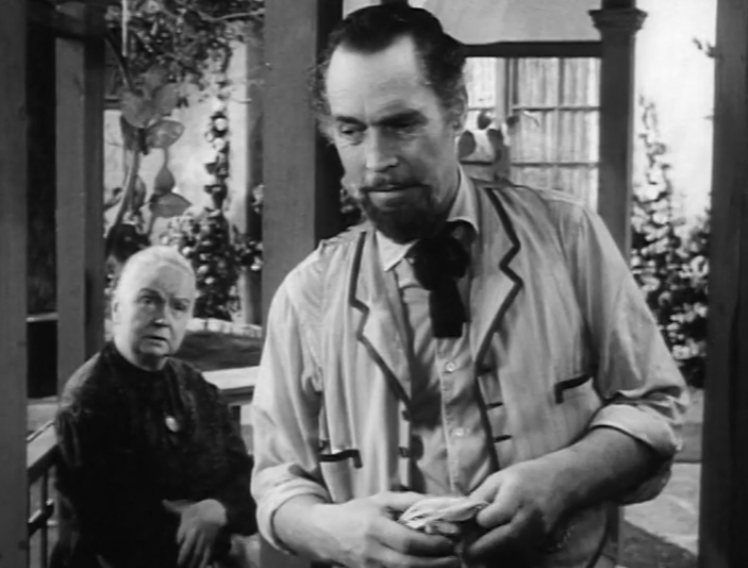
In 1956, Franchot Tone starred as the doctor in the 4th Street production of Anton Chekhov's play Uncle Vanya. After the run of the play, Franchot would produce and star in the film version. An interesting bit of trivia is that a young Franchot had originally played a character in a 1929 production of Uncle Vanya in New York in his early theater days.


Franchot plays Dr. Mikhail Lvovich Astroff, an aging doctor who takes care of all in his rural village. When a wealthy, elderly scholar and his young wife visit their country estate, Astroff's world, along with that of the estate's servants, revolves around the urban couple and their extravagant needs. Astoff and Vanya, former brother-in-law to the professor and uncle to the professor's daughter Sonia, are both immediately attracted to and distracted by the professor's beautiful wife, Elena


The professor's daughter Sonia is secretly in love with Astroff, but he is often drunk on Vodka and does not notice her. Franchot plays his drunken scenes with so much boyish mischief and delight. One thing that I love about Franchot's acting throughout his career is how expressive his face is. I imagine his original training as a stage actor and the need to get his emotions across to an audience in their theater seats is what influenced Franchot to incorporate so much facial acting and expression into his performances. Uncle Vanya is a fine example of Franchot's talents in this area.


Under the guise of helping Sonia tell the doctor about her love, the beautiful wife Elena uses the opportunity to go after Astroff herself. Astroff realizes that this flirtation is merely a game for the lovely Elena, but still falls prey to her charms. Elena is played by Franchot's fourth wife Dolores Dorn. Because they kept their real-life relationship so private, it is nice to see their interplay in Uncle Vanya scenes. The two were already secretly married when this play was filmed, but film audiences at the time had no idea. Franchot and Dolores had met during the play's first run in New York City in 1956.


When the professor and his wife announce that they are selling the country estate and returning to the city, the lives of Vanya, Astroff, and Sonia are thrown into dismay. All of the actors in this intimate drama are skilled stage performers and turn in wonderful performances. What I enjoy most about this film and Franchot's television appearances is that it gives me a chance to experience what it might have been like to see Franchot on stage. Acting on the stage was Franchot's first love and his passion for the theater is evident in this adaptation of Uncle Vanya.


I

 I highly recommend Uncle Vanya! It is available on DVD on Amazon.