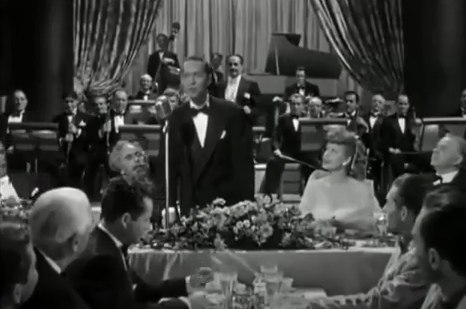
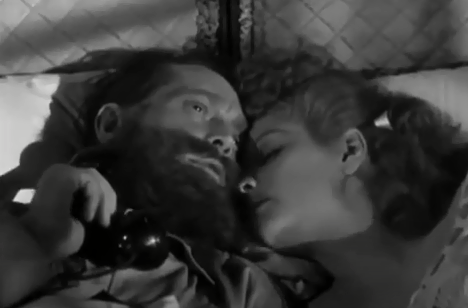
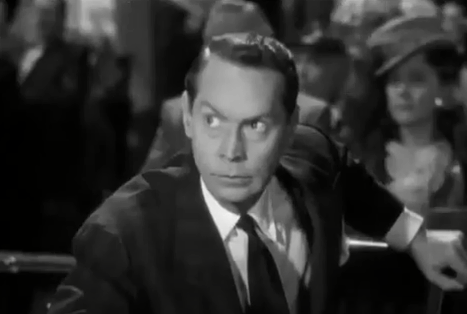
Showing posts with label 40s. Show all posts

Wednesday, June 30, 2021

Trail of the Vigilantes (1940)

Warren William and Franchot Tone. Scan from my collection.

Franchot starred in the western comedy Trail of the Vigilantes in 1940. I love this movie for many reasons. It allowed Franchot to take on a role in a genre not offered to him in the previous decade. It paired Franchot with my other favorite actor of 1930s films, Warren William. Finally, it's a fun movie full of physical comedy and Franchot shines in it. Unfortunately, a high quality print of it is not available to watch, but you can view the movie in its entirety on Youtube (click here.)

Author George Fenin, in his 1962 book The Westerns, wrote that the film:

happily disposed of its somewhat witless lampooning in the first four reels, and thereafter got down to the serious business at hand. Much of the action was admittedly tongue-in-cheek, but it was so well-staged with all the customary Universal zip, that no one really minded.

The 1940 publication The Movies...And the People Who Make Them deemed the picture a:

delightful comedy-action western...wild brawls, hectic pursuits and forthright romance handled with a light farcical touch lift the proceedings far above the conventional level.

Even reviewer Bosley Crowther, notorious Franchot detractor, seemed to enjoy Trail of the Vigilantes. He wrote:

And now it seems to be getting so any one who sits long enough in a movie theatre will see every actor he ever knew appear up there on the screen in a Western. This time it is Franchot Tone, that erstwhile Group Theatre hopeful and star in many a super-soigné Eastern, who is playing the rootin' tootin' hero in Universal's "Trail of the Vigilantes," which pulled up yesterday at the Rialto. And, believe it or not, he's okay...The story is pretty routine, but performance is better than average. Mr. Tone wins his spurs in a good, fast Western. 

At the moment splitting his time between the stage and the screen, Franchot told reporter George Benjamin that he was enjoying being back on a studio lot and appreciative that he was being offered different roles this time around. He said:

I enjoyed immensely playing in my first Western, Trail of the Vigilantes. Why didn't someone tell me about the horse operas before?
Franchot Tone and Peggy Moran. Scan from my collection.


Franchot's leading lady Peggy Moran, in an interview with Mike Fitzgerald for Western Clippings, shared that she was surprised to find Franchot was not a known entity at conventions in which she participated. Peggy recalled:
It was a spoof and of course a big picture—much bigger than the Bs I usually did. A few years ago, I went to Knoxville to a film festival. The late Robert Shayne had told me about stills—getting my best shots reproduced and all. I took some from each of the westerns. The scenes with Gene Autry and Roy Rogers were big sellers. But when it came to the shots of me with Franchot Tone, the fans would ask ‘Who’s that!?’ At first I was so taken aback, because he was a big star, much more so than Gene or Roy, at least at the time. But these fans know who they like—it’s Gene and Roy, not Franchot! But in its day, ‘Vigilantes’ did very well, especially in New York and the sophisticated areas. It was funny, with jokes. A real farce. Franchot would fall off a horse every time he tried to get on it. The dialogue was cute and the metropolitan areas ate it up. But at the festival, I could see what the other westerns meant in that part of the country. Franchot Tone and I dated for a while, but that was before I started going with my future husband.

I think the fact that this was a western convention had something to do with Franchot not being recognized. If it had been a pre-code or 30s-related convention, I think Franchot would've received more love. Also, had the stills been of Franchot's television work in the 1950s and 60s, convention attendees would have surely recognized the older gentleman who starred in episodes of Bonanza, Wagon Train, The Virginian, and Bitter Heritage.

The Film

After a newspaperman is murdered, special investigator Tim Mason, known as Kansas, is assigned to the case. Kansas (Franchot Tone) is required to trade in his tuxedo and city life for western wear and a horse. When Kansas arrives in the western town, it is in complete chaos. Horses, wagons and men run wild in the streets and there seem to be gunshots coming from every direction—the sheriff is even handcuffed to a building! Within minutes of arriving, Kansas finds himself strung from the ceiling of the saloon. Ill-prepared for battle, Kansas fends off the posse in a mixture of pushing, quips, and occasional punches. 

Franchot in Trial of the Vigilantes. Scan from my collection.

During the squabble, ranch hands Meadows (Andy Devine) and Swanee (Broderick Crawford) befriend Kansas and get him a job as a ranch hand on Mr. Thornton’s farm. When Mark Dawson (Warren William) arrives on the scene, it is clear to Kansas that Dawson’s word is law and his influence important. He learns that Dawson is the head of the Cattlemen’s Protective Association and receives a payment from every single rancher in town in order to keep in his good graces. But Thornton, Kansas’s new employer, has refused to join the CPA and faces regular vandalism on his property from Dawson’s gang. 

While learning the ropes (literally!) on the ranch, Kansas falls for the ranchman’s daughter Barbara (Peggy Moran). Investigating a hunch, Kansas breaks into Dawson’s office and is arrested—but not before he discovers that Dawson has been stealing money from the Cattlemen’s Protective Association. Soon, the other cowboys learn that Kansas is an undercover investigator and help him take the Association’s money (a whopping $20,000) before Dawson can steal it for himself. When Dawson attempts to paint him as the bad guy, cowboys vouch for Kansas's character and testify on his behalf.

As the movie progresses, the local sheriff becomes wise to Dawson's devious ways and Kansas must make an important decision: whether to return to the city life he's always known or remain a cowboy with Barbara by his side.

Source: The Movies and The People Who Make Them (1940)

Sources:

Benjamin, George. "Smoothie!" Modern Screen. June 1941
Crowther, Bosley. "The Screen." New York Times. December 6, 1940.
Fenin, George N. The Westerns: From Silent to Cinerama. Orion Press. 1962.
Interview with Mike Fitzgerald: Peggy Moran. http://www.westernclippings.com/interview/peggymoran_interview.shtml
Trail of the Vigilantes. The Movies and The People Who Make Them. 1940.

Wednesday, June 23, 2021

Her Husband's Affairs (1947)

Her Husband's Affairs. Source: my collection

1947 was Franchot's year for marriage-related comedies. He starred in Lost Honeymoon with Ann Richards and Tom Conway, Honeymoon with Shirley Temple and Guy Madison, and Her Husband's Affairs with Lucille Ball. Her Husband's Affairs was directed by S. Sylvan Simon, who would direct Franchot again in the film noir I Love Trouble the following year.

In Her Husband's Affairs, Franchot plays Bill Weldon, an advertising man looking for his big shot at wealth and fame by latching on to the hare-brained schemes of inventor Emil Glinka (Mikhail Rasumny). Bill is clever and creative, but his wife Margaret (Lucille Ball) is the real innovative problem solver in the marriage—a fact that irks Bill and causes a great deal of marital tension throughout the film, which is currently available to watch on Youtube.

Franchot, Lucy, and director S. Sylvan Simon
clown around in this on set candid. 
Source: my collection

The comedy received mixed reviews when it was released in the fall of 1947. Bosley Crowthers, New York Times reviewer and never a big Franchot fan, called the movie a "featherweight farce" and wrote:

To try to make any sense of it would be the most arrant foolishness, for it plainly was not intended to follow a coherent line. It is simply a lot of nonsense about a husband, his buttinsky wife and a thoroughly eccentric inventor...Except for occasional incidents which are good for explosive yaks—and in most of which, significantly, Mikhail Rasumny is involved—the humor is pretty labored, the going pretty rough. Lucille Ball, an able comedienne, works hard and adroitly as the wife, and Franchot Tone springs about as the husband, but they labor to little avail.

Independent Exhibitors reviewers gave the film a mere two stars and called it "an insult to audience's intelligence" and said it was "based on a premise that might have been considered funny in the days of silent two-reel comedies." But The Film Daily disagreed. Film Daily praised the film:

Tone and Ball have a field day in this wild and merry farce which rates plugging by wise exhibitors. This is one of the wildest, merriest farces to come to the screen in many moons. In addition to its laugh-provoking zany capers, it has a love story, with one or two near-censorable situations. In all, it adds up to an attraction that deserves plugging by wise exhibitors. 


The "near-censorable situations" that Film Daily refer to are many sweet, cuddling scenes in the Weldons' bed—definitely occurring more frequently than in other films of its time, and Franchot and Lucy look and act fabulous together. However, as forward as these scenes may seem in retrospect, the premise of the film—concerning a man jealous of his wife's creative ideas and not wanting her opinions, only her approval—is certainly of its time. Let's just say that the character Bill Weldon will never be upheld as an early feminist. 

 Bill (Tone) comes up with advertising ideas in the middle of the night, looking for the next big craze. He tells Margaret (Ball) that he is sick and tired of hats being sold for their durability, because what men require is a lightweight hat. As he weighs and tries on the hat and fires off possible slogans, Margaret responds with great feedback and suggestions for improvement. Bill replies:

I love you very much, but these are my slogans. Let's not collaborate...Learn to respect my ability. I don't need any creative help from you, just your approval.

Bill's so preoccupied with his work that he's postponed their honeymoon cruise to Bermuda four—soon to be five—times! With his latest lightweight hat notion, Bill knows he must stage a stunt for publicity. He aims to convince the mayor to wear the hat at the ball game and have a cameraman ready for the perfect shot. But the mayor refuses and without consulting her husband, Margaret decides to place the hat on the mayor's head during the national anthem. People grow angry with the mayor for keeping a hat on during the anthem and he responds, "I didn't know I was wearing one," exactly as Bill wanted, and all thanks to Margaret's quick thinking.


 As Bill's colleagues and supervisors praise Margaret, Bill grows jealous and embarrassed. He loses his temper and questions her, "You keep thinking I'm not able to handle my own affairs?" Margaret makes peace by calling him a genius and kissing him.


Later, Bill meets with professor Emil Glinka, who has invented an embalming fluid that "converts people into glass...Every man will serve as his own headstone." Bill is smart enough to turn this new fluid down, but is swayed by Glinka's other new formula that removes hair effortlessly and destroys the gland extract. Bill convinces his company to move quickly on the product which he has named Off Again and Mr. Winterbottom (Gene Lockhart) shuts down his shaving cream plant immediately and plans a gala that very evening, inviting 750 prominent guests and requesting that they arrive unshaven.

At the event, everyone applies the cream to their faces and is smitten with the results. Faces are soft, supple, and hairless across the room. Off Again is a success and Bill is a hero!


Bill and Margaret stay up all night dreaming of the money, maids, butlers, and trips they will soon have. But morning brings chaos. Every person who applied the cream the night before now has a full, bushy beard! One that grows back instantaneously when shaven or cut. 


Winterbottom grows angry when he realizes that he will have to compensate every single person who tried the balm and threatens to throw Weldon in jail. Margaret, as always, saves the day. She suggests that Winterbottom simply change Off Again to On Again and use it as a hair growth balm for bald men. Everyone applauds the idea except Bill, who is embarrassed that he's been rescued by his wife once more. The men laugh and tell Bill he should just go home and knit while his wife takes care of business, which causes Bill to threaten divorce. Winterbottom cautions him, "Instead of standing here bellowing like an ape you ought to go down on your knees to your wife for what she’s done.”

Film still. Source: my collection.

Soon, men all over town have full manes of hair, but Margaret's plan quickly hits a far-fetched snag. Because the formula is made of embalming fluid, it begins turning scalps into glass! Bill hides out with Professor Glinka and lets Margaret face the backlash this time.


Instead of giving up on Professor Glinka's embalming fluid inventions entirely, Bill is enthralled by the inventor's latest revelation—an unbreakable rose. Glinka may not be able to preserve human life, but he can preserve plant life! Bill enthuses, "A perpetual flower...wait! I've got a name for it. The Forever Flower!"

More outlandish hijinks ensue leading to a murder trial and more necessary meddling by Margaret.


About her husband, who is so loving and devoted at home but terribly jealous of her successes in the office, Margaret explains:
He’s really a brilliant man, Mr. Brewster, but like so many brilliant men he just runs off the track. He gets hold of an idea and it gets bigger than he is. I know he’s working on something very brilliant right now but, you see, when a man’s a genius you can’t trust him…


 As long as you can suspend reality for 84 minutes, you'll enjoy Her Husband's Affairs.  Always a skilled comedian in my eyes, Franchot is very funny in his role as Bill and does some humorous bits imitating a horse, losing his cool, and performing physical comedy. It's a silly romp that includes a lot of sweet moments and great screwball collaboration between Franchot and Lucy. The pressbook for Her Husband's Affairs had some clever ways to entice viewers and build up the film. It suggested that local radio stations hold a contest for "the most helpful wife" in which a husband submit a 50-word essay on a time his wife helped him out of a jam. Beauty parlors were encouraged to hold a contest for the married couple with the most beautiful hair. Since the film focuses on the misadventures of an advertising man, it was suggested that cinemas stage special screenings for their local advertising clubs.

Film still. Source: my collection.


Sources:
 Crowthers, Bosley. "Her Husband's Affairs' Has Its Premiere at Capitol -- 'Heaven Only Knows' Opens at Broadway." New York Times. November 14, 1947.
"'Her Husband's Affairs' Insult to Audience's Intelligence." Independent Exhibitors. 1947.
"Her Husband’s Affairs." The Film Daily. July 22, 1947. 
"The Selling Approach on New Product." Motion Picture Herald. November 1947.

Saturday, January 11, 2020

Franchot's Association with the Group Theater, Part 2

Franchot left the Group for Hollywood (click here for part one of this story), but he continued to support them. Harold Clurman wrote that Franchot's financial generosity funded much of the Group's script purchases and productions.

Franchot wrote to Harold that the Group had been ¨the most important influence¨ in his life, but that he deeply loved Joan Crawford and intended to remain with her in Hollywood. Franchot knew that the Group members judged him for his decision, yet they also came to him frequently for money, the same money he made from the Hollywood career choices on which they judged him. Clurman recalled spending afternoons with Franchot and Joan when he visited California:
Franchot was happy to play the host to his companions of old. To him we were clean spirits who brought light and warmth into his almost locked heart. Joan Crawford, a good sport, wanted to make friends with Franchot's friends. She thought at times of appearing on the stage, an ambition perhaps stimulated by Franchot. She wished to be able to follow him in all his steps, so that he might not be included to wander too far from hers.
In the afternoon we would chat, mostly about the theatre, play badminton, swim in the pool, dine, and see a picture in the projection-room, right off the pool. It was quite a pleasant routine that we followed almost every time we visited them. Once, while I lay afloat in the pool, basking lazily in the Sunday sun, Franchot observed me with friendly malice and remarked: “The life of a prostitute is pretty comfortable, isn’t it?”
Often, Franchot would take a loss on his investments with the Group. Clurman remembered:
He wanted to know about his failure to realize any money on Awake and Sing, and I tried not to be sheepish in admitting our mismanagement. He did not take the matter amiss however (in these questions he always alternated between peevishness and indulgence). Basically Franchot was an idealist, and he still idealized Lee Strasberg and me. Though in the long run there is more peril than pleasure in being idealized, I was at the moment the beneficiary of Franchot’s warmest hospitality. I was the (awkward) prophet of a religion centered in the theatre. Franchot’s wife, Joan Crawford, was prepared to believe. Some day, Franchot intimidated, he would return to the theatre, and, at the time, theatre was synonymous to him with the Group.
Franchot's return to the Group-1939's The Gentle People

The success of Golden Boy strengthened Franchot's desires to return to the stage, or as Clurman put it, Franchot ¨glowed in anticipation.¨ Once his marriage to Joan ended, Franchot found himself financing and starring in The Gentle People. Clurman no doubt was eager for Franchot's return to the theater and credited his ¨excellent¨ talent many times over the years, but he also seemed to be banking on the fact that two former Group actors-turned-movie stars (Franchot and Sylvia Sidney) would fill seats whether the play was a hit or not. Although definitely using Franchot's financial and professional reputation for the Group's gain, Clurman did seem to care and worry about Franchot the idealist:
I warned Franchot that he might encounter disappointment in the Group…I suspected that Franchot looked toward the Group with the fondness of a youthful memory. “Franchot, “I said, “promise me that you will stay with us for one year no matter what happens. Give yourself and us a chance.” Franchot looked solemn and uncertain, but he promised.
Franchot threw himself into his work with an eager will. On the whole, he was well pleased with the conduct of rehearsals; his criticisms were affable and slight. When conferences on the progress of The Gentle People were held, I failed to invite him to join them, as it was not our custom to consult members of the cast on production problems of the plays in which they took part. That Franchot was not only one of the leading players but the play’s backer gave him no special privilege in this matter. It was not my intention to snub him in any way, but Irwin Shaw pointed out that, whatever my intention , my behavior was tactless. Franchot, however, bore this with good grace. 
But Franchot was restless, just as he'd been in the year leading up to his departure from the Group and arrival in Hollywood years before. He praised the Group at a speech he gave at the Town Hall Club, saying:
I’d better not get started on the Group,” he began, “because I’ll get emotional about it and then I won’t be able to talk at all...The Group has a well-defined attitude toward human problems and affairs, and while I’m perfectly sure that such a formalized policy as this is by no means necessary to success in the theatre, it is necessary to me.


Still, Franchot turned down Clurman's offer to do the play Quiet City saying that he was too tired to do more than one play at a time. When he was offered My Heart's in the Highlands, Franchot made stipulations before stating that he didn't feel he would do a good job in the role.

When Franchot wouldn't fully commit to the Group in the 1940's, Elia Kazan, Clurman, and others staged a sort of intervention with him. They asked him to commit to them and trust in them and the theater. Franchot asked if they respected him. When they answered that he was the kind of actor they needed, Franchot asked pointedly, ¨But you don't respect the reputation I have made in pictures?¨ Clurman answered, ¨This is not why we want you.¨ Franchot confirmed his fears about the Group when he asked, ¨But you are willing to exploit my name for its commercial value?¨ and Clurman answered, ¨Of course.¨

In his book, Clurman seems misunderstood about why Franchot alternated between complete worship and bitterness in his feelings about the Group, even going so far to say that Franchot ¨built up a case against us in his mind. Perhaps he needed an inner justification for giving us up.¨ I don't believe it's that hard to see why Franchot had mixed feelings about the Group and in all of my own personal research I have only read kind or nostalgic remarks about the Group from Franchot in interviews. As late as 1966 Franchot was praising Lee Strasberg to TV Guide:
Everything I know about acting I learned from Lee Strasberg. At the Group, I learned Strasberg's variant on the Stanislavsky System—that's S-y-s-t-e-m, not Method. Method actors lack discipline. System actors are disciplined. I'm a pretty good actor today only because I've always renewed myself at the feedbag—the theater.
It's clear that Franchot acted out in many ways, but it is also clear that he had some insecurities and wanted to be told he was valued for his own talent. When he wrote to Clurman baring his soul about his deep appreciation for the Group, Franchot probably hoped for a return letter with the same sentiment about himself. Instead, he received a letter requesting money to fund another show. Back in the early 30's, young Franchot had been hurt when Strasberg told him they didn't care that he was leaving for Hollywood; after all, Franchot was secretly hoping for validation (and a personal request to stay with the Group) from this father figure he idealized. It's no surprise that Franchot would be sullen and hurt again in the 1940's when he realized that the Group begging him to come back still didn't fully respect or include him despite now benefiting from his wealth and celebrity status.

Despite this complicated history with the organization, Franchot was proud of his association with the Group and always attributed his passion for acting with the skills and conditioning he gained as a Group member.

You might also be interested in these previous related posts:
Franchot's Association with the Group Theater, Part 1
Franchot and Sylvia Sidney
An Ernest Hemingway Hero
The Gentle People
The Strasbergs Remember Franchot
John Garfield Blogathon

Sources:
  • Clurman, Harold. The Fervent Years: The Story of the Group Theatre and the Thirties. Knopf, 1950. 
  • Kramer, Joan, David Heeley, Joanne Woodward, Steve Lawson, Stella Adler, Harold Clurmaan, Cheryl Crawford, and Lee Strasberg. Broadway's Dreamers: The Legacy of the Group Theatre. New York, N.Y: PDR Productions, 1994. 
  • Lewis, Robert. Slings and Arrows: Theater in My Life. Stein and Day, 1984. 
  • Smith, Wendy. Real Life Drama: The Group Theatre and America, 1931-1940. Knopf, 1990.
  • "Who Has Ever Had a Better Time?" TV Guide. January 1, 1966. 12-14.

Sunday, September 8, 2019

An Ernest Hemingway Hero

I recently came across Time is Ripe: The 1940 Journals of Clifford Odets on my local library's shelves. Franchot is mentioned a handful of times in Odets' daily diary. Unlike the brief "Franchot Tone was also there at the Mocambo" diary entries I stumble across from others in the business at that time, Odets' delves into Franchot's complicated character and Odets' own mixture of interest and frustration with Franchot.

Franchot in Dark Waters, 1944.
Scan from my collection.

On Valentine's Day 1940, Franchot and the rest of the cast from The Fifth Column stopped by to see Odets' matinee showing. Three days later, Franchot joined everyone at a "certain bad restaurant" the actors dined in every night. Odets writes:
He was ill-at-ease, tense, and obviously very lonely or he wouldn't have joined us. All of us tried to put him at ease, but he is poor table company. He wanted to go out whoring and drinking at a speakeasy (liquor after 1:00 a.m.), but was unable to find a companion. Franchot, with all his fame, money, and position, is still afraid of rejection and repudiation. He is blustery and pushing, anxious and uneasy, just like Steve Takis*, but slightly more adult; in short, he is an Ernest Hemingway hero, and that is saying the whole thing.
*Steve Takis was the main character of Odets' play Night Music, which would begin official performances shortly after this diary entry.

On March 16, 1940, Odets writes that he had just finished Stefan Zweig's essay on Casanova the night before and that it "gave me several good ideas, particularly for a play about a modern sort of Casanova to be played by a fellow like Franchot Tone. It is not the great lover element which interests me at all; the element of adventurer, swindler, fake prince among American aristocracy, etc. is where the play lies."

June 8, 1940:
At ten we [Odets, Sid Benson, Geebee] rode uptown, we three, ate a light supper at Schrafft's, saw a newsreel and two films, or part of them. One with Heifetz fiddling...the other an old film, the first F. Tone made when he went to the coast in 1932*. Very instructive. We move so fast in this country that the film, the acting style, the lighting and settings, the clothes—all are already old-fashioned. Franchot was not bored then, not blasé, but fresh and impulsive.
*I assume Odets is referring to Franchot's first film The Wiser Sex which starred Claudette Colbert, Lilyan Tashman, and Melvyn Douglas. This is the only Franchot film I have never seen. It has been preserved by AFI's National Center for Film and Video Preservation at the Library of Congress Motion Picture Conservation Center and it was shown at a film festival several years back. Unfortunately, it's not on physical media or shown on television.

On July 7th, Odets dines at the Stork Club:
There I met Burgess Meredith, Franchot Tone, and John O'Hara, and a brother-in-law together at one table. Meredith was leaving for a Western ranch vacation the next day, so they were celebrating together by getting drunk and more morose each minute. They were in moods of careful (or cautious) self-abnegation, admitting carefully that their lives were useless, that, as Franchot put it while discussing Maxie Baer, the fighter, "the thing is to look good even while you're going down." Franchot, whom I like, still a very unusual talent in the theatre, always brings out in me a certain caginess and over consideration, a real and acute discomfort.
September 29, 1940:
Every time I see Franchot Tone around town, something stirs in me. He is one of that fraternity equally at home here or in the East, drinking, sleeping around, trying to suck the marrow out of a bony friend or two who has no marrow, making a movie, looking for a play—he is too good for this sort of life; that is what touches me about him.
That September entry is the last time that Odets mentions Franchot in his 1940 journal. Odets had known Franchot since the very early days of the Group Theatre and in a later interview would remark on Franchot's talent:
Toward the end of the summer, Franchot Tone, after being quite erratic in his relationship to the company—he was a spoiled boy in many ways—decided to leave the Group, and everyone was sick. He was very gifted. The two most talented young actors I have known in the American theater in my time have been Franchot Tone and Marlon Brando, and I think Franchot was the more talented. And when he lost what he did, I think a very valuable gift was lost to the American theater. He was our leading man. It was like a beehive had lost its queen. 
Source: 
Odets, Clifford. Time Is Ripe: the 1940 Journal of Clifford Odets. Grove, 1989.
Hethmon, Robert. Days with the Group Theatre: An Interview with Clifford Odets. Michigan Quarterly Review. Volume XLI, Issue 2, Spring 2002

Monday, April 8, 2019

"Pandemonium" at 470 Layton Drive

When I was browsing fan magazine articles about Franchot and Carole Landis' relationship earlier this year, I stumbled upon this article about Franchot living at the Layton Drive address with photographs! This is the home listed on Franchot's World War II draft card (here) that I did a brief post on last year (here.) When Bubbles Schinasi and actor Wayne Morris called it quits leaving their home vacant and open to tenants, Franchot and his pal Burgess Meredith ("as gay a brace of bachelors as ever haunted the sleep of the countless impressionable co-eds throughout our wonderful democracy") moved in. Hollywood was surprised that two bachelors would take on a large, elegant property. Jimmy Durante even asked, "Those guys and that house—what have they got in common?"


How did they end up living in such style? Burgess settled into the extra room at Jimmy Stewart's Santa Monica house when he arrived in Hollywood for film work. Soon, photographer John Swope became Jimmy and Burgess' housemate as well. All men enjoying and being popular with the ladies, the house grew crowded fast. Buzz (as Burgess was known to friends) found a beach house in need of repairs to reside in, but Jimmy and John didn't want to break up the gang. It was decided that the beach house would just be for Buzz to sleep in, but the guys would all hang out at Jimmy's house during waking hours.

Then, Franchot arrived from New York and needed a place to stay. Franchot and Buzz were roommates in New York shortly after Franchot's divorce from Joan Crawford and remained lifelong friends. Both Franchot and Buzz were acting in plays at the time and found they shared equal passion for acting and being fixtures at the hottest nightspots. Buzz and Franchot decided to lease the Morrises' chateau, now nicknamed Pandemonium. Their neighbors included Nelson Eddy, Anna Sten, and Frank Capra. Franchot felt the place was perfect for his return to Hollywood as a bachelor.

Franchot and Buzz threw a cocktail party after getting settled in and locating domestic servants. In the article, the descriptions of the rooms are pretty exaggerated in comparison to the photographs. Yes, they are beautiful, large nice rooms, but Screenland refers to their living room as "Dali-esque." Their living room was described as a "surrealistic masterpiece...The walls were a pale blue set off by a gray carpet. Two disconsolate love seats done in yellow leather hugged the fireplace, over which a mural by Lee Blair (a South American cockfight framed in blue mirror) looked down..."
The living room.

Buzz's room was decorated in red and white walls ("calculated to woo sleep"), a sea green carpeted floor, and "flaming" draperies.
The bedroom of Burgess Meredith.

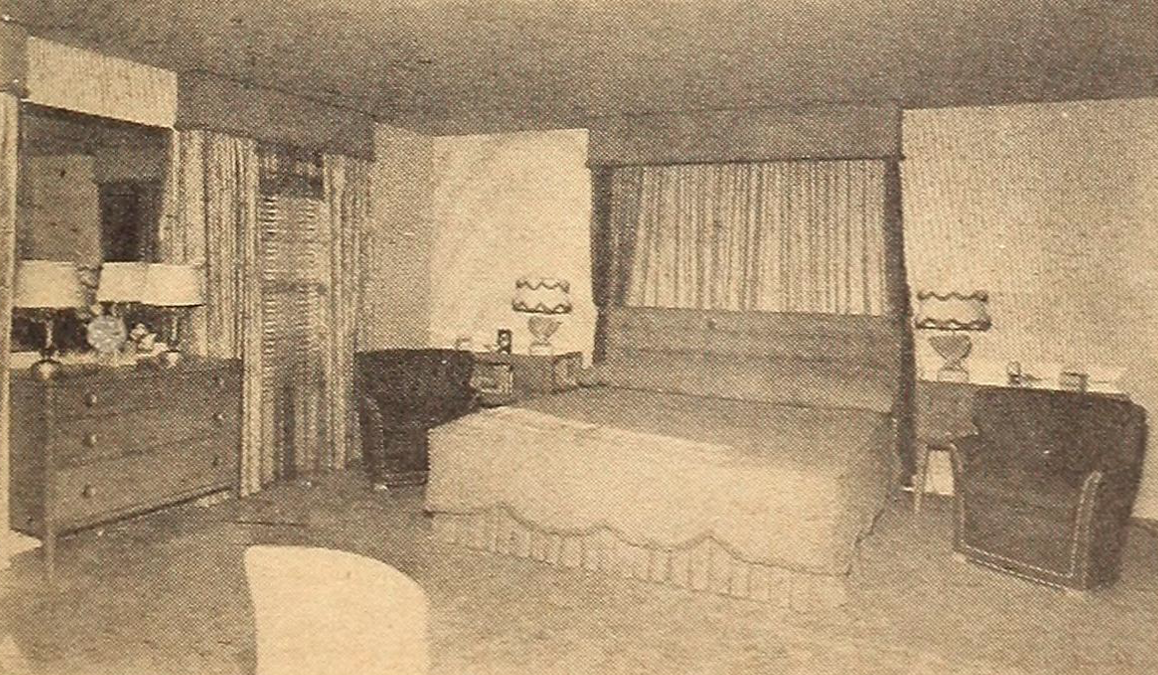
Franchot shared his room with a Great Dane named Bad Boy (pictured with Buzz and Franchot in the top photo), who used the former outdoor tennis court as his play area. Franchot's room would "stand up as the most sexy and glamorous bedroom in Hollywood...it houses the biggest bed in California—a little number measuring exactly ten feet long, ensconced on a pale grey rug and sporting a half-canopy of coral fish net...the walls are pale blue...the lights are soft and harem-like."
The bedroom of Franchot Tone.

Burgess would recall in his biography and he and Franchot "shared many a bottle and many a girl, both in New York and Hollywood, in our bachelor days. There were also some quiet times in Canada at his hunting lodge...But he enjoyed life to the end, loving and being loved by an army of fans and friends..."

Sources:
Franchey, John R. Hollywood's Gayest Bachelors! Screenland. May 1941. p. 28-29, 88. 
Meredith, Burgess. So Far, so Good: A Memoir. Boston: Little, Brown, 1994. 72-76. 

Monday, February 25, 2019

Franchot and Carole Landis


Franchot is proudly framed on Carole's table.
Franchot and actress Carole Landis met each other just a few weeks shy of Carole's divorce from Willis Hunt, Jr., which would be granted in mid-November 1940. Carole and Franchot were all smiles in the many photographs of the couple, often taken at Ciro's, published in fall 1940 and early 1941. Although she was very serious about her relationship with Franchot, Carole and Franchot both still casually dated other people in the entertainment industry.

Although both still visibly on the market, Carole apparently intimated to friends that Franchot was close to proposing or had already quietly proposed marriage. When reporters from Modern Screen magazine stopped by Carole's home, they observed a photo of Franchot signed, "Yours without protest." (Wouldn't it be nice to see that one pop up on eBay?) Still, some doubted that he had made such a commitment. Franchot was very active on the dating scene at this time and although he clearly cared about Carole, it doesn't seem like he was quite ready to jump into marriage in late 1940.


Carole described what she was looking for in a man:
I'm the happy type, by nature and by inclination. I expect men to amuse me, interest me, flatter me, spoil me, I say that if there is any heart-breaking to be done, it is a woman's privilege...if I meet the man with the qualities, he is welcome, love is welcome. But I am NOT seeking. I'm keeping my eyes and ears open, that's all. Because if you were 'in love' a couple of times when, obviously, you weren't, if you follow me—you just relax and wait. You also do a spot of figuring. I've done several spots. I've made a sort of man-map. I know now what I want in a man, what I expect of a man, what I demand of a man.

What were some of the reasons she fell so hard for Franchot? Carole shared:
Franchot Tone has a divine sense of humor. Hollywood practically turned hand-springs a few months ago over 'the change' in Franchot. Over bars, at parties, on sound stages, over the counter at Schwabs Drugstore, at the races and in print, people wondered, what's happened to Franchot? A dozen different versions were given, including one that set forth that I had changed him. Flattering, but fallacious. The real low-down is that Franchot sat himself down one night in New York, did one of those Rochester-talking-to-himself-in-the-mirror turns. He said to his reflection, 'You've a dull disposition, my boy, let's face it, let's break through and have some fun, let's go back to Hollywood, quit being snooty, laugh and make mad and merry.'
He came back to Hollywood. He broke through. But the point is that he had a sense of humor about himself. He had the very rare ability of being able to see himself as others saw him. Another nice thing about Franchot, as about Cesar [Romero], is that he is always so moderate, so restrained. No ear-marks of The Actor, not an ear-mark. I used to watch him when I first came to Hollywood, when he was still married to Joan Crawford and I'd think, what a lucky girl! I still say that any girl who gets Franchot will be a lucky girl. I think it would be very pleasant indeed to be married to Franchot...One little thing Franchot does always bowls me over when we're dining out, at Ciro's, at the Brown Derby, or wherever, and I go to the powder room, he never lets me go alone, always escorts me, always waits for me, takes me back to our table, pulls my chair out for me, and then sits down himself.  If you are in pictures, which means that your face is known, and have ever tried to battle your way through a public place, waylaid at every other table by too convivial strangers, you have some idea of what this thoughtfulness—believe me, gentlemen, this rare thoughtfulness, means...From Franchot I learned about classical music, opera. I adore men I can learn from. And they never make me feel that I don't know, never make me feel stupid or inferior. They make it seem as though we are sharing an experience together...Franchot took me to my first opera. I knew nothing about operatic music and, frankly, I expected to be bored to a welcome death. But throughout the evening, in his nice, quiet way, Franchot explained it all to me so that I was sharing the experience with him, and loving it.

According to author Eric Gans and researcher Lisa Burks, Franchot liked Carole quite a bit but felt she, nearly 14 years his junior, was "immature and coming on too strong." At some point, Franchot broke away from the relationship and shocked everyone when he suddenly eloped with Jean Wallace, who at just 18 years old was actually 4 years younger than Carole, on October 18, 1941. It has long been suspected that the ex Carole Landis talks about with reporter Gladys Hall in the article, "Glamour Girls are Suckers!" is indeed Franchot. In the interview, Carole is clearly hurting deeply from the breakup and feels betrayed. She says:
A great, terrific constant thing came into my life. A man, of course. For obvious reasons I can't use his name, but he is an actor and—it was love I felt. Real love. I knew it and I still know it...This went on for months. We were constantly together every possibly moment. I felt this, at last, was it...I lived in a dream when, suddenly, a little girl, a nonprofessional, not pretty really, clothes just so-so but not chi-chi, vivacious perhaps, but that was all, stepped in and—here I am...the minute you let a fellow know so completely that he's the whole floor show, you're sunk.
If this unnamed man is Franchot as everyone believes, then Carole, in pain, is unnecessarily cruel in her description of Franchot's wife Jean Wallace. With time, the bad feelings between Carole and Franchot disappeared and a real friendship emerged.  Franchot attended a surprise party to honor Carole's dedication to the war effort. Carole was a tireless supporter of the brave men overseas. As the actress who visited the most troops during World War II, Carole sold war bonds, entertained on multiple tours and at the Hollywood Canteen, served as an air raid warden, Aerial Nurses Corps commander, first aid instructor, and visited over two hundred bases. Carole famously documented a 1942 tour with Kay Francis, Martha Raye, and Mitzi Mayfair in her book Four Jills in a Jeep. The story of her travels was made into the 1944 film of the same name.

Although they didn't marry, Franchot and Carole remained close friends until her death. When Screen Guide and Eagle-Lion Films wanted a Christmas layout at Carole Landis's house in 1947, Carole hosted a little preview of Christmas and Franchot and his wife Jean were present. Of course, it was July when the layout was shot—with a Christmas tree by the pool and friends gathered around an outdoor Christmas feast—but it wasn't published until December 1947.

Carole, husband Horace, Jean Wallace, Betty Garrett, Larry Parks, and Franchot
celebrating Christmas in July 1947.

Franchot (under the tree) and Carole Landis directly in front. You can also see
Jean's legs to the right.

Tragically, Carole would be dead just one year after these photos were taken. On July 5, 1948, Carole was found unconscious after taking an overdose of barbiturates. She was only 29 years old. You can read a full account of her last day here: Carole Landis Official Blogspot

The website above is a fantastic resource for all information on Carole and I highly suggest it for further reading as well as the Facebook page A Comet Over Hollywood.

Sources:
  • http://carolelandisofficial.blogspot.com/
  • https://www.facebook.com/A-Comet-Over-Hollywood-1769075543417007/
  • Fleming, E.J. Fleming (2005). Carole Landis: A Tragic Life in Hollywood. McFarland and Company, 2005."What Carol Landis Demands of Men!" Screenland. October 1941.
  • Gans, Eric Lawrence. Carole Landis: A Most Beautiful Girl. Univ. Press of Mississippi, 2008.
  • "Glamour Girls are Suckers!" Photoplay. December 1941.
  • "It's Out-landis!" Modern Screen. October 1941.
  • www.mediahistoryproject.org

Sunday, January 13, 2019

The Making of the Man on the Eiffel Tower


The Man on the Eiffel Tower, produced by Franchot and often noted as one of his favorite films, was the first feature film shot entirely in color in France. Director of photography Stanley Cortez spoke with American Cinematographer about how shooting only in Ansco Color following the war created challenges:
The two studios which we used Billancourt and Joinville had been occupied by the Germans during the war. When they retreated, they sacked both studios of every available piece of equipment, leaving only the bare walls. It has been a heartbreaking job ever since for the gallant French technicians who are trying to refurnish their studios with the modern equipment necessary to full scale motion picture production.
Because there were no Ansco labs in Europe at the time and sending film to the United States for development would've been too costly, The Man on The Eiffel Tower was shot—with a Debrie Super Parvo camera—without lighting and makeup tests.

The cast and crew encountered additional issues. A coal shortage in France meant that there were days spent without electricity. Cortez elaborated:
Happily, the two days that Billancourt studios were without power, Joinville studios, several miles distant, had it; so on those days we would transport our camera, lighting equipment, and any necessary props or sets to Joinville and work there—returning to Billancourt when the rationing edict darkened the stages at Joinville.
Despite the setbacks, Cortez said that Franchot and coproducer Irving Allen "were most cooperative and considerate at all times."

Cortez was pleased with the final results:
I feel that we have given Ansco Color film the acid test, having put it through a major production under all sorts of conditions. It is safe to predict that Ansco Color film will really come into its own as a medium for feature film production once The Man on the Eiffel Tower is released.
Watching the film, you'll be struck by the numerous French locations that are captured in each scene. The mystery plays out in cafes, streets, flats, and, of course, the Eiffel Tower. The city is a major part of the plot and as American Cinematographer stated, the film can also be considered a "travelogue type of documentation of Paris." The city is even listed in the film's cast of characters.

The New York Times felt that the film was "largely composed of subdued excitements" and did not praise its actors:
...City of Light was never lovelier than as the Ansco-colored background for this manhunt and, what is more pertinent, it very often makes the other principals look like spear carriers. In losing their hearts to the Eiffel Tower, the Seine, the boulevards and Montparnasse, the producers and the director have given some distinction to an otherwise routine adventure...Although this short tour is, by and large, a delight, the same cannot be said for the rest of the cast. They don't seem to be straining, but their efforts can't be counted as outstanding. 
Franchot made The Man on the Eiffel Tower with some of his favorite people. Franchot's close friends Charles Laughton and Burgess Meredith were the principal actors along with Franchot. Meredith directed the film. Though their marriage was ending at the time, Franchot's wife Jean Wallace also starred.

I do agree that some of the scenes are subdued, but it's an interesting film, a different role for Franchot, with enough thrilling elements to keep me entertained. It has fallen into the public domain, and here it is in its entirety:


Sources:
 "Filming the Man on the Eiffel Tower." American Cinematographer. February 1949. p 46

"The Screen in Review; 'The Man on the Eiffel Tower,' From Novel by Simenon, Opens at the Criterion." The New York Times. January 30, 1950.

Sunday, October 28, 2018

Piecing together the technical story of Jigsaw

In late 1948, the publication American Cinematographer revealed the unique method in which Jigsaw was recorded. Jigsaw differed from the majority of American films being made at the time and was able to use a small budget to its advantage.

A film noir about a district attorney whose investigation into a suicide leads to a much more sinister plot involving political extremists,  Jigsaw starred Franchot, Jean Wallace, Myron McCormick, and Marc Lawrence. The film was made on a small budget, but what it lacked in budget it made up for in a Who's Who of cameo appearances. It featured cameos by Henry Fonda, John Garfield, Marlene Dietrich, Marsha Hunt, and others.

American Cinematographer praised Don Malkames, director of photography, for his skill at creating a lighting quality expected in studio films without fancy equipment and special-made sets. Journalist Norman Keane wrote:
This production demonstrates that feature films can be photographed in natural settings and locations...The natural locations were used because they afforded economy in production. Not a single set was built for the entire picture. Even the props were those found on the locations. The sites and locales used included interior of the Brooklyn Museum, a Fifth Avenue pet shop, a prominent night club, its dressing rooms, a large restaurant of unique design, an apartment house interior, elevators, and a warehouse...Every set was a challenge...none of the luxury lighting equipment of Hollywood studios. He [Don Malkames] had to get around the limitations of low ceilings of the apartment in which a great deal of the action took place, of the fixed walls of narrow halls and of elevators, and of the immovable fixtures, furniture, etc., which he invariably found in such locations as the pet shop. Before starting to shoot the picture, he had considered using mostly photo spot lamps and R-2 photofloods, but he found that even after building a number of barn doors and hangers for use with these lights, they would not give the precise lighting control necessary. 
Malkames used Mole-Richardson light spots, "inky dinks" for key lighting, and "150 watt broads for fill in light." Malkames secured lighting to ceiling beams to give scenes a more natural look and photographed the entire film with a fast lens in "exceptionally low key." He also used shafts of light to enhance the more suspenseful scenes.

Franchot said:
It is doubtful that there are many cameramen who could achieve the excellent quality of lighting that Malkames did, considering the lighting equipment he had to work with and the limitations of his sets.
Keane's article also uncovered another interesting element to Jigsaw's photography. The film was recorded entirely without sound!
Another thing which greatly simplified the photography was the absence of sound equipment—especially the mike boom which, under the lighting conditions used...most certainly would have involved unwanted shadows...It was the belief of the producers Lee and Danziger, based on long experience of dubbing foreign versions, that it is possible to get greater dramatic feeling into the dialogue when it is post-recorded and dubbed in after the picture is cut.
After the film was recorded, the cast reassembled at the recording studio. As scenes were projected on a screen, Franchot, Jean, and the rest of the cast spoke their lines. Other sounds such as the ringing of telephones, footsteps and so on were also recorded at that time. 

The cast and crew were excited to think of how this method would be studied by future producers and students of low-budget movies. They also thought it would prove a successful method for television movies in the future.

I knew the film was low-budget and that the producers, director, and Franchot himself took pride in its originality, but I had no idea of the lengths they went with natural lighting and post-filming dubbing. After learning how much the film was praised for its lighting and how the crew felt it would be studied by film students and television producers, I am even more frustrated that it fell into public domain. As a public domain title, the film has been neglected and is in bad shape. All of the copies you watch online and even the DVD I own are such poor quality in sight and sound. Can you imagine if we could see it in its original theatrical glory?

I rewatched the film after reading the American Cinematographer article and took notice of all the lighting tricks and was impressed by the effortlessly seamed dubbed video. I've always felt this was a very good performance of Franchot's (I wish he'd made more film noirs like this and I Love Trouble) and I like Jean's femme fatale character as well.

Here's the full movie on the Internet Archive. (If the embedded video doesn't play, click here.)


Source:

Keane, Norman. "'Jigsaw' Filmed Without Sound or Sets." American Cinematographer. December 1948.

Sunday, August 26, 2018

Franchot and Sylvia Sidney

Sylvia Sidney was born on August 8, 1910 in New York and, like Franchot, never abandoned her first love of the theater. In fact, Franchot and Sylvia had a lot of connections throughout the years as you'll see. Sylvia successfully juggled theater, film, and television from the mid-1920's all the way up to her last role the 1998 tv reboot of Fantasy Island. (Sylvia would argue with me that it was simply a "part," not a role...she was particular about that.)


Sylvia is a member, along with Loretta Young and Natalie Wood, of my trio of favorite actresses. I could watch her work without end. I'm fortunate that Franchot worked with all three in his lifetime. I've watched a lot of Sylvia over the last several years and wrote about the Tone-Sidney 1939 play The Gentle People back in 2016 (here.) This summer I finally read Scott O'Brien's biography Sylvia Sidney: Paid by the Tear which I highly recommend. Sylvia was beautiful, driven, talented, and very outspoken. As she grew older, she became especially cantakerous, but sometimes her quips to reporters and fans were delivered with an ounce of humor and mischief. If you've ever watched 1990's interviews of her on Youtube, you know what I am talking about here. Let's just say if I had had the opportunity to meet her, she may have very well made me cry. O'Brien writes that when a fan approached Sylvia in Bloomingdale's and told he had hundreds of photos of her, Sylvia replied, "You're f'***ing crazy! Your house must be a mess!" Reading that passage made me laugh out loud, but if I were that fan, I would've been shocked. Without further ado, all of the Sylvia Sidney photos and play-related scans in this post are from my own collection. I assure you I'm not crazy and my house is mostly tidy.


Sylvia was so much more than a grouchy workaholic (look how exuberant her smile is in the candids above) and O'Brien's biography really delves into her familial and professional experiences and her dedication to her son, dogs, and career. I also think it's telling that Sylvia liked to attend celebratory film events and then criticize its attendees for living in the past. She didn't have to attend these events or be interviewed. But she did and I think it's because she secretly liked it. There were disappointments throughout her life that I believe hardened her shell a bit so that she increasingly spouted these harsh, irascible comments as a shield of protection. As a fan myself, I wish that she would've been more receptive to and outwardly appreciative of her fans' interest in her, but I must admit that I really admire how she lived her life on her own terms. I wish that I had an ounce of the audacity she possessed. 

Like Franchot, Sylvia grew up in a household without financial issues and very early on dedicated herself to being an actor. Both Franchot and Sylvia could've coasted through life, but possessed the drive to embrace their own paths and be discovered through hard work on the stage instead. They would both state how disenchanted the film world made them feel at times and continuously worked at improving their skills while delivering plays with important social messages through the Group Theatre. Both Franchot and Sylvia refused to take fame too seriously and embraced their transformation into character actors. On top of their personal and professional similarities, Franchot and Sylvia simply liked each other.

Ten years before they teamed up for their Group Theatre comebacks in The Gentle People, 24-year old Franchot and 19-year-old Sylvia acted together in Cross Roads. It ran for 28 performances at the Morosco Theatre in November and December 1929. Written by Martin Flavin, the play would be adapted into the 1932 film The Age of Consent. Eric Dressler played a first-year medical student Michael who wants to quit school to marry Pat. When Pat (Sylvia Sidney) wants to wait, Michael is caught in a clandestine evening with a waitress and his life at school and with Pat is threatened.

On November 6, Variety called it a "poignant, wistful little comedy...Excellently acted, the dialog, easy and natural, and it has all been staged superbly." By November 27, the play had grossed $8,500 (Measuringworth.com rates that around 1 million today.) 

The dialogue may have not been the only aspect that came "easy and natural" to its actors. Author O'Brien reveals that Franchot told interviewer Gladys Hall in 1933 that he had been "seriously in love" with a co-star:
We didn't marry, because I felt it would be unfair to the girl. She was very talented. She had a big career ahead of her. We broke it off and she has gone on, as I knew she should. She is a very successful star right now.
Although Franchot didn't name the costar, Hall then and O'Brien later guessed that Sylvia may be the girl. By 1933, Sylvia had become a big star in Hollywood. 1931 to 1933 saw Sylvia in such classics as An American Tragedy, City Streets, Merrily We Go to Hell, Street Scene, Madame Butterfly and Jennie Gerhardt. In 1934, movie magazines declared that Sylvia was the Hollywood beauty with the most ideal face. I believe that it is very likely that Franchot is referring to Sylvia in this interview. Although a great deal of his costars were very successful in theater, Sylvia's the only one of his early theater costars that comes to mind who had that level of stardom in Hollywood in 1933. Franchot had many, many love affairs—some not so serious and some very serious, some well-publicized and some very secretive. But I have a feeling he may be talking about Sylvia here, too. 


In 1939 after many years focused on films, Franchot returned to the stage in The Gentle People, a Group Theatre production co-starring Sylvia. On February 6, 1939, Life magazine reported:
Where The Gentle People lags, it is supported by radiant acting from Franchot Tone, Sylvia Sidney and Sam Jaffe, all returned from Hollywood to Broadway, and from the Group company who have become past masters at U.S. realism.
Variety, on January 11, 1939, reported:
Franchot Tone returned from Hollywood to play Goff, giving the part a clear reading and believable type of tough guy...Sylvia Sidney is the willful Stella, an assignment which she excellently delivers.


During the play's run that included 141 performances from January to May 1939 at the Belasco Theatre, Franchot and Sylvia were frequently seen out together socializing for fun as well as for a cause. Sylvia was married to actor and director Luther Adler at the time and would give birth to their only son Jody whom she absolutely adored by the end of the year. Still, Franchot and Sylvia were photographed together in restaurants and many wondered if a romance was afoot.


Franchot and Sylvia took the social causes that drew them to the Group Theatre to heart. They were committed to using their fame to bring awareness to injustice. Just two months before The Gentle People's opening night, German Jews were brutally attacked by paramilitary and civilians in retaliation for the assassination of a Nazi German diplomat. We know now that this horrific persecution would only get worse. To encourage the United States government to take a stand against Nazis and brutal acts such as these, Franchot and Sylvia hosted a fundraiser for Committee of 56. The 56 was named for the number of original signers of the Declaration of Independence. The Committee aimed to rally against acts of Nazism and boycott anything associated with Germany until those acts were prevented.

Franchot and Sylvia also traveled to Washington, D.C. together. They met with President Roosevelt to protest the budget cuts against the Federal Theatre Project.

Having spent a great deal of time together in 1939, Franchot and Sylvia went their separate ways but still took such similar paths. Sylvia had her son Jody with Luther Adler. In 1946, Sylvia divorced Luther and was married to Carlton Alsop from 1947 to 1951. Franchot would marry actress Jean Wallace in 1941 and have two sons. He and Jean would divorce in 1948 and he would later marry Barbara Payton and then Dolores Dorn. Franchot would balance a life in films, theater, and television as would Sylvia.

When I'm asked which two actors I'd liked to have seen in a film together, I've always immediately answered Franchot and Sylvia. I'm so disappointed that they didn't do something together in the 1930's. I think they would've been perfect in a romantic drama together. Look at Franchot's movies that include messages about the human condition and moral dilemma. I could easily picture Sylvia as Franchot's leading lady in Exclusive Story or Gentlemen are Born or Straight is the Way. Equally, I could envision Franchot as Sylvia's leading man in Street Scene, Jennie Gerhardt, and One Third of a Nation.

It seems I was almost granted my wish in the 1940's. O'Brien's book reveals that Franchot and Sylvia nearly did co-star in a film in 1946. They both signed on to co-star in the film Repeat Performance. After the film was delayed, Sylvia dropped out to film Love from a Stranger instead. Franchot would film Honeymoon, Lost Honeymoon, and Her Husband's Affairs in 1947. Repeat Performance went on to star Louis Hayward and Joan Leslie and was released in 1947. It as a film noir that includes elements of time travel and science fiction.

In 1956, Luther Adler and Sylvia reunited to co-star in the play A Very Special Baby. There was a lot of tension and bickering between the two exes and although the play was noted for Sidney and Adler's superb acting, critics found the play to be "overwrought." Playwright Robert Alan Aurthur witnessed the battles and ended up writing The Thundering Wave, an episode of Playhouse 90. The Thundering Wave was about two exes who are reunited on the stage and clashes ensue. Those two exes, based on Sylvia and Luther, were performed by Joan Bennett and....Franchot Tone.

Sources:

  • "Cross Roads." Variety. November 6, 1929. pg 63.
  • Doherty, Thomas. "Remembering the Hollywood Mogul who Rescued Hundreds of Germany's Jews." The Hollywood Reporter. December 29, 2015.
  • "Low Tide Totals of Between Holiday Period Expected by B'way Legits." Variety. November 27, 1929. pg 59.
  • O'Brien, Scott. Sylvia Sidney: Paid by the Tear. Bear Manor Media, 2016.
  • Smith, Wendy. Real Life Drama: The Group Theatre and America, 1931-1940; New York: Knopf, 1990.