Showing posts with label action. Show all posts

Thursday, April 20, 2017

Playing Against Type: Discovering Franchot's Characters

Franchot would once protest that he was not "one of those fanatics who is always yelling for a chance to prove his versatility and yapping about being 'typed.'" The truth is that throughout his career Franchot would yearn for and express a desire to play a more wide variety of characters. And rightly so. Early on, Franchot did get put in the category of the glamorous, wealthy man who is in the film mainly to support the leading lady and to this day, many people associate Franchot solely on this character alone. However, there are many unique characters sans top hat and tails hidden in Franchot's filmography and I want to highlight those films and some of Franchot's comments regarding being typecast today.
"Of course, it's fine for those Park Avenue playboys I've done to death. I dislike that kind of part intensely. I've played so many, people actually think I'm that kind of smug chap. I agree with them, and if I weren't so lazy, I'd have done something about it long ago."
The Stranger's Return. Source: original from my collection.
The Stranger's Return (1933)
Franchot is Guy, a well-respected farmer who has given up a promising academic career to tend to the family land. This pre-code drama stars Lionel Barrymore as Guy’s neighbor and Miriam Hopkins as the stranger who comes to town and shakes up Guy’s life.

The World Moves On (1934)
The World Moves On is glamorous and Franchot is well-dressed, but it’s an epic drama directed by John Ford and with Franchot playing two men of different generations. The lengthy film also stars Madeleine Carroll.

Straight is the Way (1934)
Franchot is Benny, a criminal newly out of prison and ready to live a straight-and-narrow life in his Jewish tenament. May Robson is touching as Benny’s long-suffering mother while Gladys George and Karen Morley rival for his affections. The film is at just 59 minutes long, but left a lasting impression on me.
"If I ever had an image, it was the playboy, the white tie and tails, the elegant fellow with the good tailor. That was my image for the mass movie audience. But not for the theater audience. They saw me as an actor. Now my television image is the character actor. And then they see my old movies on the late show and I'm the rich playboy again."


Gentlemen Are Born. Source: original from my collection.

Gentlemen Are Born (1935)
Gentlemen Are Born is refreshing because it places Franchot in an ensemble cast of talented young actors, including Ross Alexander, Dick Foran, and Charles Starrett. They play four recent college graduates who struggle to come to terms with the grim reality of the Depression-era workforce.

Lives of a Bengal Lancer. Source: original from my collection.

The Lives of a Bengal Lancer (1935)
Nominated for a Best Picture Academy Award, this adventure film features Franchot, Gary Cooper, and Richard Cromwell as British officers who must defend their base in Bengal. Franchot often cited this as one of his favorite films (the other two were Mutiny on the Bounty and Man on the Eiffel Tower) and was known to privately screen it for his own enjoyment throughout the years.

Mutiny on the Bounty (1935)
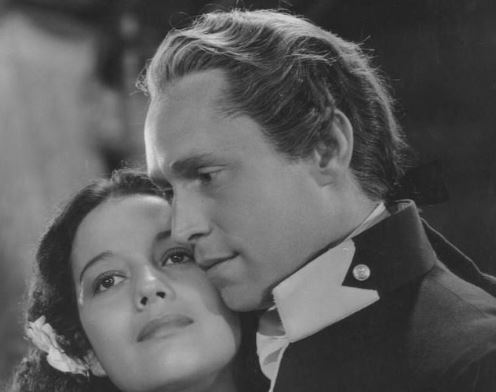
Franchot was nominated for an Oscar for his performance in this Best Picture winner. As midshipman Byam, Franchot must submit to the tyranny of Captain Bligh (Charles Laughton) and accept tough decisions made by Fletcher Christian (Clark Gable) in this classic sea adventure.

They Gave Him a Gun. Source: original from my collection.
They Gave Him a Gun (1937)
Jimmy (Tone) is fearful of his World War I army duty and relies on the encouragement of soldier Fred (Spencer Tracy). After being heralded for his wartime kills, Jimmy’s personality changes and he faces difficulty returning to civilian life.
"Since I've had my own gray hair and wrinkles, producers have been willing to recognize me as a character actor. There was a long spell in Hollywood where I appeared in nothing but bad romantic comedies. They were 'dress suit roles.' Acting talent didn't matter. The important thing was to have a good tailor. That was in the days before a dissatisfied movie star was free to refuse to work at something he didn't like and take a suspension. Maybe it's just as well because I'd have been under suspension more often than not if I had had any option to exercise. I was a leading man making an outrageous salary. But I was jealous of character actors with three-line bit roles. At least, they enjoyed their work."
Three Comrades (1938)
Three soldiers must cope with a changing Germany following World War I. Franchot plays a sensitive mechanic who looks after Robert Taylor and Robert Young with brotherly affection in the original F. Scott Fitzgerald story.
Trail of the Vigilantes. Source: original from my collection.
 

Trail of the Vigilantes (1940)
A western comedy costarring Warren William and Broderick Crawford, Trail of the Vigilantes gives Franchot the opportunity to ride a horse and face the bad guys, but in a comical manner.

This Woman is Mine (1941)
An 1800's sea adventure about a timid organizer of a fur expedition (Franchot) who falls for a stowaway (Carol Bruce) and gains courage on the voyage.

Five Graves to Cairo. Source: original from my collection.

Five Graves to Cairo (1943)
In this Billy Wilder-directed war drama, Franchot is the only survivor of a tank battle who finds himself assuming the identity of a German spy.
 
"Wait a minute...it isn't the only kind of life with which I'm acquainted. I can't remember the time, before I came out here, that I didn't spend the summer months in the woods, hobnobbing with wood-cutters, Indians, and Canadian guides, etc. I know as much about those phases of life as I do about drawing rooms. The biggest personal success I had in New York was as a cowboy in 'Green Grow the Lilacs.' Stage producers never felt that I was the ideal type for the man-about-town."-Franchot in response to a reporter who accused him of playing wealthy playboys because it was all he'd known in his real life.

Pilot No. 5 (1943)
Told in a series of flashbacks as he undergoes a vital war mission, a group of pilots (including Van Johnson and Gene Kelly) reflect on the ups and downs in Franchot’s character’s life.

Phantom Lady (1943)
He may be debonair and suited up, but Franchot also happens to be a murderous psychopath in the 1943 noir with Ella Raines.

The Hour Before the Dawn (1944)
A conscientious objector to the war, Franchot is a pacifist professor who must uncover the truth about his mysterious wife, played by Veronica Lake.

The Man on the Eiffel Tower (1949)
In this color noir that he produced, Franchot plays a murderous loner in post-war Paris. This movie was a labor of love for Franchot and costarred two of his best pals, Burgess Meredith (who also directed) and Charles Laughton.
"Most actors pay too much attention to the size of a role anyway. One good, biting scene is worth more than hours of drivel. Well, I got older, and eventually I reached a point where I looked ridiculous bounding through a bay window with a tennis raquet in my hands. I went into television at a time when the industry was hungry for movie names. I could be demanding. For instance, when one video producer offered me the romantic lead in a murder mystery, I held out for the role of the killer—a marvelous psychopathic character—and got it."
Twilight Zone. Source: original from my collection.
Uncle Vanya (1957)
Franchot and the cast of Uncle Vanya both performed the play on stage and recorded it for film. This independent film was produced by Franchot. As the alcoholic, aging doctor, Tone turns in perhaps his most authentic performance. It's definitely the closest we'll ever get to seeing Franchot perform a live play.

Advise and Consent (1962)
Franchot is the ailing president of the United States in this star-packed drama directed by Otto Preminger.

Television (1950-1968)
In my opinion, if you want to see Franchot at his best, most diverse work, you need to see his many television appearances. Television allowed an older Franchot to play every type of character imaginable and he excelled in this new medium! My top recommendations are the following episodes:
The Silence-Twilight Zone
Impossible Dream-Alfred Hitchcock Presents
The Award-Four Star Playhouse
The Little Foxes-Hallmark Hall of Fame
Along About Late in the Afternoon-The Eleventh Hour
Denver McKee-Bonanza
Old Cowboy-The Virginian
Tell It Like It Is-Run for Your Life

For all the great posts on Franchot Tone, check out the roster of participants in the first Franchot Tone Blogathon!

Sunday, February 26, 2017

A Bounty of Byam

In honor of today's Academy Awards celebration, I want to showcase some behind-the-scenes and publicity photos of Franchot at work in Mutiny on the Bounty (1935). Franchot was nominated for a Best Actor Oscar for his work as Byam in Mutiny. Mutiny on the Bounty won the Academy Award for Best Picture at the 1936 ceremony. In addition to Franchot, Clark Gable and Charles Laughton were both nominated in the Best Actor category. Other nominations for Mutiny: Frank Lloyd for Best Director, Jules Furthman, Talbot Jennings, and Carey Wilson for Best Screenplay, Margaret Booth for Best Film Editing, and Nat W. Finston and Herbert Stothart for Best Music.

I'll post a film summary and screen captures soon, but for now, enjoy this selection of photos!

 
Source: Picture Play Magazine

This one's my favorite! Source: Picture Play Magazine

Source: eBay

Source: eBay

Source: Getty

Source: Flickr

Source: eBay

Source: eBay

Source: eBay

Source: redlist

Source: eBay

Source: eBay
Source: New York Daily News


Sunday, August 28, 2016

Pilot # 5 (1943)

Pilot # 5 is a 1943 propaganda war film directed by George Sidney and told in flashback form. The film stars Franchot Tone, Marsha Hunt, and Gene Kelly. The New York Times called it "tedious, overlong" yet praised its actors, saying that Franchot gives an "intelligent performance," Marsha is "sweet and earnest," and Gene is "convincing." The Showmen's Trade Review predicted that it would "create more than average interest because of a story that is original when compared with the majority of other war dramas now being turned out." Warning: In the film summary below, there will be some revealing plot details. No ending spoiler, of course, just story details up to that point.

George Collins (Franchot Tone) insists on running a bombing mission against an enemy Japanese carrier. As they wait on him to report his progress, fellow pilots describe George Collins to their new major who says that although it is clear George is seen "much struggle and defeat," that he still approaches life with the "look of a victor."


In the first flashback, Winston Davis (Alan Baxter) recalls how he originally rejected George Collins for the Air Corps after the Dean of George's law school reported him to be a brilliant man who turned out to be a "cheap opportunist." Seeing how much this pains George, Davis goes to George's hometown to find out more about the man.


Henry Claven (Dick Simmons) remembers the proud and dignified college-aged George. At that time, George was top of his class, engaged to his high school sweetheart, and working hard to achieve personal and professional success. When Claven last saw him, George and Freddie (Marsha Hunt) were happily building their dream house.


Vito (Gene Kelly) graduates law school with George and although George starts from the bottom after graduation, Vito quickly gets a position with a large law firm. Vito employs Freddie as his secretary and hopes that she will fall in love with him, but Freddie only has eyes for George. Vito takes on George as a partner and they gain representation of sleazy Governor Durban (Howard Freeman). Observing George's awe of Durban's rhetoric and power, Freddie asks, "Can you mix with his kind of people and still be you?"

George and Vito represent Durban as he takes land from poor farmers with the promise of placing thousands of farms in their place. Durban swears that this will aid the community in production and progress. Everyone except George knows that Durban plans to take the land and its profits for himself. Blinded by Durban's public position and his own rising professional status, George doesn't realize just how culpable he is himself until a horrible tragedy strikes.


 George loses everything. Freddie leaves him because she cannot face the "cheap, wart-healing, would-be fascist" he's become. When George confronts Durban, the slimy politician has his lackeys physically beat him. George is treated like scum by the townspeople. Even after he succeeds in getting Durban kicked out of office and works hard to restore his own name, George is still treated unkindly by those who once respected him. Although Vito was involved in the scandal as well, he disappears to New York and never loses the respect and position he gained. Vito regrets not being "man enough to fight" with George and leaving George to handle the repercussions by himself.

When George is finally accepted into the Air Corps, Vito (a pilot, too) sets up a reunion between George and his lost love Freddie.  We discover that by the time he heroically volunteers to go on the bombing mission, George is the beloved husband of Freddie, friend to Vito, yet his character is still under question by his community.


I will not tell you how the film ends, but fortunately you can see for yourself with the DVD Warner Archive released in 2012. This would mark Gene Kelly's third film and you'll spot Van Johnson and Peter Lawford in small roles as pilots. I rewatched it a few days ago and was struck again by the film's originality and powerful story. It's one of Franchot's finest (and an underrated) performances.

Sources:
New York Times. June 25, 1943.
Showmen's Trade Review. April 10, 1943.

Monday, February 22, 2016

Nobody Runs Forever (1968)

In honor of the anniversary of Franchot's birth on February 27th, I'm posting daily this week instead of my usual twice-a-week posts. Today, I want to highlight Franchot's final film, Nobody Runs Forever.

Nobody Runs Forever (also known as The High Commissioner) is a late Sixties political thriller starring Christopher Plummer and Rod Taylor (an example of perfect casting, in my opinion).  Rod Taylor is Scobie Malone, a police sergeant asked to take into custody the High Commissioner of Australia, James Quentin (Christopher Plummer), who is being investigated for the murder of his first wife. Quentin requests that Malone keep the matter private and give him until after an important peace summit. Malone agrees to give the commissioner a few days, but keeps a close eye on him. During that time, Malone grows close to Quentin as he protects him against multiple assassination attempts, uncovers secrets from Quentin's current wife, and identifies a threatening spy ring. Franchot is American Ambassador Townsend, an ailing political mentor of Quentin's.

Franchot's role is very brief (under a minute). For that reason, I chose to share his actual scene instead of my usual screen caps. Knowing it is his last scene in a major motion picture and that Franchot himself was battling lung cancer as he played this gravely ill character in a hospital makes this clip bittersweet for me. (If the embedded clip doesn't play here, use the direct Youtube link.)


Although he plays this scene from a hospital bed, Franchot performs with the fortitude that I so enjoy in the charactors of his final decade. He's no feeble old man in that room. He's alive and biting and wise and in control.

Nobody Runs Forever is a stylish spy film, full of political intrigue, great dialogue, and gorgeous mod fashion on both the men and the women. Christopher Plummer and Rod Taylor, two of my favorite actors of that decade, are both fantastic in their roles and Franchot ends his career on a high note in a sophisticated tale of espionage.

Under the title The High Commissioner, this film is available on DVD.

Tuesday, September 1, 2015

They Gave Him a Gun (1937)

They Gave Him a Gun is a 1937 crime drama that was based on William J. Cowen’s 1936 novel of the same name. Admittedly, I have many favorite Franchot films, but this is one of his early dramas that I particularly enjoy. Warning: this post contains spoilers.

As Jimmy, Franchot Tone gives a convincing, sensitive portrayal of a timid World War I soldier dreading active duty who transforms into a merciless militant who confidently shoots and kills the opposing army. Fred Willis (Spencer Tracy) is Jimmy’s friend and supporter, and although he’s an obedient solider, Fred is much more interested in the kind, lovely nurse Rose Duffy (Gladys George) than in the deadly battles.
When Jimmy is critically wounded, he falls for nurse Rose himself. Jimmy has no idea that Rose is in love with Fred and Rose never divulges this secret. After Fred goes missing in action and is presumed dead, Rose marries Jimmy. Following the end of the war, we see Jimmy, in full uniform covered in medals, proudly posing for photographs and sharing stories from the battlefield. In this scene, it is clear that Jimmy may have a difficult time adjusting to quiet, civilian life. Jimmy is thrilled to discover that Fred was only captured, not killed. He is excited to have his best friend and wife both back in his life, but doesn’t notice that the reunion is painful for Rose and Fred, who are still in love with one another but loyal to Jimmy.  

A good-natured carnival barker, Fred senses a change in his buddy and soon realizes that Jimmy is making his living as a murderous gangster. Rose then makes the difficult decision to turn Jimmy into the police so that he can pay his debts and return to an honest, humble life.
While he’s incarcerated, Jimmy must decide if he’s willing to swallow his pride and pay the price for his crimes in order to return to a humble, happy life with the woman he loves. The scenes of Jimmy’s incarceration and waiting to see what choice he will ultimately make kept me enthralled. Although some of the melodramas filmed in the 30s tend to have predictable endings, I had no idea how this one was going to end. Franchot perfectly plays the part of the conflicted gangster. His face masterfully shows the conflict between his inherent vulnerability and acquired need for power. Spencer Tracy and Gladys George turn in stirring performances as a couple that places their devotion to Jimmy ahead of their own undeniable love. Tone and Tracy only acted in this single feature film together, but Gladys George costarred with Franchot in 1934’s Straight is the Way and 1938’s Love is a Headache.
You can find They Gave Him a Gun on DVD through Amazon. If you enjoy They Gave Him a Gun, I also suggest you check out Pilot No. 5 and Three Comrades.