In February 1950 Franchot traveled to Birmingham, Alabama to promote The Man on the Eiffel Tower. It was a whirlwind one-day press tour of the city including multiple newspaper and radio interviews, a special luncheon at the Downtown Club, a cocktail party at Tutwiler Hotel where his suite was located and ended the evening by making a personal appearance at the Linley Heflin Unit Mardi Gras Ball which was held in the Municipal Auditorium. By midnight, Franchot was on a plane to New York where he was slated for business meetings with friend and TMotET director Burgess Meredith.
With Birmingham press, Franchot shared that he felt his youngest son Jeff might become an actor. Franchot added that Jeff enjoyed "mugging" and always put on a great show every Christmas that his aunt Karol (Jean Wallace's younger sister and only a child herself) would direct in front of the family Christmas tree.
On producing The Man on the Eiffel Tower, Franchot said:
Production, I like, because a producer can assure himself of more interesting parts. You'll like Man on the Eiffel Tower. It's not a mystery but a suspense picture. And Charles Laughton's not the villain. I am!
Interestingly, Franchot shared that his business meetings with Burgess Meredith in New York were to plan for their next film. Burgess was set to direct and Franchot would produce and act in a film version of the novel The Song of the Flea. They planned to begin filming it in London within a year or two. A film adaptation of The Song of the Flea never happened (perhaps due to the Payton love affair and the events that it caused.) I have a special fondness for Franchot's work as a producer (The Man on the Eiffel Tower, Uncle Vanya) and co-director (Uncle Vanya) so it is a shame this other opportunity never came to fruition. It not only would've been a creative venture for Franchot, but he would've also enjoyed working with best friend Burgess Meredith on it. The Song of the Flea was written by British novelist Gerald Kersh whose most famous work Night and the City was made into a 1950 film starring Richard Widmark and again as a 1992 film starring Robert de Niro. I cannot find any proof that The Song of the Flea, which focused on a writer struggling to succeed, was ever adapted for film.
You can read more about The Man on the Eiffel Tower here .
Source:
Caldwell, Lily May. "Franchot Tone Visits Here, Talks of Kindness." The Birmingham News. February 18, 1950.
When I was browsing fan magazine articles about Franchot and Carole Landis' relationship earlier this year, I stumbled upon this article about Franchot living at the Layton Drive address with photographs! This is the home listed on Franchot's World War II draft card (here) that I did a brief post on last year (here.) When Bubbles Schinasi and actor Wayne Morris called it quits leaving their home vacant and open to tenants, Franchot and his pal Burgess Meredith ("as gay a brace of bachelors as ever haunted the sleep of the countless impressionable co-eds throughout our wonderful democracy") moved in. Hollywood was surprised that two bachelors would take on a large, elegant property. Jimmy Durante even asked, "Those guys and that house—what have they got in common?"
How did they end up living in such style? Burgess settled into the extra room at Jimmy Stewart's Santa Monica house when he arrived in Hollywood for film work. Soon, photographer John Swope became Jimmy and Burgess' housemate as well. All men enjoying and being popular with the ladies, the house grew crowded fast. Buzz (as Burgess was known to friends) found a beach house in need of repairs to reside in, but Jimmy and John didn't want to break up the gang. It was decided that the beach house would just be for Buzz to sleep in, but the guys would all hang out at Jimmy's house during waking hours.
Then, Franchot arrived from New York and needed a place to stay. Franchot and Buzz were roommates in New York shortly after Franchot's divorce from Joan Crawford and remained lifelong friends. Both Franchot and Buzz were acting in plays at the time and found they shared equal passion for acting and being fixtures at the hottest nightspots. Buzz and Franchot decided to lease the Morrises' chateau, now nicknamed Pandemonium. Their neighbors included Nelson Eddy, Anna Sten, and Frank Capra. Franchot felt the place was perfect for his return to Hollywood as a bachelor.
Franchot and Buzz threw a cocktail party after getting settled in and locating domestic servants. In the article, the descriptions of the rooms are pretty exaggerated in comparison to the photographs. Yes, they are beautiful, large nice rooms, but Screenland refers to their living room as "Dali-esque." Their living room was described as a "surrealistic masterpiece...The walls were a pale blue set off by a gray carpet. Two disconsolate love seats done in yellow leather hugged the fireplace, over which a mural by Lee Blair (a South American cockfight framed in blue mirror) looked down..."
The living room.
Buzz's room was decorated in red and white walls ("calculated to woo sleep"), a sea green carpeted floor, and "flaming" draperies.
The bedroom of Burgess Meredith.
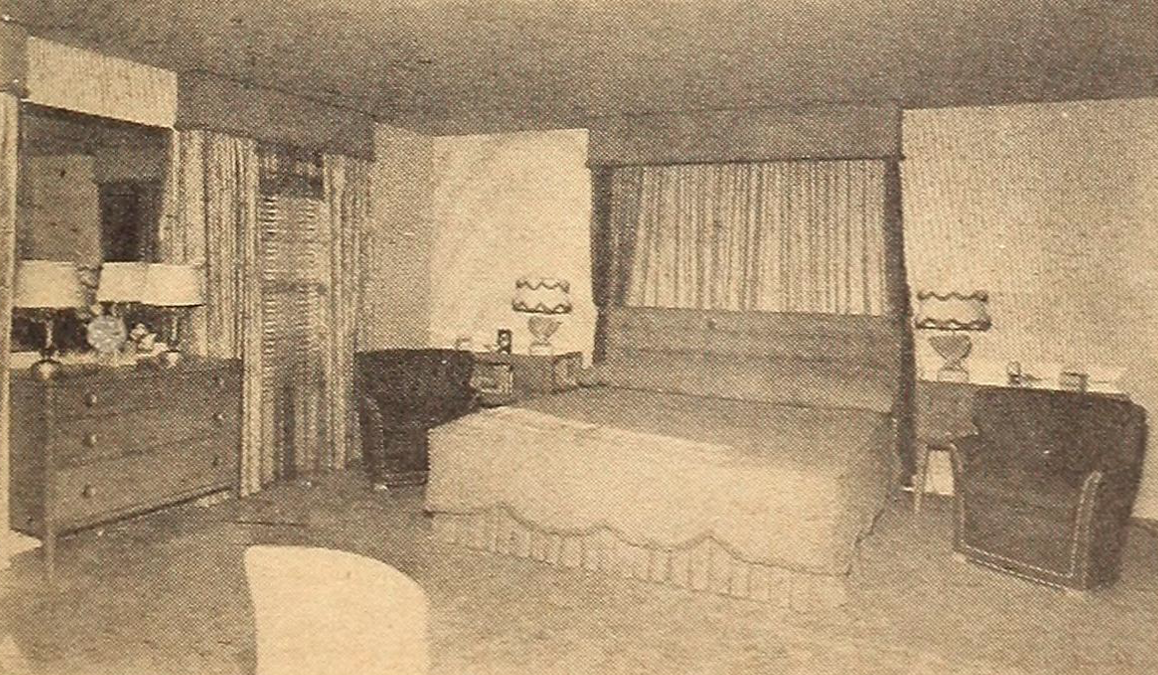
Franchot shared his room with a Great Dane named Bad Boy (pictured with Buzz and Franchot in the top photo), who used the former outdoor tennis court as his play area. Franchot's room would "stand up as the most sexy and glamorous bedroom in Hollywood...it houses the biggest bed in California—a little number measuring exactly ten feet long, ensconced on a pale grey rug and sporting a half-canopy of coral fish net...the walls are pale blue...the lights are soft and harem-like."
The bedroom of Franchot Tone.
Burgess would recall in his biography and he and Franchot "shared many a bottle and many a girl, both in New York and Hollywood, in our bachelor days. There were also some quiet times in Canada at his hunting lodge...But he enjoyed life to the end, loving and being loved by an army of fans and friends..."
Sources: Franchey, John R. Hollywood's Gayest Bachelors! Screenland. May 1941. p. 28-29, 88. Meredith, Burgess. So Far, so Good: A Memoir. Boston: Little, Brown, 1994. 72-76.
The Man on the Eiffel Tower, produced by Franchot and often noted as one of his favorite films, was the first feature film shot entirely in color in France. Director of photography Stanley Cortez spoke with American Cinematographer about how shooting only in Ansco Color following the war created challenges:
The two studios which we used Billancourt and Joinville had been occupied by the Germans during the war. When they retreated, they sacked both studios of every available piece of equipment, leaving only the bare walls. It has been a heartbreaking job ever since for the gallant French technicians who are trying to refurnish their studios with the modern equipment necessary to full scale motion picture production.
Because there were no Ansco labs in Europe at the time and sending film to the United States for development would've been too costly, The Man on The Eiffel Tower was shot—with a Debrie Super Parvo camera—without lighting and makeup tests.
The cast and crew encountered additional issues. A coal shortage in France meant that there were days spent without electricity. Cortez elaborated:
Happily, the two days that Billancourt studios were without power, Joinville studios, several miles distant, had it; so on those days we would transport our camera, lighting equipment, and any necessary props or sets to Joinville and work there—returning to Billancourt when the rationing edict darkened the stages at Joinville.
Despite the setbacks, Cortez said that Franchot and coproducer Irving Allen "were most cooperative and considerate at all times."
Cortez was pleased with the final results:
I feel that we have given Ansco Color film the acid test, having put it through a major production under all sorts of conditions. It is safe to predict that Ansco Color film will really come into its own as a medium for feature film production once The Man on the Eiffel Tower is released.
Watching the film, you'll be struck by the numerous French locations that are captured in each scene. The mystery plays out in cafes, streets, flats, and, of course, the Eiffel Tower. The city is a major part of the plot and as American Cinematographer stated, the film can also be considered a "travelogue type of documentation of Paris." The city is even listed in the film's cast of characters.
The New York Times felt that the film was "largely composed of subdued excitements" and did not praise its actors:
...City of Light was never lovelier than as the Ansco-colored background for this manhunt and, what is more pertinent, it very often makes the other principals look like spear carriers. In losing their hearts to the Eiffel Tower, the Seine, the boulevards and Montparnasse, the producers and the director have given some distinction to an otherwise routine adventure...Although this short tour is, by and large, a delight, the same cannot be said for the rest of the cast. They don't seem to be straining, but their efforts can't be counted as outstanding.
Franchot made The Man on the Eiffel Tower with some of his favorite people. Franchot's close friends Charles Laughton and Burgess Meredith were the principal actors along with Franchot. Meredith directed the film. Though their marriage was ending at the time, Franchot's wife Jean Wallace also starred.
I do agree that some of the scenes are subdued, but it's an interesting film, a different role for Franchot, with enough thrilling elements to keep me entertained. It has fallen into the public domain, and here it is in its entirety:
Sources: "Filming the Man on the Eiffel Tower." American Cinematographer. February 1949. p 46 "The Screen in Review; 'The Man on the Eiffel Tower,' From Novel by Simenon, Opens at the Criterion." The New York Times. January 30, 1950.
Mystery solved! In May, I wrote about Franchot's World War II draft card (here)and pondered the address that was included as his residence: 420 Layton Drive, Los Angeles, California. At that time, I wrote:
When I Google his address, all that gets returned is the alternate address of 470 Layton Way in Los Angeles, a plantation-style mansion designed by architect John Byers for wealthy Phillip Ilsley, who lived in it beginning in 1937. Actor Wayne Morris and his wife Leonora "Bubbles" Hornblow lived there after their marriage in 1939, but divorced soon after in 1940. I don't know how Franchot could've lived in this house at the time, logistically, but with its immaculate landscaping (it included a waterfall, tennis court, and pool) it certainly seems like the type of house Franchot might occupy, short or long term. It is probably that Google is leading me in the wrong direction since a lot of streets change over time. When he registered to vote the same year, Franchot listed his address as 10333 Wilshire Boulevard. 1940 was an interesting year for Franchot. He was fresh from his recent return to the stage and only made one film that year, the western comedy Trail of the Vigilantes. He was single and seen around town with many gorgeous and talented Hollywood ladies (including Carole Landis and Olivia deHavilland) during that time. My point is that he was playing the field in romance and his career at the time, so it is very likely that he was also not settled in one residence or another.
Well, Google was not leading me in the wrong direction. Franchot did live at 420 Layton Drive (or Way) in 1940! I found an article about the romance between Paulette Goddard and Franchot's buddy Burgess Meredith and it mentions the house:
Source: "Paulette's in Love". Photoplay.
Jan-Jun 1943. www.archive.org
The writer refers to the house as the "Pandemonium", ha! This confirms that Franchot did indeed live in the house and used it as a bachelor pad with his friend Burgess Meredith. If you'd like to virtually explore the house, please visit Paradise Leased (here) which has a full detailed post on it with photographs, but no mention of Franchot. Sadly, the house was demolished in 2000.
"I love every stick and stone in this wonderful country."
Spurred on by an interesting discussion with Ann on the Finding Franchot Facebook page (thanks, Ann!), I've been researching Franchot's ties to the Gatineau Fish & Game Club in Ottawa for the past few weeks. I have always been intrigued by Franchot's connection to the Canadian wilderness, because the land and activities there seemed to be such an important part of Franchot's life. I love that Franchot had this love of land, solitude, and survival so deeply embedded in him and how greatly it contradicts those journalists and critics who incorrectly peg Franchot as a rich playboy and little else. My research is by no means complete, but I thought you might like to see what I've discovered so far.
Background
The Gatineau Valley Historical Society has published many interesting articles on the Franchot and Tone families in its Up the Gatineau! publication. Archie Pennie and Carol Martin, in their article "A Century of the Gatineau Fish and Game Club," described S.P. Franchot's (Franchot Tone's grandfather) involvement:
On March 5th, 1894, four Quebec businessmen met in Hull, Quebec and decided to form a hunting and fishing club on Pemichangan and Thirty-One Mile Lakes in northern Quebec. They were Alexander Maclaren of Buckingham, and Dr. W. F. Scott, Charles Leduc and J. M. McDougall of Hull. The original membership included four others to make a total of eight charter members: Albert Maclaren of Buckingham, S. P. Franchot of Niagara Falls, N.Y., and John Scott and Joseph Bourque of Hull. On June 27, 1894, a meeting of the stockholders was held and it was agreed that the Club should lease these two lakes from the Quebec Government for a period of ten years at a rate of $500 per annum. Incorporation of the Gatineau Fish and Game Club dates from November 16 of that year.
Pennie and Martin's full article, which goes into detail about the Club and its early days, can be found online here.
Franchot's maternal grandfather S.P. Franchot was an impressive man. The son of a congressman, S.P. would be a civil engineer, businessman, patent holder for his electrolyte process, and senator before his death in 1908.
In various early Hollywood articles, Franchot Tone mentions spending his childhood summers in Canada and in 1937, Franchot's father Frank Jerome Tone purchased additional property (the estate of W.W. Butler) on the club limits.
Newspaper Mentions of Franchot's Involvement
From the Montreal Gazette on July 23, 1940:
When Franchot Tone wants a holiday he picks for real pleasure a fishing trip in Ontario…Mr. Tone arrived at St. Hubert Airport yesterday afternoon, visited Montreal briefly and left by plane for Ottawa at 7 o’clock. In Ottawa he is to meet his father, Frank J. Tone, of Niagara Falls, N.Y., and the two of them will spend two weeks, maybe three, fishing and relaxing with perhaps a little golf on the side…born in Niagara Falls, Mr. Tone knows that part of Ontario just across the border pretty well, having spent his summer holidays from the age of three to 23 around there.
In Ottawa Citizen, May 19, 1960:
As you read this column (Rod and Gun by Vern Bower), Cliff and I will be in the far north of the Eagle Depot country with a group of friends including actor Franchot Tone…and mayor Jean Paul Desjardins of Gracefield. We move north from our Danford Lake headquarters to Kazabazua Creek, then sweep north to the Picante and from there we push on to Cayamant and on into the Eagle…Our headquarters will be in a cedar cabin, sweet-smelling because it was built from the reclaimed timber of a barn. Very unusual, and in a long stretching line, will be the tents in which Franchot Tone and his friends prefer to live while in Canada.
On August 28, 1960, the New York Times reported:
Henrik Ibsen’s rarely staged “When We Dead Awaken” will be rehearsed at a fishing camp in the Canadian wilds…Franchot Tone, who will be starred, along with Viveca Lindfors and Betsy von Furstenberg, has invited the cast to his fishing retreat at a lake near Gracefield, Que., about sixty miles north of Ottawa.
From the Montreal Gazette on June 2, 1966:
MLA Fournier has not been alone in his efforts to develop the county’s full potential as a mecca for Canadian and American tourists. He has had the valued support of veteran Hollywood actor Franchot Tone, who maintains a year-long residence in the Gracefield area.
In the Ottawa Citizen's obituary of Franchot in 1968:
Stage and screen star Franchot Tone, whose second home from early childhood was the Gatineau area, died at his home in New York City Wednesday of lung cancer...Tone sought privacy away from the gossip columns in the Thirty-One Mile Lake area 28 miles south of Maniwaki. His father was one of the first to build a summer home on Thirty-One Mile Lake near Gracefield, Quebec. Eventually the camp on Thirty-One Mile Lake became the Gatineau Fish and Game Club. Tone visited the area annually in the summer and fall to fish and hunt moose. He held a lease on at least a dozen good trout lakes. He sometimes visited Gracefield area in winter to hunt wolves on snow sleds. He was an excellent outdoorsman. When rehearsing a Broadway play, he would frequently invite the cast to Thirty-One Mile Lake for long weekends. He was a lifelong friend of the late Jean Paul Desjardins, mayor of Gracefield for many years. "I love every stick and stone in this wonderful country," he once said.
Joan Crawford's Visits
It is possible that Franchot first showed Joan the Gatineau area in 1933, but I cannot prove it. When they were dating in November 1933, Franchot and Joan visited New York together. It's possible that Franchot would've taken this holiday to show Joan the Canadian home that he loved, too.
In July 1940, the Ottawa Citizen reported that Franchot was in the Gatineau Valley area on a vacation with his father and that he would be there for several weeks. In August 1940, the Ottawa Citizen included the headline,"Joan Crawford Pays Surprise Visit to Ottawa." The article read:
Recognized by only a few Ottawa people though she passed hundreds on foot and while driving around the Capital during an automobile ride, Joan Crawford, titian haired star of the screen, paid a flying visit to this city yesterday to do some shopping at the end of a four-day visit to the Ottawa district and Gatineau Valley, where she enjoyed what she termed a ‘real Canadian holiday’…Miss Crawford, who came to Canada unaccompanied, spent the greater part of the afternoon in Ottawa and left by train for New York. During her short stay here she was escorted by D. Leo Dolan, director of the Canadian Travel Bureau, and an old personal friend who had met her in Hollywood.
Something tells me that Franchot and Joan vacationed a bit together during this surprise visit. They were divorced at the time, but remained friendly, and Joan would visit the area with Franchot several more times after this. I've no proof, but I feel that there is no way Franchot would've been in the Gatineau Valley in July and August of 1940 and Joan would've been there in August and not been with each other at some point in their trips. I think they were just excellent secret keepers.
On March 26, 1955, the Ottawa Citizen stated about Joan:
As to Canada, she said she ‘adored’ Canada and particularly liked Lake Louise and Banff. She admitted being in Ottawa three years ago but ‘kept it quiet’.
Again, another trip to the region "kept quiet" in about 1952.
In June 1965, Franchot and Joan were photographed at the Jean Lesage International Airport after having vacationed together at Franchot's home in Gracefield. You can view those photos here.
Friends' Remembrances
John Strasberg (son of Lee Strasberg) wrote in his autobiography:
I don’t remember feeling any peace or harmony from the moment we moved back to New York in 1947 until I began spending summers in Canada with Franchot Tone when I was twelve. We hunted and fished, camping in Quebec’s wilderness country. Franchot’s wealthy industrious family owned three houses that sat on the ridge of land between two lakes that were part of the Gatineau Fish and Game Club, near Gracefield, Quebec. We portaged deep into land that he owned, smearing honey under the canoes of poachers so that the bears would destroy them. Franchot became one of my heroes, once I realized that heroes could be human…He exposed me to a world that I loved and felt at home in…Above all, he taught me that work is part of one’s natural respect and love of human life, but it is not a way to ignore it or dominate it.
In his autobiography, actor Burgess Meredith wrote:
There were also some quiet times in Canada at his hunting lodge. Tone had a secret side to him. It was his love of the Canadian woods. He was a fine woodsman.
Today
Franchot's family still owns property and is active in the Gatineau area. Franchot's grandson (also named Franchot Tone) performed at the Gatineau Fish and Game Club in 2013.
Source: Modern Screen, December 1940-February 1941.
July 1, 2016 marks the 100th birthday of actress Olivia de Havilland. The Oscar-nominated actress moved to France in 1958 and still lives there today. Possessing a gentle, flawless beauty and a willful attitude toward her career, de Havilland starred in films including The Adventures of Robin Hood, Gone with the Wind (her Melanie is my favorite character), The Heiress, Light in the Piazza (my favorite of her later performances), and Hush, Hush, Sweet Charlotte.
Olivia married author Marcus Goodrich in 1946 after romances with James Stewart, John Huston, and Franchot Tone, among others. When asked, in 1940, about her dates with Jimmy and Franchot and other high-profile actors, Olivia responded, "They're wonderful, all of them," but stated that none of these dates were too serious and that she had no intentions of getting married within the next two years. Olivia didn't kiss and tell, but it was public knowledge that Jimmy Stewart had been her most steady beau since 1939 and that they were, indeed, quite a serious couple for a while.
I'm uncertain as to how Olivia and Franchot originally came together, but at the time, Franchot was between marriages and splitting his time between Broadway and Hollywood. Franchot may not have been the love of her life, but Olivia certainly seemed to have fun and create quite a buzz in his company. Gossip columnists questioned the seriousness of their relationship and the couple were photographed at various restaurants and night clubs. In October 1940, entertainment reporter Jimmie Fidler asked, "Are Olivia de Havilland and Franchot Tone kidding—or is Jimmy Stewart really due for a red face soon?" During that time, a ticket booth worker at Rex Theater sold show tickets to Franchot and Olivia, along with Brian Aherne and Olivia's sister Joan Fontaine, in Norway, Maine, and the couple were reported to be vacationing at Rudy Vallee's lodge in Lovell, Maine.
Although highly publicized, the romance was brief. A year later, in October 1941, Franchot would be married to Jean Wallace while Olivia would be busy on the films The Strawberry Blonde and They Died with Their Boots On.
Sources: "Blitzkrieg Love Passes Her Up." Spokane Daily Chronicle. September 11, 1941. Dayton Beach Morning Journal. November 2, 1940. Modern Screen. December 1940-February 1941. Pittsburgh Press. April 22, 1941. St. Petersburg Times. October 14, 1940. Sun Journal. September 2, 1992.
I'm not sure of the particular war drama this non-Franchot fan was referring to, but Franchot starred in quite a few excellent war films: Today We Live (1933); The World Moves On (1934); The Lives of a Bengal Lancer (1935); Suzy (1936); They Gave Him a Gun (1937); Three Comrades (1938); The Wife Takes a Flyer (1942); Five Graves to Cairo (1943); Pilot No. 5 (1943); The Hour Before the Dawn (1944).
According to the naysayer in this column, I guess there ought to be more than one dreamer peddling Coca Cola in the North Pole, eh? ;)
How I imagine Franchot's face as he overheard the reporter's comments from the next room.
The Man on the Eiffel Tower stands out among Franchot's filmography for many reasons. First, it is a film that Franchot cited as one of his favorites. Second, it is the only film of his in color. Third, it features his second wife and mother of his children, Jean Wallace (yet they were either separated or divorced at the time of filming). Fourth, it was filmed with his pals Burgess Meredith and Charles Laughton. And fifth, it gave Franchot the opportunity to play a disheveled, quietly plotting killer.
Jean Wallace
Truthfully, I did not appreciate this movie the first time I watched it. I had come off a string of Franchot's 40s light romantic comedies and the plot of Eiffel Tower was a bit more complicated to follow. Also, I first watched a spotty quality copy with bad audio on Youtube, so I struggled to make out all the dialogue and was distracted by the rough cut. Later, I found a better version on Moving Image Archive and watched the film over in its entirety. (Just a note, because this film now falls under public domain, there really is no pristine copy. I've included links to the ones available online at the end of this post). On my second viewing, I enjoyed the The Man on the Eiffel Tower for the unique thriller that it is. My advice to you is don't write it off just because it hasn't been restored and it's not your typical glossy Hollywood mystery. The film has a clever plot, great cast, and amazing color views of Paris in the late 1940s.
In the movie, Bill Kirby (Robert Hutton) and his girlfriend Edna (played by Jean Wallace) confess to Bill's wife that they have been having an affair. In a cafe, Bill talks about his wealthy aunt and how her death could benefit his and Edna's future.
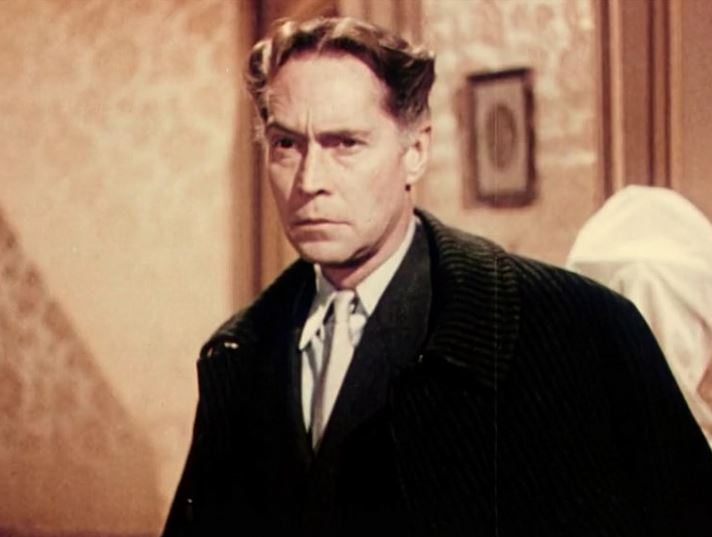
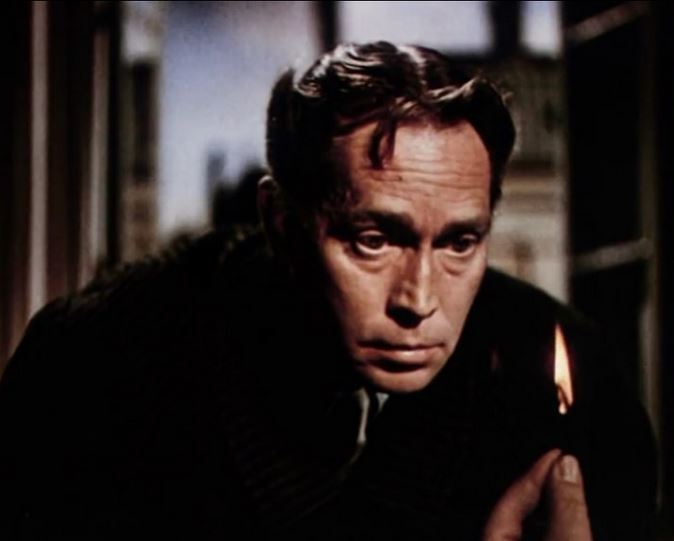
Johann Radek (Franchot Tone) is a sly, kooky character dining across the cafe. Radek passes a note to Mr. Kirby, offering to murder the wealthy aunt.
Meanwhile, the film's director Burgess Meredith stars as Joseph Heurtin, a quiet, hard-working man whose wife does nothing but belittle him. Heurtin decides to break in to and steal from Kirby's aunt's house, and unwittingly walks into a murder scene. When Heurtin loses his thick glasses (very similar to Meredith's Twilight Zone "Time Enough at Last" spectacles), the murderer Radek helps him home.
Because his glasses are left at the scene, Heurtin is first implicated in the murder. Heurtin helps the police identify Radek, but Radek is so sneaky and clever that he is able to taunt the police. Charles Laughton is brilliant as the lead inspector working to bait and catch Radek.
Franchot was 44 years old when The Man on the Eiffel Tower was filmed and the film, in my eyes, is his transition from romantic lead to interesting character actor. Although Franchot had played a killer once before in 1944's Phantom Lady, Eiffel Tower is where we first see Franchot's face (a bit more lined with wrinkles and wisdom) taking on the characteristics that he would display in his television work. His hair and clothes are somewhat disheveled and his eyes are full of mischief.
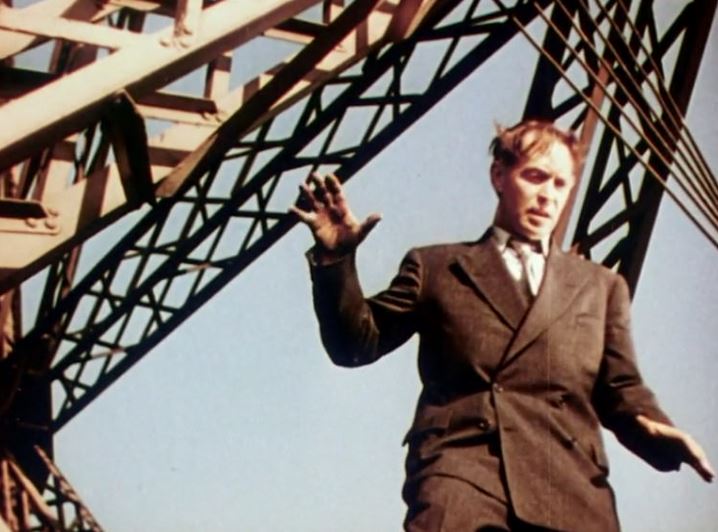
One of my favorite scenes is the exciting Eiffel Tower climb at the end of the film. Radek attempts to resist arrest by climbing the Tower, but Heurtin and the Inspector are close behind. The cityscape is visually stunning and the scene itself will have you on the edge of your seat!
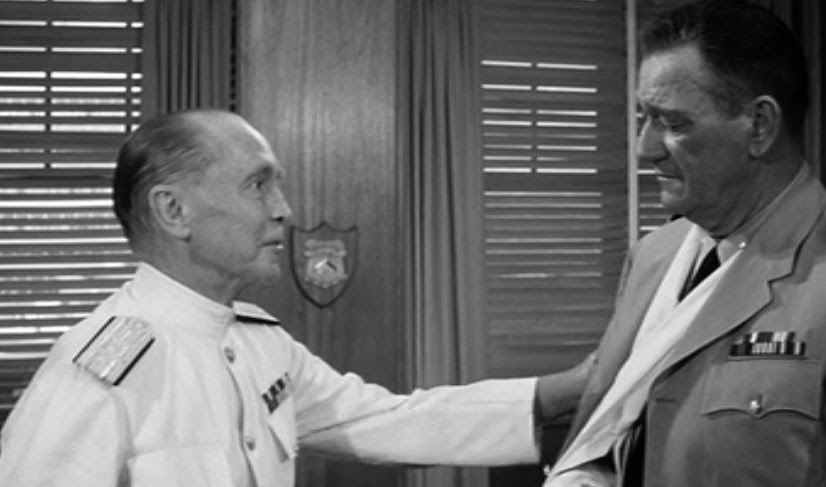
In Harm's Way is a 1965 war drama directed by Otto Preminger. The film stars John Wayne, Kirk Douglas, and Patricia Neal. Franchot Tone portrays the CINCPAC (which is Navy shorthand for Commander-In-Chief, Pacific) .
Franchot is only present in a few scenes, but his performance is effective. I enjoyed watching John Wayne and Franchot in their scene together.
Admittedly, this is not one of my favorite films of Franchot's career. That is not because of Franchot's performance. It's fantastic. I'm just not a huge fan of war movies. Franchot only made 2 more films following this one. He would die of cancer just three years after this film was released. I recommend this film to anyone who is a fan of director Otto Preminger's work and enjoys war-based action and drama.
"I don't know how good Franchot's influence was on me or mine on him. Aside from The Man on the Eiffel Tower, a movie we made together in Paris, most of our coventures were in pursuit of pleasure. We shared many a bottle and many a girl, both in New York and Hollywood, in our bachelor days. There were also some quiet times in Canada at his hunting lodge."
"Tone had a secret side to him. It was his love of the Canadian woods. He was a fine woodsman. Most people knew him only as a playboy, a friend of Howard Hughes and De Cicco and all the other high rollers. He was the chief charge-account customer at "21" and Ciro's and the Stork Club. Every place he went he was the chosen playboy-elegantly dressed, handsome, towing an array of lovely women."
"His career never reached the height his ex-wife's [Joan Crawford] did, because, I think, he seemed to have had too much given to him. Wealth, for example. His father was the president of the Carborundum Company. Brains. Phi Beta Kappa from Cornell. Talent. A superstar. Problems. Lack of discipline. But he enjoyed life to the end, loving and being loved by an army of fans and friends...Franchot and I remained close friends from that first meeting with his bride until I spoke at his funeral."
Source: Meredith, Burgess. So Far, so Good: A Memoir. Boston: Little, Brown, 1994. 72-76. Print.