Showing posts with label facial injury. Show all posts

Friday, February 23, 2018

The Gambler and His Face: Franchot Tone on his Plastic Surgery

In May 1952, Franchot was asked how he felt about his "new face." I wrote about the complicated 1951 Neal-Tone altercation that caused the need for Franchot's plastic surgery and impaired his voice last year (click here), but this is the first time I've run across Franchot making a statement about the plastic surgery to the press:
They say it's better than ever, but I liked the old one better. I'm a gambler, and gamblers sometimes lose. A man's got to live. I've had a full life, with no regrets. There was so much bad publicity, I couldn't defend it; so I've never had my day in court. I think I'll just pass it up. People all over the country tell me they're on my side. I'll settle for that. Well, you can't kill a guy for falling in love, and I've always let them make an honest man of me.
The change in his nose is very apparent in these side-by-side shots.
Source:
"The New Tone." Los Angeles Times. May 24, 1952. page 10.

Saturday, February 11, 2017

Payton-Tone: Marriage, Muir, and Malfunction

Just two weeks after the violent altercation with Tom Neal, Franchot, still bruised and swollen, married Barbara Payton in her childhood home in Cloquet, Minnesota. Many of Barbara’s family, knowing just as well as the public that this marriage would not last, were absent from the ceremony. It seems that only Franchot and Barbara were hopeful about the union. The usually astute Franchot was so wrapped up in his obsession with Barbara that he failed to recognize that, to the press and his fans, he looked more than foolish. Town officials stated that they did not appreciate the negative publicity associated with Barbara and that Cloquet was unimpressed with her and this marriage.

Following the wedding, Franchot and Barbara were photographed together and then headed to The Flame Supper Club and Hotel Duluth. Two days later, the honeymooners traveled to Franchot’s Canadian lodge before returning to Hollywood.
Franchot and Barbara following the ceremony. Source: www.pinejournal.com
A week later, on October 5th, Barbara was subpoenaed again to testify in the continuing murder trial of her friend Stanley Adams. That same month, Barbara and Franchot promoted Barbara’s film Drums in the Deep South on a publicity tour of southern cities. Completely opposite from their triumphant publicity tour just nine months before, the couple encountered “boos” from some audience members, disinterest from city officials, and mocking newspaper coverage in several of the tour’s locations. As author John O’Dowd wrote, "As a couple, the Tones had become little more than a tacky, industry joke, and sadly, everyone seemed to know it but them."
So far, Barbara had been in the definite lead for the public's disapproval, with Franchot being looked upon more with pity than anger. But on October 29th, Franchot made headlines all by himself when he spit on a gossip columnist. Dining with Barbara and his mother Gertrude at Ciro's, Franchot approached Florabel Muir. Muir had repeatedly written scathingly about Franchot and Barbara. Franchot, after quite a bit of alcohol, walked up to Florabel and her husband. After some rude remarks were made about Florabel's marriage, Florabel asked Franchot if he was mad at her. Franchot responded, "Yes, I am. So mad, in fact, that I could just spit in your face. In fact, that's just what I'm going to do."

Then, he spit right in her eye! I must admit here and now that Franchot's verbal response always gives me a chuckle. It's such a dignified, cultured way to threaten someone, before very crudely and disgustingly spitting on them.  It's hard to believe that Franchot would think that spitting in a lady's eye was a good idea, but this was his year of very bad decisions. I am not placing any blame on Florabel for the specific incident, but I bet she was actually quite pleased it happened because it made excellent fodder for the next day's column. Florabel reported in her next column that Franchot had once been an "upstanding fellow displaying at all times a brilliant mind and charming manners. What has happened to him in the last few months is as big a mystery to me as it is to all his friends and acquaintances."

Florabel called the current Franchot a "guttersnipe" and charged him with being on narcotics and kicking her in the shin. Franchot was so angry at the false narcotics claim that he voluntarily submitted to drug testing and was cleared. In court on December 11, Franchot told the judge, "Your honor, I did not kick the complainant and I did not use any vile language. However, I do admit I may have lost my sense of proportion and my sense of good conduct."
Franchot arriving at court on December 11, 1951. Source: USC Digital Collection
Franchot was fined $400, but his 45-day jail sentence for battery was suspended by the judge. Before the Muir incident was even closed in court, Franchot had already begun divorce proceedings against Barbara. As most suspected, it didn't take long for the relationship to hit a sour note. Just 53 days to be exact. In late November, Franchot filed for divorce and not even a full month later, Barbara and Tom Neal were making headlines as they traveled together on a promotional tour for Bride of the Gorilla.

But the marriage proved to be exactly like the courtship. Barbara would break up with Tom and head back to Franchot and then back to Tom again. Franchot was embarrassed and hurt each time Barbara went back to Tom, but seemed to forgive her easily and welcome her back. On their tour, Barbara and Tom were typically drunk, rude, and caught in scandalous situations. Having dropped his divorce complaint in early December, Franchot reinstated it before the end of the year. In January 1952, Franchot and Barbara moved in together again and would remain together until March 15, when Franchot finally had enough and ended it.

The Franchot that Barbara encountered in the spring months of 1952 was not the beaten, pitiful man anymore. After two years, he was done with Barbara and ready for spiteful revenge. Unbeknownst to Barbara, Franchot had never actually dropped his earlier divorce action. Since Barbara wasn't aware it still existed, she failed to contest it in time. Barbara's attorney Milton Golden would claim that this was Franchot's duplicitous plan all along and that Franchot had tricked Barbara into moving back in with him as part of this ruse. Golden and his client Payton were surprised that, for once in the relationship, Franchot had the upper hand.

Franchot had finally shaken off the romantic spell he'd been under and fired back at Barbara even harder with his next move. Knowing that Tom Neal had moved back into the house with Barbara immediately after he vacated it, Franchot hired a private investigator. Photographs were taken of a compromising situation (there were also reports that there were other photos taken of Barbara with men who were not Tom.) Franchot would use these photos as evidence for his divorce, but he'd also use them as personal retaliation by anonymously distributing  the photos in sealed, blank envelopes across Hollywood. This malicious act was not typical of Franchot at all and researcher Lisa Burks would tell author John O'Dowd that Franchot had been pushed  to "his limits with her never-ending betrayals" and that this out-of-character revenge was motivated by "extreme emotional pain." Barbara's sister-in-law Jan agreed that "it was a very cruel thing to do...and not at all like Franchot."

Presented in court, the photos nullified Barbara's cross-complaint and on May 17, 1952, Franchot was granted a divorce.

Barbara would remain with Tom Neal for quite some time, but they never married. Due to the studio and public's response to their unpredictable and salacious behavior, Barbara and Tom's careers were soon destroyed. In 1953, the couple starred together in the film The Great Jesse James Raid and the play The Postman Always Rings Twice, but both attempts failed critically and commercially. They parted later that year.

Tom would later work as a landscaper. He married Patricia Fenton in 1956 and following their divorce, Tom married Gale Bennett in 1960. On April 2, 1965, Bennett was found dead of a gunshot wound to the head. Suspicion quickly turned to Tom, who surrendered himself the next day. Tom admitted that he and Gale were separated and arguing when he visited her on April 1. He claimed that Gale was killed when the gun accidentally fired during a physical struggle between the two. Found guilty of involuntary manslaughter, Tom served six years in prison. He died of heart failure at age 58 on August 7, 1972, just eight months after being released on parole.


Barbara covered in bruises at the police station, 1962. Source: UCLA Digital Collections
The I Am Not Ashamed cover

By the late 1950's, it was hard for the public to remember Barbara as the glamorous, young actress of Kiss Tomorrow Goodbye. She was, by this time, an alcoholic and drug addict with multiple arrests. One of those arrests was for prostitution, the career she turned to once her promising acting career ended. In the early 1960's, Barbara participated in the exploitative biography project I Am Not Ashamed in order to buy more alcohol. Sadly, the one-time beauty that wealthy big names fought over was now an overweight and drunk "lady of the night" who was regularly beaten by her clients. It's devastating, truly, that someone could fall so far in such a short time. It seems Barbara was intent on self-destruction. Friends who knew her tried to intervene multiple times, but Barbara was, just like the title, not ashamed. She rejected all chances for a better life and died at only 39 years old on May 8, 1967. I highly recommend John O'Dowd's biography Kiss Tomorrow Goodbye: The Barbara Payton Story. It's a well-researched work on an interesting life. I learned a great deal from the book and couldn't have written these posts without it.

Following the circus that was 1950-1952, Franchot would quickly pick up the pieces of his own life and return his focus to his career, his sons, dates with glamorous, but more stable women, and a private life lived in New York and at his lodge in Canada. Like Barbara, Franchot would drink more heavily with each passing year, but didn't let it interfere with his work ethic or public behavior (however, it did cause the end of his final marriage to actress Dolores Dorn.) He would never again let himself be smeared and ridiculed in the press. Franchot would outlive Barbara by just one year, dying from lung cancer at the age of 63 in 1968.

In the early 60's, Franchot was stopped by a reporter and asked for his response to Barbara's prostitution charges. Franchot, no longer bitter, said he felt bad that Barbara was having a tough time and that he wished her well.

If you missed the first two parts of my Payton-Tone series, please read about the beginning of the relationship and the altercation, too. Researching Franchot and Barbara's relationship and Barbara's life afterwards has been a little emotionally draining for me. It was just such a rough time for Franchot and a rough life for Barbara. Even though Barbara was responsible for a lot of Franchot's heartache and completely responsible for the sad path of her own life, I still feel badly that her life was so tragic. I'm looking forward to celebrating happier times in Franchot's life this month, including Franchot's Oscar-nominated performances.

Sources:

Friday, February 3, 2017

Payton-Tone: The Altercation

If you missed my first post on the Barbara Payton and Franchot Tone relationship, you may want to start here: The Beginning. This is a painful post to write and read if Franchot is dear to you. Although it reads like a soap opera, the whole thing is more like a scary movie to me. You want to scream,  "Franchot, don't go to the house!," "Franchot, don't do it! It's a trap!" Spoiler alert: He does go to the house and he does fall into a trap. Well, here we go...

Barbara and Tom in 1952. Source: UCLA Digital Collections.
When we left off, Barbara had met Tom Neal and thoughtlessly renounced Franchot while he was away on business. Throughout August 1951, Barbara would change her mind several times over which man she wanted and amazingly, the men seemed to comply. Finally, Barbara stated she would marry Tom and they spent nearly the first two weeks of September together. On September 13, Franchot came to town and Barbara spent the entire day with him at Beverly Hills Hotel and the evening at Ciro's. After 1 a.m., an inebriated Franchot and Barbara returned to her apartment to find an equally inebriated Tom and his friends.

Franchot and Tom confronted each other. In I Am Not Ashamed, Barbara relates that what set Franchot off was a pair of dumbbells on the patio—a painful reminder that Tom had been living with Barbara in the apartment Franchot paid for. According to author and Payton researcher John O'Dowd, as the argument became more heated, Barbara kissed Franchot and told him to "get rid of Tom." Throughout this entire affair, Franchot had seen the printed publicity in which Tom Neal had called him old and dull. Barbara would say that during this particular argument Tom would question Franchot's virility and ability to please Barbara. Now 46-years-old, Franchot's ego must have taken a hit at these comments. To prove himself to Barbara and regain control, Franchot (about 25 pounds thinner than his opponent) challenged Tom to a fight outside.

Tom threw the first punch and it was so powerful that it lifted Franchot up in the air and then forced him to the ground. Once Franchot was down, Tom jumped on top of him and beat him mercilessly. A next door neighbor would report that he saw Tom punch Franchot over 30 times in less than 10 minutes, but the uncouth Tom would later say that he only hit him a handful of times, else Franchot "wouldn't have any face or head left!"

Franchot lost consciousness several times and was unable to remember a lot of details of the fight. He would later tell District Attorney Roll:
Neal's first blow rendered me unconscious. I regained consciousness two or three seconds subsequently, to find Mr. Neal sitting on top of me, beating me about the head and face. I raised my hand to protect my face, but lost consciousness again immediately.
After one of Neal's friends tore Tom off Franchot, Franchot, in grave condition, was rushed to the nearby California Lutheran Hospital. Reporters who caught wind of the beating and hurried to the hospital waiting room were told that there was concern about blood clots and strokes and that this was essentially a “death watch.”

The beating left Franchot with a shattered cheekbone, fractured upper jaw, broken nose, and concussion. His face was so damaged that the doctors performed emergency plastic surgery and warned that his face might never look exactly the same as the public remembered. Immediately following the fight, Barbara stated to the press that she planned to marry Franchot and called Tom a “vicious man.” Although she snuck in martinis to a bandage-wrapped and pained Franchot, Barbara’s main focus seemed to be embracing the publicity that the ordeal had produced. She didn’t appear to understand why she was getting such negative press and offered no explanations. And she didn’t alter her behavior, either.

Barbara visiting Franchot in the hospital. Source: UCLA Digital Collections.
While Franchot was recuperating in the hospital, Barbara was photographed dancing with Tom in nightclubs. Reporters witnessed Tom enter Barbara’s apartment in the evenings and exit with her each morning before Barbara, alone, went to visit her badly beaten, on-again fiancée in the hospital. The fact that Barbara continued to go behind an ailing Franchot’s back to be with the man that beat him senselessly is something that I, personally, have a hard time understanding. It’s just such a cold, selfish way to behave and a horrible way to treat any person. Payton’s son John Lee thinks that Barbara behaved this way because she didn’t understand how to give or receive love. Barbara’s friend Tina Ballard commented that Barbara was one of those people who is so deeply self-destructive that they unintentionally wreck the lives of all in their path. In O’Dowd’s biography, Tina also described Barbara’s feelings for both men:
I think Barbara wished she could combine Franchot's qualities of wealth, intelligence and class with Tom's down-and-dirty, somewhat raw sexuality, and make a whole other person out of them! She loved and admired both men...the pull to Tom, though, was way stronger...
The fight placed negative publicity on all three principal players. Barbara walked away with a pretty horrible reputation in the public's opinion and was dropped from a leading role in Lady in the Iron Mask (I’ll get into her dreary post-Franchot years in a later blog post.) Franchot was able to redeem his reputation and career after some time, but it would take years of dedication to his craft and re-embracing the privately-lived life he’d known before Barbara.

In the year after the fight, however, Franchot was ridiculed by the press for his behavior with Barbara and publicly humiliated (even by some colleagues) for engaging in and losing a fight with a physically stronger man. But the embarrassment of the situation and stain against his character were nothing compared to the physical damages Franchot suffered. I think the plastic surgeons were extremely skilled, because they were able to maintain his recognizable facial features. Still, to me, he never looked quite the same after the fight. How could he after a shattered cheekbone, fractured upper jaw, and broken nose? Franchot looked like himself, just a slightly different version.

I do not have source info for this photo, but I think it's a good example of the
work done on Franchot's face. His nose looks differently here. Smoother, not with
the natural, imperfect slope of his nose prior to the incident.

Here's a good side-by-side comparison that shows
how Franchot's nose bump and nostrils looked in 1937 and
then after required plastic surgery in 1951.
His voice was affected, too. Don’t get me wrong. I realize that a lot of his vocal change in later years was due to cigarettes and scotch. Barbara herself said that Franchot never quite talked the same way and a few years later, in 1953, Franchot would unsuccessfully sue Lloyds of London for damages inflicted by Tom. Franchot stated that he had suffered “facial disfigurement and impairment of his voice.” (Resisting the suit, Lloyds argued that Franchot “was intoxicated, provoked a fight and exposed himself deliberately to danger.”)

Tom’s post-Franchot life will require a future post as well, but immediately following the assault, Tom was facing felony charges and possible prison time. Franchot was planning on pressing charges on Tom and following his hospital release, gave his version of the event to District Attorney S. Ernest Roll. During the meeting, a still-in-recovery Franchot, who was described as being very swollen, bloodshot, and pale, made it clear that Tom was the aggressor, but his fiancée backpedaled on it. Despite her earlier statements that Tom was a violent brute who nearly killed Franchot, Barbara was now obviously lessening those charges in order to protect Tom.

Franchot on September 25, 1951. This was the first photo of Franchot following the assault
and his hospital stay. It was taken at the DA's office. Source:UCLA Digital Collections.
Between that meeting and September 27th, Barbara privately convinced her fiancée not to file charges on her lover (former lover, thought Franchot, but the world knew differently.) On September 26th, Barbara flew with her son for a visit of her hometown in Minnesota. The next day, Franchot angered the district attorney when he withdrew charges on Neal and caught a flight to Minnesota.

Franchot waiving assault charges against Tom Neal. Source: UCLA Digital Collections.

By September 28th, Franchot and Barbara were married.

Next week, I'll share the story of Franchot and Barbara's hasty marriage and, as most predicted, divorce less than 9 months later.

Sources:
  • "Lloyd's Fights Tone's Suit." New York Times. May 10, 1953.
  • O'Dowd, John. Kiss Tomorrow Goodbye: The Barbara Payton Story. Bear Manor Media, 2006.
  • Payton, Barbara. I Am Not Ashamed. Holloway House, 1963.
  • UCLA Digital Collections. http://digital2.library.ucla.edu/

Thursday, July 16, 2015

Mickey One (1965)

In 1965, Franchot played a secondary character in a Warren Beatty vehicle called Mickey One. Before I get started, I want to admit that Mickey One is not my favorite film. I found the shots and mood of the film interesting, but the actual story didn't do much for me. However, it is directed by Arthur Penn (who would direct Beatty again in the brilliant Bonnie and Clyde just two years later), and has achieved a cult status among modern viewers.


Warren Beatty is a successful stand-up comedian. His character performs at all the popular nightclubs and always has a beautiful woman on his arm. He appears to have everything in the opening scenes, but we soon learn that the mob has hold of him. Not sure of how he's incurred the wrath of the mafia, Beatty aims to pay his debts and move on with his life. He quickly learns that it isn't that easy. Paranoia follows him as he runs away from the life he knows and takes on the identity of Mickey One. Mickey is eager to experience and seeks out the fame of his comedy career again, all while being terrified that the  mafia will catch up to him and murder him.


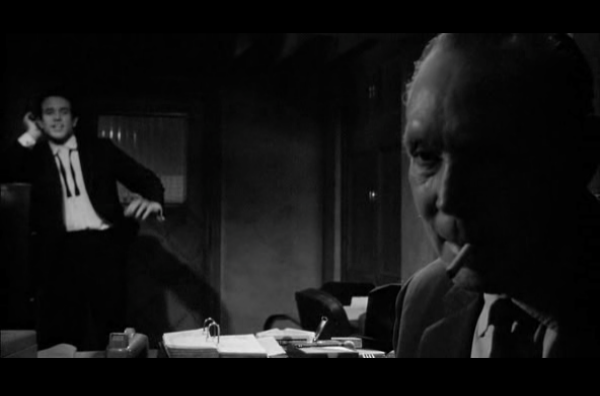
How does Franchot factor in all of this? Well, he portrays Ruby Lapp, a club manager and sort of middle man for the mobsters. Mickey One never meets with the mafia itself, but always directly to Ruby, who advises him to play it safe. Ruby hints that Mickey is in trouble because he shared too much information in a Turkish bath. When the comedian runs away, Ruby warns him that he'll never be able to escape, that his debts will follow him for life. Franchot only has a few brief, quiet scenes in the film and his character, like most of the film's characters, is vague and a bit kooky.

Speaking of the film's kookiness, here's an odd little piece of trivia I uncovered while reading the original reviews of the film. (By the way, I felt better when I read that most reviewers were as confused about the plot as me.) In his first scene, there are close-ups of Franchot. I noticed what I thought was a dark scratch, stitch, or scar on the right side of his head (left side to viewer). As you are aware, I am a bit preoccupied with Franchot, so I wondered what was up with that. I found my answer in Dorothy Kilgallen's "The Voice of Broadway" column dated March 19, 1964:

"Franchot Tone will be a little late reporting to Chicago for his role with Warren Beatty in Mickey One. He tripped over his cat, got a black eye and had to have 10 stitches taken in his head."

(I've heard rumors that Franchot didn't have a cat and that the injury was caused by inebriation, but Franchot actually referred to having a cat in another context in another article around the same time.)


My favorite scene is shown in the screen captures below. This is when Franchot gives his big speech, telling Warren Beatty that the mob will control his entire life and that there is no escape or fix for it.


Watch Mickey One for its unique cinematic shots, combination of noir and new wave, and cult status. Don't watch it for a straightforward, cohesive plot.

Mickey One is available on DVD on Amazon.