Showing posts with label group theatre. Show all posts

Saturday, January 11, 2020

Franchot's Association with the Group Theater, Part 2

Franchot left the Group for Hollywood (click here for part one of this story), but he continued to support them. Harold Clurman wrote that Franchot's financial generosity funded much of the Group's script purchases and productions.

Franchot wrote to Harold that the Group had been ¨the most important influence¨ in his life, but that he deeply loved Joan Crawford and intended to remain with her in Hollywood. Franchot knew that the Group members judged him for his decision, yet they also came to him frequently for money, the same money he made from the Hollywood career choices on which they judged him. Clurman recalled spending afternoons with Franchot and Joan when he visited California:
Franchot was happy to play the host to his companions of old. To him we were clean spirits who brought light and warmth into his almost locked heart. Joan Crawford, a good sport, wanted to make friends with Franchot's friends. She thought at times of appearing on the stage, an ambition perhaps stimulated by Franchot. She wished to be able to follow him in all his steps, so that he might not be included to wander too far from hers.
In the afternoon we would chat, mostly about the theatre, play badminton, swim in the pool, dine, and see a picture in the projection-room, right off the pool. It was quite a pleasant routine that we followed almost every time we visited them. Once, while I lay afloat in the pool, basking lazily in the Sunday sun, Franchot observed me with friendly malice and remarked: “The life of a prostitute is pretty comfortable, isn’t it?”
Often, Franchot would take a loss on his investments with the Group. Clurman remembered:
He wanted to know about his failure to realize any money on Awake and Sing, and I tried not to be sheepish in admitting our mismanagement. He did not take the matter amiss however (in these questions he always alternated between peevishness and indulgence). Basically Franchot was an idealist, and he still idealized Lee Strasberg and me. Though in the long run there is more peril than pleasure in being idealized, I was at the moment the beneficiary of Franchot’s warmest hospitality. I was the (awkward) prophet of a religion centered in the theatre. Franchot’s wife, Joan Crawford, was prepared to believe. Some day, Franchot intimidated, he would return to the theatre, and, at the time, theatre was synonymous to him with the Group.
Franchot's return to the Group-1939's The Gentle People

The success of Golden Boy strengthened Franchot's desires to return to the stage, or as Clurman put it, Franchot ¨glowed in anticipation.¨ Once his marriage to Joan ended, Franchot found himself financing and starring in The Gentle People. Clurman no doubt was eager for Franchot's return to the theater and credited his ¨excellent¨ talent many times over the years, but he also seemed to be banking on the fact that two former Group actors-turned-movie stars (Franchot and Sylvia Sidney) would fill seats whether the play was a hit or not. Although definitely using Franchot's financial and professional reputation for the Group's gain, Clurman did seem to care and worry about Franchot the idealist:
I warned Franchot that he might encounter disappointment in the Group…I suspected that Franchot looked toward the Group with the fondness of a youthful memory. “Franchot, “I said, “promise me that you will stay with us for one year no matter what happens. Give yourself and us a chance.” Franchot looked solemn and uncertain, but he promised.
Franchot threw himself into his work with an eager will. On the whole, he was well pleased with the conduct of rehearsals; his criticisms were affable and slight. When conferences on the progress of The Gentle People were held, I failed to invite him to join them, as it was not our custom to consult members of the cast on production problems of the plays in which they took part. That Franchot was not only one of the leading players but the play’s backer gave him no special privilege in this matter. It was not my intention to snub him in any way, but Irwin Shaw pointed out that, whatever my intention , my behavior was tactless. Franchot, however, bore this with good grace. 
But Franchot was restless, just as he'd been in the year leading up to his departure from the Group and arrival in Hollywood years before. He praised the Group at a speech he gave at the Town Hall Club, saying:
I’d better not get started on the Group,” he began, “because I’ll get emotional about it and then I won’t be able to talk at all...The Group has a well-defined attitude toward human problems and affairs, and while I’m perfectly sure that such a formalized policy as this is by no means necessary to success in the theatre, it is necessary to me.


Still, Franchot turned down Clurman's offer to do the play Quiet City saying that he was too tired to do more than one play at a time. When he was offered My Heart's in the Highlands, Franchot made stipulations before stating that he didn't feel he would do a good job in the role.

When Franchot wouldn't fully commit to the Group in the 1940's, Elia Kazan, Clurman, and others staged a sort of intervention with him. They asked him to commit to them and trust in them and the theater. Franchot asked if they respected him. When they answered that he was the kind of actor they needed, Franchot asked pointedly, ¨But you don't respect the reputation I have made in pictures?¨ Clurman answered, ¨This is not why we want you.¨ Franchot confirmed his fears about the Group when he asked, ¨But you are willing to exploit my name for its commercial value?¨ and Clurman answered, ¨Of course.¨

In his book, Clurman seems misunderstood about why Franchot alternated between complete worship and bitterness in his feelings about the Group, even going so far to say that Franchot ¨built up a case against us in his mind. Perhaps he needed an inner justification for giving us up.¨ I don't believe it's that hard to see why Franchot had mixed feelings about the Group and in all of my own personal research I have only read kind or nostalgic remarks about the Group from Franchot in interviews. As late as 1966 Franchot was praising Lee Strasberg to TV Guide:
Everything I know about acting I learned from Lee Strasberg. At the Group, I learned Strasberg's variant on the Stanislavsky System—that's S-y-s-t-e-m, not Method. Method actors lack discipline. System actors are disciplined. I'm a pretty good actor today only because I've always renewed myself at the feedbag—the theater.
It's clear that Franchot acted out in many ways, but it is also clear that he had some insecurities and wanted to be told he was valued for his own talent. When he wrote to Clurman baring his soul about his deep appreciation for the Group, Franchot probably hoped for a return letter with the same sentiment about himself. Instead, he received a letter requesting money to fund another show. Back in the early 30's, young Franchot had been hurt when Strasberg told him they didn't care that he was leaving for Hollywood; after all, Franchot was secretly hoping for validation (and a personal request to stay with the Group) from this father figure he idealized. It's no surprise that Franchot would be sullen and hurt again in the 1940's when he realized that the Group begging him to come back still didn't fully respect or include him despite now benefiting from his wealth and celebrity status.

Despite this complicated history with the organization, Franchot was proud of his association with the Group and always attributed his passion for acting with the skills and conditioning he gained as a Group member.

You might also be interested in these previous related posts:
Franchot's Association with the Group Theater, Part 1
Franchot and Sylvia Sidney
An Ernest Hemingway Hero
The Gentle People
The Strasbergs Remember Franchot
John Garfield Blogathon

Sources:
  • Clurman, Harold. The Fervent Years: The Story of the Group Theatre and the Thirties. Knopf, 1950. 
  • Kramer, Joan, David Heeley, Joanne Woodward, Steve Lawson, Stella Adler, Harold Clurmaan, Cheryl Crawford, and Lee Strasberg. Broadway's Dreamers: The Legacy of the Group Theatre. New York, N.Y: PDR Productions, 1994. 
  • Lewis, Robert. Slings and Arrows: Theater in My Life. Stein and Day, 1984. 
  • Smith, Wendy. Real Life Drama: The Group Theatre and America, 1931-1940. Knopf, 1990.
  • "Who Has Ever Had a Better Time?" TV Guide. January 1, 1966. 12-14.

Friday, November 8, 2019

Franchot's Association with the Group Theatre, Part 1

Theater director Harold Clurman invited Franchot to join the Group Theatre after seeing him in the 1928 play The International.

Although Franchot and actor Morris Carnovsky were already both on contract with the guild, they were allowed to participate in the Group Theatre's intensive project to create a community of actors that tackled social justice and the world within its plays. In his book The Fervent Years, Clurman explained the group's goal:
...to go away to some country place with twenty-eight actors and rehearse two plays till they were ready for production in New York. We would pay no salaries, but we would provide meals, living quarters, laundry expense.
We had chosen our actors before we knew what play we would do. They were our actors, and they would have to suit our plays. That is what we directors were there for. Nor did we have any money to finance our ambitious plan. We only had the will to carry it out. When the Guild agreed to let us have The House of Connelly and a thousand dollars, they were our only concrete assets.
Billy Rose Theatre Division, The New York Public Library.
"Margaret Barker and Franchot Tone in the stage production The House of Connelly."
The New York Public Library Digital Collections. 1931.
 http://digitalcollections.nypl.org/items/6adb3a10-2408-0133-8625-58d385a7b928

On the morning of June 8, 1931, a group of over 30 people (including actors, spouses, children, directors, friends) traveled to Connecticut to begin working. On moving in day, Franchot started a baseball game “to overcome the natural self-consciousness of the occasion.” Clurman also noticed that Stella Adler looked sadly on her fellow actors, as it looked more like a “camp for overgrown high-school kids.”

The actors rehearsed morning, noon, and night, and in between rehearsals played piano, cards, and debated. During the card games, Franchot led the others in pranking a young member of the group. They would deal him unbeatable hands until he gained confidence in betting and then deal him terrible hands. Lee and Harold observed this one night and found it “very funny, particularly since the hoax was executed with consummate sangfroid and deftness by Franchot Tone.”

Although Franchot was a respected man and actor within the group and had helped to make the group feel comfortable, there came a time when "some of the actors began to be troubled by Franchot Tone’s attitude." Clurman went on:
He was, of course, one of the original 1928 group. Since then he had had the opportunity to feel his oats. He had played leading parts on Broadway, he was in demand, and the other actors sensed in him a general resistance that at times manifested itself toward the directors and at other times toward the influences prevailing among the group. Actually he was suffering from a variety of growing-pains, but our work as such was not in question.
He was lonely. Though he had been raised in easy circumstances, and had been popular at college, he was not a good mixer. He was shy, with a tendency toward suspiciousness when ill at ease. He particularly suspected that he was not liked because, being more privileged than others, he was regarded as somewhat inferior in character. There was perhaps a mite of truth in his suspicions, but, for my part, I believed they lay chiefly in his distrust of himself. The tension that gripped him made him rude, almost insolent. He was unconsciously revenging himself on us, testing both himself and us. Thus he demonstrated little courtesy to Strasberg, although he had real admiration for him.
Franchot, intelligent and sometimes psychologically keen, said to me, 'In the old days we talked only when we didn’t work. Now we work only when we don’t talk!' I was somewhat taken aback by the remark and repeated it to Strasberg. He agreed at once: Yes, we talk a lot because we are not simply rehearsing a play; we are laying the foundation for a theatre. Our theatre is more than just a matter of getting one or two plays produced.
The actors, I repeat, watched Franchot with increasing misgivings. Why was he allowed to get away with little breaches of politeness and discipline? He rarely came to the afternoon talks. He lumbered into rehearsals, sat aloof, whittled away at the side of the barn as he rehearsed. No one reprimanded him. Was he a favored child among the directors? Was he to be treated as a star? Was Lee afraid of him? These disturbing questions were never openly put because the actors had an abiding confidence in the directors’ good sense in handling the problem⁠—if it was a problem.
Despite Franchot's turn to loneliness and rebelliousness, Clurman refers to him at this time as "the finest young actor of recent arrival." Franchot continuously contributed his own money to help fund the group's endeavors, often giving $1,000 or more for each play. With the Group, Franchot starred in 1931, House of Connelly, Night over Taos, Red Rust, and Success Story.

Billy Rose Theatre Division, The New York Public Library.
"Rose McClendon, Fanny de Knight, Franchot Tone, and Margaret Barker
 in the stage production The House of Connelly." The New York Public Library Digital Collections.
1931. http://digitalcollections.nypl.org/items/d100e900-2405-0133-b1f9-58d385a7b928


Beginning in 1932, Clurman noticed that the group began "turning in on itself." Actors became more confrontational and suspicious of one another's motives. The bubble started to burst. Clurman recalled the changes in Franchot at this time:
In Franchot’s case the matter was special. The girl Franchot was attached to at the time, the one who worked with us in the old Riverside Drive days, visited him one weekend. Somehow we didn’t think she was Group material. Franchot’s life with the Group would have been much easier if she had spent more time with us, but Franchot was too proud to say so, and we were too one-tracked in our thinking to notice it. The girl felt separated from Franchot by us and would have been pleased if we had asked her to remain and work with us, even as an apprentice. We disregarded her very existence, and Franchot was irritated by our tactlessness.
Franchot was very emotionally attached to the Group and, in spite of or perhaps witnessed in his rebellious nature, was desperate for the Group's leaders to care about him, to show him that he was needed, that he mattered. The more I read about Franchot from those who knew him personally, the more I see that he had this dichotomy about his personality. On one hand, he was a confident, private individual who seemed to live and love easily. On the other hand, he felt a great deal of melancholy, of not fitting in, and wishing for more approval and assurance from those in his circle and the public at large. In his book, Clurman devoted a lot of time to the complicated personality of Franchot. Clurman said:
Franchot’s problem, however, was deeper than this. In Boston, when I finally got around to talking to him about his refractoriness, he asked me questions relating to my estimate of him as an actor. By my lights, how good would he become? In answering him I dwelt on his need to stick by what was strongest and most alive in himself. Tears came to his eyes. He confessed later that when I left he had actually sobbed, but he added with a sly grin: 'It didn’t do much good. The feeling didn’t last.'
Franchot loved us out of a great need, a feeling that we were good people who were bringing him just that supply of his sound work and clear faith that despite the advantages of his background, he had missed all his life. But he was very much part of the world that had provided him with these advantages, and he could not, would not, turn his back on it; it was the big world, the substantial world, in which all of us, willy-nilly, were living.
Of course, even in his attachment to the big world there was a contradiction. Franchot’s father, though associated with business, was basically a scientist; and Franchot’s mother was as much of an aristocrat as we ever get in America. Both of them were glad that Franchot preferred the Group to the ordinary commercial thatre. But the entertainment channels of the big world lie in the commercial theatre. We have no national theatre for our “best people.” We have Broadway, and Broadway has Hollywood. The cradle of opinion with theatre folk was not some Mermaid Tavern of intellectuals or artists, but the speakeasies of Fifty-second Street.
There they laughed at Franchot’s devotion to the Group. Franchot probably thought Lilyan Tashman and her crowd who came to see him in Taos lacked taste, but he did not, for all that, feel particularly comfortable at their seeing him in a flop that had been preceded by another, whose most enthusiastic audience sat in the balcony uttering strange cries of approval. Franchot was torn between the Group of tactless people, led chiefly by two exasperated hotheads who offered a way of life that was personally real and perhaps part of the mainstream of the time, and a Broadway plus Hollywood which, though he knew it to be shoddy, actually possessed the only power and glory the world could offer today.
Billy Rose Theatre Division, The New York Public Library.
"Luther Adler, Stella Adler, Franchot Tone, and Dorothy Patten in the stage production Success Story"
The New York Public Library Digital Collections. 1932.
http://digitalcollections.nypl.org/items/281640c0-2409-0133-1322-58d385a7b928

Franchot seemed to behave more strangely during the final summer with the Group. (In all fairness, if you read Wendy Smith's book Real Life Drama, it seems a lot of the members were acting strangely during this time.) Clurman remembered:
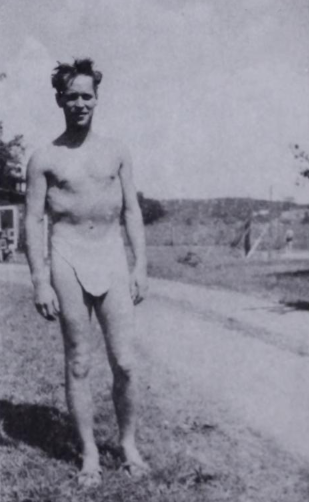
Franchot behaved more peculiarly this summer than the last. He was remarkably fine at rehearsals of Success Story, but he was rather antisocial in other ways. He drank stiffly, and carried off some other pretty good bottlemen to drink with him almost every night after rehearsals. When he came back he sometimes took delight in driving his car over the main lawn and crashing all the garden furniture left there during the day. He grew a beard, walked about in a loincloth, went shooting fairly close to the rehearsal grounds. He shied away from most of us, alternating between a distant courtesy that implied an insult, and the manner of a cagey maniac.
With all this, Franchot was always shrewd and observant. He saw what was going on. What was going on was a subtle transformation with the Group as a whole. The very air was fermenting with something that blew from we know not where, but which roused everyone to doubts, questions, wonder, eagerness, dispute. ….
The day came when Strasberg was no longer able to tolerate the disruptive ambiguity of Franchot’s behavior. He decided to have the showdown I had recommended the year before, and both us now confronted Franchot with ultimatum written on our faces. Franchot admitted at once that he had decided to quit the Group, that he was going into pictures. I do not know whether he had already made arrangements or whether our severity at this meeting finally decided him. I am inclined to believe that some of his mischievous conduct arose from an anger with himself, and some was designed to provoke us to such a discussion as we were having. Perhaps, however, he expected a gentler approach, for people like Franchot, always want evidence that they are loved. Strasberg, hurt himself, lashed forth a white-hot 'We don’t care' when Franchot disclosed his intentions. 'I know you don’t care,' Franchot answered quietly but painfully, as if to say: 'That is exactly why I wish to go.'
That day the bad news of Franchot’s resignation was announced to the Group at a special meeting addressed by Strasberg. It was the first resignation of any importance from our organization. The actors were shocked, for they appreciated Franchot’s value. Strasberg’s talk was calculated to affirm the strength and integrity of the Group, which could ill afford to keep a member whose spirit had turned against it. When the day came for Franchot to leave, he told me he was going to try Hollywood. At Tony’s, on West Fifty-second Street, he wept over his drink. …
I find it interesting that, according to Clurman, Franchot was pushed out of the Group for "disruptive ambiguity" much like he was pushed out of The Hill School as a teen for "subtle influence for disorder." And both of these punishments only led to more success for Franchot—leaving The Hill School led to success at Cornell University while leaving the Group led to success in films.

Clurman goes on to address the difficulty the Group had replacing Franchot in their plays. I think it's telling that despite his causing trouble, the other actors always appreciated Franchot's value and that Clurman was able to see that some of his rebelliousness was due to Franchot's schrewd observation of the inner shifting of the group.

Although he'd worked himself into a corner with Strasberg and Clurman, Franchot was definitely torn in leaving the Group for Hollywood and would never be able to definitely choose one over the other for the rest of his career. Actress Ruth Nelson shared in the documentary Broadway Dreamers:
I remember the night, his last Saturday night with Success Story. He came to me to say goodbye. He leaned over, kissed me, and had tears in his eyes. I said, 'Franchot, if that's the way you feel, why are you leaving?' And he said, 'Well, Ruthie, I just have to find out what it's [Hollywood] all about.'
Actors Sandy Meisner and Robert Lewis went with Franchot to Grand Central Station. As they said their goodbyes, an emotional Franchot:
...stood on the steps of the famous Twentieth Century Limited club car, teary-eyed, and as the train started to pull out of the station, he called to us, 'Keep your line.'
Walking across Forty-second Street, I turned to Sandy and observed, 'Did you hear what he said? Here we are, going back to our struggling new Group while he's off to Hollywood to make a movie with Lilyan Tashman and he tells us to keep our line.'
Said Sandy, 'He meant keep it for him.'
I think Clurman's belief that Franchot "expected a gentler approach, for people like Franchot, always want evidence that they are loved" is valid and that his statements about the emotional contrasts in Franchot's character echo those of Gloria Vanderbilt and Clifford Odets and Christopher Plummer.

Franchot, of course, would maintain an association with the Group Theatre, both publicly as an actor and privately as a benefactor. Much more on the post-1933 involvement with the Group coming soon!

Sources:
  • Clurman, Harold. The Fervent Years: The Story of the Group Theatre and the Thirties. Knopf, 1950.
  • Kramer, Joan, David Heeley, Joanne Woodward, Steve Lawson, Stella Adler, Harold Clurmaan, Cheryl Crawford, and Lee Strasberg. Broadway's Dreamers: The Legacy of the Group Theatre. New York, N.Y: PDR Productions, 1994.
  • Lewis, Robert. Slings and Arrows: Theater in My Life. Stein and Day, 1984.
  • Smith, Wendy. Real Life Drama: The Group Theatre and America, 1931-1940. Knopf, 1990.

Sunday, September 8, 2019

An Ernest Hemingway Hero

I recently came across Time is Ripe: The 1940 Journals of Clifford Odets on my local library's shelves. Franchot is mentioned a handful of times in Odets' daily diary. Unlike the brief "Franchot Tone was also there at the Mocambo" diary entries I stumble across from others in the business at that time, Odets' delves into Franchot's complicated character and Odets' own mixture of interest and frustration with Franchot.

Franchot in Dark Waters, 1944.
Scan from my collection.

On Valentine's Day 1940, Franchot and the rest of the cast from The Fifth Column stopped by to see Odets' matinee showing. Three days later, Franchot joined everyone at a "certain bad restaurant" the actors dined in every night. Odets writes:
He was ill-at-ease, tense, and obviously very lonely or he wouldn't have joined us. All of us tried to put him at ease, but he is poor table company. He wanted to go out whoring and drinking at a speakeasy (liquor after 1:00 a.m.), but was unable to find a companion. Franchot, with all his fame, money, and position, is still afraid of rejection and repudiation. He is blustery and pushing, anxious and uneasy, just like Steve Takis*, but slightly more adult; in short, he is an Ernest Hemingway hero, and that is saying the whole thing.
*Steve Takis was the main character of Odets' play Night Music, which would begin official performances shortly after this diary entry.

On March 16, 1940, Odets writes that he had just finished Stefan Zweig's essay on Casanova the night before and that it "gave me several good ideas, particularly for a play about a modern sort of Casanova to be played by a fellow like Franchot Tone. It is not the great lover element which interests me at all; the element of adventurer, swindler, fake prince among American aristocracy, etc. is where the play lies."

June 8, 1940:
At ten we [Odets, Sid Benson, Geebee] rode uptown, we three, ate a light supper at Schrafft's, saw a newsreel and two films, or part of them. One with Heifetz fiddling...the other an old film, the first F. Tone made when he went to the coast in 1932*. Very instructive. We move so fast in this country that the film, the acting style, the lighting and settings, the clothes—all are already old-fashioned. Franchot was not bored then, not blasé, but fresh and impulsive.
*I assume Odets is referring to Franchot's first film The Wiser Sex which starred Claudette Colbert, Lilyan Tashman, and Melvyn Douglas. This is the only Franchot film I have never seen. It has been preserved by AFI's National Center for Film and Video Preservation at the Library of Congress Motion Picture Conservation Center and it was shown at a film festival several years back. Unfortunately, it's not on physical media or shown on television.

On July 7th, Odets dines at the Stork Club:
There I met Burgess Meredith, Franchot Tone, and John O'Hara, and a brother-in-law together at one table. Meredith was leaving for a Western ranch vacation the next day, so they were celebrating together by getting drunk and more morose each minute. They were in moods of careful (or cautious) self-abnegation, admitting carefully that their lives were useless, that, as Franchot put it while discussing Maxie Baer, the fighter, "the thing is to look good even while you're going down." Franchot, whom I like, still a very unusual talent in the theatre, always brings out in me a certain caginess and over consideration, a real and acute discomfort.
September 29, 1940:
Every time I see Franchot Tone around town, something stirs in me. He is one of that fraternity equally at home here or in the East, drinking, sleeping around, trying to suck the marrow out of a bony friend or two who has no marrow, making a movie, looking for a play—he is too good for this sort of life; that is what touches me about him.
That September entry is the last time that Odets mentions Franchot in his 1940 journal. Odets had known Franchot since the very early days of the Group Theatre and in a later interview would remark on Franchot's talent:
Toward the end of the summer, Franchot Tone, after being quite erratic in his relationship to the company—he was a spoiled boy in many ways—decided to leave the Group, and everyone was sick. He was very gifted. The two most talented young actors I have known in the American theater in my time have been Franchot Tone and Marlon Brando, and I think Franchot was the more talented. And when he lost what he did, I think a very valuable gift was lost to the American theater. He was our leading man. It was like a beehive had lost its queen. 
Source: 
Odets, Clifford. Time Is Ripe: the 1940 Journal of Clifford Odets. Grove, 1989.
Hethmon, Robert. Days with the Group Theatre: An Interview with Clifford Odets. Michigan Quarterly Review. Volume XLI, Issue 2, Spring 2002

Wednesday, July 3, 2019

An Interesting Independence Day Display

Both Harold Clurman, in his book The Fervent Years, and Robert Lewis, in his book Slings and Arrows, recounted Franchot defiantly celebrating the 4th of July alone while he was a member of the Group Theatre in the early 1930's. Both refer to this display as being attached to Franchot's frustration with the constant "plethora of intellectual talk and classic music", but that reason seems so in contrast with everything else I've learned about him. Franchot was a fond participator in deep discussion and I can't tell you how much I've read about his enthusiasm for classical music, especially Mozart.

But Franchot's time with the Group Theatre seemed to be a complicated mixture of joyful success and feelings of alienation and I have much more to share about that subject in a future post. Perhaps Franchot was just letting off steam or drunk. Perhaps even the most devoted Mozart fan can grow weary of endless playback.  Or, perhaps, Franchot was just very enthusiastic about Independence Day. Here's what Clurman said:
On the Fourth of July, Franchot alone had decided to celebrate by shooting off fireworks. He began rather early in the day. Perhaps this was his childhood custom, perhaps it released his tension, perhaps it was his protest against what seemed to be the indifference of the others to the proprieties of this holiday. Solitary, with darkened brow, he went from place to place over the grounds and set off his firecrackers. Carnovsky and others were fond of music and played recordings of Mozart at every opportunity (except one man who played Caruso records, and Puccini). Carnovsky, no longer able to tolerate Franchot's acoustic vandalism, came out on the porch and cried: "Franchot, for God's sake, I can't stand the noise." Franchot turned and yelled: "And I can't stand your  noise"—referring to Mozart and the rest. He stamped off yelling: "I am an American." 
I have written a little bit about the Group Theatre (click here), but have some more detailed stories of Franchot's time with the Group coming soon.

Happy Independence Day! Set off some fireworks for loin-clothed Franchot the American!
Photo Source: Slings and Arrows, 1996.

Sources: 

Clurman, Harold. The Fervent Years. Harcourt. 1945.
Lewis, Robert. Slings and Arrows: Theatre in My Life. 1996.

Sunday, August 26, 2018

Franchot and Sylvia Sidney

Sylvia Sidney was born on August 8, 1910 in New York and, like Franchot, never abandoned her first love of the theater. In fact, Franchot and Sylvia had a lot of connections throughout the years as you'll see. Sylvia successfully juggled theater, film, and television from the mid-1920's all the way up to her last role the 1998 tv reboot of Fantasy Island. (Sylvia would argue with me that it was simply a "part," not a role...she was particular about that.)


Sylvia is a member, along with Loretta Young and Natalie Wood, of my trio of favorite actresses. I could watch her work without end. I'm fortunate that Franchot worked with all three in his lifetime. I've watched a lot of Sylvia over the last several years and wrote about the Tone-Sidney 1939 play The Gentle People back in 2016 (here.) This summer I finally read Scott O'Brien's biography Sylvia Sidney: Paid by the Tear which I highly recommend. Sylvia was beautiful, driven, talented, and very outspoken. As she grew older, she became especially cantakerous, but sometimes her quips to reporters and fans were delivered with an ounce of humor and mischief. If you've ever watched 1990's interviews of her on Youtube, you know what I am talking about here. Let's just say if I had had the opportunity to meet her, she may have very well made me cry. O'Brien writes that when a fan approached Sylvia in Bloomingdale's and told he had hundreds of photos of her, Sylvia replied, "You're f'***ing crazy! Your house must be a mess!" Reading that passage made me laugh out loud, but if I were that fan, I would've been shocked. Without further ado, all of the Sylvia Sidney photos and play-related scans in this post are from my own collection. I assure you I'm not crazy and my house is mostly tidy.


Sylvia was so much more than a grouchy workaholic (look how exuberant her smile is in the candids above) and O'Brien's biography really delves into her familial and professional experiences and her dedication to her son, dogs, and career. I also think it's telling that Sylvia liked to attend celebratory film events and then criticize its attendees for living in the past. She didn't have to attend these events or be interviewed. But she did and I think it's because she secretly liked it. There were disappointments throughout her life that I believe hardened her shell a bit so that she increasingly spouted these harsh, irascible comments as a shield of protection. As a fan myself, I wish that she would've been more receptive to and outwardly appreciative of her fans' interest in her, but I must admit that I really admire how she lived her life on her own terms. I wish that I had an ounce of the audacity she possessed. 

Like Franchot, Sylvia grew up in a household without financial issues and very early on dedicated herself to being an actor. Both Franchot and Sylvia could've coasted through life, but possessed the drive to embrace their own paths and be discovered through hard work on the stage instead. They would both state how disenchanted the film world made them feel at times and continuously worked at improving their skills while delivering plays with important social messages through the Group Theatre. Both Franchot and Sylvia refused to take fame too seriously and embraced their transformation into character actors. On top of their personal and professional similarities, Franchot and Sylvia simply liked each other.

Ten years before they teamed up for their Group Theatre comebacks in The Gentle People, 24-year old Franchot and 19-year-old Sylvia acted together in Cross Roads. It ran for 28 performances at the Morosco Theatre in November and December 1929. Written by Martin Flavin, the play would be adapted into the 1932 film The Age of Consent. Eric Dressler played a first-year medical student Michael who wants to quit school to marry Pat. When Pat (Sylvia Sidney) wants to wait, Michael is caught in a clandestine evening with a waitress and his life at school and with Pat is threatened.

On November 6, Variety called it a "poignant, wistful little comedy...Excellently acted, the dialog, easy and natural, and it has all been staged superbly." By November 27, the play had grossed $8,500 (Measuringworth.com rates that around 1 million today.) 

The dialogue may have not been the only aspect that came "easy and natural" to its actors. Author O'Brien reveals that Franchot told interviewer Gladys Hall in 1933 that he had been "seriously in love" with a co-star:
We didn't marry, because I felt it would be unfair to the girl. She was very talented. She had a big career ahead of her. We broke it off and she has gone on, as I knew she should. She is a very successful star right now.
Although Franchot didn't name the costar, Hall then and O'Brien later guessed that Sylvia may be the girl. By 1933, Sylvia had become a big star in Hollywood. 1931 to 1933 saw Sylvia in such classics as An American Tragedy, City Streets, Merrily We Go to Hell, Street Scene, Madame Butterfly and Jennie Gerhardt. In 1934, movie magazines declared that Sylvia was the Hollywood beauty with the most ideal face. I believe that it is very likely that Franchot is referring to Sylvia in this interview. Although a great deal of his costars were very successful in theater, Sylvia's the only one of his early theater costars that comes to mind who had that level of stardom in Hollywood in 1933. Franchot had many, many love affairs—some not so serious and some very serious, some well-publicized and some very secretive. But I have a feeling he may be talking about Sylvia here, too. 


In 1939 after many years focused on films, Franchot returned to the stage in The Gentle People, a Group Theatre production co-starring Sylvia. On February 6, 1939, Life magazine reported:
Where The Gentle People lags, it is supported by radiant acting from Franchot Tone, Sylvia Sidney and Sam Jaffe, all returned from Hollywood to Broadway, and from the Group company who have become past masters at U.S. realism.
Variety, on January 11, 1939, reported:
Franchot Tone returned from Hollywood to play Goff, giving the part a clear reading and believable type of tough guy...Sylvia Sidney is the willful Stella, an assignment which she excellently delivers.


During the play's run that included 141 performances from January to May 1939 at the Belasco Theatre, Franchot and Sylvia were frequently seen out together socializing for fun as well as for a cause. Sylvia was married to actor and director Luther Adler at the time and would give birth to their only son Jody whom she absolutely adored by the end of the year. Still, Franchot and Sylvia were photographed together in restaurants and many wondered if a romance was afoot.


Franchot and Sylvia took the social causes that drew them to the Group Theatre to heart. They were committed to using their fame to bring awareness to injustice. Just two months before The Gentle People's opening night, German Jews were brutally attacked by paramilitary and civilians in retaliation for the assassination of a Nazi German diplomat. We know now that this horrific persecution would only get worse. To encourage the United States government to take a stand against Nazis and brutal acts such as these, Franchot and Sylvia hosted a fundraiser for Committee of 56. The 56 was named for the number of original signers of the Declaration of Independence. The Committee aimed to rally against acts of Nazism and boycott anything associated with Germany until those acts were prevented.

Franchot and Sylvia also traveled to Washington, D.C. together. They met with President Roosevelt to protest the budget cuts against the Federal Theatre Project.

Having spent a great deal of time together in 1939, Franchot and Sylvia went their separate ways but still took such similar paths. Sylvia had her son Jody with Luther Adler. In 1946, Sylvia divorced Luther and was married to Carlton Alsop from 1947 to 1951. Franchot would marry actress Jean Wallace in 1941 and have two sons. He and Jean would divorce in 1948 and he would later marry Barbara Payton and then Dolores Dorn. Franchot would balance a life in films, theater, and television as would Sylvia.

When I'm asked which two actors I'd liked to have seen in a film together, I've always immediately answered Franchot and Sylvia. I'm so disappointed that they didn't do something together in the 1930's. I think they would've been perfect in a romantic drama together. Look at Franchot's movies that include messages about the human condition and moral dilemma. I could easily picture Sylvia as Franchot's leading lady in Exclusive Story or Gentlemen are Born or Straight is the Way. Equally, I could envision Franchot as Sylvia's leading man in Street Scene, Jennie Gerhardt, and One Third of a Nation.

It seems I was almost granted my wish in the 1940's. O'Brien's book reveals that Franchot and Sylvia nearly did co-star in a film in 1946. They both signed on to co-star in the film Repeat Performance. After the film was delayed, Sylvia dropped out to film Love from a Stranger instead. Franchot would film Honeymoon, Lost Honeymoon, and Her Husband's Affairs in 1947. Repeat Performance went on to star Louis Hayward and Joan Leslie and was released in 1947. It as a film noir that includes elements of time travel and science fiction.

In 1956, Luther Adler and Sylvia reunited to co-star in the play A Very Special Baby. There was a lot of tension and bickering between the two exes and although the play was noted for Sidney and Adler's superb acting, critics found the play to be "overwrought." Playwright Robert Alan Aurthur witnessed the battles and ended up writing The Thundering Wave, an episode of Playhouse 90. The Thundering Wave was about two exes who are reunited on the stage and clashes ensue. Those two exes, based on Sylvia and Luther, were performed by Joan Bennett and....Franchot Tone.


Sources:

  • "Cross Roads." Variety. November 6, 1929. pg 63.
  • Doherty, Thomas. "Remembering the Hollywood Mogul who Rescued Hundreds of Germany's Jews." The Hollywood Reporter. December 29, 2015.
  • "Low Tide Totals of Between Holiday Period Expected by B'way Legits." Variety. November 27, 1929. pg 59.
  • O'Brien, Scott. Sylvia Sidney: Paid by the Tear. Bear Manor Media, 2016.
  • Smith, Wendy. Real Life Drama: The Group Theatre and America, 1931-1940; New York: Knopf, 1990.

Friday, May 18, 2018

Pre-Hollywood Variety Mentions

Franchot first gained notice with filmgoers in 1933, but he was creating a buzz in Variety magazine as early as 1927. I've gathered a timeline of those Variety mentions.

May 4, 1927:
First National Pictures searched college campuses for future cinema talent and spotted ten talented actors at Cornell University. "The lucky ten at Cornell included Franchot Tone, president of the Cornell Dramatic Club.

January 18, 1928:
Starring as David Fitch in "The International", which Variety noted was "anything but not original in creation and presentation. So hectic and cacaphonous is its production that the play might well be styled a true exponent of a new school of vo-do-de-o drama."

October 23, 1929:
Franchot is busy rehearsing "Cross Roads" with Sylvia Sidney and others.

November 20, 1929:
Performing as Duke in "Cross Roads", Franchot is called "capable" in this "truthful, sympathetic picture of youth wrecked by the standards of modern society."

May 7, 1930:
"Franchot Tone, Niagara Falls boy, and protege of the late Garry McGarry, has signed with the New York Theatre Guild."

My note: I'm currently working on an individual post on Garry McGarry that I'll be posting within the next two days. I feel he deserves his own post, not a mere mention in this little Variety timeline.

September 1930:
Franchot is busy rehearsing Uncle Vanya, his first of several associations with this play.

October 6, 1931:

Performing as Will Connelly in The House of Connelly. "First nighters were impressed with this carefully prepared, serious drama"

December 5, 1931:
Performing as Adam in the play "1931". "A graphic picture of unemployment among the city's laboring class, strikingly scened but a depressing play."

March 15, 1932:
Performing as Federico in "Night Over Taos". "The Group Theatre which had the aid of the Theatre Guild but claimed now to be on its own offers a third production this season. 'Night Over Taos' is as good a production as 'House of Connelly' if not more skillful and certainly more striking. The mistake called '1931' has been forgotten."

May 3, 1932:
For his work in "A Thousand Summers", Variety writes, "Franchot Tone is especially good as the boy, presenting him sincerely and with great earnestness."

June 28, 1932:
Franchot leaves "A Thousand Summers" on June 25 and is replaced by actor Johnny Griggs.

October 4, 1932:
Performing as Raymond Merritt in "Success Story". "Franchot Tone, one of the Group's most promising players, does well but is third to the Adlers [Luther and Stella]."

October 25, 1932:
"Franchot Tone goes Metro on a six months' contract, plus a similar option, booked by Mike Connolly of the Jenie Jacobs office. He leaves 'Success Story', current New York play, and goes to the Coast next week. First assignment is 'Nora' opposite Jean Harlow."

November 8, 1932:
"Franchot Tone arrived Saturday (6) from New York, to start his Metro contract."

Source:
Variety Publishing Company. Accessed via Media History Digital Library

Friday, March 3, 2017

John Garfield Blogathon

I am happy to be participating in Phyllis Loves Classic Movies' John Garfield Blogathon since John and Franchot were good friends with similar career interests. Garfield has been a favorite of mine ever since he stole my fourteen-year-old heart when I first watched Four Daughters.

The Group Theatre

Franchot and John both got their start on the New York stage and honed their skills in the Group Theatre. Franchot was one of the Group's original members when Harold Clurman, Cheryl Crawford, and Lee Strasberg formed the Group Theatre with the hope of presenting plays that featured believable characters who spread important real-world messages through their thought-provoking scripts. Franchot actually starred in the group's very first production The House of Connelly in 1931 and the plays that followed that year and in 1932. Franchot used his own money to finance much of the group's work and was a firm believer in its essentiality to modern theater. In fact, when Franchot first pursued a film career in Hollywood in 1933, his main intent was to earn a lot of money quickly and eventually return to the Group with the additional funds. But he immediately fell in love with Joan and—despite sporadic statements that he may permanently return to a solely theatrical career—Franchot never fully abandoned Hollywood.

John joined the Group after Franchot physically left it (I say this because Franchot always morally and financially supported the Theatre.) John was a student of method acting at the American Laboratory Theatre, which included Group Theatre founders Strasberg, Crawford, and Clurman. John gained critical success in Lost Boy in 1932. After an apprenticeship, John was accepted as a member of the newly named "The Group," but, like Franchot, was drawn to Hollywood. Unlike Franchot, John's first film Four Daughters garnered him immediate acclaim and an Oscar nomination. Despite his obvious talent, John, like Franchot, was soon relegated to quickly churned out, pleasant films. But John fought back against the studios much harder than Franchot ever did. While Franchot was never able to recapture the early critical success of his mid-1930's work, John's lasting success came in the 40's with films like Destination Tokyo, The Postman Always Rings Twice, Humoresque, and Gentlemen's Agreement. I went through a period where I watched every single one of Garfield's films, and I cannot think of one performance that did not impress me.

In spite of their success, some Group members made both John and Franchot feel guilty for leaving to pursue opportunities in Hollywood. In later interviews, some group members shared that they felt that Hollywood had put John and Franchot’s focus on money, women, and alcohol, and interfered with their ability to produce quality work. (In my opinion, the two actors were able to balance their dedication to the craft with their extracurricular pleasures quite successfully.) This frustration with Franchot and John for pursuing film careers makes better sense when you realize that one of the Group's main objectives was to be a cooperative ensemble and an emphasis was placed on the good of the group, not the pursuit of fame by one individual.

For more information on the Group Theatre and both actors' involvement, I highly recommend the full-length American Masters documentary on the Group Theatre that the Stella Adler Studio of Acting posted on Youtube:

Friendship in the 1940's

In the early 40's, Franchot and John were involved in many of the same wartime support efforts. They both worked hard to support their fellow men overseas by serving on multiple war effort committees, making public appearances, and selling war bonds.

In Hollywood, John and Franchot were prominent board members of the Screen Actors Guild and participated in meetings until September 15, 1946 when they had to resign due to a new “conflict of interest” by-law. Also resigning were Robert Montgomery, James Cagney, Dick Powell, Harpo Marx, and Dennis O’Keefe.

Another connection I find interesting is that John's 1941 film Out of the Fog was based on Franchot's 1939 play The Gentle People and, in these productions, John and Franchot played the same role.

In 1945, Franchot and John returned to New York to discuss future theatre plans
with their former Group Theatre leaders. Film Daily. November 12, 1945.

Variety. November 1945.

Their similar career beginnings, current involvement in important causes, and enjoyment of a good time brought Franchot and John together as friends. They were frequently seen out together in bars and restaurants with a drink in one hand and a pretty lady not far from reach. Sherry Davis recalled that her grandfather, actor Robert Davis named his son Franchot because of his friendship with Tone. Robert Davis, Franchot, and John would gallivant around the nightspots drinking heavily, until young Franchot Davis was sent by his mother Myra to fetch them home.

John and Franchot on the set of Jigsaw, 1949.

In 1949, John made a cameo in his pal Franchot's noir Jigsaw. That film (a good one, in my opinion!) is in the public domain and can be viewed in full on Youtube here.


The Blacklist

The promise of the 30's and fun of the 40's were no match for the HUAAC who attacked John and Franchot—both public about their liberal beliefs—in the late 40's and early 50's. Although Franchot was publicly cleared by the Dies committee early on, he was softly but purposely blacklisted throughout the 50's. (You can read a more in-depth post on Franchot's blacklisting here.) Obviously, John was more publicly and viciously attacked by the House Committee. John refused to name names when he was forced to testify and as a result, was blacklisted by the major studios. But the blacklist damaged more than his career. It destroyed his health and led to his tragic death of a heart attack at only 39 years old.

Thank you Phyllis for hosting the John Garfield Blogathon! For some great Garfield reading, please head over to Phyllis Loves Classic Movies for the full roster.

Sources:
  • Kramer, Joan, David Heeley, Joanne Woodward, Steve Lawson, Stella Adler, Harold Clurmaan, Cheryl Crawford, and Lee Strasberg. Broadway's Dreamers: The Legacy of the Group Theatre. New York, N.Y: PDR Productions, 1994.
  • Gelman, Howard. The Films of John Garfield. Citadel Press, 1975.
  • Hirsch, Foster. A Method to their Madness: The History of the Actors Studio. Da Capo Press, 2001.
  • Kazan, Elia. Elia Kazan: A Life. New York: Knopf, 1988.
  • Lasseter, Don. Body Double. Kensington, 2002.
  • Media Lantern Digital History Project: http://lantern.mediahist.org/
  • SAG: www.sagaftra.org
  • Smith, Wendy. Real Life Drama: The Group Theatre and America, 1931-1940; New York: Knopf, 1990.

Monday, June 20, 2016

The Gentle People (1939)

The Gentle People ran for 141 performances from January to May 1939 at the Belasco Theatre. The play, written by Irwin Shaw and directed by Harold Clurman, was a Group Theatre production and Franchot's first play in 6 years. The cast included: Franchot Tone, Sylvia Sidney, Sam Jaffe, Elia Kazan, Karl Malden, and Lee J. Cobb.

The play is about two men who fish in their downtime to escape everyday pressures. On one outing, a gangster named Harold Goff (Franchot Tone) demands protection money from Jonah Goodman (Sam Jaffe) and Philip Anagnos (Roman Bohnen). To save their boat and maintain peace, the fishermen pay him. Soon, through his romance with one of the men's daughters (Sylvia Sidney), Harold discovers that the humble, middle-aged guys have saved quite a bit of their hard-earned money. When a court of law does not protect the men from Harold's threats, they take the matter into their own hands. Jonah and Philip take the scheming gangster out for a boat ride and he never returns.
Franchot Tone and Sylvia Sidney in The Gentle People. Source: www.collections.mcny.org

Franchot in The Gentle People. Source: Life, February 6, 1939.

On February 6, 1939, Life magazine reported:
Where The Gentle People lags, it is supported by radiant acting from Franchot Tone, Sylvia Sidney and Sam Jaffe, all returned from Hollywood to Broadway, and from the Group company who have become past masters at U.S. realism.
Postcard promoting The Gentle People from my collection.
The back of the postcard includes a comment and critique section
for the play's audience members to complete.
There was much publicity surrounding Franchot's return to the New York stage, because it coincided with his divorce from Joan Crawford. Reporter Inez Robb was disappointed to find that the "never lovelier" Franchot darted into the Belasco Theatre and successfully dodged all questions about his personal life during the run of the play. Although Ms. Robb speculated that Franchot was completely over Joan, columnist George Ross predicted the Tones would reunite following a performance of The Gentle People, to which Franchot had given Joan tickets.

Franchot, who had been a celebrated young stage actor before he moved to Hollywood, dealt with a lot of putdowns and pondering in the gossip columns of the day. While he was busy rehearsing the play, most of the entertainment columnists were focusing on Franchot's "mighty, mighty purty" face, hinting that he'd been a failure at M-G-M, and questioning whether he could make it as an actor without Joan Crawford at his side. Once the play began its run, Franchot received rave reviews and the play was a major success. From 1939 on, Franchot would steadily perform in both films and plays.
Sylvia Sidney and Franchot Tone. Source: www.julia-loves-bette-davis.tumblr.com
Sources:
Robb, Inez. "Valet Helps Franchot Tone Evade Persistent Press, Public." The Deseret News. February 14, 1939.
Ross, George. "Rumor Rumbles." The Pittsburgh Press. January 19, 1939.
"The Gentle People." Internet Broadway Database. https://www.ibdb.com/Show/View/3806
"The Gentle People." Playbill. http://www.playbill.com/production/the-gentle-people-belasco-theatre-vault-0000010886

Sunday, April 24, 2016

Christopher Plummer on Franchot Tone

Franchot & Christopher in the Alcoa production of Even the Weariest River, 1956.
Source: www.fantasfilm.org
Not too many years ago, Christopher Plummer published his autobiography, In Spite of Myself. I greatly admire Mr. Plummer, so much so that I wrote him a letter gushing to him just how much I loved him several years ago. In Spite of Myself is one of the most intelligent, entertaining, and encompassing autobiographies I've ever read. I've always considered Christopher and Franchot to be similar in their approach to their work, sensitivity, and intelligence. In fact, I keep my autographed photos of the two proudly displayed together.


For me, it's only fitting that the older and ailing Franchot's final scene in a film is with the young Christopher Plummer in the 1968 film Nobody Runs Forever. It's over in a heartbeat, but to see these two actors I admire share a bit of brief dialogue and knowing looks with one another is a cherished film moment for me.

Many years before Nobody Runs Forever, Plummer and Tone worked together in the Bermuda Repertory Theatre (I believe this was in/around 1952). Plummer dedicated several pages of his book to his experience with and analysis of Tone. I think his words on Franchot as an actor and as a man are the most insightful I've ever read. I was pleased that Christopher was able to see the similarities that I've noticed in Franchot and himself, and I was vastly moved by his eloquent summary of my favorite actor of all time.


On Franchot's early theater days:
At one time, not too far into the recent past, he was considered by critics, pundits and public alike 'the bright white hope of the American theatre.'...he had shown staggering potential in the famed Group Theatre days...Franchot, with his and his family's money had largely financed the Group Theatre from its inception. So it would not be an exaggeration to surmise that almost single-handedly he had oiled the machinery for the great New Wave movement...
On Franchot's vulnerability and pain:
But Franchot had a weakness for the movies and a penchant for domineering, glamorous women...He seemed to search for this kind of self-destructive alliance, and alliance that could not but help inflict certain pain. Indeed, Franchot Tone was a handsome, sensitive, highly educated and tremendously talented gentleman who was, nevertheless, motivated and driven by pain. His hard living had somewhat diminished his former brilliance, but every so often his work showed strong evidence of great depth and nobility of spirit...His sense of humor, as one might guess, was seeringly self-deprecating, drawn as always from this inexplicable inner torment. These vulnerable qualities were to make his Chekovian performances (Uncle Vanya and A Moon for the Misbegotten), both of which I later saw, so memorable—a rare combination of lightness and poignancy.
On working with Franchot in "The Petrified Forest":
He brought a substance to the play it didn't quite deserve...he managed at times to lift the piece far above its ken into the loftier spheres of O'Neill.
On their similarities:
...we shared an unspoken bond. We were both romantics—incurable to the last—and our separate upbringings shared the same confusion of identity. He may have seen in me, occasionally, his younger self. I'm not sure and I wouldn't wish it on him; but I saw in him someone I could perhaps aspire to; not the hidden sad, pained man that was part of Franchot but the part he couldn't conceal, no matter how hard he tried, the part that was refined, noble and infinitely kind—the man of golden promise.

Nobody Runs Forever, 1968

Source: Plummer, Christopher. In Spite of Myself: A Memoir. New York: Afred A. Knopf, 2008. Print. 104-107.

Friday, May 8, 2015

Wendy Smith on Franchot Tone

Wendy Smith, the author of Real Life Drama: The Group Theatre and America, 1931-1940, writes that director Harold Clurman first saw Franchot in the 1928 production of "The International". Smith writes,

"Tall, handsome, always well dressed, this affluent young Cornell graduate seemed out of place in a company founded the previous year to present radical plays-which may have accounted for the stiffness Clurman observed in his performance. But Tone had a serious side not evident to those who saw him squiring beautiful women around New York nightclubs; his lively interest in social and economic issues had steered him toward New Playwrights and made him receptive to Clurman's ardent formulations."

Source: Smith, Wendy. Real Life Drama: The Group Theatre and America, 1931-1940; New York: Knopf, 1990. 21. Print.