Showing posts with label articles. Show all posts

Thursday, March 25, 2021

Mutiny on the Bounty (1935)

Mutiny on the Bounty

The filming of Mutiny on the Bounty was delayed and rescheduled several times in 1934 and 1935. In September 1934, Motion Picture Herald reported that two different ships were being constructed as scenery and for crew commuting purposes and that 90 percent of the film would be recorded in the South Seas. In fact, shooting locations would include Catalina Island and multiple spots in the South Seas.

Franchot was not originally slated to play the role of Roger Byam. At one point, Cary Grant was in talks to play the midshipman In 1934, Hollywood Reporter and Hollywood Filmograph both reported the film would star Wallace Beery, Clark Gable and Robert Montgomery. When it came time to shoot, Gable remained but Beery and Montgomery were replaced by Laughton and Tone, respectively. On July 10, 1935, Variety reported that the start of production was contingent upon "Franchot Tone's washing up" on location.


The shoot was exhausting and not without tragedy. As a barge being used for scenes sank off Miguel Island, cameraman Glenn Strong attempted to rescue a camera of shot film and lost his life. Fifty other crew members had to be rescued from the sinking. After the picture was finished, actor Charles Laughton responded to an interviewer by saying:
I'm worn out. You'd be worn out, too, if you'd just finished Mutiny on the Bounty. What a picture. Such work. The location was at Catalina. We climbed up the rigging and sat on guns, and bits of mast kept falling on us.


Franchot was reported as having put on twenty pounds during filming, but if he did, it certainly doesn't show in the final footage. When writer Muriel Babcock visited the set, she found Franchot a bit standoffish. Muriel spent most of her experience fawning over Gable and wrote:
Franchot is invariably bored. He had no scenes on board ship that day, but I saw him in the evening on land nonchalantly putting nickels in the marble machine. He looked surprised at my appearance and inquired, "What for heaven's sakes are you doing here?" And when I told him he said, "My, it doesn't seem possible anyone would deliberately choose such an assignment! When Clark asked to go on a speed boat that night Franchot "wouldn't be bothered". 

However, I think Muriel caught Franchot on an off day—possibly she may have visited when he had a painful tooth that had to be extracted—because Franchot and other cast members bonded over shooting and fishing. In fact, Franchot and Clark—often considered rivals because of their mutual love for Joan Crawford—became fast friends on the set and held admiration for one another because of the experience. For example, New Movie Magazine wrote in September 1935:

And so to a hectic day with the Mutiny on the Bounty company at Catalina aboard an exact replica of the old Bounty that was sunk by mutineers 150 years ago in the South Seas near Tahiti. Discovering that it was really great sport to shoot fish, Clark Gable could be found hanging over the ship's rail any time of day drawing a bead on any herring or filet of sole that happened to be unfortunate enough to swim that way. Watching the fun Franchot Tone, Herbert Mundin and Donald Crisp were so intrigued that they sent ashore for some rifles and in no time at all the placid Bounty sounded like nothing so much as a man-o-war going full blast!


Following the film's release, Mutiny was heralded as the picture of the year. Movie Classic deemed it: 
an epic of man's struggle for justice and peace, embracing every emotion of mankind, with the restless, tireless, ageless sea for its setting. 

The National Board of Review agreed:

In its best and predominate sequences it fills the screen with cinematically visualized imagination. It opens up the sea, and the sea moves or lies placid. It brings the wind and it lets it go. It brings the ship, her sweat, blood, and vigor, her sadness and the sorrow of her people, in a word, her spirit, her adventure, and her end—it brings these succinctly, visually, movingly, as only the motion picture can, and must do.  


And Franchot was praised as a star to watch. Topper's Film Reviews in Hollywood Magazine noted:
Franchot Tone emerges as the big hit of the picture. He drew the only burst of applause at the preview upon completion of his defense in the Admiralty Court on mutiny charges.

Hollywood magazine predicted that Franchot would emerge an in-demand star in 1935:

The role of Roger Byam was one of the biggest plums of the year in Hollywood, and it fell to Franchot Tone by the sort of accident that put him in Lives of a Bengal Lancer. Another actor withdrew to take a different picture assignment and history repeated itself when the Bounty was cast. Robert Montgomery was broken-hearted when other work interfered and Tone got the job. The role fits him glove tight, and depend on it, Franchot will emerge a star when the Bounty is shown. He, too, did his share of suffering for the sake of Metro, to make the Bounty. A paining tooth was no fun, marooned as he was a the isthmus, but a boat finally was hired and he had the tooth yanked without delaying production. Metro chose wisely in casting Franchot, for bear in mind that Gable leaves the picture after the mutiny, and so does Captain Bligh. Laughton and Tone must carry the picture from then on.  


Yet, after this major, critically-acclaimed performance and an Oscar nomination for Best Actor, Franchot was relegated back to a lot of tuxedo roles and programmers after 1935. (I've noted before that if it had been up to Irving Thalberg, MGM's support of Tone would have been substantial.) Many critics and fans (still today) were frustrated at how Franchot's career was treated following such a brilliant performance in Mutiny. Franchot consistently noted that Mutiny and Bengal Lancers were his favorites of his performances and expected those roles to give his film career the momentum he desired. Silver Screen, in 1936, wrote:  
Franchot Tone's studio kept him in white tie and tails most of the time and never gave the poor guy a chance to act. But Paramount borrowed him for The Lives of a Bengal Lancer and he gave such a good performance that his home studio gave him the third most important part in Mutiny on the Bounty and dead indeed is your soul if you did not thrill to his speech before the big shots of the British Navy. But, unfortunately, Franchot's reward for this magnificent bit of acting was one of the dullest parts of the year in a very dull picture called Exclusive Story.

Mutiny was the highest grossing film of 1935 and won the Academy Award for Best Picture. Franchot, Clark and Charles were all nominated as Best Actor for their performances, yet all lost to Victor McLaglen for The Informer—in future years the Best Supporting Actor award would be introduced. The film also received nominations for Best Director, Best Screenplay, Best Music Score and Best Film Editing. 


I would be remiss to write a post on Mutiny without including these three photos which I spotted in past online auctions, but sadly (nearly inconsolable about the first one) I did not win.

Un-retouched candid photo of Franchot on the set

A candid of Franchot with a fan on the set.

Another candid of Franchot with fans on the set.

The Film

Set in England in 1787, Mutiny on the Bounty begins with laboring men of all ages being forced into two years of naval service on the HMS Bounty. In stark contrast to the men unhappy to have their freedom taken away, wealthy Roger Byam (Franchot Tone) is eager to board the ship. Byam is very green and idealistic—so much so that Christian (Clark Gable) remarks "A little child shall lead them" when Byam asserts that the ship is safe under his command. Unlike the other men, he has no clue as to how traumatic the next two years of his life will be. After all, Byam is going along for scientific study. Because of his societal position and his family's prominent naval history, Byam has been assigned the task of writing a dictionary of the Tahitian language. When he is warned that Captain Bligh is a "seagoing disaster," the good-natured Byam laughs.


On boarding, Byam discovers that the ship is not as large as he expected and that he will bunk with Hayward and Stewart. As they cross the Pacific Ocean,  the crew is subjected to flogging, severe food and water rationing, chains and other brutal punishments for any perceived infraction by the ruthless Captain Bligh (Charles Laughton). Bligh makes his position known before the ship leaves port, saying:
Discipline's the thing. A seaman's a seaman. A captain's a captain. And a midshipman
—Sir Joseph or no Sir Joseph—is the lowest form of animal life.
Byam quickly learns the ropes and adjusts to life at sea. Unaware that an amused Christian is listening, Byam brags to his bunkmates:
We're off around the world, boys. Light hearts and tight britches off around the world...Don't worry, Stewart, if you get tangled, I'll jump in and pull you out...Mr. Christian holds no terrors for me. I can wade the seven seas and never wet my shirt. They have whales down there that can sink a ship but I can sink the whale. Behold the face that launched a thousand ships!

For all his playful talk, Byam truly does pull his weight and immerse with the crew from the start. When Bligh forces him to hold the masthead during a brutal rainstorm, a sick and freezing Byam holds tight through the night.

Byam remains respectful of the captain although he abhors his practices and becomes good friends with Lieutenant Fletcher Christian. Christian is the voice of reason throughout the film, the man that all other characters (and we, the viewers) look to for guidance and compassion. Still, Christian's been trained to follow the orders of his captain completely and is cautious about challenging Bligh's increasingly brutal practices. When he does defend his fellow men, Christian is punished.


The ship arrives in Tahiti where Byam works with the chief (William Bambridge) to create his Tahitian dictionary and quickly falls in love with the chief's daughter Tehani (Movita Castaneda).  The men finally have an opportunity to enjoy themselves without restraint. After having two passes on the island denied by Captain Bligh, Christian defies him to enjoy a day on the island with Maimiti (Mamo Clark).


As the ship leaves Tahiti for its voyage back, the crew grows weaker and Bligh's punishments intensify. After a man dies and the men continue to starve, Christian can stand by no longer. He incites mutiny and, with the aid of the crew, seizes the ship and forces the Captain and his allies into other boats.


Byam has been locked in his cabin and does not agree with Christian's actions. When Christian asks him for his word that he will not try to take the ship back from him, Byam responds:
You may have it but I'll escape if I can.
Christian has to hit Byam in order to restrain him from stopping the mutiny. When he apologizes, Byam replies:
That didn't hurt. What hurts is that you and I can never again be friends.
Christian sets the ship back to the island where he and Roger return to their loves. With time, their friendship and trust in each other is restored. 


When a British ship is spotted, Byam and other men decide to return to England and allow Christian to escape to another island with his new family and crew. Byam and the loyal crew are shocked to find that Captain Bligh is aboard the new ship as he takes immediate action to imprison them for mutiny.  Upon return to England, the men are court-martialed and found guilty by the court. 


As Byam, Franchot delivers one of the most memorable and powerful speeches in film history. He states:
Milord, as much as I desire to live, I am not afraid to die. Since I first sailed on the Bounty over 4 years ago, I've known how men can be made to suffer worse things than death
—cruelly, beyond duty, beyond necessity. 
Captain Bligh, you've told your story of the mutiny on the Bounty, how men plotted against you, seized your ship, cast you adrift in an open boat. A great venture in science brought to nothing. Two British ships lost. But there's another story, Captain Bligh...of ten coconuts and two cheeses and  a story of a man who robbed his seamen, cursed them, flogged them not to punish but to break their spirit. A story of greed and tyranny and of anger against it, of what it cost. 
One man, milord, would not endure such tyranny. That's why you hounded him, that's why you hated him, hated his friends. And that's why you're beaten. Fletcher Christian's still free.  But Christian lost too, milord. God knows he's judged himself more harshly than you could judge him. I say to his father, he was my friend, no finer man ever lived. I don't try to justify his crime, his mutiny, but I condemn the tyranny that drove him to it. 
I don't speak here for myself alone but for these men you've condemned. I speak in their names and Fletcher Christian's name and all men at sea. These men don't ask for comfort. They don't ask for safety. If they could speak to you they'd say "Let us choose to do our duty willingly, not the choice of a slave but the choice of free Englishmen." They ask only the freedom that England expects for every man. If one man among you believe that, one man, he could command the fleets of England. He could sweep the seas for England if he called his men to their duty not by flaying their backs, but by lifting their hearts, their...that's all. 
Because of his familial connections and pressure from influential friends, Byam receives a pardon by the king and his life is spared.  As the film ends, we see Byam returning to life on the sea and Christian inhabiting a new island.

Sources:
Asher, Jerry. "Franchot tells on himself." Picture Play, 1935.
"A New Log of the Bounty." Hollywood. Jan-Nov 1935.
Babcock, Muriel. "The Only Girl on a Gable Location. Screenland. November 1935.
The Year's Best Pictures and What They Brought Us." Silver Screen April 1936.
Variety, 1934.
Motion Picture Herald, September 1934.
Hollywood Filmograph. January-June 1934.
"Topper's Film Reviews." Hollywood Magazine. June 1935.
Movie Classic. February 1936.
Hollywood. January-November 1935.

Thursday, October 22, 2020

Franchot in Picture Show Annual

Picture Show was a weekly film fan magazine from the United Kingdom that ran from 1919 to 1960. Picture Show also released an annual magazine with film highlights from the year. Many of the Picture Show Annual magazines are available digitally through the Media Lantern Digital History Project. I search through the MLDH project regularly and digitized indexing doesn't always catch every instance of a person's name. I decided to browse all of the Picture Show Annuals this week and discovered that Franchot was included in many of the years, and even more exciting, some of the photos were new poses for me. 

In other fan magazines I've come across, Franchot had a highly active period of features and interviews in 1933-1935 when he first came to Hollywood and was a sought after leading man. Once Franchot married Joan, most of the fan magazines focused on photos of the couple dining and dancing and attention to Franchot as an individual performer dwindled—at least to those reading at home. Moving forward several years, Franchot became an eligible bachelor and immersed in Hollywood's nightlife. This season of Franchot's life as well as the early days of his marriage to Jean Wallace resulted in frequently published photos in the fan magazines once again.

Here is a timeline of Franchot as featured in Picture Show Annual. Because the periodical was released annually and because it was based in the United Kingdom, you'll notice that some of the film news may seem to be reported on a delay.

1934: Franchot is pictured with the cast of Today We Live at one of Joan's parties.


1935: "Franchot Tone began his screen career as Joan Crawford's brother in Today We Live. Since then he has climbed rapidly to success. The 'T' is silent in his unusual first name, which is actually his third, and his mother's maiden name."


1936: "Franchot Tone, during the three years that he has been making films, has become one of the most sought-after leading men in Hollywood. His previous experience was on the stage. He took part in University dramatics, then appeared in stock companies and in the 'little theatre' movements. This he did in preference to an easy job in his father's big and flourishing business. He had made a film in New York—The Wiser Sex—but he was none too keen on it. However, he went to Hollywood and made his debut with Joan Crawford and Gary Cooper in Today We Live. Since then he has been at work almost continuously, his latest films including Lives of a Bengal Lancer and One New York Night. He lives in a beach house with a friend from New York, a Scottie named Woo-Woo, and a dachshund. Franchot Tone has never lacked money. Even when he ran short, his family was behind him to supply what was lacking. He does not think that this has been in any way detrimental to his character or talents. Relief from the worry of wondering how you are going to get your next meal leaves the mind free to develop far more quickly."


1937: "Franchot Tone brings intelligence and sincerity to every role he plays. His work in Mutiny on the Bounty as Midshipman Byam and in Exclusive Story alone proves his brilliance and versatility."


1938: Franchot Tone and Katharine Hepburn are featured in Quality Street.

1939: Franchot's portrait was featured.

1940: "Franchot Tone, who has recently been on the New York stage, smokes a contemplative pipe."


1942: "Unstarlike Star. Franchot Tone returned to films, after a year on the stage, in Trail of the Vigilantes, followed by Nice Girl with Deanna Durbin. Thirty-five films in the previous seven years, he'd decided, had earned him the change which is proverbially as good as a rest. He is quite untypical of a Hollywood star. He is slow to make friends, his few close ones including Robert Taylor and Barbara Stanwyck, James Stewart, Francis Lederer and Henry Fonda. He says he's not 'high hat' and he adds that he's not 'low brow.' He doesn't like small talk or people who talk about subjects they know nothing about. Among his likes are chess and horse racing. Music is one of his chief interests, sleep another. When is working in a film, he is always in bed by nine-thirty.'


1943:"Individual. Franchot Tone is one of the most individual stars Hollywood has seen--and it's not for effect. He seeks the best in music and literature and he seeks to give the best in his work. He is not what is known as a 'good mixer' and between scenes of a film, when the majority of players gossip or play cards, he can usually be found concentrating on a complicated chess problem in lonely state. He says he is not unsocial, but he is content with a few friends instead of many. He enjoys talk, but not small talk or gossip. He has a subtle, satirical humour, and enjoys discussions on politics, economics and philosophy. He dislikes emotional displays and the broadcasting of private affairs. Born on the American side of Niagara Falls, he chose acting as his profession when he was at college and was given his first job in a stock company owned by his mother's cousin. He has recently been in Nice Girl, This Woman is Mine."


1948: Franchot's portrait with signature was featured. Picture Show Annual included signed photos (many signed specifically for and dedicated to the magazine) of their favorite stars.


Source:
Picture Show Annual. Media Lantern Digital History: https://lantern.mediahist.org/

Monday, April 8, 2019

"Pandemonium" at 470 Layton Drive

When I was browsing fan magazine articles about Franchot and Carole Landis' relationship earlier this year, I stumbled upon this article about Franchot living at the Layton Drive address with photographs! This is the home listed on Franchot's World War II draft card (here) that I did a brief post on last year (here.) When Bubbles Schinasi and actor Wayne Morris called it quits leaving their home vacant and open to tenants, Franchot and his pal Burgess Meredith ("as gay a brace of bachelors as ever haunted the sleep of the countless impressionable co-eds throughout our wonderful democracy") moved in. Hollywood was surprised that two bachelors would take on a large, elegant property. Jimmy Durante even asked, "Those guys and that house—what have they got in common?"


How did they end up living in such style? Burgess settled into the extra room at Jimmy Stewart's Santa Monica house when he arrived in Hollywood for film work. Soon, photographer John Swope became Jimmy and Burgess' housemate as well. All men enjoying and being popular with the ladies, the house grew crowded fast. Buzz (as Burgess was known to friends) found a beach house in need of repairs to reside in, but Jimmy and John didn't want to break up the gang. It was decided that the beach house would just be for Buzz to sleep in, but the guys would all hang out at Jimmy's house during waking hours.

Then, Franchot arrived from New York and needed a place to stay. Franchot and Buzz were roommates in New York shortly after Franchot's divorce from Joan Crawford and remained lifelong friends. Both Franchot and Buzz were acting in plays at the time and found they shared equal passion for acting and being fixtures at the hottest nightspots. Buzz and Franchot decided to lease the Morrises' chateau, now nicknamed Pandemonium. Their neighbors included Nelson Eddy, Anna Sten, and Frank Capra. Franchot felt the place was perfect for his return to Hollywood as a bachelor.

Franchot and Buzz threw a cocktail party after getting settled in and locating domestic servants. In the article, the descriptions of the rooms are pretty exaggerated in comparison to the photographs. Yes, they are beautiful, large nice rooms, but Screenland refers to their living room as "Dali-esque." Their living room was described as a "surrealistic masterpiece...The walls were a pale blue set off by a gray carpet. Two disconsolate love seats done in yellow leather hugged the fireplace, over which a mural by Lee Blair (a South American cockfight framed in blue mirror) looked down..."
The living room.

Buzz's room was decorated in red and white walls ("calculated to woo sleep"), a sea green carpeted floor, and "flaming" draperies.
The bedroom of Burgess Meredith.

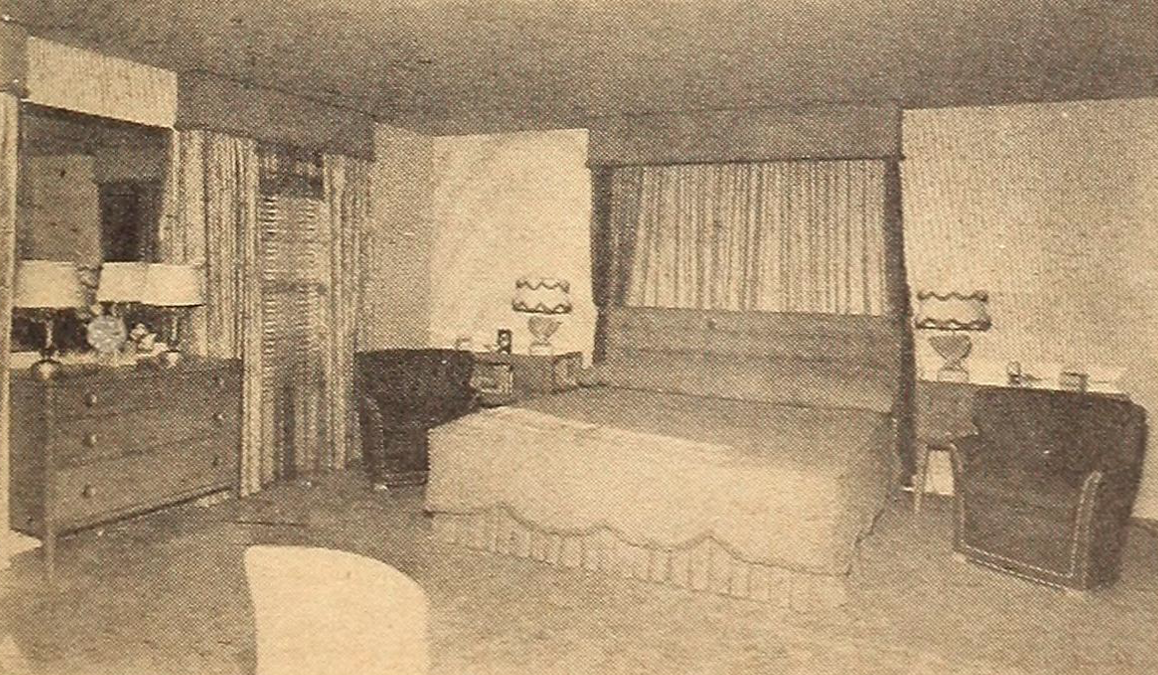
Franchot shared his room with a Great Dane named Bad Boy (pictured with Buzz and Franchot in the top photo), who used the former outdoor tennis court as his play area. Franchot's room would "stand up as the most sexy and glamorous bedroom in Hollywood...it houses the biggest bed in California—a little number measuring exactly ten feet long, ensconced on a pale grey rug and sporting a half-canopy of coral fish net...the walls are pale blue...the lights are soft and harem-like."
The bedroom of Franchot Tone.

Burgess would recall in his biography and he and Franchot "shared many a bottle and many a girl, both in New York and Hollywood, in our bachelor days. There were also some quiet times in Canada at his hunting lodge...But he enjoyed life to the end, loving and being loved by an army of fans and friends..."

Sources:
Franchey, John R. Hollywood's Gayest Bachelors! Screenland. May 1941. p. 28-29, 88. 
Meredith, Burgess. So Far, so Good: A Memoir. Boston: Little, Brown, 1994. 72-76. 

Sunday, October 28, 2018

Piecing together the technical story of Jigsaw

In late 1948, the publication American Cinematographer revealed the unique method in which Jigsaw was recorded. Jigsaw differed from the majority of American films being made at the time and was able to use a small budget to its advantage.

A film noir about a district attorney whose investigation into a suicide leads to a much more sinister plot involving political extremists,  Jigsaw starred Franchot, Jean Wallace, Myron McCormick, and Marc Lawrence. The film was made on a small budget, but what it lacked in budget it made up for in a Who's Who of cameo appearances. It featured cameos by Henry Fonda, John Garfield, Marlene Dietrich, Marsha Hunt, and others.

American Cinematographer praised Don Malkames, director of photography, for his skill at creating a lighting quality expected in studio films without fancy equipment and special-made sets. Journalist Norman Keane wrote:
This production demonstrates that feature films can be photographed in natural settings and locations...The natural locations were used because they afforded economy in production. Not a single set was built for the entire picture. Even the props were those found on the locations. The sites and locales used included interior of the Brooklyn Museum, a Fifth Avenue pet shop, a prominent night club, its dressing rooms, a large restaurant of unique design, an apartment house interior, elevators, and a warehouse...Every set was a challenge...none of the luxury lighting equipment of Hollywood studios. He [Don Malkames] had to get around the limitations of low ceilings of the apartment in which a great deal of the action took place, of the fixed walls of narrow halls and of elevators, and of the immovable fixtures, furniture, etc., which he invariably found in such locations as the pet shop. Before starting to shoot the picture, he had considered using mostly photo spot lamps and R-2 photofloods, but he found that even after building a number of barn doors and hangers for use with these lights, they would not give the precise lighting control necessary. 
Malkames used Mole-Richardson light spots, "inky dinks" for key lighting, and "150 watt broads for fill in light." Malkames secured lighting to ceiling beams to give scenes a more natural look and photographed the entire film with a fast lens in "exceptionally low key." He also used shafts of light to enhance the more suspenseful scenes.

Franchot said:
It is doubtful that there are many cameramen who could achieve the excellent quality of lighting that Malkames did, considering the lighting equipment he had to work with and the limitations of his sets.
Keane's article also uncovered another interesting element to Jigsaw's photography. The film was recorded entirely without sound!
Another thing which greatly simplified the photography was the absence of sound equipment—especially the mike boom which, under the lighting conditions used...most certainly would have involved unwanted shadows...It was the belief of the producers Lee and Danziger, based on long experience of dubbing foreign versions, that it is possible to get greater dramatic feeling into the dialogue when it is post-recorded and dubbed in after the picture is cut.
After the film was recorded, the cast reassembled at the recording studio. As scenes were projected on a screen, Franchot, Jean, and the rest of the cast spoke their lines. Other sounds such as the ringing of telephones, footsteps and so on were also recorded at that time. 

The cast and crew were excited to think of how this method would be studied by future producers and students of low-budget movies. They also thought it would prove a successful method for television movies in the future.

I knew the film was low-budget and that the producers, director, and Franchot himself took pride in its originality, but I had no idea of the lengths they went with natural lighting and post-filming dubbing. After learning how much the film was praised for its lighting and how the crew felt it would be studied by film students and television producers, I am even more frustrated that it fell into public domain. As a public domain title, the film has been neglected and is in bad shape. All of the copies you watch online and even the DVD I own are such poor quality in sight and sound. Can you imagine if we could see it in its original theatrical glory?

I rewatched the film after reading the American Cinematographer article and took notice of all the lighting tricks and was impressed by the effortlessly seamed dubbed video. I've always felt this was a very good performance of Franchot's (I wish he'd made more film noirs like this and I Love Trouble) and I like Jean's femme fatale character as well.

Here's the full movie on the Internet Archive. (If the embedded video doesn't play, click here.)


Source:

Keane, Norman. "'Jigsaw' Filmed Without Sound or Sets." American Cinematographer. December 1948.

Friday, May 18, 2018

Pre-Hollywood Variety Mentions

Franchot first gained notice with filmgoers in 1933, but he was creating a buzz in Variety magazine as early as 1927. I've gathered a timeline of those Variety mentions.

May 4, 1927:
First National Pictures searched college campuses for future cinema talent and spotted ten talented actors at Cornell University. "The lucky ten at Cornell included Franchot Tone, president of the Cornell Dramatic Club.

January 18, 1928:
Starring as David Fitch in "The International", which Variety noted was "anything but not original in creation and presentation. So hectic and cacaphonous is its production that the play might well be styled a true exponent of a new school of vo-do-de-o drama."

October 23, 1929:
Franchot is busy rehearsing "Cross Roads" with Sylvia Sidney and others.

November 20, 1929:
Performing as Duke in "Cross Roads", Franchot is called "capable" in this "truthful, sympathetic picture of youth wrecked by the standards of modern society."

May 7, 1930:
"Franchot Tone, Niagara Falls boy, and protege of the late Garry McGarry, has signed with the New York Theatre Guild."

My note: I'm currently working on an individual post on Garry McGarry that I'll be posting within the next two days. I feel he deserves his own post, not a mere mention in this little Variety timeline.

September 1930:
Franchot is busy rehearsing Uncle Vanya, his first of several associations with this play.

October 6, 1931:

Performing as Will Connelly in The House of Connelly. "First nighters were impressed with this carefully prepared, serious drama"

December 5, 1931:
Performing as Adam in the play "1931". "A graphic picture of unemployment among the city's laboring class, strikingly scened but a depressing play."

March 15, 1932:
Performing as Federico in "Night Over Taos". "The Group Theatre which had the aid of the Theatre Guild but claimed now to be on its own offers a third production this season. 'Night Over Taos' is as good a production as 'House of Connelly' if not more skillful and certainly more striking. The mistake called '1931' has been forgotten."

May 3, 1932:
For his work in "A Thousand Summers", Variety writes, "Franchot Tone is especially good as the boy, presenting him sincerely and with great earnestness."

June 28, 1932:
Franchot leaves "A Thousand Summers" on June 25 and is replaced by actor Johnny Griggs.

October 4, 1932:
Performing as Raymond Merritt in "Success Story". "Franchot Tone, one of the Group's most promising players, does well but is third to the Adlers [Luther and Stella]."

October 25, 1932:
"Franchot Tone goes Metro on a six months' contract, plus a similar option, booked by Mike Connolly of the Jenie Jacobs office. He leaves 'Success Story', current New York play, and goes to the Coast next week. First assignment is 'Nora' opposite Jean Harlow."

November 8, 1932:
"Franchot Tone arrived Saturday (6) from New York, to start his Metro contract."

Source:
Variety Publishing Company. Accessed via Media History Digital Library

Saturday, December 16, 2017

Franchot Talks to TV Guide, 1966

Franchot Tone as Daniel Freeland in Ben Casey, 1965-66.
Source: my collection.
In late 1965, Franchot granted an interview about joining the cast of Ben Casey and it appeared in the January 1, 1966 edition of TV Guide. It is my favorite of his print interviews, because it really shows that wit he possessed that all of his friends talked about in their recollections of him. I've collected some of Franchot's quotes from the interview as well as some of the interviewer's observations about him in this post. After buying a copy on eBay, I read the article and couldn't help but smile at Franchot's responses and feel emotional about his "best to come" response. Everything he says here is just so quotable! I love his reference to theater as the "feed bag" and his jokingly calling himself a "reasonable prima donna." When I read interviews of Franchot's, I always come away thinking "I really like this guy." And I think you will, too. That's why you're here, right?

On joining a television series in his 60's:
Tone flashes a smile familiar to two generations of moviegoers. "What's the use of having all this talent and not using it?" Tone says, and a network of laugh lines crinkle at the corners of his eyes. "Seriously, no plays came along and few pictures for a man my age except the odd cameo bits. I simply wanted to work."

Franchot's personality:

He has the aura of substance, the tenor of actorish dignity. A variety of books and recordings are stacked neatly in the living room, with the emphasis on Shakespeare and Mozart. "A man is happiest when his tastes are eclectic," Tone says. Only one magazine is in view, a copy of Playboy on the coffee table.

When Tone offers suggestions, [costar Vince] Edwards nods agreeably. "Fine, Franchot," Edwards says. "Whatever makes you comfortable." "I'm a very reasonable prima donna," Tone says. Edwards grins.

Both Vince and Franchot have a mutual love of horse racing. Sitting in his dressing room, Tone is usually immersed in a scratch sheet, pencil in hand. When the thoroughbreds are running, Tone and Edwards are at the track, although not together—Tone, the rich man's son, patronizes the $5 window, Edwards the $100 window.

"I'm unlucky in love. I should be lucky at gambling." But he isn't.

Gig Young, who starred with Franchot in "Oh Men! Oh Women!" told TV Guide:
Without being a fool about it, Franchot shared the limelight. He's an unselfish man, and when you say that an actor is unselfish—well, who's ever heard of an unselfish actor?

Another actor who chose to remain anonymous commented:
Tone has so much charm he makes people forget he's as self-centered as anyone in this business. Tone does what is best for Tone.

Franchot's Thoughts on Awards:
They are good for the people who give them and the people who get them and that's what awards are good for. (The interviewer noted Franchot was "properly sardonic" on the subject.)

Franchot's Thoughts on Marriage:
Marriage is very good for the children.

Franchot's Thoughts on Acting:
Everything I know about acting I learned from Lee Strasberg. At the Group, I learned Strasberg's variant on the Stanislavsky System—that's S-y-s-t-e-m, not Method. Method actors lack discipline. System actors are disciplined. I'm a pretty good actor today only because I've always renewed myself at the feedbag—the theater.

His Pride:
I'm proud that I've still got the best to come. I'm proud of "Strange Interlude" and "Uncle Vanya" and "Bicycle Ride to Nevada," which the critics roasted. I'm proud of some of the movies I was in. I'm proud of a half-hour GE Theater on Charles Steinmetz. I'm proud of my Mark Twain on a Playhouse 90. I'm proud of "The Old Cowboy" on The Virginian. And I'm going to be proud of Ben Casey.

Source:
"Who Has Ever Had a Better Time?" TV Guide. January 1, 1966. 12-14.

Wednesday, July 12, 2017

Franchot: A Wealthy, but Sensitive Comrade

Three Comrades. Source: www.ha.com
Sonia Lee, in a July 1938 piece on the stars of Three Comrades for Hollywood Magazine, was impressed at how well Franchot Tone, Robert Taylor, and Robert Young created "the illusion of being products of the same world, the same thought, and the same troubled times" when they all had come from such different backgrounds and represented such different types in Hollywood. These distinct types Lee described as follows:

Franchot—the idealist, the man with the philosophical turn of mind; the cultured product of New England, whose reserve and balance has not been lessened by fame and fortune.
Robert Taylor—the Horatio Alger hero, if there ever was one. A youngster who achieved world adulation overnight, became king of a million feminine hearts, but still retained the liking and respect of the men who know him.
Robert Young—the enthusiastic lad to whom fame came slowly; who worked for what he has achieved over a period of years, who is similar in many respects to ambitious men his age in every walk of life.
If you have not yet watched Three Comrades, you must find it. I agree with Lee when she writes that Tone, Taylor, and Young play their scenes with "tenderness and integrity. They make the story unfold vividly and brilliantly. They make of friendship a tangible thing." I enjoy Franchot's films so much that I don't know that I will ever be able to definitively state which one contains his best performance. I find that I toss up Lives of a Bengal Lancer, Uncle Vanya, Mutiny on the Bounty, Man on the Eiffel Tower, The Bride Wore Red, Advise and Consent, Gentlemen are Born, The Stranger's Return, and Three Comrades as the many contenders for Franchot's best performance as an actor. Each time I watch Three Comrades, I find myself ready to announce it as THE finest performance of his career. The part of the sensitive mechanic who feels a brotherly need to take care of those around him is the perfect role to highlight Franchot's strengths as an actor. I wrote a film summary with screen captures back in 2015 which you can find here.

Franchot in a rare color portrait. Scanned from my collection.

In her examination of the film's male stars, Lee shares this personality sketch of Franchot:
By the very nature of his character, Hollywood knows Franchot least of these three. He is sensitive and intuitive. He is not one of those hale and hearty individuals who slaps a person on the back on short acquaintance, tells the story of his life, or reveals his cherished thoughts at the drop of a hat. As a matter of fact, his sole complaint about the business of being an actor is that the private affairs of a player become the property of the world at large. The one thing which made his courtship of Joan Crawford less than ideal was the minute report of its progress in the public press.
His circle of intimates is small. Robert Taylor and Barbara Stanwyck are frequently on the guest list of those attending the charming dinners given by Mr. and Mrs. Franchot Tone, when they entertain a famous musician, a world-renowned savant, or others who have distinction outside the Hollywood world.With the exception of the reception Joan and Franchot gave for Leopold Stokowski, they have never entertained on  a large scale. That is in keeping with the graceful, gracious background of Franchot's. Son of an important figure in America's business world, his childhood was serene, his education comprehensive.
He attended private schools here and abroad. He had tutors during the time when family travels made school attendance impossible. He is a graduate of Cornell University. He has been awarded the Phi Beta Kappa key—the mark of scholastic excellence. Franchot Tone is serious and studious—with deep, untapped wells of reserve. He makes friendships slowly, but once his allegiance is given, it is lasting and loyal.
Few know him, for he is not an easy person to know well. But his brilliant mind, his deep understanding of human nature, his fine artistry as an actor have achieved for him a deep respect in Hollywood, which is unmixed by envy or resentment. His interests are wide. Books, the progress of the theatre, music, new trends in thoughts and world events, engage his attention. He takes his life and his work seriously, but not himself.
Lee's assessment of Franchot rehashes the same "wealthy son with an impressive education and cultured background" story that we read time and time again, and it's true, of course. But I love the description of his personality as being sensitive and guarded and how he accrued respect among his peers in Hollywood. These are facts about Franchot that many of his colleagues have shared about him as well. My favorite part of the article is that last sentence, "He takes his life and his work seriously, but not himself." What a perfect way to describe Franchot's attitude in 11 words! In my research, I've seen evidence of this many times. Franchot cared about his career (even if his career choices did seem inconsistent to others and at times, even to me) but seemed to remain this down-to-earth guy who never boasted about his talents—he actually comes across as quite self-deprecating in interviews—and had strong beliefs about human rights and political matters and stuck to his convictions, and who—apart from his out-of-character publicity whirlwind with Barbara Payton—maintained his private life, a life he lived and enjoyed to the fullest.

Source:
Lee, Sonia."Three Comrades—On the Screen and Off." Hollywood. July 1938.

Friday, June 30, 2017

Hope for the Best (1945)

Hope for the Best ran for 117 performances between February 7, 1945 and May 19, 1945. Produced by Jean Dalrymple and Marc Connelly, the play was first housed at the Fulton Theatre and then in late April, moved to the Royal Theatre. Writer William McCleery's plot revolved around a newspaper writer who is dissatisfied with only covering gossip and is encouraged by a young woman to pursue more groundbreaking territory. Although his fiancée prefers him not to "rock the boat," the main character attempts to investigate and report on American politics.

Franchot Tone starred as the writer and was supported by a cast of Leo Bulgakov, Jane Wyatt, Jack Hartley, Doro Merande, Joan Wetmore, and Paul Potter.

Hope for the Best. Source: scan from my collection.

Theatre Arts Monthly reviewed the play in April 1945. Rosamond Gilder wrote:
In Franchot Tone, the producers, Jean Dalrymple and Marc Connelly—and Mr. Connelly as director— have found a convincing as well as a winning interpreter of the leading role. Mr Tone, last seen as a ‘round actor’ in Ernest Hemingway’s The Fifth Column, proves that he is still a skillful craftsman in the theatre in spite of his protracted dallying with the screen. He has balance and proportion in his acting, precise timing, a nice sense of humor. One of the hilarious moments in the play is the scene in which the columnist, about to launch forth on the new type of writing he is so eager to undertake, bogs down under the subtle discouragements administered by his dark angel. Mr. Tone sits alone on the stage in front of his typewriter; absorbed, intent, concentrated. His fingers dash over the keys, the little bell rings a cheerful note, he slams the carrier back with a masterful flip. Then doubt creeps into his mind. He stops, re-reads the paragraph, types on, tears the sheet out of the machine, puts a new one in, starts again. The tapping goes more and more slowly, becomes uneven, hesitant. The jubilant song of the keys has turned into a disheartened pecking; Mr. Tone’s very spine wilts, his hair stands on end, his face seems drained of vitality. The curtain goes down on a dogged pounding of keys that presages no good.
The New York Times was not as glowing in their review of Mr. Tone's performance. In his February 8th review, Lewis Nichols wondered if Franchot was the best actor for the part. Nichols' wrote:
He is easy and likable, of course, and he manages a vague, shy quality which is all right part of the time. However...in several scenes, he is shy to the point of cuteness.
Hope for the Best. Source: scan from my collection.

Hope for the Best: Source: New York Times clipping

Sources:
Gilder, Rosamond. "Foxhole Critics. Broadway in Review." Theatre Arts. April 1945. 
Internet Broadway Database: https://www.ibdb.com/broadway-production/hope-for-the-best-1672
Nichols, Lewis. "The Play." The New York Times. February 8, 1945.
Playbill Vault: http://www.playbill.com/production/hope-for-the-best-fulton-theatre-vault-0000004538

Thursday, June 1, 2017

Janet Blair on Franchot Tone


In 1948, actress Janet Blair discussed working with Franchot Tone. Blair said:

Yes, when Franchot and I started to work together in I Love Trouble, it was really meeting up with a Dream Prince. I discovered his brilliant mind, his sharp wit. Here is a great talent and frankly, I’m plain irritated that he doesn’t do more with it. After working with him, I’d class him as one of the greatest technicians in our business. He’s so greatly gifted it’s a shame he has a lazy streak. I’d like to see him pitching on many more productions a year than he does, and brother, how we can use his talent in building up theater here—and radio too, and television. But, as I say, the guy’s lazy. He says he wants to enjoy life a little.
Working with Franchot is a great challenge. You have to step it up in all departments. Consequently, you do a better job than you think you are capable of doing. An actress learns something from every person she works with in this business, good and bad. Without qualification I say I learned the most to the good from Franchot. I had such respect for him, a respect he rates for his great knowledge and for the sure instinct he has for imparting it to associates. It was absolutely impossible to read a line badly in a scene with him. There’s a lot of the little boy in him. It’s that and his irresistible crooked grin that captures and holds his feminine fans. So I’m corny? Okay! It’s the way I feel-having been a fan, and after being a coworker.
And there’s his sportsmanship. Once, on a different scene, I wrestled with my lines until it was embarrassing. Franchot dispelled the tension which he knew my fluffs were making for me. How? By deliberately lousing up his own lines. Him—when he could have read perfectly with a mouthful of grapefruits!
Once, I was catching it from the director for failing to come through perfectly on a piece of business he especially wanted. Chivalrous Tone stepped in between the fine line of my determination and hysteria and said softly to our director, “Now, you leave her alone, you big bully-she’s doing okay.” And grinned at both of us.
I Love Trouble and I-love-working-with-Tone are synonymous in my mind. It was hard work, and swell fun, and plenty educational. He stacks up 100 percent with me, and if he decides to take over in the directing department I want to be the first in line flagging down a role in his picture for Janet Blair.

Source:
"Franchot's Femmes: Four Women in His Life Tell All, About the Suave and Elegant Mr. Tone." Screenland. July 1948. Vol 52, No.9.Page 42-43, 64-65.

Saturday, February 25, 2017

Franchot Tells On Himself: Vintage Magazine Articles

 
In the 1930's, writer and later press agent Jerry Asher wrote many articles on Franchot for fan magazines. I have mixed feelings about Jerry Asher, who became incredibly and exaggeratedly gossipy as time passed and later made some pretty damaging claims about the private lives of both his once confidante Joan and his one-time friend Franchot. (I am researching the validity of some of Asher's statements and will go more in detail about all of this later, but I'm always mistrustful of "friends" who make themselves readily available for any public opportunity to divulge very private details.) No matter my feelings of Asher's future behavior, back in the 1930's, he could be depended upon to publish quality magazine articles on Franchot. In Franchot Tells On Himself, Franchot divulged the many things he disliked about himself, personally and professionally:
I dislike my so-called ease of manner. I dislike it on the screen and I dislike it in real life. It stands in the way of my creating a character on the screen instead of just playing myself over and over again. If I'm portraying strong, true emotions, instead of giving subtle indications of what the emotion might be, it stands in the way of my ever doing any really fine work, such as in Shakespearean tales. Some day I hope to go beyond it. Of course, it's fine for those Park Avenue playboys I've done to death. I dislike that kind of part intensely. I've played so many, people actually think I'm that kind of smug chap. I agree with them, and if I weren't so lazy, I'd have done something about it long ago.
Speaking of laziness, this is another thing I dislike about myself. For instance, I put off writing letters for weeks at a time. I hate to delegate them to some one else, especially my fan mail. It takes about four or five hours a week to do it, but somehow I seldom get around to it. But when I do write or send photographs, I send them myself. I feel it is cheating to let some one fake my signature, so at least I do it right when it is done.
My family back in Niagara Falls likes to hear from me every week. A few hastily written lines to let them know I am well is all they expect. But I put off writing, and then have to go to the expense of a long-distance call, when a three-cent stamp would have done the work.
People may think I'm conceited, but that doesn't prevent me from disliking my looks in general. The first thing that hits my eye when I see myself on the screen is my big Adam's apple. Can you imagine a surprised-looking turtle with a huge lump in its throat? Well, that's exactly the way I look to myself.
I dislike my superficial knowledge of a great many things, and my lack of real knowledge of any particular one. I dislike it because it gives the impression of being well read and intellectual. The truth is, I went to college and happen to have a good memory for stray facts, which gives me a superficial knowledge of a great many things.
Generations of a legal family behind me have made me pedantic. I dislike this in myself. I argue about dates, exaggeration of facts, wrong descriptions, et cetera. Often they are not important and the inaccuracy usually makes better conversation. But so many of my ancestors were lawyers that it has made me a stickler for the exact statement about everything.
I think there's too much vanity in my general make-up. If I weren't so vain I'd make those playboy roles mean something as in 'Dancing Lady' and 'Reckless.' But vanity kept me from doing anything unusual with these roles. I thought it was more important to look well. If I hadn't been so vain, I could have played the parts drunk and disheveled and really kept myself in character. Vanity enters into it when I talk with people. Somehow I never can bring myself to admit my superficial knowledge, even if I only have a vague idea what we are discussing.
At heart I am timid. But I dislike myself for being that way. I am an actor, and people expect me to be colorful, self-assured and amusing. I feel they expect these things, and they should be carried off with a flourish and an air. When I feel some one looking at me I get terribly self-conscious.
I dislike myself for not living up to my screen personality. I haven't a right to do this to the people who go to see me. I really should have an act. It would be much more intriguing and interesting. It's easy to put on an act on the screen, but off the screen there just isn't any act. I know it's disappointing, but I can't help it.
One of my pet dislikes is that I am such a sane fellow. I don't want to be sane, but I'm so colorless I just never think of crazy things to do. I don't seem to have that magnificent abandon that makes a man suddenly make up his mind to jump in a plane and fly to Alaska, or go tramping off to some desert to dig for gold. If I contemplated giving way to an impulse, I'd first figure out how long it would take, and which would be the best way to do it.
Source:
Asher, Jerry. "Franchot Tells on Himself." Picture Play Magazine. 1935.

Friday, February 24, 2017

Franchot Thaws: Vintage Magazine Articles


When reporter Madeline Glass was assigned an interview with Franchot Tone for Picture Play Magazine in 1935, she was less than enthused. Glass had heard rumors that Franchot was haughty, disagreeable, and uncooperative. After her face-to-face meeting with a friendly Franchot on the set of Reckless, Glass shared her suspicion that "innate shyness has caused him to take refuge from argus-eyed reporters behind a barrier of aloofness. He strikes me as being a person whom one must know more than casually before his lurking friendliness can adequately manifest itself."

During their conversation, Franchot broached many subjects.

On his wealthy upbringing:
No, I've never been in want of material things. Sometimes I wish that life hadn't been so easy for me. A few hard knocks would have been beneficial, I think. At times I wonder how I would react if disaster did overtake me. I might crack up because of no previous experience in dealing with severe trials.


On rumors that he'd been difficult to work with on the set of Lives of a Bengal Lancer:
That was the only time I've asserted myself since coming to Hollywood, and my work in the production has proved to be the best I've done in pictures. Some of my dialogue was poor, so I changed it. I also insisted on doing some of my scenes the way that I felt would be most effective. I wouldn't work on Sunday as my contract stipulated that I need not.
On his love of the theater:
I like picture work, but I can do better acting on the stage. There's more opportunity to create characterizations in a medium where one studies and rehearses a role for weeks. Pictures are made too rapidly for one to get a genuine understanding of the part one plays. Too much is left to chance. On the stage a role is developed gradually. In the end one has a complete characterization.
Source:
Glass, Madeline. "Franchot Thaws." Picture Play Magazine. April 1935.

Thursday, February 23, 2017

The Winning Mr. Tone: Vintage Magazine Articles

I've transcribed one of my favorite articles on/interviews with Franchot that was conducted by Edmund Douglas for Silver Screen Magazine in May 1935. In it, Franchot discusses his struggles with his public image and film career.


The Winning Mr. Tone
by Edmund Douglas
Silver Screen-May 1935

The whole trouble with most stories about Franchot Tone is that they never give him a chance. He is not an easy person to interview—or to know—and most of the stories about him have unconsciously, I am sure, made him out as pretty dull. He isn't dull. He has a quiet rippling humor, as I discovered to my cost.

Not long ago I visited a set where he was working. In reporting the activities on the set, I wrote "I can never quite figure Franchot out. He always speaks civilly, sometimes even pleasantly—and that is all. You never know whether he likes you or whether he doesn't and the idea of just sitting down for a chat with Franchot would never occur to you. Or, at least, not to me."

A few weeks later, I encountered him at our tailor's. "Hello," he grinned. "Sit down and have a chat!"

I think I was the first writer to meet him on his arrival in Hollywood. A mutual friend took me to his beach home one day. He was a swell fellow then. Today, two and a half years later, he is still a swell fellow.

Conversation revealed that his real love was the theatre. "I've been in a number of plays in New York," he confessed, "but I've never been in a hit. I want to be in a successful stage play."

"Why did you come out here then?" I inquired.

"The money mostly. At any rate, I have a clause in my contract which gives me an option at the end of a year, too. The studio, of course, can let me go at the end of the year if they don't want me. But on the other hand, if I don't like pictures I can let them go. I can't go to work for another studio but I can go back to the stage. I figure in pictures I'll either be a quick flop or a sudden star. A year should be long enough to tell the story."

Today he is neither a quick flop nor a star. And he is still in pictures. "How come?" I asked.

Franchot grinned. "Oh shucks, Ed. When the year was up I didn't want to leave Hollywood. I had friends here."

"Do you feel you're any nearer stardom now?" I persisted.

He smiled ruefully. "Look, what's happened to me: when I first came out here I had about six stories in the motion picture magazines. You did one that I liked. That was done out of friendship. The other five were written because I was a newcomer—as one would write about a newly discovered freak.

Then I met Joan Crawford and immediately there was another cycle of stories—this time about 'Joan and Franchot.' I hated that. I feel flattered, of course, when I see my name linked with hers. Who wouldn't? But I don't think those stories were fair to her—or to me. Joan has worked like the devil to attain the position she has. I think it's a cheap way to gain publicity to try to do it on the strength of a friendship with someone who happens to have a big name. Her fans resent it. As far as I'm concerned, I feel a little ashamed every time I see an interview purporting to be about myself but which is, in reality, about my friendship with her, because I know down in my heart that if it hadn't been for that friendship the story would never have been written."
 
"Why did you give out those interviews?" I asked bluntly.
 
"I didn't. At least, when the appointments were arranged nothing was intimated about the writers wanting to talk to me about Joan. The first time or two they asked what I thought of her and I suppose I let my enthusiasm run away with my tongue. I didn't know they intended using that stuff. I hadn't had a great many interviews and up to that time all they had used was chiefly biographical data. but after a couple of those stories broke I got wise and refused to talk about her. If you've noticed, the subsequent stories had darned few quotes in them. They were mostly written about us and consisted chiefly of speculation on the part of the writers.
 
People have intimated that I'm riding the crest on the strength of my friendship with her and its attendant publicity. That hurts. I don't think Fox borrowed me for the lead in The World Moves On or Warner Brothers for Gentlemen Are Born or Twentieth Century for Moulin Rouge or Paramount for Lives of a Bengal Lancer because I happen to be friendly with her.
 
I don't want to succeed whether in pictures or in magazines as a freak (which the first cycle of stories made me out to be) or in someone else's reflected limelight (as the second cycle implied.)
 
This may sound conceited but I don't intend it that way. I'm discussing myself as though I were a barrel of apples I was trying to sell the public. I feel that I have something to offer the screen. If I can ever develop a personality in which I feel thoroughly at ease I believe the public will accept me in it and that I can make it fit almost any part in which they cast me.

So far, I haven't been able to find that personality and I don't believe it is to be found among the rich young men in dress shirts I have so far been required to play."
 
"Why not?" I demanded. "Don't interesting things ever happen to rich young men in dress shirts and pants? Anyhow, it's the kind of life with which you're most thoroughly acquainted and you're not guessing what you're doing."
 
"Wait a minute," Franchot protested. "Answering your last remark first, it isn't the only kind of life with which I'm acquainted. I can't remember the time, before I came out here, that I didn't spend the summer months in the woods, hobnobbing with wood-cutters, Indians, and Canadian guides, etc. I know as much about those phases of life as I do about drawing rooms. The biggest personal success I had in New York was as a cowboy in 'Green Grow the Lilacs.' Stage producers never felt that I was the ideal type for the man-about-town.
 
Now, coming to your first question, 'Don't interesting things happen to rich young men'I suppose they do. But I think in any situation involving a rich young man there is almost certain to be some other character involved in the same situation who is more interesting."
 
"Suppose the whole play involves only rich people?" I went on obstinately.
 
"There are only thirty-six dramatic situations," Franchot explained patiently. "It is quite possible that a rich young man might be interesting in one or several of those situations but if characters from some other walk of life were dumped into the same situations I think they would be infinitely more interesting.
 
Don't get me wrong. I'm not one of those fanatics who is always yelling for a chance to prove his versatility and yapping about being 'typed.' I lay no claims to being versatile. All I want is to find that personality I spoke about and I'll be perfectly contented to go on playing it to the end of the chapter."
 
"You said you haven't been able to find it so far," I observed. "Have you made any progress in your search for it?"
 
"I don't know," he admitted. "I've never liked myself in anything I've seen myself do on the screen. That goes without exception, up to the time of "Lives of a Bengal Lancer.' I saw the preview of the picture and, at least, I didn't have to cringe.
 
There has been a lot of talk and a lot written about my not wanting to do that part. It's true, I didn't. But I had good reasons. Originally it was written for a Ronald Colman type. Then it was changed to fit Henry Wilcoxin. When the studio decided not to have him do it, it was rewritten as a silly-ass Englishman. I'm not a silly-ass Englishman and I said I couldn't play the part that way. One of the executives at Paramount assured me it would be rewritten—but it never was. We changed it on the set as we went along, trying to revamp the dialogue so I could speak the lines as if I meant them.
 
And let me tell you here and now that I have never worked with a finer director than Henry Hathaway, who did that picture. The picture is finished and released, he is on one lot and I'm on another so it isn't a question of trying to curry favor. I think he is one of the few really fine directors the screen has and he should be among the top few.

But I'm getting pretty far afield. I was supposed to be talking about my publicity—the first cycle and the second cycle of stories. Lately the stories about Joan and me have died down. I hope the subject has been exhausted. I haven't had more than one or two stories in the past six months. I hope when, or rather if, the next cycle starts there will be some interest in me as an actor and a personality."

Franchot's hopes are going to bear fruit. In "Lives of a Bengal Lancer" you see what he can do with a good part when he gets one. And it's plenty. I do not know whether that is the personality he has been seeking—in fact, I doubt it—but it is one that is going to establish him on the screen as a definite entity about whom the public will want to know more, rather than as a newcomer or a satellite.