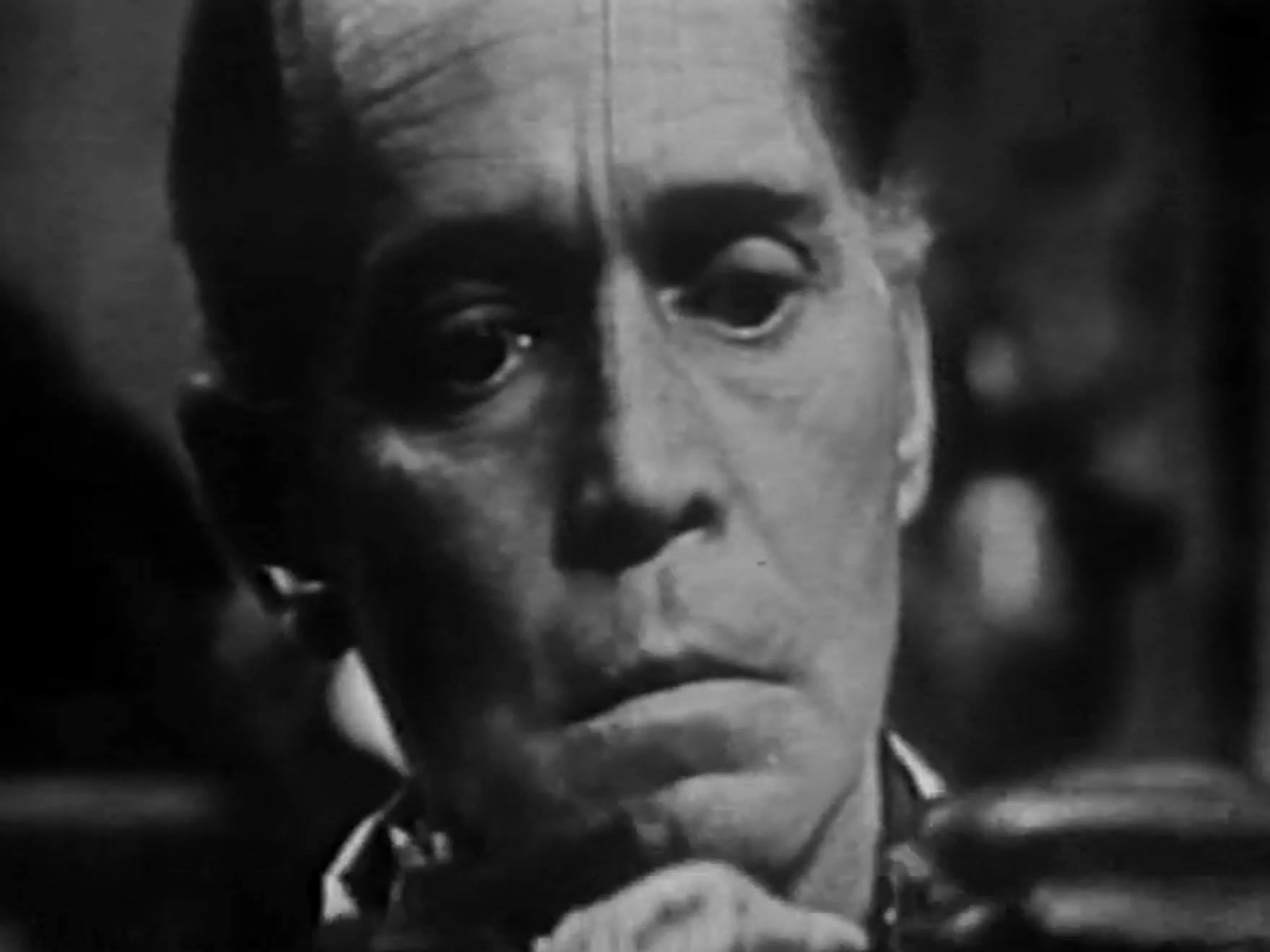
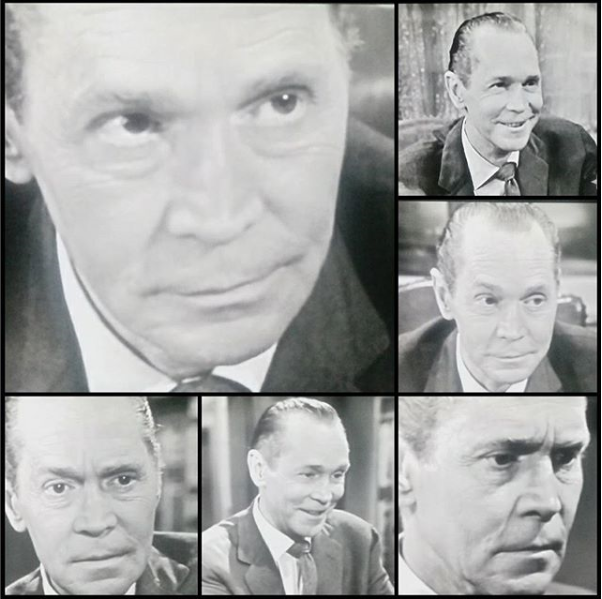
On his way to the guillotine, a scientist recounts his discovery of a diamond lens and his overwhelming need to perfect the microscope for all generations—an obsession so great that it would lead to murder.
This story entitled "Diamond Lens" aired in the Tales of Tomorrow anthology series on March 14, 1952. Franchot would also star in another episode called "The Horn" later that year. Both episodes are intriguing with fantastical elements and strong acting, and fortunately both are available on Youtube. However, my favorite of the two is "Diamond Lens." You can watch it here:
With only a half hour to live, Andre (Franchot Tone) shares his story with a priest who has been sent to perform last rites. Andre passionately tells of his life as a starving student of the microscope, a scientist out to make a name for himself while showing everyone a new way to see the world around them.
Andre has only one mission in life: to find the perfect diamond to create a microscope with a diamond lens. He goes without food and new clothes and lives in a tenement, but when a new tenant Gaston Dubois arrives so does an opportunity. The new tenant confides that there's a rare 150-carat diamond worth 50 million francs in his employer's shop.
Knowing this is the diamond he seeks, Andre begs Gaston to steal the diamond and strangles him to get him to reveal its hiding place. When the landlady barges in, the man escapes Andre's grip. Later, Gaston tries to prevent Andre from taking the diamond and is finally killed by Andre.
With only one mission in life, Andre feels no guilt about the murder as he sees it as a necessity. He is frankly giddy and full of wonder as he creates a special acid and shapes the diamond into a perfect lens.
When a police inspector shows up in the middle of his experiments, Andre gives himself away by knowing that the diamond is missing and a man dead, information not publicly available. The investigator opts to keep a close eye on Andre in the coming days.
As Andre peers into the diamond lens for the first time, he is dazzled by what his eye beholds. In a single drop of water, Andre sees a new, magical world full of movement and details undetectable to the naked eye. Eager to see the professor about his groundbreaking discovery, Andre hides the diamond in a houseplant as his landlady arrives to clean.
Andre returns with the professor, who calls him a crackpot, but the diamond is missing. The landlady has used the water pitcher to water the plants—only the water she has used was really Andre's secret acid, which has completely destroyed the precious diamond.
When the professor asserts that Andre is a lunatic who lied about the diamond, Andre replies that he committed murder to get it. As he utters this confession, he sees the police inspector at his door.
In February 1950 Franchot traveled to Birmingham, Alabama to promote The Man on the Eiffel Tower. It was a whirlwind one-day press tour of the city including multiple newspaper and radio interviews, a special luncheon at the Downtown Club, a cocktail party at Tutwiler Hotel where his suite was located and ended the evening by making a personal appearance at the Linley Heflin Unit Mardi Gras Ball which was held in the Municipal Auditorium. By midnight, Franchot was on a plane to New York where he was slated for business meetings with friend and TMotET director Burgess Meredith.
With Birmingham press, Franchot shared that he felt his youngest son Jeff might become an actor. Franchot added that Jeff enjoyed "mugging" and always put on a great show every Christmas that his aunt Karol (Jean Wallace's younger sister and only a child herself) would direct in front of the family Christmas tree.
On producing The Man on the Eiffel Tower, Franchot said:
Production, I like, because a producer can assure himself of more interesting parts. You'll like Man on the Eiffel Tower. It's not a mystery but a suspense picture. And Charles Laughton's not the villain. I am!
Interestingly, Franchot shared that his business meetings with Burgess Meredith in New York were to plan for their next film. Burgess was set to direct and Franchot would produce and act in a film version of the novel The Song of the Flea. They planned to begin filming it in London within a year or two. A film adaptation of The Song of the Flea never happened (perhaps due to the Payton love affair and the events that it caused.) I have a special fondness for Franchot's work as a producer (The Man on the Eiffel Tower, Uncle Vanya) and co-director (Uncle Vanya) so it is a shame this other opportunity never came to fruition. It not only would've been a creative venture for Franchot, but he would've also enjoyed working with best friend Burgess Meredith on it. The Song of the Flea was written by British novelist Gerald Kersh whose most famous work Night and the City was made into a 1950 film starring Richard Widmark and again as a 1992 film starring Robert de Niro. I cannot find any proof that The Song of the Flea, which focused on a writer struggling to succeed, was ever adapted for film.
You can read more about The Man on the Eiffel Tower here .
Source:
Caldwell, Lily May. "Franchot Tone Visits Here, Talks of Kindness." The Birmingham News. February 18, 1950.
Franchot made appearances on quite a few variety, entertainment, and game shows in the 1950's. He also did two brief spots on Playhouse 90 and Sizeman and Son to plug the next week's episode in 1955-56. IMDb lists the following shows featuring Franchot as himself:
The Milton Berle Show
Perry Como's Kraft Music Hall
Saturday Night Revue with Jack Carter
General Electric Guest House
The Name's the Same
The Ed Sullivan Show
The Cassini Show
The Colgate Comedy Hour
Igor Cassini's Million Dollar Showcase
The Arthur Murray Party
I know that there are more appearances than what IMDb includes, because Franchot hosted a 1959 A Salute to the American Theater production that is not listed there.
I wish I could write that all of these episodes had been lovingly saved and restored for us to enjoy, but that is not the case. I've been searching for years and have only been able to view one of Franchot's personal appearances so far. I think many (especially the Dumont Network shows) are probably permanently lost, but I know that some are likely included in archive collections—more on that below. There are a few that I believe may actually pop up somewhere online in the future if we're lucky...perhaps one will appear at the very end of this post! Let's work backwards from 1959!
Franchot on A Salute to the American Theatre
This production was listed as being available to rent in kinescope form in the Jewish Audio-visual Review published in 1966. Since I know copies were circulated at least 7 years after it first aired, I'm hopeful this program is out there waiting to be discovered. Here is that vintage listing in full:
A Salute to the American Theatre, an edited kinescope, based on the original one-hour program by CBS/TV, in cooperation with the Anti-Defamation League of B'nai B'rith, 1959, scrips by Elliot Baker, narrated by Franchot Tone, 45 minutes. Rental price on request. Distributed by Anti-Defamation League of B'nai B'rith.
Content: Presents excerpts of outstanding dramatic and musical plays whose theme is freedom and anti-discrimination.
Evaluation: "A Salute to the American Theatre" constitutes a fine anthology of dramatic presentations of social problems. In addition to showing how the theatre has been alert to its responsibility of dealing with grave issues of the day, this kinescope provides the viewer with good entertainment. While the transitions from one play to another are abrupt, at times, and the treatment of some of the issues is not always adequate, given a good discussion leader, "A Salute to the American Theatre" can be used effectively as program material. This program is recommended for high school-adult groups of all religious denominations.
Franchot hosted this entire production and also read a speech from "Abe Lincoln in Illinois." I have a newspaper clipping photo of Franchot hosting this, but I cannot find it...as soon as I find that file I will add it to this post.
Franchot on The Arthur Murray Party
Franchot appeared on The Arthur Murray Party three times! In season 3, episode 6, Franchot and his wife Barbara Payton appeared together in a production that also featured singer Kitty Kallen, dancer William Callahan, and the Ray Carter Orchestra. This episode aired on February 10th, 1952.
Franchot returned on July 15, 1957, for season 8, episode 14. This star-studded episode also included Errol Flynn, Farley Granger, June Lockhart, and Cornelia Otis Skinner. Featured dancers were Rod Alexander and William H. Vaux.
Franchot's third and final appearance at the party was for season 9, episode 1 on September 29, 1958. Franchot and Susan Strasberg were promoting their latest play. Teresa Brewer, Ricardo Montalban, and Dan Dailey were also on hand. Featured dancers were Martel and Mignon and William H. Vaux.
The Library of Congress has thirteen of the episodes in their archives and there are a handful of clips, mostly featuring singer Johnnie Ray, from the show on Youtube. As far as I know, the Franchot episodes are not part of the surviving collection.
Franchot on Igor Cassini's Million Dollar Showcase and The Cassini Show
Franchot was a guest on the eighth episode of the first season of Igor Cassini's Million Dollar Showcase. His interview on this talk show was broadcast on December 9, 1955. The show only aired from 1955-1956 and its host was a popular gossip columnist whose column appeared in Hearst newspapers across the nation.
Just a year before this appearance, Franchot was featured on The Cassini Show which was really just the same talk show format with a more succinct name. On April 25, 1954, Franchot, John Drew Barrymore, Arthur Blake, and Geraldine Page were just several of the names that audiences at home were able to see on their tv sets.
Since these shows were part of the Dumont Network, they are most likely lost unless a collector is stowing them away somewhere. The Dumont Network library was mostly destroyed in 1958 and then the surviving archival material was dumped into the New York bay in the 1970's. The horror! So many Franchot gems discarded.
Franchot on The Colgate Comedy Hour
Franchot and costar Gloria Vanderbilt performed for hosts Jerry Lewis and Gordon MacRae on The Colgate Comedy Hour in late January 1955. Franchot and Gloria performed a scene from the play The Time of Your Life.
Colgate Comedy Hour was a variety show that aired from 1950 to 1955 and was hosted by Eddie Cantor, Dean Martin and Jerry Lewis and Abbott & Costello, among others. The show lost viewers as The Ed Sullivan Show gained favor. Not all episodes survived and those that exist are typically poor quality duplicates that came from the original kinescopes. Some have been released on DVD or posted online, but I've yet to see the Franchot episode.
Franchot on The Ed Sullivan Show
Franchot, Gig Young, and Betsy von Furstenberg performed scenes from the theater comedy hit Oh, Men! Oh, Women! on Ed Sullivan's Toast of the Town. The episode aired on January 17, 1954. This one is probably in an archive, possibly the Paley.
Getty Images has photos from this episode here and here.
Franchot on The Name's the Same
I feel like this episode is possibly out there somewhere! The Name's the Same was a 1951-1955 game show in the vein of What's My Line. Contestants shared their name with a celebrity and the panelists would ask a series of yes/no questions to try to guess the name. A few years ago the episodes aired on both Game Show Network and Buzzr Network. Not all episodes are surviving and I'm not sure if Franchot's show (which aired on August 25, 1953) was saved, but I'm hoping a collector out there has it. A Youtube user even posted many of the 1953 episodes, but, sadly, not Franchot's. The Paley Center has some episodes in their archives, but I haven't located Franchot's.
On this particular episode, the host was Robert Q. Lewis and the panelists included Carl Reiner, Joan Alexander and Bill Stern.
Franchot on General Electric Guest House
Franchot popped on General Electric Guest House on July 29, 1951. Durward Kirby hosted and the guests included Melville Cooper, Ginny Simms, Ogden Nash, and Franchot. The Guest House aired over 10 episodes and served as a summer replacement for The Fred Waring Show in 1951. On each episode, four celebrities participated in a trivia game about the entertainment industry.
The Paley Center has a few of the episodes in their archives, but I haven't placed Franchot's yet.
Franchot on The Saturday Night Revue with Jack Carter
On March 4, 1950, Franchot stopped by The Saturday Night Revue to talk with host Jack Carter.
Cass Daley, Don Ameche, The Step Brothers, and Gertrude Niesen were also on hand for the entertainment.
This show aired weekly in 1950 and 1951 and was vaudeville-inspired. The Paley Center has some of these episodes but I've yet to see an entry for this particular episode.
Franchot on Perry Como's Kraft Music Hall/The Chesterfield Supper Club
Franchot Tone and his best friend Burgess Meredith appeared on Perry Como's Kraft Music Hall on February 5, 1950. This is also listed as The Chesterfield Supper Club in the Paley Center's archives, where it exists! Franchot and Burgess were there to promote their film The Man on the Eiffel Tower. They were dressed as gangsters as they talked with host Perry Como. Also appearing on this episode were Ethel Waters and the Fontane Sisters.
This long-running show entertained audiences from 1947 to 1967.
Franchot on The Milton Berle Show
Franchot stopped by The Milton Berle Show on January 31, 1950. Franchot appeared in a comedy skit with Milton and comedic actress Pert Kelton and, shared with the intent of educational and entertainment purposes only, here it is!
If you cannot see the embedded video, you can watch it on my Youtube channel here. Enjoy!
The 115th anniversary of Franchot's birth is coming up in just a few days, on February 27th. Happy Birthday, Mr. Tone. I hope you know how much love you receive here.
Franchot left the Group for Hollywood (click here for part one of this story), but he continued to support them. Harold Clurman wrote that Franchot's financial generosity funded much of the Group's script purchases and productions.
Franchot wrote to Harold that the Group had been ¨the most important influence¨ in his life, but that he deeply loved Joan Crawford and intended to remain with her in Hollywood. Franchot knew that the Group members judged him for his decision, yet they also came to him frequently for money, the same money he made from the Hollywood career choices on which they judged him. Clurman recalled spending afternoons with Franchot and Joan when he visited California:
Franchot was happy to play the host to his companions of old. To him we were clean spirits who brought light and warmth into his almost locked heart. Joan Crawford, a good sport, wanted to make friends with Franchot's friends. She thought at times of appearing on the stage, an ambition perhaps stimulated by Franchot. She wished to be able to follow him in all his steps, so that he might not be included to wander too far from hers.
In the afternoon we would chat, mostly about the theatre, play badminton, swim in the pool, dine, and see a picture in the projection-room, right off the pool. It was quite a pleasant routine that we followed almost every time we visited them. Once, while I lay afloat in the pool, basking lazily in the Sunday sun, Franchot observed me with friendly malice and remarked: “The life of a prostitute is pretty comfortable, isn’t it?”
Often, Franchot would take a loss on his investments with the Group. Clurman remembered:
He wanted to know about his failure to realize any money on Awake and Sing, and I tried not to be sheepish in admitting our mismanagement. He did not take the matter amiss however (in these questions he always alternated between peevishness and indulgence). Basically Franchot was an idealist, and he still idealized Lee Strasberg and me. Though in the long run there is more peril than pleasure in being idealized, I was at the moment the beneficiary of Franchot’s warmest hospitality. I was the (awkward) prophet of a religion centered in the theatre. Franchot’s wife, Joan Crawford, was prepared to believe. Some day, Franchot intimidated, he would return to the theatre, and, at the time, theatre was synonymous to him with the Group.
Franchot's return to the Group-1939's The Gentle People
The success of Golden Boy strengthened Franchot's desires to return to the stage, or as Clurman put it, Franchot ¨glowed in anticipation.¨ Once his marriage to Joan ended, Franchot found himself financing and starring in The Gentle People. Clurman no doubt was eager for Franchot's return to the theater and credited his ¨excellent¨ talent many times over the years, but he also seemed to be banking on the fact that two former Group actors-turned-movie stars (Franchot and Sylvia Sidney) would fill seats whether the play was a hit or not. Although definitely using Franchot's financial and professional reputation for the Group's gain, Clurman did seem to care and worry about Franchot the idealist:
I warned Franchot that he might encounter disappointment in the Group…I suspected that Franchot looked toward the Group with the fondness of a youthful memory. “Franchot, “I said, “promise me that you will stay with us for one year no matter what happens. Give yourself and us a chance.” Franchot looked solemn and uncertain, but he promised.
Franchot threw himself into his work with an eager will. On the whole, he was well pleased with the conduct of rehearsals; his criticisms were affable and slight. When conferences on the progress of The Gentle People were held, I failed to invite him to join them, as it was not our custom to consult members of the cast on production problems of the plays in which they took part. That Franchot was not only one of the leading players but the play’s backer gave him no special privilege in this matter. It was not my intention to snub him in any way, but Irwin Shaw pointed out that, whatever my intention , my behavior was tactless. Franchot, however, bore this with good grace.
But Franchot was restless, just as he'd been in the year leading up to his departure from the Group and arrival in Hollywood years before. He praised the Group at a speech he gave at the Town Hall Club, saying:
I’d better not get started on the Group,” he began, “because I’ll get emotional about it and then I won’t be able to talk at all...The Group has a well-defined attitude toward human problems and affairs, and while I’m perfectly sure that such a formalized policy as this is by no means necessary to success in the theatre, it is necessary to me.
Still, Franchot turned down Clurman's offer to do the play Quiet City saying that he was too tired to do more than one play at a time. When he was offered My Heart's in the Highlands, Franchot made stipulations before stating that he didn't feel he would do a good job in the role.
When Franchot wouldn't fully commit to the Group in the 1940's, Elia Kazan, Clurman, and others staged a sort of intervention with him. They asked him to commit to them and trust in them and the theater. Franchot asked if they respected him. When they answered that he was the kind of actor they needed, Franchot asked pointedly, ¨But you don't respect the reputation I have made in pictures?¨ Clurman answered, ¨This is not why we want you.¨ Franchot confirmed his fears about the Group when he asked, ¨But you are willing to exploit my name for its commercial value?¨ and Clurman answered, ¨Of course.¨
In his book, Clurman seems misunderstood about why Franchot alternated between complete worship and bitterness in his feelings about the Group, even going so far to say that Franchot ¨built up a case against us in his mind. Perhaps he needed an inner justification for giving us up.¨ I don't believe it's that hard to see why Franchot had mixed feelings about the Group and in all of my own personal research I have only read kind or nostalgic remarks about the Group from Franchot in interviews. As late as 1966 Franchot was praising Lee Strasberg to TV Guide:
Everything I know about acting I learned from Lee Strasberg. At the Group, I learned Strasberg's variant on the Stanislavsky System—that's S-y-s-t-e-m, not Method. Method actors lack discipline. System actors are disciplined. I'm a pretty good actor today only because I've always renewed myself at the feedbag—the theater.
It's clear that Franchot acted out in many ways, but it is also clear that he had some insecurities and wanted to be told he was valued for his own talent. When he wrote to Clurman baring his soul about his deep appreciation for the Group, Franchot probably hoped for a return letter with the same sentiment about himself. Instead, he received a letter requesting money to fund another show. Back in the early 30's, young Franchot had been hurt when Strasberg told him they didn't care that he was leaving for Hollywood; after all, Franchot was secretly hoping for validation (and a personal request to stay with the Group) from this father figure he idealized. It's no surprise that Franchot would be sullen and hurt again in the 1940's when he realized that the Group begging him to come back still didn't fully respect or include him despite now benefiting from his wealth and celebrity status.
Despite this complicated history with the organization, Franchot was proud of his association with the Group and always attributed his passion for acting with the skills and conditioning he gained as a Group member.
Clurman, Harold. The Fervent Years: The Story of the Group Theatre and the Thirties. Knopf, 1950.
Kramer, Joan, David Heeley, Joanne Woodward, Steve Lawson, Stella Adler, Harold Clurmaan, Cheryl Crawford, and Lee Strasberg. Broadway's Dreamers: The Legacy of the Group Theatre. New York, N.Y: PDR Productions, 1994.
Lewis, Robert. Slings and Arrows: Theater in My Life. Stein and Day, 1984.
Smith, Wendy. Real Life Drama: The Group Theatre and America, 1931-1940. Knopf, 1990.
"Who Has Ever Had a Better Time?" TV Guide. January 1, 1966. 12-14.
Directed by Frank Capra, Here Comes the Groom is a 1951 musical romantic comedy starring Bing Crosby, Jane Wyman, and Franchot Tone. It is a fun romp about two men competing over a woman with some great Bing tunes thrown in for good measure. Be forewarned that you'll be singing and dancing around your house to "In the Cool, Cool, Cool of the Evening" for days after you watch it.
Franchot in Here Comes the Groom, 1951. Scan from my collection.
The Film
Peter Garvey (Bing Crosby) is a news reporter stationed in a Parisian orphanage. He is fond of all the children there and takes pride in placing them in perfect homes, but itching for a new traveling assignment. In a neat little special effects scene, his abandoned fiancée Emmadel Jones (Jane Wyman) comes to him in the form of a hologram atop a spinning record. Emmadel lets him know that she is sick of waiting for him after three long years. She is ready for marriage and motherhood and realizes that Pete will never give up his traveling assignments for her.
Not wanting to lose Emmadel, Pete writes to her immediately, decides to adopt orphans Bobby and Suzi and fly back to America. Documentation issues delay the trip and Emmadel gives up on Pete altogether. (Louis Armstrong, Dorothy Lamour, Phil Harris, and Cass Daley make cameo appearances during the flight's musical number.)
Pete arrives in his hometown, but must marry and find permanent residence immediately in order to maintain guardianship of the children. He assumes he will sweep Emmadel right off her feet, but she reveals that she is engaged to be married to the wealthy Wilbur Stanley (Franchot Tone).
We learn that Pete and Emmadel grew up with similar modest backgrounds and have always known how to enjoy life without money and status. Pete plays up that angle as he tries to convince Emmadel that marriage to a wealthy man is all wrong for her. Pete assumes Wilbur Stanley is an elderly, unattractive man who has nothing to offer but a life of comfort. This vision of Wilbur (whom we've not seen yet in the film) is supported by Emmadel's father's comment that Wilbur is "not even a man. He's a tradition. He's a mummy."
Franchot in Here Comes the Groom, 1951. Scan from my collection.
During the "In the Cool, Cool, Cool of the Evening" scene, Pete and Emmadel dance around the Stanley building and are clearly a good match for each other. Knowing he has to get permanent residence to keep Bobby and Suzi, Pete changes a housing file (owned by Wilbur's company) from rented to vacant.
When Pete and the true renter fight over the house, Wilbur Stanley arrives on the scene. This bad publicity could potentially ruin his reputation, but a younger, more handsome, more generous Wilbur than Pete expected takes it all in stride. Wilbur agrees to let Pete and the children stay in his gatehouse. I uploaded my favorite scene from the movie to Youtube. Franchot and Bing's characters face off in the car and agree to let the best man win. If you cannot see the embedded video below, click here.
Once he settles in the gatehouse, Pete Garvey does everything he can to prevent Wilbur's wedding to Emmadel.
Franchot is delightful as the charming Wilbur Stanley and turns in a solid performance. His delivery of the final line is fabulous. Alexis Smith plays Wilbur's distant cousin Winifred Stanley (and does so perfectly!) and there are some hilarious scenes between her and Bing and her and Jane. If you like romantic musical comedies, Here Comes the Groom is a must-see. It has a strong director and cast as well as an enjoyable story and pleasant songs.
The Backstory
Here Comes the Groom had its big premiere in Elko, Nevada with festivities being held July 29-31, 1951. The cast traveled to Elko (a place with close ties for Bing. Read more here) to introduce the film and entertain citizens. Franchot was not part of the festivities as he had business obligations in New York.
By the time the film had its New York premiere on September 20th, Franchot was recuperating from plastic surgery to fix the shattered cheekbone, fractured upper jaw, and broken nose he had sustained in the September 13th fight with Tom Neal, lover of his fiancée Barbara Payton. This high-profile incident would lead to a reckless year of marriage, separation, and divorce with Payton, lawsuits, and bad publicity (details here.)
Sadly, audiences wouldn't see Franchot in a film again for six years, when he adapted the stage play Uncle Vanya for the screen in 1957. He wasn't to be seen in another major motion picture until 1962 when he starred as the president in Otto Preminger's Advise and Consent. Of course, Franchot continued to work diligently and prosperously in theater and television productions while working to regain his privacy during this time.
You can watch the Franchot-less footage of the Elko visit (from the Bing Crosby Archives and originally posted by www.bingcrosby.com on Youtube) here:
In May 1952, Franchot was asked how he felt about his "new face." I wrote about the complicated 1951 Neal-Tone altercation that caused the need for Franchot's plastic surgery and impaired his voice last year (click here), but this is the first time I've run across Franchot making a statement about the plastic surgery to the press:
They say it's better than ever, but I liked the old one better. I'm a gambler, and gamblers sometimes lose. A man's got to live. I've had a full life, with no regrets. There was so much bad publicity, I couldn't defend it; so I've never had my day in court. I think I'll just pass it up. People all over the country tell me they're on my side. I'll settle for that. Well, you can't kill a guy for falling in love, and I've always let them make an honest man of me.
The change in his nose is very apparent in these side-by-side shots.
Source: "The New Tone." Los Angeles Times. May 24, 1952. page 10.
On May 16th, 1952, a new play "New Faces of 1952" had a reading at the Metropolitan Opera House Lounge. The play starred Eartha Kitt and Ronny Graham and received positive reviews. Franchot Tone attended a party that was given in honor of the play. He was photographed sharing the good reviews with Eartha and Ronny on the steps of the opera house. Everyone gravitated toward Eartha that night, including Franchot, who called her "the most electric personality I've ever seen" and, according to Jet Magazine, blushed when a photographer asked to take their photo.
Seven years later, Franchot was set to costar with Eartha in "Jolly's Progress." In September 1959, Jet published that Eartha was resting briefly before going into rehearsals with Franchot, but by September 18th, the New York Times revealed that Franchot had already dropped out of the play. There seems to be some debate as to why he dropped out. Franchot told reporters that he had an additional work commitment that he couldn't discuss at the time. The word around town, though, was that Franchot left the play because he wasn't pleased with the way Coleman's dramatization had turned out. Franchot had liked Coleman's book, but felt the characterization was lacking in the play's script. Columnist Dorothy Kilgallen hinted that Eartha, having gone through the deterioration of several romantic relationships in previous months, was having "temperamental outbursts" throughout the process of casting and rehearsals. It was also rumored that Franchot left due to a billing dispute.
Perhaps, it's a good thing that Franchot dropped out. Reviewer Peter Dee, in his 1959 Second Balcony column suggested that the playwright "thought that if he combined ideas from 'Pygmalion' and 'Uncle Tom's Cabin' he'd have a great play. He doesn't, but surely has an arresting one." Dee would go on to say that Eartha's "electric histrionics cannot hide the fact that this play needs such judicious fixing-up..." Wendell Corey took Franchot's place in the play, which ran for 9 performances from December 5th through December 9th on Broadway.
Getty has an even better photo of Franchot and Eartha here: Getty Images
Sources: Dee, Peter. "Second Balcony: Jolly's Progress." The Heights. November 13, 1959. "Eartha Kitt, Franchot Tone to Costar in Play." Jet Magazine. September 10, 1959. Internet Broadway Database: https://www.ibdb.com/broadway-production/jollys-progress-2803 "Round Up." Jet Magazine. September 17, 1959. "Star is Acclaimed by Celebrities." Jet Magazine. July 31, 1952. "Tone Withdraws from Role Opposite Eartha Kitt." Jet Magazine. October 1, 1959. Zolotow, Sam. "Corey May Take Role Tone Quit." The New York Times. September 18, 1959.
Waiting for the elevator in his office building, Bill Gibson (Franchot Tone) decides to break routine and check out the travel agency on the ground floor. Miss Devereaux (Sheila Bromley) is a peppy, impassioned travel agent who convinces Bill that a trip to Tahiti is just the reward he needs. Bill, a widower, agrees. He's been working his entire life, raising a son who doesn't reciprocate his appreciation, and is ready to get away and have some fun. Bill has almost enough money saved up and, with a smile and excitement in his eyes, assures Miss Devereaux he will return to finalize travel plans soon.
Bill returns to his office and dreams of this chance to escape everyday life and begins recording a message to his boss saying that he will be taking a leave of absence on his dictation machine. Bill's son Jim appears requesting money from his father. Jim's a young, new father who changes jobs frequently and is behind on all of his bills. Bill is clearly thrilled to see his son, but it's obvious to viewers that Jim is immature and taking advantage of his father on a regular basis. His heart set on an exotic getaway, Bill promises he will consider giving him a loan and let him know the following day.
We also discover that although Bill's message to his boss says that he has no ties to anyone or anything, Bill actually has a girlfriend Maggie (Kim Hunter) who desires to be more committed. Maggie can see that Jim and his new wife Shirley (Olive Sturgess) are using Bill for monetary support while denying him the right to spend time with his new grandchild.
Screenshots from Ticket to Tahiti.
When he makes a surprise visit to Jim and Shirley's home, Bill sees firsthand how irresponsible, disorganized, and childish his son and daughter-in-law are. After Jim disrespects him in a restaurant, Bill has had enough (and calls him a "little punk." I like hearing Franchot call people little punks. Also, I love when Franchot tells someone they are "outta brains" on Bonanza!) Bill devises a special arrangement which will end with payment to his son should his son agree to some pretty strict terms. If Jim doesn't take the deal, Bill will continue on his trip to Tahiti.
Ticket to Tahiti was a Studio One production that originally aired on June 2, 1958. It's a rare episode that occasionally airs on the Decades channel. Kim Hunter is absolutely wonderful as the loving, wise partner to Franchot's character, who hasn't fully committed to her yet. Franchot's character begins the episode exhausted with the daily grind, feeling unappreciated, and not demanding much of anyone. As the show progresses, Franchot's character Bill gains the upperhand and skillfully manages to secure a future of contentment and purpose for himself. I hope you're able to catch this rarity on television at some point, because it is completely worth the watch!
Franchot starred as Frank James, the brother of outlaw Jesse James in Bitter Heritage, a 1958 television production featuring a young Elizabeth Montgomery. Airing on August 7, 1958, Bitter Heritage was a 90 minute western drama focused on Jesse James, Jr. coming to terms with his family's notorious legacy. Warning: there are plot spoilers in this summary.
Jesse Jr. (James Drury) has nightmares about his father's death. He has been raised by his uncle Frank James (Franchot Tone), a man who has desperately tried to escape his former life of crime by living far away from the James homestead. Frank hasn't been home in 15 years, but there's good land there and a brood mare sale that lands him back in Kearney. (There's a funny scene in which Jr. asks his uncle if he remembered to bring money. Franchot, as Frank, grabs his belly—he's hidden the money under his shirt—shakes it, and smirks, "That's not belly fat, boy!")
As they ride closer and the town comes into view, Jesse Jr. asks his uncle what he sees. Frank replies:
Ghosts!...Some things you can't forget. People don't letcha...things don't change if people stay the same.
Jesse Jr. thinks that his uncle and grandmother (Eva Le Gallienne) are living in the past and making too big a deal of the events that transpired here before. He's optimistic and naïve and fails to face who his father really was. As Frank says over breakfast with his mother:
We lived those times. We understand them. He don't.
Although fifteen years have passed, Frank's instantly recognized in town. Colonel Brecker sees Frank checking in at the hotel and refuses to shake his hand. The colonel's young and fearless daughter Mary (Elizabeth Montgomery) invites Frank and Jesse Jr. to a party at their house while the colonel complains to the town sheriff about their presence.
Frank is already doubting his decision to come back to Kearney under any circumstances when old gangmates spot him. Luke (Robert Middleton) has been waiting to kill Frank James ever since Frank ran out and Luke narrowly escaped death at a hanging. Now, Luke assumes that Frank is back to step on Luke's toes and start trouble. Luke and his pals bombard Frank's hotel room, punch and threaten him.
Frank wants to leave immediately. He says that he's been tried and acquitted twice cause no witnesses ever came forward, and he doesn't plan on causing a stir now. Jesse Jr. thinks Frank's a coward. Frank responds:
There's a difference between running and stepping outta something you've got no control over.
We learn that when Jesse Jr. was a boy, Frank saved him from being a sideshow attraction. Frank rescued him and gave him a normal life. He doesn't want it ruined now.
Jesse Jr. refuses to leave. He's smitten with Mary and plans to attend her party. Frank becomes drunk at the bar and is telling lively stories. Luke's posse comes in, bully Frank, introduce a mentally ill homeless man who claims he is the real Jesse James, and taunt Frank by singing a song about his brother.
Frank is beaten by the men outside of the bar and his gun is stolen from him on the first night he's carried it in 15 years.
Frank recovers at the James homestead and Grandma criticizes Jesse Jr. for attending the Brecker party and says that Jesse Jr. is denying his birthright.
While Frank and Jesse are at home, masked men calling themselves Frank and Jesse rob the local bank. They kill the banker and leave behind a gun marked with the initials FJ. Mary is in the bank when it happens and swears that it wasn't Frank and Jesse. But the townspeople are eager to persecute the James family and a posse rides out to impose their own justice.
Grandma walks out front with a gun while Frank abandons the house from the backdoor. Jesse Jr. (and some viewers) assume Frank, desperate to escape the past, is running out. In truth, Frank gets on a horse and purposely leads the posse away to protect Grandma and Jesse Jr. As the men chase Frank, Jesse Jr. rides to the sheriff and asserts himself. With a loaded gun, Jesse Jr. threatens to shoot if he is not heard. The mentally ill man who believes he is the original Jesse James tells Jesse Jr. that the bank robbers are in a cave. The posse (with Frank) and Jesse Jr. ride to the cave to discover Luke and his gang hiding inside with the stolen money. Finally, Frank and Jesse Jr. are vindicated and welcomed back to their home.
Bitter Heritage is an engrossing tale of embracing the future while never forgetting the past. The telefilm is full of accomplished actors providing meaningful performances. Franchot is touching as the ex-outlaw eager to live a regular life away from scandal. Franchot starred in a handful of western roles in television and he seems right at home in that genre. It's a wonder that Franchot never starred in a western film after the 1940 western-comedy Trail of the Vigilantes. He was able to easily embody the good guy, bad guy, and especially, the man in-between in his western characters.
Happy Halloween! Or, if you don't celebrate, happy Tuesday! I have something I hope you will consider a special treat today. I added Franchot's opening and closing segments of Witchcraft to Youtube.
Witchcraft was intended to be a weekly anthology show, much like Twilight Zone and The Outer Limits, with a horror and witchcraft theme. Franchot was to host this series, but the pilot episode "The Doll in Brambles" never aired and so this unique television opportunity never came to pass. I've seen the dates 1958 and 1961 attached to this pilot, but, to me, Franchot looks much younger here than he did in those years. I feel like there is no way this was shot in 1961, because this is a 1950-1955ish looking Franchot here. It's possible it was 1958, but even that seems a little too late, compared to photos of Franchot in that year.
Franchot is a perfect fit as host of this series and it's too bad this did not become a regular hosting gig for him. He has the elegance, intelligence, and perfect, shall we say, tone to be a trusted host that you return to each week for another night of entertainment. The actual story (which Franchot does not act in) is about a grandmother witch who tortures her granddaughter and has threatened to curse the granddaughter's fiancée should they proceed with a wedding. Although the main story is not quite on par with a Twilight Zone story, it is still entertaining and matches a lot of the anthology shows of the time.
Without further hesitation, here's a clip of Franchot hosting Witchcraft. Enjoy! If anyone has more concrete details about this anthology, the actual date, why it didn't air, or any information at all, I'd love to know more.
In October 1957, Franchot talked to drama editor and critic Lewis Funke for Theatre Arts Monthly. Franchot explained, in detail, his reasons for filming, producing, and co-directing a version of Uncle Vanya. The play was earning phenomenal reviews and Franchot felt it was worthwhile to capture the production for eternity. I've written about the film before (here) and it is top-notch. Franchot is completely wonderful in the role. In light of his costar and fourth wife Dolores Dorn-Heft's comments about Franchot's ultimate disappointment and deterioration over the film's reception (here), the transcribed interview in which Franchot is very hopeful and eager may leave you with a tinge of heartache for him. When it was released, the film received rave reviews from critics, but failed to be a commercial success. It cost Franchot a lot of money and he was saddened that his performance didn't garner any awards or individual acclaim. Although Franchot could see that films were changing and was absolutely correct to see that it was the right time to create an art-house film for intelligent audiences, he failed to foresee that audiences would even more heavily embrace a film like Uncle Vanya as time went on. He was ahead of his time in a lot of ways. Uncle Vanya is now on DVD and is praised for its nuanced performances. I think Franchot would be pleased and proud that Uncle Vanya is now out in the world in the hands of those who appreciate it.
Here's what Franchot had to say about this endeavor in 1957:
You might say that I was driven by a wish to immortalize our production. I don't know exactly when the wish was born, but I do know that once it was, I could not put it away. I kept thinking what a shame it would be for the play to end just because it had run its course on Fourth Street. It was so good, the ensemble playing was so superb, and Stark Young's translation was so beautiful and fresh that I couldn't put the thought out of my mind.
Then suddenly it occurred to me that the play could and ought to be put on film just the way we were doing it on the stage, with some changes, of course, to avoid the danger of its becoming a static thing on the screen. That, you know, is the great pitfall in trying to make an exact copy from the stage.
Up until comparatively recently, of course, the idea of putting a play such as this on film would have been pretty foolhardy. The market potential would not have warranted the financial risk. But there has been tremendous growth of the art-film houses throughout the country which can only be attributed to the maturing artistic taste that is everywhere notable among our people. There was a time when you could count the number of art houses in New York on one hand, and the number throughout the country was equally minute.
Although there are no firm figures at present, it is estimated that there are now over four hundred of these little houses across the country catering to that discriminating clientele that is seeking better and more intelligent fare than they can find on their television sets or in their neighborhood movie palaces.
But even with this knowledge, I still was not in a position to take the risk until I had really professional advice. I called upon my old friend Arthur Krim, who used to be the lawyer for the Group Theatre when I belonged to it, and who now is the president of United Artists. He saw the play and assured me that with the proper budget, I might hope to break even and perhaps make a little money. That did it.
We didn't want to have anyone else's mind or anyone else's creativity super imposed on or interfering with the play. We realized that for a motion picture it would be necessary to get more action into the telling of the story than there was on the stage. But we felt that whatever action we wanted we could get from the play itself. By following Chekhov's directions and his writing we could move the action around up a staircase, around a room, in the garden. This we believed would be sufficient to give the film the necessary fluidity.
Yes, there have been a few cuts. But I don't think anyone is going to really mind those decisions. They have been made only where we found that Chekhov was somewhat repetitions. For instance, playwrights have to contend with intermission and when their plays resume they are bound to reiterate exposition points. This repetition has been eliminated because in pictures once you've made a statement you can believe that the audience will not forget it.
It's one of the biggest gambles of my life. But I cannot recall when I received more gratification from an undertaking. This is the first time in America that anyone has put Chekhov on film. Call it a great financial risk, a noble experiment or what you will. But if we've succeeded in duplicating what we had on 4th street, there will be no greater thrill for me. It surely would have been a terrible waste to lose forever George Voskovec's Uncle Vanya, Clarendon Derwent's Serebriakoff, Geraldine Hiken's Telegin, Mary Perry's Marina, Peggy McCay's Sonia and Shirley Gale's Maria Vasilievna. And, although we have lost Signe Hasso's Elena, we have Dolores Dorn-Heft, giving what I think is another beautiful portrait. Who knows? We may wind up among the archive films of the Museum of Modern Art.
Source: Funke, Lewis. "Uncle Vanya." Theatre Arts Monthly. October 1957.
1955 production
Although disappointed that an agreement to play Mister Roberts dissolved after director's Josh Logan's protests (I wrote about that here), Franchot signed on to play Joe in William Saroyan's The Time of Your Life in its place. (In my research of The Time of Your Life, I actually came across a January 3rd notice in Theatre Arts magazine that states that Franchot will headline Mister Roberts through January 16.) When asked if he'd be interested, Franchot's response to Jean Dalrymple was ""Joe! The Time of Your Life! Wonderful! I'd love to do it!" The Time of Your Life resulted in a major success for Franchot. The play ran as part of New York City Center's season for 15 performances between January 19th and January 30th, 1955.
Franchot in The Time of Your Life, 1955.
William Saroyan wrote on January 16th that the two-week revival of his play
represents the only play by me to be professionally produced on Broadway in more than ten years. I have every hope and very nearly every reason to believe the play will be effectively performed by an excellent cast...
Saroyan's wish for the play to be well-received came true. Brooks Atkinson reviewed Franchot's performance:
The acting is out of the top drawer. As the central character, Mr.Tone plays with a dry detached geniality that establishes the right relationship between the environment and himself, and that admirably avoids sentimentality...It belongs on the stage where it is alive, unique and delightful.
Maurice Zolotow called it a "beautiful play whose lines are filled with a tender and warm feeling for language, whose people are real and moving." Zolotow praised the acting of cast members John Carradine, Wolfe Barzell, Myron McCormick, Fred Kareman, and Paula Lawrence. You'll notice an important name missing from that list. Zolotow confessed:
Every human being has one blind spot, and I confess mine is Franchot Tone, the Joe of this revival. I have seen him in many roles and I know it is irrational to say this, but he has never convinced me he is the person he is playing.
The play was such a success that Playhouse owner Ben Marden wanted to transfer the City Center production to Broadway once its two weeks were up. Louis Calta also publicly lamented that such a play could not be moved to a longer Broadway engagement. Actors who performed in City Center productions did so because they believed in the mission of the center and to hone their craft. All those involved in City Center productions, including Franchot, generously worked for minimum salaries so that they could keep ticket prices low and the Center's vision pure.
Franchot Tone and Gloria Vanderbilt
During the run of the play, Franchot's romance with heiress Gloria Vanderbilt added extra publicity for the production. Vanderbilt's small role in the play was being highly publicized during the time and she and Franchot engaged in what she termed a "transient" relationship. You can read her thoughts on Franchot here.
During the run of the play, Franchot and Gloria made a special television appearance on The Colgate Comedy Hour on January 23, 1955. I've not seen this appearance but their scene was summarized as "Franchot Tone and Gloria Vanderbilt in "In the French Style." The episode was hosted by Gordon MacRae. Other guests on the show that evening were Paul Winchell, Ronny Graham, Joyce Bryant, the DeMarco Sisters and the Mayo Brothers.
1958 production
Although The Time of Your Life never did a full Broadway run, fans had another opportunity to see Franchot in the role of Joe. Three years after the first production, Jean Dalrymple secured Franchot Tone and actress Susan Strasberg for a weeklong engagement of The Time of Your Life at the Brussels World's Fair in Belgium. Also in this production were Dan Dailey and Ann Sheridan.
The play opened to an audience of 1,150 socially prominent citizens (attendees were listed as commissioners and ambassadors) at the United States Pavilion Theatre on October 8, 1958. Belgian reviewers gave the performance high praise and the cast received eight curtain calls on opening night.
Franchot Tone and Susan Strasberg
This special event led to the play being filmed for television in Britain. The production aired as a presentation of Armchair Theatre on October 19,1958. I'd love to see this. I feel like it would be equivalent to seeing Franchot in the filmed version of Uncle Vanya. Viewing Franchot in his element as Astroff in Uncle Vanya is a serious and emotional experience for me and I think that seeing his performance of Joe would have the same effect. I don't know if a recording even exists of The Time of Your Life, but I hope if there is, it'll be released someday.
Franchot in the Armchair Theatre production, 1958.
British TV Times promoting The Time of Your Life, 1958.
Sources: http://abcatlarge.co.uk/armchair-theatre/ Atkinson, Brooks. "Time of Your Life: Saroyan in Top Form in an Excellent Revival for the City Center Series." The New York Times. January 30, 1955. Calta, Louis. "Center Play Eyed as Broadway Item." The New York Times. January 25, 1955. Funke, Lewis. "News and Gossip of the Rialto." The New York Times. May 11, 1958. Saroyan, William. "Saroyan on Saroyan: Pulitzer-Prize Playwright Investigates His Record." The New York Times. January 16, 1955. http://www.televisionheaven.co.uk/at134.htm "U.S. Play Opens at Fair." The New York Times. October 9, 1955. Zolotow, Maurice. "The Season On and Off Broadway." Theatre Arts. April 1955.
Recently, I wrote about the Theatre Four, which was the theater Franchot and Jean Dalrymple purchased together in 1967. In her memoir of her time spent at the New York City Center, producer Jean Dalrymple talks a lot about Franchot's involvement there from the 1940's to his death in 1968. I learned about several plays Franchot really desired to do, but the productions fell through for one reason or another.
For example, Franchot wanted to do the play Arms and the Man, the George Bernard Shaw comedy that deals with war's futility. That plan disintegrated, because Shaw refused to cut his 15 percent royalty, a cost that the sometimes financially-struggling City Center could not afford.
Franchot Tone and Jose Iturbi kiss Jean Dalrymple.
Another play that Franchot had his heart set on was Mister Roberts. Dalrymple was enthusiastic about Franchot's abilities and benefited from his participation at City Center. First of all, Franchot was considered a big name and would draw an audience. Secondly, Franchot was a dependable and capable actor that she admired but often struggled to find the perfect part for. Third, Franchot and Jean were very good friends and had been since Franchot starred in Dalrymple's Broadway production of Hope for the Best in 1945. Mister Roberts' original producer Leland Hayward approved the Mister Roberts project, provided the set pieces, and the promotional mailers were set to go.
When the announcement appeared in papers, Josh Logan, angry, called and forbid the play to go on. Logan was directing the film version which would be premiering around the same time as Franchot's performance in the play and felt the play's revival would damage the returns on the film. The film would go on to be nominated for Academy Awards (Jack Lemmon won one for his performance) and grossed 8 million, so I don't feel his reasons were justified. There's no way, in my mind, a City Center theater performance would be a spoiler for a big budget film starring Cagney, Powell, Lemmon, and Fonda. Logan wouldn't budge. He refused to approve and said Hayward had no right to give his approval. Dalrymple understood and needed to maintain a good relationship with Logan (he often directed plays for her), so she had to break the news to Franchot:
...how was I to break the news to Franchot, who already was busy studying the part? He was the first one I ran to and after his first outburst of anger and disappointment, good friend that he was, Franchot agreed to do some other play—if I could come up with one he liked.
Franchot Tone and friend Jean Dalrymple on the Maid of the Mist,
in Franchot's hometown Niagara Falls.
Dalrymple relates that she pored over play anthology over play anthology in her personal library, but couldn't find a project that she felt was suitable for Franchot. In the middle of the night, an exhausted and discouraged Dalrymple threw a book down onto her bed and it opened to a page and the lines jumped out at her:
Joe: Out of the twenty-four hours at least twenty-three and a half—my God, I don't know why—are dull, dead, boring, empty and murderous.
It was a middle of the night hallucination, but I heard Franchot say those words. Whoever Joe was, it had to be a part for Franchot. It was Joe in Saroyan's the Time of Your Life...in that moment I knew it was for him and could hardly wait for morning to come, Franchot to wake up, and the good news to reach him.
I was right. No sooner had I said to him,"How would you like to play a man sitting in a bar, drinking champagne, philosophizing and trying to set other people's lives to rights?" than he exclaimed, "Joe! The Time of Your Life! Wonderful! I'd love to do it!"
I enjoyed this backstory of how The Time of Your Life came to be and I'm glad that it turned out to be such a perfect fit for Franchot. It was a great success and over the next week, I will be writing in more detail about its production, both on the stage and on television. There's another, sadder story that Jean tells of her time with Franchot that I'll also share in short time.
In the meantime, you can learn more about Jean Dalrymple by reading her obituary here or brush up on your knowledge of City Center here and here.
Sources: Dalrymple, Jean. From the Last Row. New York: JT White, 1975. City Center's All-Star Winter Play Festival theater program. 1955.