Showing posts with label life of FT. Show all posts

Monday, December 9, 2019

Puppy from a Fan

I was looking for another article on Franchot and came across this funny little piece of news from 1941:
Franchot Tone was walking down Hollywood Boulevard, when a group of children asked for his autograph. He complied, and one of the little boys gave him a tiny puppy. Franchot explained that he had no place to keep a dog. But the kid looked so hurt that Franchot took the puppy, anyhow. As the children disappeared, Franchot heard one of them remark, "Gee, now we've got only five more to get rid of." Since then, Franchot has been phoning all his friends, but he admits that, to date, he isn't as good a salesman as the kid.

Source: "In Movieland." Statesville Daily Record. March 7, 1941.

Saturday, October 19, 2019

Childhood Photos and Memories

Tiny Franchot Tone. Source: Photoplay, May 1937.
In May 1937, Walter Ramsey published his authorized biography of Franchot within the pages of Photoplay Magazine. The May issue focused on Franchot's childhood through his high school years. The second volume detailed Franchot's collegiate years and entry into an acting career. Franchot provided some of his favorite memories as well as a joyful abundance of childhood photographs. In the lengthy articles, Franchot recalled a happy, close family life, a home in which he was encouraged to have interests and embrace adventures and causes. His father became more successful with each year. Franchot said:
We started out modestly enough but each time Father was promoted, we moved up the street a notch. We approached the Falls as father approached the presidency of his Carborundum Company of America.
I've noticed these changes in addresses, from 328 Buffalo Avenue to 131 Buffalo Avenue, on census reports and always wondered about that, so now it makes sense!

Franchot was the youngest child of Frank and Gertrude. When Franchot was born, older brother Jerry said the baby's squealing was "something terrible. Bet my cat's caught his tail under the pantry door again."
Tiny Franchot in the snow. Source: Photoplay, May 1937.
Franchot's first taste of being a star came at the age of three. Although Jerry had been practicing a Christmas poem for weeks, he forgot the lines when it came time to recite them at a Christmas party. Franchot, having listened to his brother's practice, recited all the lines by heart for the family and friends gathered there.
Tiny Franchot among the trees. Source: Photoplay, May 1937.
Franchot was a thin, small child with a penchant for mischief. After fishing in the family's goldfish bowl, Franchot received a spanking from his mother. Franchot remembered thinking this punishment was ridiculous and irrational. He's successfully caught a goldfish so why all the fuss?

When Franchot's dad traveled to observe factories in Europe, the whole family went along. Franchot lived in Paris, Cannes, and on the Riviera. It was in France that little Franchot saw his first film, a "flickering, green sort of affair" about cowboys, playing in the hotel lobby and viewed by a little boy peeking from the banister.

Jerry Tone (left) and Franchot Tone (right) with their burro in Arizona.
Source: Photoplay, May 1937.
When Frank came down with a serious illness, the family moved to a more restorative climate in Tucson, Arizona. In Arizona, Jerry and Franchot had a burro, pictured above with Franchot on top and Jerry on the stairs. Franchot shared:
We were never off his back for a moment and the neighborhood kids joined in the fun, too...And I recall this vivid reaction—that while it didn't bother me to ride the burro to death in the daytime, I'd cry about him at night because of the awful way he was treated.
Franchot (left) and Jerry (right).
Franchot has this exact same stance
later in so many film scenes!
Source: Photoplay, May 1937.

When living in Arizona didn't appear to make any changes to Frank's health, the family returned to New York—first to Saranac Lake and then to Franchot's birthplace of Niagara Falls. Eventually, Frank regained his health fully.

Franchot swimming as a child. Source: http://lantern.mediahist.org


Franchot loved wandering off and seeking adventure. Except for writing poems, Franchot didn't care for school very much. Here is one of his childhood compositions:

It reads:

I was going to a schol my 
mother siad I cood not go for 
she siad you wood see there 
something that wood make 
you crie and crie until thie 
one eyess wood be out of 
thie one hed which ye 
see in your one vishuns 
in the night.
O human best, O giv me bak
my hart O didst yee now
yee hast my hart? O giv
me bak my hart; I will neverey be
cinde to yee inlest yee giv
me bak my hart.
-By S.P. Franchot Tone.


Upon return to Niagara Falls, Franchot went to a private school with Miss Otis. Still not much for school, Franchot would lead the rest of the kids down Buffalo Avenue to the Shredded Wheat factory where they would join the groups of tourists that were allowed to sample biscuits with fruit and cream. 

Franchot remembered that his first love was named Alice and he kissed her on the porch when tourists goaded him into it one day. He liked movies, banana splits, Charlie Chaplin, Pearl White, eating, fighting with another gang of kids, and being in charge.


Franchot. Source: Photoplay, May 1937.
When Franchot entered The Hill School (in Pottstown, Pennsylvania) in 1919, he worked on the newspaper and managed the football team. His family moved into a nicer house at 131 Buffalo Avenue and when he came home for the holidays, Franchot liked to cruise around Niagara Falls with a pretty girl by his side in the family Buick. Just as he'd fallen for Alice as a kid, teenaged Franchot now set his eyes on a local girl named Caroline. 

As a teen, Franchot contracted scarlet fever and spent eight weeks in the school infirmary before being sent to specialists in Atlantic City and Philadelphia. It was a long, slow time of recuperation and Franchot felt he was missing out on all the fun. He later reflected:
I was alone so much that I really think that period was a big turning point in my life. I started to read good books. I got a chance to rearrange my outlook on life and people and transpose or change many former ideas and ideals. Where before, I had merely accepted—I began to question everything and find new answers. Many of the ideals I formed at that time are still working for me, unchanged.
Then, in December 1923, Franchot received a letter dismissing him from The Hill School for being a "subtle influence for disorder":
I think I shall never forget that phrase: subtle influence for disorder. I didn't know that the real reason had been a senior class rebellion after I had left for the holiday and that the professors had traced the spirit of the rebellion to me. At that moment, as I read those words, it seemed as though the whole four years of my life at The Hill were passing in review on that small piece of white paper. As though it were unwinding on a motion picture screen, I could see myself waging campaigns for more self government among the students (this was the reason)...agitation for more senior class liberties...my head bowed deeply as I stood outside the church on Sunday awaiting the more devout students with whom I would argue religion vs. agnosticism for hours, later...the long summer twilights and the rendezvous with the 'Town Girls' who would wander out to the edge of town to meet the upperclassmen...those nonchalant affairs somehow became terribly important in retrospect...quick mental flashes of my contempt for rules and the secret satisfaction I got out of shooting-a-smoke in the basement of the professors' building on the very morning the treasurer of the school was showing the insurance salesman how little fire hazard there was about such a building...the happy hours I had spent at the editor's desk of the newspaper and the literary desk of the school magazine...
No, there was nothing they could pin on me definitely—I'd seen to it that I was never caught infringing any rule. But there was my notice. I was fired! There it was on cold, white paper and I had to show it to father. Just before my graduation, too. I remember walking into my father's study, handing him the paper, and walking slowly upstairs to my room. 
Franchot at 20. Source: Cornell University Yearbook.

Franchot's older brother Jerry had the idea for Franchot to take this opportunity to test and enter Cornell University early. (Jerry was already a student at Cornell.) Franchot passed all his exams. Soon, Franchot was an active member (and later president) of Cornell's dramatic club. Three students joined Franchot in renting a house that they named "The Little Gray Home in the West." Franchot said:
If that paints a quiet, sentimental picture, it's a false one. If The Little Gray House could talk, it would certainly have tales to tell of Saturday night beer busts, of dishes that were never washed, floors that were left unswept and of a big, blazing fireplace that soon became the focal point of every mentally undigested idea or notion in the clan. We had grand times, great talks and sometimes a heavy beer hang-over. The four of us did almost everything—including joining the Book & Bowl Club and acquring a model T Ford. When a fire broke out in The Little Gray Home, we spent three winter weeks with nothing but a canvas flap over the burned-away front door. And I'll never forget the night my Ford went "nuts" and chased the night watchman all over the campus—well, no one knows the truth of that little incident but the model T and myself.
Franchot at 22. Source: Cornell University Yearbook.

Several years into his Cornell education, Franchot enrolled in a French school and spent weekends with a Yvonne whom he described as a "cute little girl at Zelli's in Montmartre. There, at a small table in a far and dimly-lighted corner, we'd sit over a bottle of wine and she would speak to me in French. I learned a lot from her—about French, I mean—and I grew rather fond of her in the bargain."

You can read more about Franchot's childhood and school years in these earlier posts:

~I think this definitely wins Most Adorable Post in this blog's 4.5 year history for all these childhood Franchot pics. What a cutie! I squeaked when I saw the first photo while swiping through the online Photoplay archives. I'm so glad Franchot shared these photos and stories with Walter Ramsey! ~

Sources:
Ramsey, Walter. "The Intimate Life of a Gentleman Rebel." Photoplay. May 1937.
Ramsey, Walter. "The Intimate Life of a Gentleman Rebel." Photoplay. June 1937.


Saturday, September 14, 2019

Franchot in North Carolina

Last month, I was searching digital archives in California and New York and coming up with the same articles and photos I've seen time and again. I took a chance and searched my home state of North Carolina's digital archives, which I've never thought to do for Franchot before. And...
Franchot visiting Pat on campus.
Source: University of North Carolina at Chapel Hill Photographic Laboratory Collection #P0031,
North Carolina Collection Photographic Archives, The Wilson Library, University of North Carolina at Chapel Hill.

I was finding Franchot all over again! I knew that Franchot's oldest son Pat attended the University of North Carolina at Chapel Hill, but never even considered Franchot was sitting right in their archives.

Franchot visited Pat on campus in April 1964 and, fortunately for us, photos were taken of father and son and Franchot was interviewed by the local paper.

Franchot said:
Well, I just couldn't resist an opportunity to come down to Chapel Hill and spend a pleasant week with my son, Pat. Of course, since I've been here, I've been wearing out the pavement between the Carolina Inn and Swain Hall, and the only chance I've had to see Pat is during meals.
When asked about his acting career, Franchot said:
 ...just one of those things that happened. I was exposed to the old silent movies and I also had the opportunity of seeing a number of stage plays. After I would see a picture or a play, I used to go home and stand in front of a mirror and act out scenes for myself...Nowadays, an actor works in all the media. There are differences, of course. The stage actor must act with his whole body because the audience always sees him that way. In films and, to a large extent in television, the acting is in his eyes.
And what did Franchot think of Pat, who had been in several university plays, becoming an actor? Franchot smiled:
Who knows? He seems to have the bug, but he may come to his senses.
The reporter summarized his meeting with Franchot by writing:
By his own admission, he has found a full and complete life in acting, and he went out for the final rehearsal with an air of confidence and satisfaction which indicated he was doing the thing he loved best.
Franchot visiting Pat on campus. 
Source: University of North Carolina at Chapel Hill Photographic Laboratory Collection #P0031, 
North Carolina Collection Photographic Archives, The Wilson Library, University of North Carolina at Chapel Hill.
In a separate article, the Daily Tar Heel examined how the son of a movie star came to study in North Carolina. Bob Quincy reported that sophomore Pat Tone was making a name for himself with a javelin at UNC-Chapel Hill. The coach commented that Pat was "strong and works hard."

Quincy noted:
Pat and his actor dad spent several weeks together here recently...He and his son are quite close and spent many hours enjoying the good life. The Tones have a track background, and it began at the same institution. Both attended the Hill School in New Jersey*. Papa Franchot was a manager of the track team in his time. Pat excelled in weights and dashes.
*My note: The Hill School was actually in Pennsylvania. 


The javelin caught Pat's eye after watching UCLA athletes when visiting his mother Jean Wallace and he chose to move to North Carolina because a lot of his peers were moving south to attend school. Franchot must've approved this choice, because Pat notes:
Dad had gone to Cornell. But he is a very good friend of Paul Green, the playwright, who lives near the Carolina campus. They have worked together on many projects.

Shakespeare: A Portrait

I was already thrilled to my core to find these two articles and two photographs, but there's more! While he was in town, Franchot appeared in the university's 90-minute television show commemorating William Shakepeare's 400th birthday anniversary. The show was entitled Shakespeare: A Portrait and aired on the local WUNC-TV on April 23, 1964. It seems that the Chairman of the Department of Radio, Television and Motion Pictures requested Franchot's participation and Franchot accepted. Franchot praised the students and crew that worked with him on the project. I was unaware of this production and am now digging into whether or not a recording or photographs of it still exist in the university or WUNC-TV archives.

Sources: 
Digital NC: http://www.digitalnc.org/
Digital Public Library of America:  https://dp.la/
Hardy, William M. "Tone Kills 2 Birds with 1 Stone." The Daily Tar Heel. April 19, 1964.
Quincy, Bob. "Former Actor's Son Goes Own Way with NC Javelin." The Daily Tar Heel. April 18, 1964.

Wednesday, July 3, 2019

An Interesting Independence Day Display

Both Harold Clurman, in his book The Fervent Years, and Robert Lewis, in his book Slings and Arrows, recounted Franchot defiantly celebrating the 4th of July alone while he was a member of the Group Theatre in the early 1930's. Both refer to this display as being attached to Franchot's frustration with the constant "plethora of intellectual talk and classic music", but that reason seems so in contrast with everything else I've learned about him. Franchot was a fond participator in deep discussion and I can't tell you how much I've read about his enthusiasm for classical music, especially Mozart.

But Franchot's time with the Group Theatre seemed to be a complicated mixture of joyful success and feelings of alienation and I have much more to share about that subject in a future post. Perhaps Franchot was just letting off steam or drunk. Perhaps even the most devoted Mozart fan can grow weary of endless playback.  Or, perhaps, Franchot was just very enthusiastic about Independence Day. Here's what Clurman said:
On the Fourth of July, Franchot alone had decided to celebrate by shooting off fireworks. He began rather early in the day. Perhaps this was his childhood custom, perhaps it released his tension, perhaps it was his protest against what seemed to be the indifference of the others to the proprieties of this holiday. Solitary, with darkened brow, he went from place to place over the grounds and set off his firecrackers. Carnovsky and others were fond of music and played recordings of Mozart at every opportunity (except one man who played Caruso records, and Puccini). Carnovsky, no longer able to tolerate Franchot's acoustic vandalism, came out on the porch and cried: "Franchot, for God's sake, I can't stand the noise." Franchot turned and yelled: "And I can't stand your  noise"—referring to Mozart and the rest. He stamped off yelling: "I am an American." 
I have written a little bit about the Group Theatre (click here), but have some more detailed stories of Franchot's time with the Group coming soon.

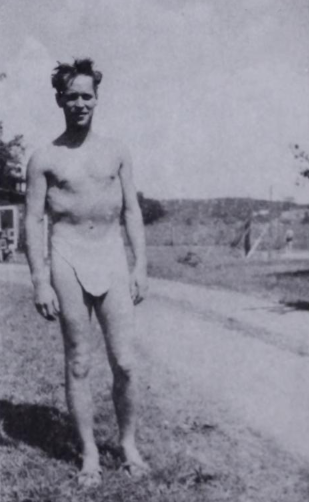
Happy Independence Day! Set off some fireworks for loin-clothed Franchot the American!
Photo Source: Slings and Arrows, 1996.

Sources: 

Clurman, Harold. The Fervent Years. Harcourt. 1945.
Lewis, Robert. Slings and Arrows: Theatre in My Life. 1996.

Monday, April 8, 2019

"Pandemonium" at 470 Layton Drive

When I was browsing fan magazine articles about Franchot and Carole Landis' relationship earlier this year, I stumbled upon this article about Franchot living at the Layton Drive address with photographs! This is the home listed on Franchot's World War II draft card (here) that I did a brief post on last year (here.) When Bubbles Schinasi and actor Wayne Morris called it quits leaving their home vacant and open to tenants, Franchot and his pal Burgess Meredith ("as gay a brace of bachelors as ever haunted the sleep of the countless impressionable co-eds throughout our wonderful democracy") moved in. Hollywood was surprised that two bachelors would take on a large, elegant property. Jimmy Durante even asked, "Those guys and that house—what have they got in common?"


How did they end up living in such style? Burgess settled into the extra room at Jimmy Stewart's Santa Monica house when he arrived in Hollywood for film work. Soon, photographer John Swope became Jimmy and Burgess' housemate as well. All men enjoying and being popular with the ladies, the house grew crowded fast. Buzz (as Burgess was known to friends) found a beach house in need of repairs to reside in, but Jimmy and John didn't want to break up the gang. It was decided that the beach house would just be for Buzz to sleep in, but the guys would all hang out at Jimmy's house during waking hours.

Then, Franchot arrived from New York and needed a place to stay. Franchot and Buzz were roommates in New York shortly after Franchot's divorce from Joan Crawford and remained lifelong friends. Both Franchot and Buzz were acting in plays at the time and found they shared equal passion for acting and being fixtures at the hottest nightspots. Buzz and Franchot decided to lease the Morrises' chateau, now nicknamed Pandemonium. Their neighbors included Nelson Eddy, Anna Sten, and Frank Capra. Franchot felt the place was perfect for his return to Hollywood as a bachelor.

Franchot and Buzz threw a cocktail party after getting settled in and locating domestic servants. In the article, the descriptions of the rooms are pretty exaggerated in comparison to the photographs. Yes, they are beautiful, large nice rooms, but Screenland refers to their living room as "Dali-esque." Their living room was described as a "surrealistic masterpiece...The walls were a pale blue set off by a gray carpet. Two disconsolate love seats done in yellow leather hugged the fireplace, over which a mural by Lee Blair (a South American cockfight framed in blue mirror) looked down..."
The living room.

Buzz's room was decorated in red and white walls ("calculated to woo sleep"), a sea green carpeted floor, and "flaming" draperies.
The bedroom of Burgess Meredith.

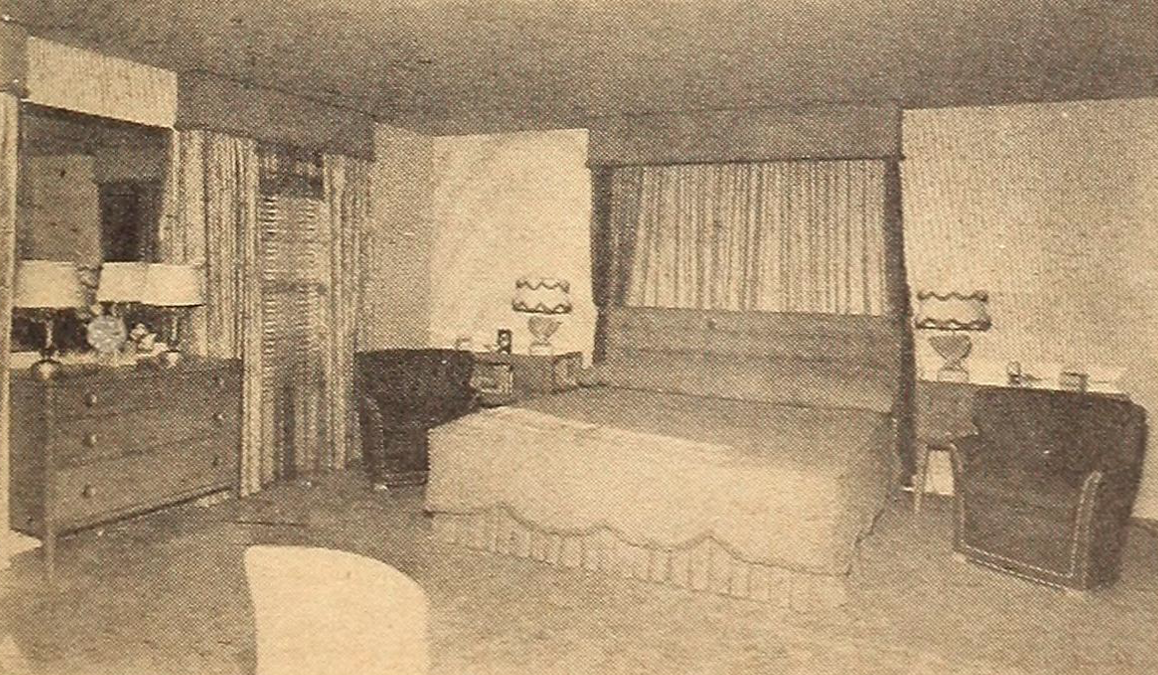
Franchot shared his room with a Great Dane named Bad Boy (pictured with Buzz and Franchot in the top photo), who used the former outdoor tennis court as his play area. Franchot's room would "stand up as the most sexy and glamorous bedroom in Hollywood...it houses the biggest bed in California—a little number measuring exactly ten feet long, ensconced on a pale grey rug and sporting a half-canopy of coral fish net...the walls are pale blue...the lights are soft and harem-like."
The bedroom of Franchot Tone.

Burgess would recall in his biography and he and Franchot "shared many a bottle and many a girl, both in New York and Hollywood, in our bachelor days. There were also some quiet times in Canada at his hunting lodge...But he enjoyed life to the end, loving and being loved by an army of fans and friends..."

Sources:
Franchey, John R. Hollywood's Gayest Bachelors! Screenland. May 1941. p. 28-29, 88. 
Meredith, Burgess. So Far, so Good: A Memoir. Boston: Little, Brown, 1994. 72-76. 

Monday, February 25, 2019

Franchot and Carole Landis


Franchot is proudly framed on Carole's table.
Franchot and actress Carole Landis met each other just a few weeks shy of Carole's divorce from Willis Hunt, Jr., which would be granted in mid-November 1940. Carole and Franchot were all smiles in the many photographs of the couple, often taken at Ciro's, published in fall 1940 and early 1941. Although she was very serious about her relationship with Franchot, Carole and Franchot both still casually dated other people in the entertainment industry.

Although both still visibly on the market, Carole apparently intimated to friends that Franchot was close to proposing or had already quietly proposed marriage. When reporters from Modern Screen magazine stopped by Carole's home, they observed a photo of Franchot signed, "Yours without protest." (Wouldn't it be nice to see that one pop up on eBay?) Still, some doubted that he had made such a commitment. Franchot was very active on the dating scene at this time and although he clearly cared about Carole, it doesn't seem like he was quite ready to jump into marriage in late 1940.


Carole described what she was looking for in a man:
I'm the happy type, by nature and by inclination. I expect men to amuse me, interest me, flatter me, spoil me, I say that if there is any heart-breaking to be done, it is a woman's privilege...if I meet the man with the qualities, he is welcome, love is welcome. But I am NOT seeking. I'm keeping my eyes and ears open, that's all. Because if you were 'in love' a couple of times when, obviously, you weren't, if you follow me—you just relax and wait. You also do a spot of figuring. I've done several spots. I've made a sort of man-map. I know now what I want in a man, what I expect of a man, what I demand of a man.

What were some of the reasons she fell so hard for Franchot? Carole shared:
Franchot Tone has a divine sense of humor. Hollywood practically turned hand-springs a few months ago over 'the change' in Franchot. Over bars, at parties, on sound stages, over the counter at Schwabs Drugstore, at the races and in print, people wondered, what's happened to Franchot? A dozen different versions were given, including one that set forth that I had changed him. Flattering, but fallacious. The real low-down is that Franchot sat himself down one night in New York, did one of those Rochester-talking-to-himself-in-the-mirror turns. He said to his reflection, 'You've a dull disposition, my boy, let's face it, let's break through and have some fun, let's go back to Hollywood, quit being snooty, laugh and make mad and merry.'
He came back to Hollywood. He broke through. But the point is that he had a sense of humor about himself. He had the very rare ability of being able to see himself as others saw him. Another nice thing about Franchot, as about Cesar [Romero], is that he is always so moderate, so restrained. No ear-marks of The Actor, not an ear-mark. I used to watch him when I first came to Hollywood, when he was still married to Joan Crawford and I'd think, what a lucky girl! I still say that any girl who gets Franchot will be a lucky girl. I think it would be very pleasant indeed to be married to Franchot...One little thing Franchot does always bowls me over when we're dining out, at Ciro's, at the Brown Derby, or wherever, and I go to the powder room, he never lets me go alone, always escorts me, always waits for me, takes me back to our table, pulls my chair out for me, and then sits down himself.  If you are in pictures, which means that your face is known, and have ever tried to battle your way through a public place, waylaid at every other table by too convivial strangers, you have some idea of what this thoughtfulness—believe me, gentlemen, this rare thoughtfulness, means...From Franchot I learned about classical music, opera. I adore men I can learn from. And they never make me feel that I don't know, never make me feel stupid or inferior. They make it seem as though we are sharing an experience together...Franchot took me to my first opera. I knew nothing about operatic music and, frankly, I expected to be bored to a welcome death. But throughout the evening, in his nice, quiet way, Franchot explained it all to me so that I was sharing the experience with him, and loving it.

According to author Eric Gans and researcher Lisa Burks, Franchot liked Carole quite a bit but felt she, nearly 14 years his junior, was "immature and coming on too strong." At some point, Franchot broke away from the relationship and shocked everyone when he suddenly eloped with Jean Wallace, who at just 18 years old was actually 4 years younger than Carole, on October 18, 1941. It has long been suspected that the ex Carole Landis talks about with reporter Gladys Hall in the article, "Glamour Girls are Suckers!" is indeed Franchot. In the interview, Carole is clearly hurting deeply from the breakup and feels betrayed. She says:
A great, terrific constant thing came into my life. A man, of course. For obvious reasons I can't use his name, but he is an actor and—it was love I felt. Real love. I knew it and I still know it...This went on for months. We were constantly together every possibly moment. I felt this, at last, was it...I lived in a dream when, suddenly, a little girl, a nonprofessional, not pretty really, clothes just so-so but not chi-chi, vivacious perhaps, but that was all, stepped in and—here I am...the minute you let a fellow know so completely that he's the whole floor show, you're sunk.
If this unnamed man is Franchot as everyone believes, then Carole, in pain, is unnecessarily cruel in her description of Franchot's wife Jean Wallace. With time, the bad feelings between Carole and Franchot disappeared and a real friendship emerged.  Franchot attended a surprise party to honor Carole's dedication to the war effort. Carole was a tireless supporter of the brave men overseas. As the actress who visited the most troops during World War II, Carole sold war bonds, entertained on multiple tours and at the Hollywood Canteen, served as an air raid warden, Aerial Nurses Corps commander, first aid instructor, and visited over two hundred bases. Carole famously documented a 1942 tour with Kay Francis, Martha Raye, and Mitzi Mayfair in her book Four Jills in a Jeep. The story of her travels was made into the 1944 film of the same name.

Although they didn't marry, Franchot and Carole remained close friends until her death. When Screen Guide and Eagle-Lion Films wanted a Christmas layout at Carole Landis's house in 1947, Carole hosted a little preview of Christmas and Franchot and his wife Jean were present. Of course, it was July when the layout was shot—with a Christmas tree by the pool and friends gathered around an outdoor Christmas feast—but it wasn't published until December 1947.

Carole, husband Horace, Jean Wallace, Betty Garrett, Larry Parks, and Franchot
celebrating Christmas in July 1947.

Franchot (under the tree) and Carole Landis directly in front. You can also see
Jean's legs to the right.

Tragically, Carole would be dead just one year after these photos were taken. On July 5, 1948, Carole was found unconscious after taking an overdose of barbiturates. She was only 29 years old. You can read a full account of her last day here: Carole Landis Official Blogspot

The website above is a fantastic resource for all information on Carole and I highly suggest it for further reading as well as the Facebook page A Comet Over Hollywood.

Sources:
  • http://carolelandisofficial.blogspot.com/
  • https://www.facebook.com/A-Comet-Over-Hollywood-1769075543417007/
  • Fleming, E.J. Fleming (2005). Carole Landis: A Tragic Life in Hollywood. McFarland and Company, 2005."What Carol Landis Demands of Men!" Screenland. October 1941.
  • Gans, Eric Lawrence. Carole Landis: A Most Beautiful Girl. Univ. Press of Mississippi, 2008.
  • "Glamour Girls are Suckers!" Photoplay. December 1941.
  • "It's Out-landis!" Modern Screen. October 1941.
  • www.mediahistoryproject.org

Tuesday, September 18, 2018

Franchot, 1905-1968

Franchot Tone 
February 27, 1905 - September 18, 1968


In 1936, Franchot shared this:
I'd like to stay with acting for the rest of my life. When I'm middle-aged—well, then I'll take middle-aged parts. And when I'm old I can always be a character actor...I wouldn't give up pictures. The stage is better, offers more opportunity for sustained moods and continued work; but it would be swell to come out to Hollywood for a part of every year, and then go back to the footlights.
It is easy to lament that Franchot did not end up with more prominent, starring roles in films throughout his entire life. I think about the big roles he didn't get that would've made a perfect fit, the awards I wish he'd been bestowed, the attention his talent deserved but never fully received. This is the wrong way to think of Franchot though.

Look at the massive amount of work he did! The words he shared with a reporter in '36 held true. He stayed with acting and had no qualms about transferring to middle-aged parts and later, character roles. In fact, Franchot seemed to relish his parts more as the years passed.

He lived the life he wanted—dividing his time between the New York stage and a California studio. He worked through professional successes and disappointments, personal triumphs and struggles, health and illness. Acting was clearly his true love and one to which he forever remained faithful.

Franchot's life is not a sad story. It's the story of a man who lived on his own terms, who didn't measure his worth on the amount of top billings he received, who continues to positively impact a woman 79 years his junior on a daily basis.


Thank you, Franchot.

Sunday, August 26, 2018

Franchot and Sylvia Sidney

Sylvia Sidney was born on August 8, 1910 in New York and, like Franchot, never abandoned her first love of the theater. In fact, Franchot and Sylvia had a lot of connections throughout the years as you'll see. Sylvia successfully juggled theater, film, and television from the mid-1920's all the way up to her last role the 1998 tv reboot of Fantasy Island. (Sylvia would argue with me that it was simply a "part," not a role...she was particular about that.)


Sylvia is a member, along with Loretta Young and Natalie Wood, of my trio of favorite actresses. I could watch her work without end. I'm fortunate that Franchot worked with all three in his lifetime. I've watched a lot of Sylvia over the last several years and wrote about the Tone-Sidney 1939 play The Gentle People back in 2016 (here.) This summer I finally read Scott O'Brien's biography Sylvia Sidney: Paid by the Tear which I highly recommend. Sylvia was beautiful, driven, talented, and very outspoken. As she grew older, she became especially cantakerous, but sometimes her quips to reporters and fans were delivered with an ounce of humor and mischief. If you've ever watched 1990's interviews of her on Youtube, you know what I am talking about here. Let's just say if I had had the opportunity to meet her, she may have very well made me cry. O'Brien writes that when a fan approached Sylvia in Bloomingdale's and told he had hundreds of photos of her, Sylvia replied, "You're f'***ing crazy! Your house must be a mess!" Reading that passage made me laugh out loud, but if I were that fan, I would've been shocked. Without further ado, all of the Sylvia Sidney photos and play-related scans in this post are from my own collection. I assure you I'm not crazy and my house is mostly tidy.


Sylvia was so much more than a grouchy workaholic (look how exuberant her smile is in the candids above) and O'Brien's biography really delves into her familial and professional experiences and her dedication to her son, dogs, and career. I also think it's telling that Sylvia liked to attend celebratory film events and then criticize its attendees for living in the past. She didn't have to attend these events or be interviewed. But she did and I think it's because she secretly liked it. There were disappointments throughout her life that I believe hardened her shell a bit so that she increasingly spouted these harsh, irascible comments as a shield of protection. As a fan myself, I wish that she would've been more receptive to and outwardly appreciative of her fans' interest in her, but I must admit that I really admire how she lived her life on her own terms. I wish that I had an ounce of the audacity she possessed. 

Like Franchot, Sylvia grew up in a household without financial issues and very early on dedicated herself to being an actor. Both Franchot and Sylvia could've coasted through life, but possessed the drive to embrace their own paths and be discovered through hard work on the stage instead. They would both state how disenchanted the film world made them feel at times and continuously worked at improving their skills while delivering plays with important social messages through the Group Theatre. Both Franchot and Sylvia refused to take fame too seriously and embraced their transformation into character actors. On top of their personal and professional similarities, Franchot and Sylvia simply liked each other.

Ten years before they teamed up for their Group Theatre comebacks in The Gentle People, 24-year old Franchot and 19-year-old Sylvia acted together in Cross Roads. It ran for 28 performances at the Morosco Theatre in November and December 1929. Written by Martin Flavin, the play would be adapted into the 1932 film The Age of Consent. Eric Dressler played a first-year medical student Michael who wants to quit school to marry Pat. When Pat (Sylvia Sidney) wants to wait, Michael is caught in a clandestine evening with a waitress and his life at school and with Pat is threatened.

On November 6, Variety called it a "poignant, wistful little comedy...Excellently acted, the dialog, easy and natural, and it has all been staged superbly." By November 27, the play had grossed $8,500 (Measuringworth.com rates that around 1 million today.) 

The dialogue may have not been the only aspect that came "easy and natural" to its actors. Author O'Brien reveals that Franchot told interviewer Gladys Hall in 1933 that he had been "seriously in love" with a co-star:
We didn't marry, because I felt it would be unfair to the girl. She was very talented. She had a big career ahead of her. We broke it off and she has gone on, as I knew she should. She is a very successful star right now.
Although Franchot didn't name the costar, Hall then and O'Brien later guessed that Sylvia may be the girl. By 1933, Sylvia had become a big star in Hollywood. 1931 to 1933 saw Sylvia in such classics as An American Tragedy, City Streets, Merrily We Go to Hell, Street Scene, Madame Butterfly and Jennie Gerhardt. In 1934, movie magazines declared that Sylvia was the Hollywood beauty with the most ideal face. I believe that it is very likely that Franchot is referring to Sylvia in this interview. Although a great deal of his costars were very successful in theater, Sylvia's the only one of his early theater costars that comes to mind who had that level of stardom in Hollywood in 1933. Franchot had many, many love affairs—some not so serious and some very serious, some well-publicized and some very secretive. But I have a feeling he may be talking about Sylvia here, too. 


In 1939 after many years focused on films, Franchot returned to the stage in The Gentle People, a Group Theatre production co-starring Sylvia. On February 6, 1939, Life magazine reported:
Where The Gentle People lags, it is supported by radiant acting from Franchot Tone, Sylvia Sidney and Sam Jaffe, all returned from Hollywood to Broadway, and from the Group company who have become past masters at U.S. realism.
Variety, on January 11, 1939, reported:
Franchot Tone returned from Hollywood to play Goff, giving the part a clear reading and believable type of tough guy...Sylvia Sidney is the willful Stella, an assignment which she excellently delivers.


During the play's run that included 141 performances from January to May 1939 at the Belasco Theatre, Franchot and Sylvia were frequently seen out together socializing for fun as well as for a cause. Sylvia was married to actor and director Luther Adler at the time and would give birth to their only son Jody whom she absolutely adored by the end of the year. Still, Franchot and Sylvia were photographed together in restaurants and many wondered if a romance was afoot.


Franchot and Sylvia took the social causes that drew them to the Group Theatre to heart. They were committed to using their fame to bring awareness to injustice. Just two months before The Gentle People's opening night, German Jews were brutally attacked by paramilitary and civilians in retaliation for the assassination of a Nazi German diplomat. We know now that this horrific persecution would only get worse. To encourage the United States government to take a stand against Nazis and brutal acts such as these, Franchot and Sylvia hosted a fundraiser for Committee of 56. The 56 was named for the number of original signers of the Declaration of Independence. The Committee aimed to rally against acts of Nazism and boycott anything associated with Germany until those acts were prevented.

Franchot and Sylvia also traveled to Washington, D.C. together. They met with President Roosevelt to protest the budget cuts against the Federal Theatre Project.

Having spent a great deal of time together in 1939, Franchot and Sylvia went their separate ways but still took such similar paths. Sylvia had her son Jody with Luther Adler. In 1946, Sylvia divorced Luther and was married to Carlton Alsop from 1947 to 1951. Franchot would marry actress Jean Wallace in 1941 and have two sons. He and Jean would divorce in 1948 and he would later marry Barbara Payton and then Dolores Dorn. Franchot would balance a life in films, theater, and television as would Sylvia.

When I'm asked which two actors I'd liked to have seen in a film together, I've always immediately answered Franchot and Sylvia. I'm so disappointed that they didn't do something together in the 1930's. I think they would've been perfect in a romantic drama together. Look at Franchot's movies that include messages about the human condition and moral dilemma. I could easily picture Sylvia as Franchot's leading lady in Exclusive Story or Gentlemen are Born or Straight is the Way. Equally, I could envision Franchot as Sylvia's leading man in Street Scene, Jennie Gerhardt, and One Third of a Nation.

It seems I was almost granted my wish in the 1940's. O'Brien's book reveals that Franchot and Sylvia nearly did co-star in a film in 1946. They both signed on to co-star in the film Repeat Performance. After the film was delayed, Sylvia dropped out to film Love from a Stranger instead. Franchot would film Honeymoon, Lost Honeymoon, and Her Husband's Affairs in 1947. Repeat Performance went on to star Louis Hayward and Joan Leslie and was released in 1947. It as a film noir that includes elements of time travel and science fiction.

In 1956, Luther Adler and Sylvia reunited to co-star in the play A Very Special Baby. There was a lot of tension and bickering between the two exes and although the play was noted for Sidney and Adler's superb acting, critics found the play to be "overwrought." Playwright Robert Alan Aurthur witnessed the battles and ended up writing The Thundering Wave, an episode of Playhouse 90. The Thundering Wave was about two exes who are reunited on the stage and clashes ensue. Those two exes, based on Sylvia and Luther, were performed by Joan Bennett and....Franchot Tone.


Sources:

  • "Cross Roads." Variety. November 6, 1929. pg 63.
  • Doherty, Thomas. "Remembering the Hollywood Mogul who Rescued Hundreds of Germany's Jews." The Hollywood Reporter. December 29, 2015.
  • "Low Tide Totals of Between Holiday Period Expected by B'way Legits." Variety. November 27, 1929. pg 59.
  • O'Brien, Scott. Sylvia Sidney: Paid by the Tear. Bear Manor Media, 2016.
  • Smith, Wendy. Real Life Drama: The Group Theatre and America, 1931-1940; New York: Knopf, 1990.

Saturday, July 7, 2018

Franchot at 420 Layton Drive

Mystery solved! In May, I wrote about Franchot's World War II draft card (here)and pondered the address that was included as his residence: 420 Layton Drive, Los Angeles, California. At that time, I wrote:
When I Google his address, all that gets returned is the alternate address of 470 Layton Way in Los Angeles, a plantation-style mansion designed by architect John Byers for wealthy Phillip Ilsley, who lived in it beginning in 1937. Actor Wayne Morris and his wife Leonora "Bubbles" Hornblow lived there after their marriage in 1939, but divorced soon after in 1940. I don't know how Franchot could've lived in this house at the time, logistically, but with its immaculate landscaping (it included a waterfall, tennis court, and pool) it certainly seems like the type of house Franchot might occupy, short or long term. It is probably that Google is leading me in the wrong direction since a lot of streets change over time. When he registered to vote the same year, Franchot listed his address as 10333 Wilshire Boulevard. 1940 was an interesting year for Franchot. He was fresh from his recent return to the stage and only made one film that year, the western comedy Trail of the Vigilantes. He was single and seen around town with many gorgeous and talented Hollywood ladies (including Carole Landis and Olivia deHavilland) during that time. My point is that he was playing the field in romance and his career at the time, so it is very likely that he was also not settled in one residence or another.
Well, Google was not leading me in the wrong direction. Franchot did live at 420 Layton Drive (or Way) in 1940! I found an article about the romance between Paulette Goddard and Franchot's buddy Burgess Meredith and it mentions the house:

Source: "Paulette's in Love". Photoplay.
Jan-Jun 1943. www.archive.org
The writer refers to the house as the "Pandemonium", ha! This confirms that Franchot did indeed live in the house and used it as a bachelor pad with his friend Burgess Meredith. If you'd like to virtually explore the house, please visit Paradise Leased (here) which has a full detailed post on it with photographs, but no mention of Franchot. Sadly, the house was demolished in 2000.

Sunday, May 27, 2018

Franchot's World War II Draft Card

Today I discovered Franchot's World War II draft card on Fold3. Fold3 is an online database of historical military records that I've used often for my own family history research. Knowing Franchot didn't serve in the war, I hadn't even considered that his draft card would be there. Fold3's basic access is free but some items are limited to those with a paid subscription. Check with your local library to see if it has a subscription for patrons to use—I used my own public library to access Fold3 today! (This post is not an ad for or sponsored by Fold3. I just like to cite my sources.)

Ok, on to the record...


The card is labeled order # 1301 and serial # 272. It is dated October 16, 1940 and Franchot has added his distinctive signature at the bottom. Franchot is 35 years old and employed by Universal Pictures, Inc. at Universal City studios in Los Angeles, California. At the time, Franchot's address is 470 No (I think this stands for # here) Layton Drive in Los Angeles, California. His phone number is GL-3115—don't you wish you could just call him up and have a chat?

When I Google his address, all that gets returned is the alternate address of 470 Layton Way in Los Angeles, a plantation-style mansion designed by architect John Byers for wealthy Phillip Ilsley, who lived in it beginning in 1937. Actor Wayne Morris and his wife Leonora "Bubbles" Hornblow lived there after their marriage in 1939, but divorced soon after in 1940. I don't know how Franchot could've lived in this house at the time, logistically, but with its immaculate landscaping (it included a waterfall, tennis court, and pool) it certainly seems like the type of house Franchot might occupy, short or long term. It is probably that Google is leading me in the wrong direction since a lot of streets change over time. When he registered to vote the same year, Franchot listed his address as 10333 Wilshire Boulevard. 1940 was an interesting year for Franchot. He was fresh from his recent return to the stage and only made one film that year, the western comedy Trail of the Vigilantes. He was single and seen around town with many gorgeous and talented Hollywood ladies (including Carole Landis and Olivia deHavilland) during that time. My point is that he was playing the field in romance and his career at the time, so it is very likely that he was also not settled in one residence or another.

He lists his father as a further contact and places his father at the family home on Buffalo Avenue in Niagara Falls, New York.


On the Registrar's Report side, we get a physical description of Franchot. With mostly black and white photos available, you may have wondered about the color of his eyes...they are hazel, his hair brown, and his complexion light. He's just shy of 6 feet tall and weighs 160 pounds. A kidney scar is listed as another identifying body marker. Franchot seemed to have major kidney issues. I'm not sure if this was a medical issue independent of his drinking habit or due to it. In his book, Elia Kazan makes mention of Franchot having an issue with his kidneys (and with drinking binges) as early as the Group Theatre days of the early 1930's. I am not sure when Franchot acquired the scar, but he had additional medical issues from 1938 to 1941.

Just before his 33rd birthday, in 1938, doctors advised the ailing actor that "rest, strict diet and avoidance of all exercise" were "essential" to recovery of a non-disclosed, serious illness.

On July 24th, 1941, not even a full year after this draft card was completed, Franchot was stricken by extreme pain and had to undergo an immediate "major abdominal operation" at Good Samaritan Hospital. Following the operation, the Los Angeles Times reported that Franchot was "as good as can be expected." If the draft record had been completed in October 1941, the identifying body markings field would indicate an additional scar from that operation.

On September 9, 1941, the Los Angeles Times reported that Franchot had recently recovered and was no longer hospitalized. It said he was set to begin filming of Eadie was a Lady with Rita Hayworth and John Hubbard, a project that did not come to fruition. (Eadie was a Lady would be released in 1945 starring Ann Miller, Joe Besser, and William Wright.)


Despite completing his draft card immediately after the Selective Training and Service Act of 1940, Franchot did not serve in World War II. The records do not indicate which draft classification he received, so I am not sure if he was deferred for any reason or why he did not serve.

Franchot—who would marry Jean Wallace in 1941 and start a family—was a prominent war bond seller across the country, served on charitable committees and entertained the troops. I will write about his contributions on the homefront in another post.

Sources:
  • Clippings. The Los Angeles Times. July 5, 1937; February 11, 1938; July 26, 1941; September 9, 1941.
  • Fold3: https://www.fold3.com/title/816/wwii-draft-registration-cards
  • Kazan, Elia. Elia Kazan: A Life. New York: Knopf, 1988.
  • Paradise Leased: https://paradiseleased.wordpress.com/2011/01/03/lost-hollywood-a-swimmingly-grand-estate-in-brentwood-heights/
  • "Tone Undergoes Major Operation." Los Angeles Times. July 25, 1941.


Friday, February 23, 2018

The Gambler and His Face: Franchot Tone on his Plastic Surgery

In May 1952, Franchot was asked how he felt about his "new face." I wrote about the complicated 1951 Neal-Tone altercation that caused the need for Franchot's plastic surgery and impaired his voice last year (click here), but this is the first time I've run across Franchot making a statement about the plastic surgery to the press:
They say it's better than ever, but I liked the old one better. I'm a gambler, and gamblers sometimes lose. A man's got to live. I've had a full life, with no regrets. There was so much bad publicity, I couldn't defend it; so I've never had my day in court. I think I'll just pass it up. People all over the country tell me they're on my side. I'll settle for that. Well, you can't kill a guy for falling in love, and I've always let them make an honest man of me.
The change in his nose is very apparent in these side-by-side shots.
Source:
"The New Tone." Los Angeles Times. May 24, 1952. page 10.

Thursday, October 12, 2017

Franchot Talks of Uncle Vanya

In October 1957, Franchot talked to drama editor and critic Lewis Funke for Theatre Arts Monthly. Franchot explained, in detail, his reasons for filming, producing, and co-directing a version of Uncle Vanya. The play was earning phenomenal reviews and Franchot felt it was worthwhile to capture the production for eternity. I've written about the film before (here) and it is top-notch. Franchot is completely wonderful in the role. In light of his costar and fourth wife Dolores Dorn-Heft's comments about Franchot's ultimate disappointment and deterioration over the film's reception (here), the transcribed interview in which Franchot is very hopeful and eager may leave you with a tinge of heartache for him. When it was released, the film received rave reviews from critics, but failed to be a commercial success. It cost Franchot a lot of money and he was saddened that his performance didn't garner any awards or individual acclaim. Although Franchot could see that films were changing and was absolutely correct to see that it was the right time to create an art-house film for intelligent audiences, he failed to foresee that audiences would even more heavily embrace a film like Uncle Vanya as time went on. He was ahead of his time in a lot of ways. Uncle Vanya is now on DVD and is praised for its nuanced performances. I think Franchot would be pleased and proud that Uncle Vanya is now out in the world in the hands of those who appreciate it.


Here's what Franchot had to say about this endeavor in 1957:

You might say that I was driven by a wish to immortalize our production. I don't know exactly when the wish was born, but I do know that once it was, I could not put it away. I kept thinking what a shame it would be for the play to end just because it had run its course on Fourth Street. It was so good, the ensemble playing was so superb, and Stark Young's translation was so beautiful and fresh that I couldn't put the thought out of my mind.
Then suddenly it occurred to me that the play could and ought to be put on film just the way we were doing it on the stage, with some changes, of course, to avoid the danger of its becoming a static thing on the screen. That, you know, is the great pitfall in trying to make an exact copy from the stage.


Up until comparatively recently, of course, the idea of putting a play such as this on film would have been pretty foolhardy. The market potential would not have warranted the financial risk. But there has been tremendous growth of the art-film houses throughout the country which can only be attributed to the maturing artistic taste that is everywhere notable among our people. There was a time when you could count the number of art houses in New York on one hand, and the number throughout the country was equally minute. Although there are no firm figures at present, it is estimated that there are now over four hundred of these little houses across the country catering to that discriminating clientele that is seeking better and more intelligent fare than they can find on their television sets or in their neighborhood movie palaces.
But even with this knowledge, I still was not in a position to take the risk until I had really professional advice. I called upon my old friend Arthur Krim, who used to be the lawyer for the Group Theatre when I belonged to it, and who now is the president of United Artists. He saw the play and assured me that with the proper budget, I might hope to break even and perhaps make a little money. That did it.

We didn't want to have anyone else's mind or anyone else's creativity super imposed on or interfering with the play. We realized that for a motion picture it would be necessary to get more action into the telling of the story than there was on the stage. But we felt that whatever action we wanted we could get from the play itself. By following Chekhov's directions and his writing we could move the action around up a staircase, around a room, in the garden. This we believed would be sufficient to give the film the necessary fluidity.
Yes, there have been a few cuts. But I don't think anyone is going to really mind those decisions. They have been made only where we found that Chekhov was somewhat repetitions. For instance, playwrights have to contend with intermission and when their plays resume they are bound to reiterate exposition points. This repetition has been eliminated because in pictures once you've made a statement you can believe that the audience will not forget it.


It's one of the biggest gambles of my life. But I cannot recall when I received more gratification from an undertaking. This is the first time in America that anyone has put Chekhov on film. Call it a great financial risk, a noble experiment or what you will. But if we've succeeded in duplicating what we had on 4th street, there will be no greater thrill for me. It surely would have been a terrible waste to lose forever George Voskovec's Uncle Vanya, Clarendon Derwent's Serebriakoff, Geraldine Hiken's Telegin, Mary Perry's Marina, Peggy McCay's Sonia and Shirley Gale's Maria Vasilievna. And, although we have lost Signe Hasso's Elena, we have Dolores Dorn-Heft, giving what I think is another beautiful portrait. Who knows? We may wind up among the archive films of the Museum of Modern Art.

Source: Funke, Lewis. "Uncle Vanya." Theatre Arts Monthly. October 1957.