

Today We Live is Franchot's second film (the first being The Wiser Sex) and his first film with Joan Crawford. With an all-star cast of Joan, Franchot, Robert Young and Gary Cooper, the World War I melodrama is directed by Howard Hawks and is based on a story by William Faulkner. As is the case with many movies of this era, the fashion is more 1933 and not so much 1916. Also, the majority of the characters are English and the film is set in England, but the accents are decidedly American despite the use of common English phrases. Again, a pretty common practice in films of the day but I know some viewers who really dislike this.
Franchot and Joan play brother and sister yet their chemistry onscreen already speaks volumes. Joan's character looks at Franchot's character just as lovingly and longingly as she does her actual two love interests. Franchot's character is the confidante and protector, the one steadfast thing in the unsteady life of Joan's character.
Film Summary
American Richard Bogard (Gary Cooper) arrives in England in 1916 and visits the Smith house just as Diana (Joan Crawford) receives news that her father has died in action. Distraught, Diana says she is without hope or faith and fears for her brother's safety as her brother Ronnie (Franchot Tone) and her neighbor Claude (Robert Young) reminisce about Mr. Smith and announce that they have just five more hours until they must report for duty.
Ronnie confides in his sister that their childhood friend and neighbor Claude plans to propose to Diana. The three of them have a rationed dinner where Diana agrees to marry Claude with Ronnie's blessing.


While her loved ones are fighting in the war, the family's American guest Bogard spends more time with Diana and they realize that they have fallen in love with each other. Bogard decides to enlist in the war to fight for England and honor the woman he loves. A distraught Diana has now lost her father and has to contend with the fact that the lives of the three men she cares for are all now in danger.

Ronnie comes back injured but on the mend and Claude returns as in love with Diana as ever. Not wanting to hurt a soldier, Diana asks her brother for advice and understanding in a tender, lovely scene between Joan and Franchot. In an equally tender scene, Ronnie must share that Diana's true love Bogard has died in action.
Joan is wonderfully effective as a woman left lonely and bereaved by war. Despite this, she puts on a brave face and soldiers through it all, putting her own emotions aside and aiding the war effort. She is the beacon of strength for her brother and her fiancee. Before Claude is sent off on a dangerous assignment, Diana marries him. After he survives the mission, Claude and Diana break the news to Ronnie, who has long suspected and supported it.


And the next scene is a shock. Bogard, reported to have been deceased, is on the family's doorstep. I will not spoil the remainder of the film for you. The rest of the film is full of love, heartbreak, death and hope as well as some quite lengthy battle scenes.
Franchot's character Ronnie is the binding force and voice of reason for all characters and with the skills he applies to the role, it is easy to see why both Gary Cooper and Joan Crawford would praise him as the most talented, underrated actor for the rest of their lives.


Publicity
Franchot received a good amount of publicity build-up in fan magazines for his early role in Today We Live. Although Franchot's first film The Wiser Sex is the only film I've not seen, it is still available at the Library of Congress and reportedly his role is very small. Today We Live was his real break into the business it seems and, of course, the film that introduced him to Joan, a woman whom he would love for the rest of his life. Here are just a few of the various photos and publicity pieces that accompanied the film's release.
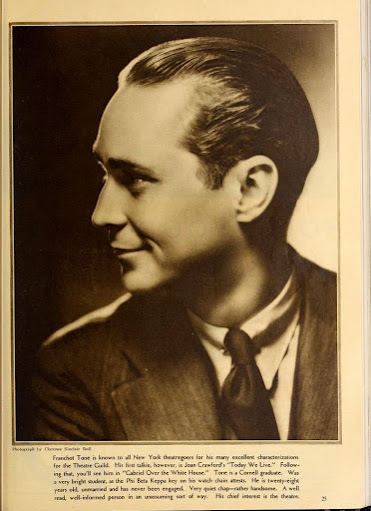 |
| Modern Screen, 1933. |
 |
| Photoplay, 1933. |
 |
| Modern Screen, 1933. |
The New Movie Magazine reviewed the film stating:
Joan belongs in pictures of this type; that's what you're going to say when you see her. She can do all that a star is asked to do, and she does; but when she has a real story, with clever character actors around her, shading her role with the sympathy and humor that it needs—then Miss Crawford can supply some of the finest entertainment that is available in motion picture theaters today.
Today We Live is on DVD from Warner Archive and can be purchased through most online DVD retailers.

