Showing posts with label genealogy. Show all posts

Sunday, May 27, 2018

Franchot's World War II Draft Card

Today I discovered Franchot's World War II draft card on Fold3. Fold3 is an online database of historical military records that I've used often for my own family history research. Knowing Franchot didn't serve in the war, I hadn't even considered that his draft card would be there. Fold3's basic access is free but some items are limited to those with a paid subscription. Check with your local library to see if it has a subscription for patrons to use—I used my own public library to access Fold3 today! (This post is not an ad for or sponsored by Fold3. I just like to cite my sources.)

Ok, on to the record...


The card is labeled order # 1301 and serial # 272. It is dated October 16, 1940 and Franchot has added his distinctive signature at the bottom. Franchot is 35 years old and employed by Universal Pictures, Inc. at Universal City studios in Los Angeles, California. At the time, Franchot's address is 470 No (I think this stands for # here) Layton Drive in Los Angeles, California. His phone number is GL-3115—don't you wish you could just call him up and have a chat?

When I Google his address, all that gets returned is the alternate address of 470 Layton Way in Los Angeles, a plantation-style mansion designed by architect John Byers for wealthy Phillip Ilsley, who lived in it beginning in 1937. Actor Wayne Morris and his wife Leonora "Bubbles" Hornblow lived there after their marriage in 1939, but divorced soon after in 1940. I don't know how Franchot could've lived in this house at the time, logistically, but with its immaculate landscaping (it included a waterfall, tennis court, and pool) it certainly seems like the type of house Franchot might occupy, short or long term. It is probably that Google is leading me in the wrong direction since a lot of streets change over time. When he registered to vote the same year, Franchot listed his address as 10333 Wilshire Boulevard. 1940 was an interesting year for Franchot. He was fresh from his recent return to the stage and only made one film that year, the western comedy Trail of the Vigilantes. He was single and seen around town with many gorgeous and talented Hollywood ladies (including Carole Landis and Olivia deHavilland) during that time. My point is that he was playing the field in romance and his career at the time, so it is very likely that he was also not settled in one residence or another.

He lists his father as a further contact and places his father at the family home on Buffalo Avenue in Niagara Falls, New York.


On the Registrar's Report side, we get a physical description of Franchot. With mostly black and white photos available, you may have wondered about the color of his eyes...they are hazel, his hair brown, and his complexion light. He's just shy of 6 feet tall and weighs 160 pounds. A kidney scar is listed as another identifying body marker. Franchot seemed to have major kidney issues. I'm not sure if this was a medical issue independent of his drinking habit or due to it. In his book, Elia Kazan makes mention of Franchot having an issue with his kidneys (and with drinking binges) as early as the Group Theatre days of the early 1930's. I am not sure when Franchot acquired the scar, but he had additional medical issues from 1938 to 1941.

Just before his 33rd birthday, in 1938, doctors advised the ailing actor that "rest, strict diet and avoidance of all exercise" were "essential" to recovery of a non-disclosed, serious illness.

On July 24th, 1941, not even a full year after this draft card was completed, Franchot was stricken by extreme pain and had to undergo an immediate "major abdominal operation" at Good Samaritan Hospital. Following the operation, the Los Angeles Times reported that Franchot was "as good as can be expected." If the draft record had been completed in October 1941, the identifying body markings field would indicate an additional scar from that operation.

On September 9, 1941, the Los Angeles Times reported that Franchot had recently recovered and was no longer hospitalized. It said he was set to begin filming of Eadie was a Lady with Rita Hayworth and John Hubbard, a project that did not come to fruition. (Eadie was a Lady would be released in 1945 starring Ann Miller, Joe Besser, and William Wright.)


Despite completing his draft card immediately after the Selective Training and Service Act of 1940, Franchot did not serve in World War II. The records do not indicate which draft classification he received, so I am not sure if he was deferred for any reason or why he did not serve.

Franchot—who would marry Jean Wallace in 1941 and start a family—was a prominent war bond seller across the country, served on charitable committees and entertained the troops. I will write about his contributions on the homefront in another post.

Sources:
  • Clippings. The Los Angeles Times. July 5, 1937; February 11, 1938; July 26, 1941; September 9, 1941.
  • Fold3: https://www.fold3.com/title/816/wwii-draft-registration-cards
  • Kazan, Elia. Elia Kazan: A Life. New York: Knopf, 1988.
  • Paradise Leased: https://paradiseleased.wordpress.com/2011/01/03/lost-hollywood-a-swimmingly-grand-estate-in-brentwood-heights/
  • "Tone Undergoes Major Operation." Los Angeles Times. July 25, 1941.


Friday, August 25, 2017

Pamp in the 1925 Cornelian

A few years ago I shared Franchot's senior photo from Cornell University's 1927 yearbook (shared here again lower in this post.) Today I stumbled upon a group photo that includes Franchot in the 1925 yearbook!

I know it's small, but Franchot is second row from the bottom and third from the left in this Alpha Delta Phi photo from 1925.
 
Here's an enlarged view of Franchot with classmates.
 
And here's 20 year old Franchot alone.
And resharing in case you missed it in an earlier post, here's Franchot two years later at 22 and a senior in college.
 

The 1925-1927 yearbooks shed light on Franchot's activities at Cornell University. Classmates used the nickname of "Pamp" for Franchot. This nickname was also reported in an early 30's fan magazine. Here's the story of how Franchot came to be Pamp, according to The New Movie Magazine:
He's Pamp because a kid cousin, Betty Franchot, couldn't negotiate the double consonants of Franchot and dogged her handsome young relative's footsteps piping 'Pampo...Pampo!'
'Sounds like a cocker-spaniel or something!' cracked another cousin and watched to see if Franchot would wince. Not a twitch. The kid could take it! So the clan graciously elided the nickname to "Pamp" and it's stuck.

He was a member of Alpha Delta Phi, Phi Beta Kappa, Phi Kappa Phi, and Kappa Beta Phi. Franchot was also active in the Sphinx Head society, Book and Bowl, Savage Club, and Dramatic Club. After years as an active member, Franchot served as the President of the Dramatic Club in his senior year. There are some very small photos of students acting in plays throughout the yearbooks, but I have been unable to identify Franchot in any of those photographs. I'm sure he's there somewhere and if I am able to spot him, I'll share those later.

Any new photo of Franchot is exciting to me and the non-Hollywood ones are even rarer. I'm hoping careful inspection of these yearbooks might lead me to spy Franchot hidden away in other group photos.

Monday, April 17, 2017

Gatineau Treasure

Last year, I wrote about Franchot's ties to the Gatineau region of Quebec. Franchot always spoke fondly of his time outdoors fishing on the Thirty-One Mile lakes, hunting in the woods, and relaxing in his cabin there. Franchot escaped his hectic life in Hollywood by returning to this region and shared its beauty with all four wives, spending several of his honeymoons here. It's easily one of my favorite aspects of Franchot's life to research, because it's so in contrast to the gentleman role in which he was often typecast and because it seems like such a joyous place for him. My original detailed post on the Tone family cabin and Franchot's visits can be found here. Franchot's fourth wife Dolores Dorn described her honeymoon there and I wrote about that here.

Recently, multiple 16 mm film of home movies belonging to Franchot's brother, Jerry, were up for auction on eBay. Most of the film was dedicated to Jerry's family with glimpses of Franchot's parents here and there. I didn't see any indication that Franchot would appear in most of the reels. Then, I saw one small preview picture of a 1938 reel from Gatineau and there he was with a huge grin on his face fishing from a boat. There was also a separate film of Gatineau from 1935, but I doubted Franchot would pop up there because '35 was a busy year for him. I bid on both despite the fact that I have no means to play or transfer 16 mm film. My plan was to find a way to transfer the film to digital, so that I could share the videos here. I bid as high as I felt I could, but a more competitive bidder took it home instead. eBay can be quite an emotional roller coaster! Ever since the auction ended, I've gone back and forth between devastation that I didn't bid just a little bit higher and relief that I didn't bid above my means.

Sadly, I didn't win but my hope is that the person who did win was either 1. Franchot's family (and if so, I apologize for the bidding war!) 2. a library or archive or  3. a fan like me who plans to transfer the film for others to enjoy.

I did, however, save the preview shots that were posted on eBay and they give a wonderful view of life at Franchot's family cabin in Canada!

From the 1938 color reel:
Franchot fishing. I love this candid shot!


Franchot with his father Frank J. Tone


Franchot's father Frank J. Tone and brother Jerry
 
I did not see any indication that Franchot appears in the '35 film, but it still gives a wonderful view of what vacation life was like for the Tones there. From the 1935 black and white reel:


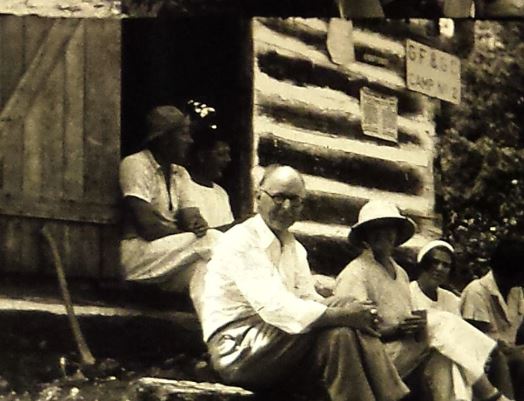
Franchot's father Frank J. Tone with other family members


Don't forget that my Franchot Tone Blogathon happens later this week! Check back this weekend for great entries on Mr. Tone from multiple bloggers.

Saturday, October 22, 2016

A Political Ancestry: Franchot & Politics

For this week's (belated) entry into my Franchot & Politics series, I'd like to share with you some biographical sketches on the political figures of Franchot's maternal family. Franchot's grandfather and great grandfather held Republican seats in the Senate and Congress, respectively. Franchot's mother was a progressive liberal who fought for women's equality and was an anti-war activist. Franchot's uncles also had political positions.

Note: Since Franchot is the given name of the main subject of this blog and the surname of his ancestors, I will avoid confusion by using Franchot Tone's ancestors given names. Also, Franchot Tone's full name was Stanislaus Pascal Franchot Tone, a name passed down through generations. In some sources, I've seen Pascal spelled as Paschal. For the purposes of this blog, I am going to stick with the spelling that Franchot Tone used: Pascal.

Richard Hansen Franchot (1816-1875)-Franchot's Great Grandfather
Richard Hansen Franchot, Franchot Tone's great grandfather.
Source: www.geni.com
Born in Otsego County, New York in 1816, Richard Franchot was the well-educated son of French emigrant Stanislaus Pascal Franchot. A civil engineer, Richard was engaged in mercantile and manufacturing before becoming a member of the Thirty-seventh Congress, representing the Nineteenth District of New York from 1861 to 1863. He had also served as a general in the U.S. Volunteers.

His business and civil engineering interests led Richard to help form the New York Central railroad and become an important member of the Pacific Railroad Committee.  After leaving Congress, Richard was hired by railroad magnate Collis Huntington to lobby Congress to enact legislation that would support the Central Pacific. Author Stephen E. Ambrose, in his book Nothing Like It in the World, suggests that Richard Franchot was more than likely the first paid lobbyist and that he made quite a lot of money in this new role.

This description of Richard in Notable Men in the House is reminiscent of some comments I've read about his great grandson Franchot:
And notwithstanding his quiet ways and unpretending manners, he was well known in the political canvasses of those days as an intelligent and effective platform-champion of his party. Although born and bred a gentleman, and accustomed from infancy to the most refined and elevating associations, he early learned to know and appreciate the great, true heart of the masses, and the people loved him; and in this was the mighty secret of his political success and power.
Stanislaus Pascal Franchot (1851-1908)-Franchot's Grandfather
Stanislaus P. Franchot, Franchot Tone's grandfather.
Source: National Library of Canada.
Stanislaus Pascal Franchot, often referred to in print as S.P., was the son of Congressman Richard H. Franchot. A civil engineer by education, S.P. was involved in lumber, oil producing, mining, and chemical businesses. He patented an electrolyte process for manufacturing and managed the National Electrolyte Company.  A police commissioner in Niagara Falls in the early 1900's, S.P. was elected to the State Senate, representing the Forty-seventh Senate District, in 1906.

S.P.'s brother Nicholas Van Vranken Franchot (1855-1943) was a delegate to the Republican National Convention in the 1890's and in 1905, was appointed New York State Superintendent of Public Works. N.V.V. Franchot also served as mayor of Olean, New York.

S.P.'s children were Edward Eells Franchot, Nicholas Van Vranken Franchot II, and Gertrude Van Vranken Franchot (Franchot Tone's mother.)

S.P. passed down the political involvement he had acquired from his father Richard. Son Edward was a delegate to the New York State Constitutional Convention and son Nicholas was a member of the New York State Assembly.

Gertrude Van Vranken Franchot Tone (1876-1953)-Franchot's Mother
Gertrude Franchot Tone, Franchot's mother.
Source:The New Movie Magazine.
Like her father and grandfather before her, Gertrude Franchot was passionate about politics. Unlike the male Franchots, however, Gertrude was a progressive liberal who was an early champion for women's rights. 

Gertrude led the Suffragists' State Convention in 1917. Involved in the Women's International League for Peace and Freedom in 1915, Gertrude was a key member during the formation of the Women's Peace Society in 1919. Gertrude became an active member and served as treasurer of the new Women's Peace Union of the Western Hemisphere in the 1920's. According to a letter the union submitted to The Nation in 1921, members differentiated the two groups in this manner: The Women's Peace Society focused on education while the new Women's Peace Union would work on "political and economic lines." To join the Women's Peace Union, Gertrude made the following affirmation:
I affirm it is my intention never to aid in or sanction war, offensive or defensive, international or civil, in any way, whether by making or handling munitions, subscribing to war loans, using my labor for the purpose of setting others free for war service, helping by money or work any relief organization which supports or condones war.
Not content to be the stay-at-home wife of wealthy businessman Frank J. Tone, Gertrude welcomed WPU-related travel to Washington, D.C. and New York City. A financial advisor for the union, Gertrude was often in charge of lobbying for the group.

I've read that when Franchot was in NYC he would avoid dining at restaurants where his mother publicly crusaded. I don't know if that's true or not. Gertrude certainly seemed to live an interesting personal and political life (I requested some additional books that mention Gertrude, but they did not arrive at my library in time for this post.) Franchot contributed to many war relief organizations and sold war bonds during World War II, so I wonder if, given his mother's formal affirmation to the WPU, Franchot's support caused any minor or major rift with Gertrude. It would seem to me that Gertrude would've disliked Franchot's role as a WWII pilot in Pilot No. 5, but liked his non-fighting pacifist in The Hour Before the Dawn.

Franchot Tone and the Screen Actors' Guild

As you can see, Franchot Tone came from a long line of politicians and political activists. The Franchot family was involved in many historic American moments. Richard Franchot helped form and support the Transcontinental Railroad and his granddaughter Gertrude fought for women's right to vote. Franchot must have been shaped by his ancestors' political history. By pursuing a career as an actor, Franchot broke the chain of political positions, but never abandoned his well-versed knowledge in political history and support of social causes. Many of his films and plays take place in a political setting or take on political issues. Also, Franchot was active in the Screen Actors' Guild.

In 1937, Franchot joined the negotiating committee of the Screen Actors' Guild and fought (and succeeded) to get the Guild officially recognized by studio heads. He served as a prominent board member of SAG until the following by-law was passed in 1946:
no actor or actress who becomes a motion picture producer or director and who, in the judgment of the Board of Directors after a hearing and full examination of the facts, is found to have primarily and continually the interest of an employer, rather than that of an actor, shall hold office in the Screen Actors Guild.
Once this resolution was passed, Franchot, James Cagney, Dick Powell, Robert Montgomery, John Garfield, Harpo Marx, and Dennis O'Keefe all resigned. Since the resigned Robert Montgomery had been long-time president, the board of directors held a secret vote and replaced Montgomery with future U.S. president Ronald Reagan.


Next week, I'll be covering the 1962 Preminger film Advise & Consent, in which Franchot plays the president, for Pop Culture Reverie's Hail to the Chief Blogathon. Additional posts I've written in my Franchot & Politics series include:


Sources:

  • Alonso, Harriet Hyman. The Women's Peace Union and the Outlawry of War, 1921-1942. Syracuse University Press, 1989.
  • Ambrose, Stephen E. Nothing Like It In the World: The Men Who Built the Transcontinental Railroad 1863-1869. Simon and Schuster, 2000.
  • "Franchot Family of New York." Political Graveyard. www.politicalgraveyard.com/families/18090.html
  • Glyndon, Howard. Notable Men in the House: A series of sketches of prominent men in the House of Representatives, members of the Thirty-seventh Congress. Baker & Godwin, 1862.
  • Greiner, James. Subdued by the Sword: A Line Officer in the 121st New York Volunteers. SUNY Press, 2012.
  • Guide to the Mary E. Gawthorpe Papers. The Taminent Library & Robert F. Wagner Labor Archives. http://dlib.nyu.edu/findingaids/html/tamwag/tam_275/
  • Hills, Frederick Simon. New York State Men: Biographical Studies and Character Portraits. Argus Company, 1910.
  • Hoffman, Ethel. "Pamp Tone Makes Good." The New Movie Magazine. October 1934. 54-55.
  • Hubbard, John T. and James W. Geary. Biographical Dictionary of the Union: Northern Leaders of the Civil War. Greenwood Publishing Group, 1995.
  • Richard Hansen Franchot Genealogy. https://www.geni.com/people/Brevet-Brig-General-Richard-Franchot-USA/6000000012697659426
  • Screen Actors' Guild Timeline: 1930's. http://www.sagaftra.org/sag-timeline-1930s
  • Screen Actors' Guild Timeline: 1940's. http://www.sagaftra.org/sag-timeline-1940s
  • "The Women's Peace Union of the Western Hemisphere." The Nation. September 21, 1921. 321.

Monday, September 5, 2016

Franchot's Ties to the Gatineau Fish & Game Club


"I love every stick and stone in this wonderful country."


Spurred on by an interesting discussion with Ann on the Finding Franchot Facebook page (thanks, Ann!), I've been researching Franchot's ties to the Gatineau Fish & Game Club in Ottawa for the past few weeks. I have always been intrigued by Franchot's connection to the Canadian wilderness, because the land and activities there seemed to be such an important part of Franchot's life. I love that Franchot had this love of land, solitude, and survival so deeply embedded in him and how greatly it contradicts those journalists and critics who incorrectly peg Franchot as a rich playboy and little else. My research is by no means complete, but I thought you might like to see what I've discovered so far.

Background
The Gatineau Valley Historical Society has published many interesting articles on the Franchot and Tone families in its Up the Gatineau! publication. Archie Pennie and Carol Martin, in their article "A Century of the Gatineau Fish and Game Club," described S.P. Franchot's (Franchot Tone's grandfather) involvement:
On March 5th, 1894, four Quebec businessmen met in Hull, Quebec and decided to form a hunting and fishing club on Pemichangan and Thirty-One Mile Lakes in northern Quebec. They were Alexander Maclaren of Buckingham, and Dr. W. F. Scott, Charles Leduc and J. M. McDougall of Hull. The original membership included four others to make a total of eight charter members: Albert Maclaren of Buckingham, S. P. Franchot of Niagara Falls, N.Y., and John Scott and Joseph Bourque of Hull. On June 27, 1894, a meeting of the stockholders was held and it was agreed that the Club should lease these two lakes from the Quebec Government for a period of ten years at a rate of $500 per annum. Incorporation of the Gatineau Fish and Game Club dates from November 16 of that year.
Pennie and Martin's full article, which goes into detail about the Club and its early days, can be found online here.

Franchot's maternal grandfather S.P. Franchot was an impressive man. The son of a congressman, S.P. would be a civil engineer, businessman, patent holder for his electrolyte process, and senator before his death in 1908.

In various early Hollywood articles, Franchot Tone mentions spending his childhood summers in Canada and in 1937, Franchot's father Frank Jerome Tone purchased additional property (the estate of W.W. Butler) on the club limits.

Newspaper Mentions of Franchot's Involvement
From the Montreal Gazette on July 23, 1940:
When Franchot Tone wants a holiday he picks for real pleasure a fishing trip in Ontario…Mr. Tone arrived at St. Hubert Airport yesterday afternoon, visited Montreal briefly and left by plane for Ottawa at 7 o’clock. In Ottawa he is to meet his father, Frank J. Tone, of Niagara Falls, N.Y., and the two of them will spend two weeks, maybe three, fishing and relaxing with perhaps a little golf on the side…born in Niagara Falls, Mr. Tone knows that part of Ontario just across the border pretty well, having spent his summer holidays from the age of three to 23 around there.
In Ottawa Citizen, May 19, 1960:
As you read this column (Rod and Gun by Vern Bower), Cliff and I will be in the far north of the Eagle Depot country with a group of friends including actor Franchot Tone…and mayor Jean Paul Desjardins of Gracefield. We move north from our Danford Lake headquarters to Kazabazua Creek, then sweep north to the Picante and from there we push on to Cayamant and on into the Eagle…Our headquarters will be in a cedar cabin, sweet-smelling because it was built from the reclaimed timber of a barn. Very unusual, and in a long stretching line, will be the tents in which Franchot Tone and his friends prefer to live while in Canada.
On August 28, 1960, the New York Times reported:
Henrik Ibsen’s rarely staged “When We Dead Awaken” will be rehearsed at a fishing camp in the Canadian wilds…Franchot Tone, who will be starred, along with Viveca Lindfors and Betsy von Furstenberg, has invited the cast to his fishing retreat at a lake near Gracefield, Que., about sixty miles north of Ottawa.
From the Montreal Gazette on June 2, 1966:
MLA Fournier has not been alone in his efforts to develop the county’s full potential as a mecca for Canadian and American tourists. He has had the valued support of veteran Hollywood actor Franchot Tone, who maintains a year-long residence in the Gracefield area.
In the Ottawa Citizen's obituary of Franchot in 1968:
Stage and screen star Franchot Tone, whose second home from early childhood was the Gatineau area, died at his home in New York City Wednesday of lung cancer...Tone sought privacy away from the gossip columns in the Thirty-One Mile Lake area 28 miles south of Maniwaki. His father was one of the first to build a summer home on Thirty-One Mile Lake near Gracefield, Quebec. Eventually the camp on Thirty-One Mile Lake became the Gatineau Fish and Game Club. Tone visited the area annually in the summer and fall to fish and hunt moose. He held a lease on at least a dozen good trout lakes. He sometimes visited Gracefield area in winter to hunt wolves on snow sleds. He was an excellent outdoorsman. When rehearsing a Broadway play, he would frequently invite the cast to Thirty-One Mile Lake for long weekends. He was a lifelong friend of the late Jean Paul Desjardins, mayor of Gracefield for many years. "I love every stick and stone in this wonderful country," he once said. 


Joan Crawford's Visits
It is possible that Franchot first showed Joan the Gatineau area in 1933, but I cannot prove it. When they were dating in November 1933, Franchot and Joan visited New York together. It's possible that Franchot would've taken this holiday to show Joan the Canadian home that he loved, too.

In July 1940, the Ottawa Citizen reported that Franchot was in the Gatineau Valley area on a vacation with his father and that he would be there for several weeks. In August 1940, the Ottawa Citizen included the headline,"Joan Crawford Pays Surprise Visit to Ottawa." The article read:
Recognized by only a few Ottawa people though she passed hundreds on foot and while driving around the Capital during an automobile ride, Joan Crawford, titian haired star of the screen, paid a flying visit to this city yesterday to do some shopping at the end of a four-day visit to the Ottawa district and Gatineau Valley, where she enjoyed what she termed a ‘real Canadian holiday’…Miss Crawford, who came to Canada unaccompanied, spent the greater part of the afternoon in Ottawa and left by train for New York. During her short stay here she was escorted by D. Leo Dolan, director of the Canadian Travel Bureau, and an old personal friend who had met her in Hollywood.
Something tells me that Franchot and Joan vacationed a bit together during this surprise visit. They were divorced at the time, but remained friendly, and Joan would visit the area with Franchot several more times after this. I've no proof, but I feel that there is no way Franchot would've been in the Gatineau Valley in July and August of 1940 and Joan would've been there in August and not been with each other at some point in their trips. I think they were just excellent secret keepers.

On March 26, 1955, the Ottawa Citizen stated about Joan:
As to Canada, she said she ‘adored’ Canada and particularly liked Lake Louise and Banff. She admitted being in Ottawa three years ago but ‘kept it quiet’.
Again, another trip to the region "kept quiet" in about 1952.

In June 1965, Franchot and Joan were photographed at the Jean Lesage International Airport after having vacationed together at Franchot's home in Gracefield. You can view those photos here.

Friends' Remembrances
John Strasberg (son of Lee Strasberg) wrote in his autobiography:
I don’t remember feeling any peace or harmony from the moment we moved back to New York in 1947 until I began spending summers in Canada with Franchot Tone when I was twelve. We hunted and fished, camping in Quebec’s wilderness country. Franchot’s wealthy industrious family owned three houses that sat on the ridge of land between two lakes that were part of the Gatineau Fish and Game Club, near Gracefield, Quebec. We portaged deep into land that he owned, smearing honey under the canoes of poachers so that the bears would destroy them. Franchot became one of my heroes, once I realized that heroes could be human…He exposed me to a world that I loved and felt at home in…Above all, he taught me that work is part of one’s natural respect and love of human life, but it is not a way to ignore it or dominate it.
In his autobiography, actor Burgess Meredith wrote:
There were also some quiet times in Canada at his hunting lodge. Tone had a secret side to him. It was his love of the Canadian woods. He was a fine woodsman.
Today
Franchot's family still owns property and is active in the Gatineau area. Franchot's grandson (also named Franchot Tone) performed at the Gatineau Fish and Game Club in 2013.

Sources:
  • The Concluding Chapter of Crawford: http://www.theconcludingchapterofcrawford.com/1965.html
  • Hills, Frederick Simon. New York State Men: Biographical Studies and Character Portraits. Vol. 1. 158-159.
  • Ottawa Citizen: November 16, 1933, July 20, 1937, July 23, 1940, August 28, 1940, March 26, 1955, May 19, 1960, June 2, 1966, September 19, 1968.
  • Meredith, Burgess. So Far, so Good: A Memoir. Boston: Little, Brown, 1994. 72-76. Print.
  • Pennie, Archie and Carol Martin. "A Century of the Gatineau Fish and Game Club." Up the Gatineau! Vol. 21: http://www.gvhs.ca/publications/utga-a-century.html
  • Strasberg, John. Accidentally on Purpose: Reflections on Life, Acting, and the Nine Natural Laws of Creativity. New York: Applause, 1996. Print. 8-9.

Tuesday, February 23, 2016

Franchot Tone's Early Life in Niagara Falls

Franchot was born on February 27, 1905 in Niagara Falls, New York. His father Frank Jerome Tone was the Works Manager and President of the Carborundum Company and made many scientific and technological contributions. There's an impressive bio on Frank J. Tone here. Franchot's mother was Gertrude Franchot Tone and he had an older brother named Frank Jerome "Jerry" Tone.

Franchot as a boy.
This photo originally appeared in a 1930s fan magazine.
I saved it, but I cannot find the original article in my files today.
It's somewhere in the Media History Digital Library database. http://lantern.mediahist.org/
 

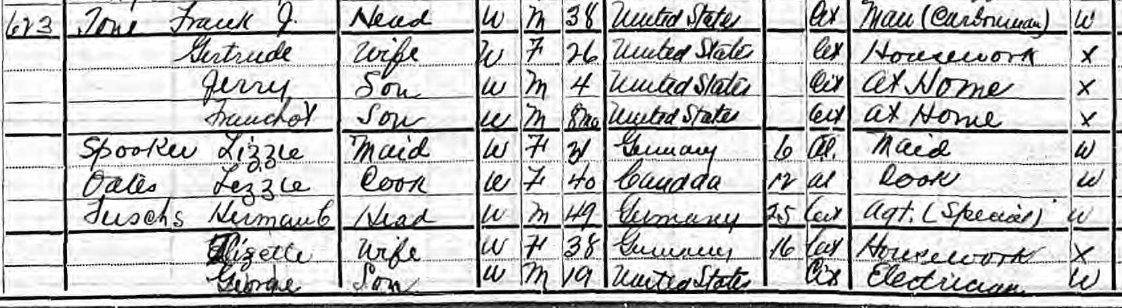
The 1905 New York Census shows an 8 month old baby Franchot living with his father Frank J., mother Gertrude, and brother Jerry at 613 Buffalo Avenue in Niagara Falls, New York. Franchot would later describe his street as the "main residential street of Niagara Falls" running from "the Falls and passes the Shredded Wheat factory. This is one of the points of interests for visiting tourists, so this particular street carried a lot of traffic". Also in the house are Lizzie Spooker, a German maid, and Lizzie Oates, a Canadian cook. The state census also shows a Tusch family and does not give them a separate street number. Herman Tusch is a special agent (am I reading that right?), so I'm not sure if or how he is connected to the Tones. There are other Tuschs at residences near the Tones, so I don't know if this is a census error or if the Tuschs indeed lived in the Tone residence.
1905 New York Census, www.ancestry.com
 
The 1915 New York Census shows the Tone family on the same street, but with a different street number. Frank J. Tone is still the head of the Carborundum Company, with wife Gertrude, 13-year-old Frank J. "Jerry", and 9-year-old Franchot. In their household at this time is an English maid named Georgiana Pittman and an Irish cook named Anna H. Ryan. In this census, there are many Franchot households around the Tone residence (Franchot being Gertrude Tone's maiden name).
1915 New York Census, www.ancestry.com
In the article, "I've Always Been a Show-Off" attributed to Franchot and published in Hollywood Magazine in 1935, Franchot shared the following childhood memories:

I can remember when I was only four years old. I was taken to a summer resort in the Canadian woods. Some boys were trying to spear fish and I was watching them. Suddenly I looked up, and there was a beautiful little girl standing a few feet away. Immediately I grabbed a spear and tried to show how good I was. Instead, I went in head first. Of course, I was too young to know how to swim and actually I was going down for the third time when my nurse came along and jumped in after me. She couldn't swim either but she managed to hold me up until help came...
 Another time I remember when some new people moved in next door to us. They had a boy just about my age and, of course, I was curious to know what he was like. He played in his yard and I played in mine. I kept watching him out of the corner of my eye, but whenever he looked over, I would assume the most innocent air of indifference. One day a truckload of coal arrived. The boy next door completely ignored me by concentrating on the man emptying the coal into the basement. I had a new bicycle, so I ran and jumped on it. I pedaled furiously and tried to do all sorts of fancy tricks. Then something happened. The wheel gave a sudden twist and I found myself sitting in the middle of the coal-chute.

Sources:
  • Tone, Franchot. "I've Always Been a Show-Off". Hollywood Magazine. June 1935. Page 23, 55.
  • New York State Archives; Albany, New York; State Population Census Schedules, 1915; Election District: 01; Assembly District: 02; City: Niagara Falls Ward 02; County: Niagara; Page: 21
  • New York State Archives; Albany, New York; State Population Census Schedules, 1905; Election District: E.D. 02; City: Niagara Falls Ward 01; County: Niagara; Page: 11

Thursday, May 21, 2015

Franchot's Parents: The Love Letters

Franchot was born to Frank Jerome Tone and Gertrude Franchot Tone. Some research has been compiled on Frank Tone, a prominent Niagara Falls resident and president of the Carborundum Company. One article that I came across references a collection of sweet and meaningful love letters sent from Frank to Gertrude and dating back to 1890. You can read Bob Kostoff's article "The Unabashedly Romantic Frank Jerome Tone" and view a photo of Franchot's father on NiagaraHub.