Showing posts with label newspapers. Show all posts

Tuesday, June 16, 2020

Franchot Visits Birmingham, Alabama

Photo of Franchot that
accompanied the article.

In February 1950 Franchot traveled to Birmingham, Alabama to promote The Man on the Eiffel Tower. It was a whirlwind one-day press tour of the city including multiple newspaper and radio interviews, a special luncheon at the Downtown Club, a cocktail party at Tutwiler Hotel where his suite was located and ended the evening by making a personal appearance at the Linley Heflin Unit Mardi Gras Ball which was held in the Municipal Auditorium. By midnight, Franchot was on a plane to New York where he was slated for business meetings with friend and TMotET director Burgess Meredith.

With Birmingham press, Franchot shared that he felt his youngest son Jeff might become an actor. Franchot added that Jeff enjoyed "mugging" and always put on a great show every Christmas that his aunt Karol (Jean Wallace's younger sister and only a child herself) would direct in front of the family Christmas tree.

On producing The Man on the Eiffel Tower, Franchot said:

Production, I like, because a producer can assure himself of more interesting parts. You'll like Man on the Eiffel Tower. It's not a mystery but a suspense picture. And Charles Laughton's not the villain. I am!

Interestingly, Franchot shared that his business meetings with Burgess Meredith in New York were to plan for their next film. Burgess was set to direct and Franchot would produce and act in a film version of the novel The Song of the Flea. They planned to begin filming it in London within a year or two. A film adaptation of The Song of the Flea never happened (perhaps due to the Payton love affair and the events that it caused.)  I have a special fondness for Franchot's work as a producer (The Man on the Eiffel Tower, Uncle Vanya) and co-director (Uncle Vanya) so it is a shame this other opportunity never came to fruition. It not only would've been a creative venture for Franchot, but he would've also enjoyed working with best friend Burgess Meredith on it. The Song of the Flea was written by British novelist Gerald Kersh whose most famous work Night and the City was made into a 1950 film starring Richard Widmark and again as a 1992 film starring Robert de Niro. I cannot find any proof that The Song of the Flea, which focused on a writer struggling to succeed, was ever adapted for film.

You can read more about The Man on the Eiffel Tower here .

Source:
Caldwell, Lily May. "Franchot Tone Visits Here, Talks of Kindness." The Birmingham News. February 18, 1950.

Sunday, May 10, 2020

Franchot headlines the Mark Twain Festival

Franchot's lecture was the highlight of the Mark Twain Festival that took place at Elmira College from October 12th to October 14th, 1960. Franchot's presentation was titled "An Actor's Approach to Mark Twain" and was scheduled for 8:30 p.m. on Friday, October 14th at the Emerson Building auditorium.

Ad for Franchot's lecture. Source: Elmira Telegraph. October 9, 1960.

Franchot was requested for the lecture after gaining rave reviews for his performance as Mark Twain in Horton Foote's "The Shape of the River," which aired as a Playhouse 90 production on May 2, 1960.  Interestingly enough, the Playhouse 90 production that set Franchot up for this particular lecture was about Mark Twain preparing for the lecture circuit! Twain's niece said about Franchot, "He seemed more like my uncle than any of the many Mark Twain impersonators I have seen." Before the event, it was publicized that Horton Foote would accompany him, but I cannot locate any proof that Foote definitely attended. He's not mentioned in any of the interviews or articles about the presentation, so I'm not sure if he visited with Franchot or not.


The Shape of the River, 1960. Source: my collection.

Franchot started off his presentation by joking that the audience should bear with him as he spoke "from the top" of his head and that if everyone stayed until the end he would return the admission fee. It was later disclosed that Franchot generously returned both the admission fees and his lecture fee.

Franchot described how he prepared to play Mark Twain in "The Shape of the River" before reading Twain's "Roughing It." Next, Franchot read part of Susan Twain's essay on her father that explained how Mark Twain stopped going to church because "he couldn't bear to hear anyone else talk but him." After this essay, Franchot joked that once he knew that fact about Twain "all I had to do was let the ham in me out." Franchot also read from Twain's "The Mysterious Stranger" and "Jumping Frog of Calaveras County."

Franchot then showed several clips of Mark Twain, played recorded imitations and finally, played a recording of his very first rehearsal imitating Twain. In addition to the readings and conversation, Franchot screened clips of his television portrayal as Mark Twain.

500 people attended Franchot's lecture and called it "smooth...flawlessly imitating...eloquent speech."

Franchot at Mark Twain's grave in Elmira.
Source: Elmira Advertiser. October 15, 1960.

Franchot at Mark Twain's monument.
Source: Elmira Star-Gazette. October 14, 1960.

Before his presentation, Franchot took the time to pay his respects to Mark Twain. He chatted with reporters and citizens over breakfast at the Mark Twain Hotel, brought flowers to and visited the author's grave, and toured the author's study with Elmira College president Dr. J. Ralph Murray.

Franchot and Dr. J. Ralph Murray at the Mark Twain Study.
Source: Elmira Star-Gazette, October 14, 1960.
Franchot had arrived in Elmira the night before his presentation, on Thursday, October 13th. Reporters and fans met him at the airport. One fan handed him a tiny piece of paper and asked for an autograph for his son. Seeing the size of the paper, Franchot joked, "Well, your son must be a very little boy!" Franchot signed the small paper and was proud of his handiwork. When he finished, he remarked, "There! I could have gotten it on the head of a pin."

Franchot was questioned about the speech he was due to deliver the following night. What would he say on stage? Franchot encouraged the crowd to "come up to the college to hear my speech and you'll find out what I'm going to say. Everything I'm going to say will be completely ad lib. I haven't anything prepared—I think a lecture loses its freshness if it's prepared."

One spectator didn't seem to understand the notion of ad lib and caught Franchot off guard when he asked, "How long does it take to prepare an ad lib speech?" Franchot laughed and responded, "Well, you've got to think about it for a long time."

Members of the Thomas A. Edison High School Thespis club were able to enjoy breakfast with Franchot while he was in town and called him "delightful." Elmira resident Helen Brown asked reporter Peggy Gallagher to relay to Franchot Tone that she loved him to which Franchot replied, "That's one thing I never get tired of hearing."

For further reading and two more photos of Franchot at Elmira, you can read about what he said on politics here and what he said about choosing the acting profession here.

Sources:
"Appearing at Elmira College..." Elmira Telegraph. October 9, 1960.
Bannister, Sharon and John Gardner. "Edison Bits." Elmira Star-Gazette. October 23, 1960.
"College Taps Tone for Twain Festival." Elmira Star-Gazette. October 2, 1960.
"Franchot Tone Draws 500 for Mark Twain Festival." Elmira Advertiser. October 15, 1960.
Gallagher, Peggy. "Evenin' Neighbor!" Elmira Star-Gazette. October 17, 1960.
Gallagher, Peggy. "Franchot to Give Twain Tone." Elmira Star-Gazette. October 14, 1960.
Morken, Mary Lee. "Actor Long Acquainted with Twain." Elmira Advertiser. October 14, 1960.

Thursday, April 30, 2020

Franchot on Understanding the Acting Profession

Franchot over breakfast. Source: Elmira Star-Gazette.
Reporter Peggy Gallagher interviewed Franchot over breakfast on his first morning in Elmira, New York. He was due to give a presentation on Mark Twain at Elmira College that evening. When asked if he was comfortable portraying older men or father figures, Franchot assured that he felt very comfortable in the role and proudly talked of his sons Pat and Jeff:

And, the rascals! They both want to be actors...A useless profession! Unless you thoroughly understand it, of course. But, I don't see that they'll ever work their way out. They're thoroughly soaked in theater. 

Franchot went on to explain that although he'd prefer "physics, law, chemistry" for his sons, he would not have chosen a different life for himself.

But, that's what I mean—I understand it. Let me explain it this way: entertainment, as a function of escape for the human race, has been in its best times a signpost to the greater aspirations of which the human race is capable...how's that sound for 9:30 in the morning?

When Gallagher pressed for more meaning, Franchot answered:

It means the entertainment business makes dreams real—and it's the dreams of man which have made our world possible.

Franchot went on to share that he preferred the theater over film because of the "immediate relationship with the audience."

And when asked about the high point of his career, Franchot insisted that his high point was still to come.

There was a very wonderful book by the author, Christopher Morley, about a cocker spaniel named Mr. Gissing. Mr. Gissing lived in a valley. He kept looking at the hillside and at the blue beyond. He decided he wanted to climb the hill and find out where the blue began. But when he reached the top, doggone if he didn't find another hill!

The novel that Franchot refers to is Where the Blue Begins and was first published in 1922 and its author also penned the 1939 novel Kitty Foyle, which was brought to the screen with Ginger Rogers in the title role in 1940.

Franchot talked quite a bit with Elmira reporters (here's what he said about politics) and there is more to come about his presentation on Mark Twain!

Source:
Gallagher, Peggy. "Franchot to Give Twain Tone." Elmira Star-Gazette. October 14, 1960.

Tuesday, April 21, 2020

Franchot on Politics

Franchot Tone 1960
Franchot found himself in a sea of reporters and fans when he landed at an airport in Elmira, New York in 1960. Franchot asked them to gather in the airport waiting room, where reporter Mary Lee Morken said he "wrapped the crowd around him like a cloak" and answered questions. When Franchot was asked by a newsman whether or not he had ever participated in political work, Franchot responded:

I was one of the members of the Hollywood Democratic Committee. We were quite active. Melvyn Douglas and lot of others—I can't remember now. It was back about 1940. I think we were quite influential in breaking up—well, let me put it this way. We helped elect Olson, who was the first Democratic governor elected in California in 50 years. We helped break the way for Gov. Warren, one of the finest statesmen of our times.

When someone asked whether actors should even be "mixed up" in politics, Franchot is described as bristling and answering disdainfully:

I think every citizen should be 'mixed up' in politics.

Another person in the crowd broke the tension by asking Franchot if he'd consider playing Abraham Lincoln. Franchot made the crowd laugh when he answered:

I'd be afraid to play Lincoln. Any actor who plays Lincoln is never happy until they shoot him.

Franchot granted multiple interviews during his visit to Elmira College where he was speaking on Mark Twain and his performance as Twain in the television production The Shape of the River. I will be sharing more of Franchot's quotes from this trip as well as details of his itinerary over the next week.

Click here for previous posts on Franchot and politics.

Source:
Morken, Mary Lee. "Actor Long Acquainted with Twain." Elmira Advertiser. October 14, 1960. 

Saturday, September 14, 2019

Franchot in North Carolina

Last month, I was searching digital archives in California and New York and coming up with the same articles and photos I've seen time and again. I took a chance and searched my home state of North Carolina's digital archives, which I've never thought to do for Franchot before. And...
Franchot visiting Pat on campus.
Source: University of North Carolina at Chapel Hill Photographic Laboratory Collection #P0031,
North Carolina Collection Photographic Archives, The Wilson Library, University of North Carolina at Chapel Hill.

I was finding Franchot all over again! I knew that Franchot's oldest son Pat attended the University of North Carolina at Chapel Hill, but never even considered Franchot was sitting right in their archives.

Franchot visited Pat on campus in April 1964 and, fortunately for us, photos were taken of father and son and Franchot was interviewed by the local paper.

Franchot said:
Well, I just couldn't resist an opportunity to come down to Chapel Hill and spend a pleasant week with my son, Pat. Of course, since I've been here, I've been wearing out the pavement between the Carolina Inn and Swain Hall, and the only chance I've had to see Pat is during meals.
When asked about his acting career, Franchot said:
 ...just one of those things that happened. I was exposed to the old silent movies and I also had the opportunity of seeing a number of stage plays. After I would see a picture or a play, I used to go home and stand in front of a mirror and act out scenes for myself...Nowadays, an actor works in all the media. There are differences, of course. The stage actor must act with his whole body because the audience always sees him that way. In films and, to a large extent in television, the acting is in his eyes.
And what did Franchot think of Pat, who had been in several university plays, becoming an actor? Franchot smiled:
Who knows? He seems to have the bug, but he may come to his senses.
The reporter summarized his meeting with Franchot by writing:
By his own admission, he has found a full and complete life in acting, and he went out for the final rehearsal with an air of confidence and satisfaction which indicated he was doing the thing he loved best.
Franchot visiting Pat on campus. 
Source: University of North Carolina at Chapel Hill Photographic Laboratory Collection #P0031, 
North Carolina Collection Photographic Archives, The Wilson Library, University of North Carolina at Chapel Hill.
In a separate article, the Daily Tar Heel examined how the son of a movie star came to study in North Carolina. Bob Quincy reported that sophomore Pat Tone was making a name for himself with a javelin at UNC-Chapel Hill. The coach commented that Pat was "strong and works hard."

Quincy noted:
Pat and his actor dad spent several weeks together here recently...He and his son are quite close and spent many hours enjoying the good life. The Tones have a track background, and it began at the same institution. Both attended the Hill School in New Jersey*. Papa Franchot was a manager of the track team in his time. Pat excelled in weights and dashes.
*My note: The Hill School was actually in Pennsylvania. 


The javelin caught Pat's eye after watching UCLA athletes when visiting his mother Jean Wallace and he chose to move to North Carolina because a lot of his peers were moving south to attend school. Franchot must've approved this choice, because Pat notes:
Dad had gone to Cornell. But he is a very good friend of Paul Green, the playwright, who lives near the Carolina campus. They have worked together on many projects.

Shakespeare: A Portrait

I was already thrilled to my core to find these two articles and two photographs, but there's more! While he was in town, Franchot appeared in the university's 90-minute television show commemorating William Shakepeare's 400th birthday anniversary. The show was entitled Shakespeare: A Portrait and aired on the local WUNC-TV on April 23, 1964. It seems that the Chairman of the Department of Radio, Television and Motion Pictures requested Franchot's participation and Franchot accepted. Franchot praised the students and crew that worked with him on the project. I was unaware of this production and am now digging into whether or not a recording or photographs of it still exist in the university or WUNC-TV archives.

Sources: 
Digital NC: http://www.digitalnc.org/
Digital Public Library of America:  https://dp.la/
Hardy, William M. "Tone Kills 2 Birds with 1 Stone." The Daily Tar Heel. April 19, 1964.
Quincy, Bob. "Former Actor's Son Goes Own Way with NC Javelin." The Daily Tar Heel. April 18, 1964.

Monday, April 8, 2019

"Pandemonium" at 470 Layton Drive

When I was browsing fan magazine articles about Franchot and Carole Landis' relationship earlier this year, I stumbled upon this article about Franchot living at the Layton Drive address with photographs! This is the home listed on Franchot's World War II draft card (here) that I did a brief post on last year (here.) When Bubbles Schinasi and actor Wayne Morris called it quits leaving their home vacant and open to tenants, Franchot and his pal Burgess Meredith ("as gay a brace of bachelors as ever haunted the sleep of the countless impressionable co-eds throughout our wonderful democracy") moved in. Hollywood was surprised that two bachelors would take on a large, elegant property. Jimmy Durante even asked, "Those guys and that house—what have they got in common?"


How did they end up living in such style? Burgess settled into the extra room at Jimmy Stewart's Santa Monica house when he arrived in Hollywood for film work. Soon, photographer John Swope became Jimmy and Burgess' housemate as well. All men enjoying and being popular with the ladies, the house grew crowded fast. Buzz (as Burgess was known to friends) found a beach house in need of repairs to reside in, but Jimmy and John didn't want to break up the gang. It was decided that the beach house would just be for Buzz to sleep in, but the guys would all hang out at Jimmy's house during waking hours.

Then, Franchot arrived from New York and needed a place to stay. Franchot and Buzz were roommates in New York shortly after Franchot's divorce from Joan Crawford and remained lifelong friends. Both Franchot and Buzz were acting in plays at the time and found they shared equal passion for acting and being fixtures at the hottest nightspots. Buzz and Franchot decided to lease the Morrises' chateau, now nicknamed Pandemonium. Their neighbors included Nelson Eddy, Anna Sten, and Frank Capra. Franchot felt the place was perfect for his return to Hollywood as a bachelor.

Franchot and Buzz threw a cocktail party after getting settled in and locating domestic servants. In the article, the descriptions of the rooms are pretty exaggerated in comparison to the photographs. Yes, they are beautiful, large nice rooms, but Screenland refers to their living room as "Dali-esque." Their living room was described as a "surrealistic masterpiece...The walls were a pale blue set off by a gray carpet. Two disconsolate love seats done in yellow leather hugged the fireplace, over which a mural by Lee Blair (a South American cockfight framed in blue mirror) looked down..."
The living room.

Buzz's room was decorated in red and white walls ("calculated to woo sleep"), a sea green carpeted floor, and "flaming" draperies.
The bedroom of Burgess Meredith.

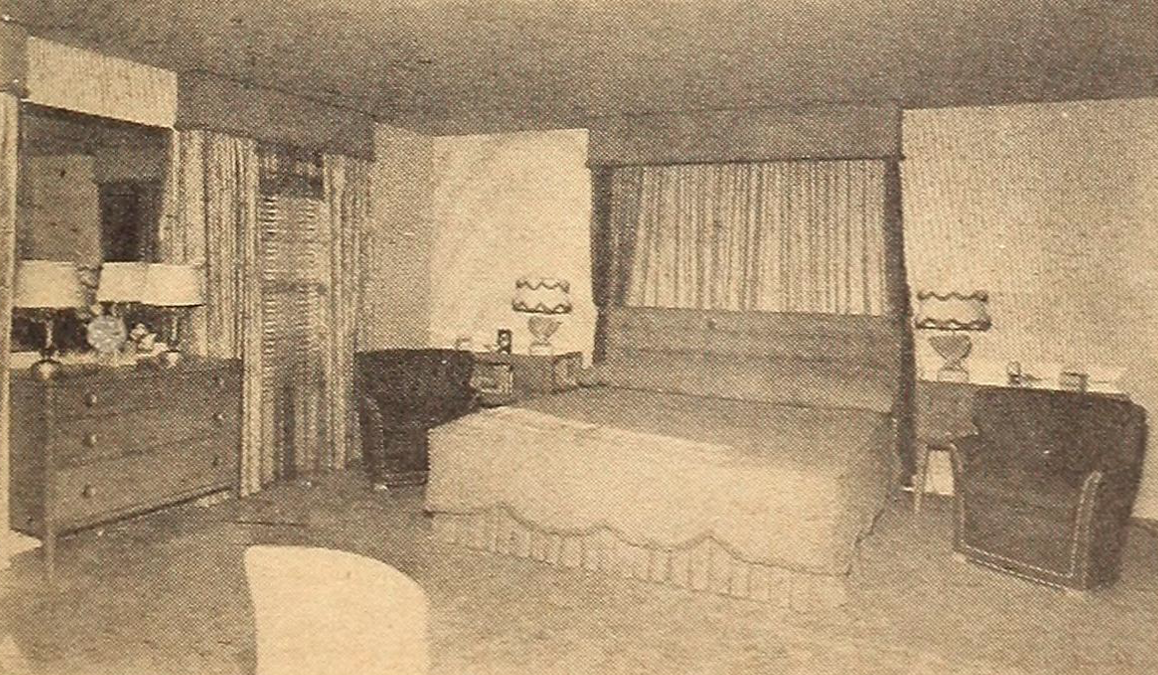
Franchot shared his room with a Great Dane named Bad Boy (pictured with Buzz and Franchot in the top photo), who used the former outdoor tennis court as his play area. Franchot's room would "stand up as the most sexy and glamorous bedroom in Hollywood...it houses the biggest bed in California—a little number measuring exactly ten feet long, ensconced on a pale grey rug and sporting a half-canopy of coral fish net...the walls are pale blue...the lights are soft and harem-like."
The bedroom of Franchot Tone.

Burgess would recall in his biography and he and Franchot "shared many a bottle and many a girl, both in New York and Hollywood, in our bachelor days. There were also some quiet times in Canada at his hunting lodge...But he enjoyed life to the end, loving and being loved by an army of fans and friends..."

Sources:
Franchey, John R. Hollywood's Gayest Bachelors! Screenland. May 1941. p. 28-29, 88. 
Meredith, Burgess. So Far, so Good: A Memoir. Boston: Little, Brown, 1994. 72-76. 

Sunday, October 28, 2018

Piecing together the technical story of Jigsaw

In late 1948, the publication American Cinematographer revealed the unique method in which Jigsaw was recorded. Jigsaw differed from the majority of American films being made at the time and was able to use a small budget to its advantage.

A film noir about a district attorney whose investigation into a suicide leads to a much more sinister plot involving political extremists,  Jigsaw starred Franchot, Jean Wallace, Myron McCormick, and Marc Lawrence. The film was made on a small budget, but what it lacked in budget it made up for in a Who's Who of cameo appearances. It featured cameos by Henry Fonda, John Garfield, Marlene Dietrich, Marsha Hunt, and others.

American Cinematographer praised Don Malkames, director of photography, for his skill at creating a lighting quality expected in studio films without fancy equipment and special-made sets. Journalist Norman Keane wrote:
This production demonstrates that feature films can be photographed in natural settings and locations...The natural locations were used because they afforded economy in production. Not a single set was built for the entire picture. Even the props were those found on the locations. The sites and locales used included interior of the Brooklyn Museum, a Fifth Avenue pet shop, a prominent night club, its dressing rooms, a large restaurant of unique design, an apartment house interior, elevators, and a warehouse...Every set was a challenge...none of the luxury lighting equipment of Hollywood studios. He [Don Malkames] had to get around the limitations of low ceilings of the apartment in which a great deal of the action took place, of the fixed walls of narrow halls and of elevators, and of the immovable fixtures, furniture, etc., which he invariably found in such locations as the pet shop. Before starting to shoot the picture, he had considered using mostly photo spot lamps and R-2 photofloods, but he found that even after building a number of barn doors and hangers for use with these lights, they would not give the precise lighting control necessary. 
Malkames used Mole-Richardson light spots, "inky dinks" for key lighting, and "150 watt broads for fill in light." Malkames secured lighting to ceiling beams to give scenes a more natural look and photographed the entire film with a fast lens in "exceptionally low key." He also used shafts of light to enhance the more suspenseful scenes.

Franchot said:
It is doubtful that there are many cameramen who could achieve the excellent quality of lighting that Malkames did, considering the lighting equipment he had to work with and the limitations of his sets.
Keane's article also uncovered another interesting element to Jigsaw's photography. The film was recorded entirely without sound!
Another thing which greatly simplified the photography was the absence of sound equipment—especially the mike boom which, under the lighting conditions used...most certainly would have involved unwanted shadows...It was the belief of the producers Lee and Danziger, based on long experience of dubbing foreign versions, that it is possible to get greater dramatic feeling into the dialogue when it is post-recorded and dubbed in after the picture is cut.
After the film was recorded, the cast reassembled at the recording studio. As scenes were projected on a screen, Franchot, Jean, and the rest of the cast spoke their lines. Other sounds such as the ringing of telephones, footsteps and so on were also recorded at that time. 

The cast and crew were excited to think of how this method would be studied by future producers and students of low-budget movies. They also thought it would prove a successful method for television movies in the future.

I knew the film was low-budget and that the producers, director, and Franchot himself took pride in its originality, but I had no idea of the lengths they went with natural lighting and post-filming dubbing. After learning how much the film was praised for its lighting and how the crew felt it would be studied by film students and television producers, I am even more frustrated that it fell into public domain. As a public domain title, the film has been neglected and is in bad shape. All of the copies you watch online and even the DVD I own are such poor quality in sight and sound. Can you imagine if we could see it in its original theatrical glory?

I rewatched the film after reading the American Cinematographer article and took notice of all the lighting tricks and was impressed by the effortlessly seamed dubbed video. I've always felt this was a very good performance of Franchot's (I wish he'd made more film noirs like this and I Love Trouble) and I like Jean's femme fatale character as well.

Here's the full movie on the Internet Archive. (If the embedded video doesn't play, click here.)


Source:

Keane, Norman. "'Jigsaw' Filmed Without Sound or Sets." American Cinematographer. December 1948.

Friday, May 18, 2018

Pre-Hollywood Variety Mentions

Franchot first gained notice with filmgoers in 1933, but he was creating a buzz in Variety magazine as early as 1927. I've gathered a timeline of those Variety mentions.

May 4, 1927:
First National Pictures searched college campuses for future cinema talent and spotted ten talented actors at Cornell University. "The lucky ten at Cornell included Franchot Tone, president of the Cornell Dramatic Club.

January 18, 1928:
Starring as David Fitch in "The International", which Variety noted was "anything but not original in creation and presentation. So hectic and cacaphonous is its production that the play might well be styled a true exponent of a new school of vo-do-de-o drama."

October 23, 1929:
Franchot is busy rehearsing "Cross Roads" with Sylvia Sidney and others.

November 20, 1929:
Performing as Duke in "Cross Roads", Franchot is called "capable" in this "truthful, sympathetic picture of youth wrecked by the standards of modern society."

May 7, 1930:
"Franchot Tone, Niagara Falls boy, and protege of the late Garry McGarry, has signed with the New York Theatre Guild."

My note: I'm currently working on an individual post on Garry McGarry that I'll be posting within the next two days. I feel he deserves his own post, not a mere mention in this little Variety timeline.

September 1930:
Franchot is busy rehearsing Uncle Vanya, his first of several associations with this play.

October 6, 1931:

Performing as Will Connelly in The House of Connelly. "First nighters were impressed with this carefully prepared, serious drama"

December 5, 1931:
Performing as Adam in the play "1931". "A graphic picture of unemployment among the city's laboring class, strikingly scened but a depressing play."

March 15, 1932:
Performing as Federico in "Night Over Taos". "The Group Theatre which had the aid of the Theatre Guild but claimed now to be on its own offers a third production this season. 'Night Over Taos' is as good a production as 'House of Connelly' if not more skillful and certainly more striking. The mistake called '1931' has been forgotten."

May 3, 1932:
For his work in "A Thousand Summers", Variety writes, "Franchot Tone is especially good as the boy, presenting him sincerely and with great earnestness."

June 28, 1932:
Franchot leaves "A Thousand Summers" on June 25 and is replaced by actor Johnny Griggs.

October 4, 1932:
Performing as Raymond Merritt in "Success Story". "Franchot Tone, one of the Group's most promising players, does well but is third to the Adlers [Luther and Stella]."

October 25, 1932:
"Franchot Tone goes Metro on a six months' contract, plus a similar option, booked by Mike Connolly of the Jenie Jacobs office. He leaves 'Success Story', current New York play, and goes to the Coast next week. First assignment is 'Nora' opposite Jean Harlow."

November 8, 1932:
"Franchot Tone arrived Saturday (6) from New York, to start his Metro contract."

Source:
Variety Publishing Company. Accessed via Media History Digital Library. 

Monday, January 22, 2018

Joining Ben Casey in 1965 and Harry Landers' Take on Franchot

In December, I shared Franchot's interview with TV Guide (here.) That interview was conducted after Franchot joined the cast of Ben Casey and was published in January 1966. The previous year (on June 23, 1965) Franchot talked to reporter Bob Thomas, for Thomas' Movie-TV Talk column, about accepting the role of Dr. Daniel Freeland. Franchot was visiting his brother Jerry in Florida when he received the call that Bing Crosby Productions wanted him to step in as a new character after veteran actor Sam Jaffe left the show. According to Franchot, Jaffe (who costarred with Franchot in the play The Gentle People decades before) noticed that his option had been picked up days late which freed him of his contractual obligations to the show. Franchot said:
I grew a beard for the play; They'll have to take me and the beard or not at all...I had refused a series for years because I wanted to remain in New York to be near the theater. But lately there haven't been enough plays worth doing. I turned down more guest shots on television than I accepted. Parts in films were few and small in nature—cameo shots, they are called.
I like my profession. Since there is not enough work elsewhere, I can work at it here, where I have a chance to test my abilities. It's better to know that you have a challenge than to sit on your rear and wait.
On returning to California to film the show:
There was a lot of froth in those days or maybe I was frothier then. Anyway, the froth seems to be separating. There are still those who hang out at the Whisky A-Go-Go and the Pink Pussycat. But the real people don't go to those places. There is plenty for them to do in the cultural vein. California is no longer the 'cultural desert' we used to say it was.
Actor Harry Landers died in October of last year. Landers played Dr. Ted Hoffman on Ben Casey from 1961 to 1966 and was also well-known for his film and commercial appearances. In 2010, Stephen Bowie, of the Classic TV History Blog, interviewed Mr. Landers and shared it on that blog in 2011. The interview is in-depth and Landers is very forthcoming. Among other things, he talks about his work on Ben Casey and describes in detail the strengths and weaknesses of his costars—including Ben Casey star Vince Edwards and Franchot Tone.

Landers brings up Franchot before Bowie asks about him and remembers Franchot as "brilliant...amazing....marvelous, compassionate, bright guy" and also a "total alcoholic." Landers talks about how Franchot kept to himself and was at first slow to relate to the cast, handled on-set dalliances, ruined his car, and how his drinking began to affect the staging of the episodes Landers directed. Landers clearly admired and respected Franchot as a man and actor, and was amused by the incidents Franchot's drinking caused. The interview is a must-read so please head over to The Classic TV History Blog and read Mr. Bowie's full interview with Harry Landers (click here.)

Sources:
Bowie, Stephen. "An Interview with Harry Landers. The Classic TV History Blog. https://classictvhistory.wordpress.com/2011/05/31/an-interview-with-harry-landers/

Thomas, Bob. "Franchot Tone Happy for Chance to be a Regular on 'Ben Casey'." Daytona Beach Morning Journal. June 23, 1966.

Friday, June 30, 2017

Hope for the Best (1945)

Hope for the Best ran for 117 performances between February 7, 1945 and May 19, 1945. Produced by Jean Dalrymple and Marc Connelly, the play was first housed at the Fulton Theatre and then in late April, moved to the Royal Theatre. Writer William McCleery's plot revolved around a newspaper writer who is dissatisfied with only covering gossip and is encouraged by a young woman to pursue more groundbreaking territory. Although his fiancée prefers him not to "rock the boat," the main character attempts to investigate and report on American politics.

Franchot Tone starred as the writer and was supported by a cast of Leo Bulgakov, Jane Wyatt, Jack Hartley, Doro Merande, Joan Wetmore, and Paul Potter.

Hope for the Best. Source: scan from my collection.

Theatre Arts Monthly reviewed the play in April 1945. Rosamond Gilder wrote:
In Franchot Tone, the producers, Jean Dalrymple and Marc Connelly—and Mr. Connelly as director— have found a convincing as well as a winning interpreter of the leading role. Mr Tone, last seen as a ‘round actor’ in Ernest Hemingway’s The Fifth Column, proves that he is still a skillful craftsman in the theatre in spite of his protracted dallying with the screen. He has balance and proportion in his acting, precise timing, a nice sense of humor. One of the hilarious moments in the play is the scene in which the columnist, about to launch forth on the new type of writing he is so eager to undertake, bogs down under the subtle discouragements administered by his dark angel. Mr. Tone sits alone on the stage in front of his typewriter; absorbed, intent, concentrated. His fingers dash over the keys, the little bell rings a cheerful note, he slams the carrier back with a masterful flip. Then doubt creeps into his mind. He stops, re-reads the paragraph, types on, tears the sheet out of the machine, puts a new one in, starts again. The tapping goes more and more slowly, becomes uneven, hesitant. The jubilant song of the keys has turned into a disheartened pecking; Mr. Tone’s very spine wilts, his hair stands on end, his face seems drained of vitality. The curtain goes down on a dogged pounding of keys that presages no good.
The New York Times was not as glowing in their review of Mr. Tone's performance. In his February 8th review, Lewis Nichols wondered if Franchot was the best actor for the part. Nichols' wrote:
He is easy and likable, of course, and he manages a vague, shy quality which is all right part of the time. However...in several scenes, he is shy to the point of cuteness.
Hope for the Best. Source: scan from my collection.

Hope for the Best: Source: New York Times clipping

Sources:
Gilder, Rosamond. "Foxhole Critics. Broadway in Review." Theatre Arts. April 1945. 
Internet Broadway Database: https://www.ibdb.com/broadway-production/hope-for-the-best-1672
Nichols, Lewis. "The Play." The New York Times. February 8, 1945.
Playbill Vault: http://www.playbill.com/production/hope-for-the-best-fulton-theatre-vault-0000004538

Tuesday, March 21, 2017

Franchot on Joan's Humor, Talent, and Feminist Example

Joan. Dancing Lady, 1933.
Franchot continues his conversation with Jack Jamison on his love for Joan:
And then, of course, there's her sense of humor. You can always tell if a person really has a sense of humor by his willingness to let himself seem ridiculous. Joan loves to be caught looking 'silly,' so that people will laugh.
Sometimes at the end of a scene, while the cameras are still turning, she makes a face or lets her mouth hang open. Then when she goes into the projection room to see the rushes, she too laughs at the foolish picture of herself. It isn't loud, insincere laughter—the kind of laughter so many people use to cover a situation which embarrasses them. Nor is it the kind of laughter that seems to say, 'See what a good sport I am?' It's more a snicker, like a youngster's, but very real. She honestly loves to kid herself.
She loves to kid other people, too, but never cruelly—always gently. Once when we were making a picture together, I was supposed to do a swimming scene. Joan went to the director and asked anxiously, 'The tank isn't deep, is it?'
'Sure! Ten feet or so.' The director replied. 'Why?'
'Mr. Tone can't swim.'
'Can't he swim at all?'
'Well,' she said. 'He can do the breast-stroke a little.'
She had them nearly crazy, explaining that I'd look silly if I couldn't do a crawl stroke, wondering if they could get a shallow tank so I could just wade, arranging for me to stay up all night and learn strokes. Then after they were all wild, she broke down and told them that I really could swim, after all.
But there is something even more important than a sense of humor—especially in a woman. And that is good taste. Joan's taste is exquisite. Like her intelligence, it is instinctive. While William Haines gets the credit for decorating her beautiful home, Joan, as a matter of fact, did a great deal of the actual choosing.
And her taste is as creative as it is discriminating. I've even heard her make suggestions to Adrian when he was planning clothes for her. They must have been good suggestions, because Adrian followed them.
Incidentally, Joan's wardrobe is stunning because she has good taste and not because she spends large sums of money on clothes. Undoubtedly one of the best-dressed girls in pictures, she spends far less for clothes than many another feminine stars. Recently, when complimented on a lovely new outfit, Joan winked and said, 'Last year's suit. New scarf and new hat, that's all.'
Most important is her taste in people. I have never, and there is not a single exception, found a soul she liked whom I didn't like, too. In choosing her friends, accomplishment—what they've done—means nothing to her. She's interested in what they are. If what they are helped them to do something, that is another matter. But popular acclaim, fame, popularity—they mean nothing to her. They two qualities Joan looks for in a person are sincerity and self-reliance.
And then, last but not least, there is Joan's talent. She has temperament. Her emotions are quick and full. She's angry when she's angry, gay when she's gay. I think she is one of the most vivid personalities on the screen or stage today. And I think that, with her determination, she is going to become one of the greatest artists America has ever produced. She herself believes she is only beginning now.
I believe Joan Crawford would have achieved outstanding success in any profession she chose for herself. She is the perfect example for feminists to point to in maintaining that the sexes are capable of equal achievement. With her shrewd, clear, quick thinking, she would make a marvelous business woman. With her executive powers and ability at handling people, she could go far in politics. With her sympathy and intelligent understanding for other people's troubles, she would be ideal for social service. Every child she meets falls in love with her—she ought to be a wonderful teacher. That girl could do anything!
Part One: Franchot on Joan's Intelligence and Beauty

Source:
Jamison, Jack. "'I'd Rather Know Joan Than Anybody Else' says Franchot Tone." Photoplay Magazine. November 1933.

Monday, March 20, 2017

Franchot on Joan's Intelligence and Beauty

In 1933, in the very early days of their relationship, Franchot talked to a reporter about the reasons Joan fascinated him:
I'd rather know Joan Crawford than anybody else I know. And I have any number of reasons. In the first place, Joan is more intelligent than most people. Joan has what the French call l'intelligence de coeur, or intelligence of the heart. It is a human and sympathetic intelligence, the power of learning by putting herself in the other person's place. But it is more than that, too. It is the power of giving meaning to every new experience by relating it to a past experience. When Joan comes in contact with something new, she instantly coordinates it with the rest of her knowledge. Therefore, Joan is intelligent in a deep and understanding way.
She is receptive to every new idea. There are some people who make a pose of being receptive and brag about being 'open-minded.' Not so with Joan. She never accepts anything just because it is new, or because she wants to prove she is broad-minded. But she examines everything with an open mind, then chooses that which she considers worthwhile. And she has an instinctive mental judgment which helps her pick the wheat from the chaff. For example, Joan honestly believes that she knows nothing about acting, and is just beginning to learn. And yet, when we talk about the stage, when I tell her things that happened to me when I was on the New York stage, little tricks of technique that I saw actors use there—she can pick the good ones from the bad ones instantly. She knows at once what would be right for pictures and what would be wrong.
Then there is Joan Crawford's beauty. I hardly need mention that. But a fascinating thing about her beauty—and a thing you don't realize until you know her personally—is that she is beautiful in two distinct and different ways. One the screen her beauty is formal. It gives you the impression of a classic statue. It might be sculptured, that head of hers. But you don't really appreciate her beauty until you see her without her make-up. Sometimes when you're traveling in a foreign country you suddenly come across a woman who literally makes you catch your breath. If you're in Bavaria you find yourself saying, 'Here is the perfect type of Bavarian beauty.' Well, seeing Joan as she really is, so fresh-looking, with that clean-scrubbed look of hers, you say: 'Here is the perfect type of American beauty.' And her freckles are a part of it.
I think the first time I became aware of her great beauty was once when I had been asked to her house for lunch. She was in the back yard taking a sun bath. She came in, her hair rumpled, and oil all over her face and arms. And she was beautiful! Beauty like hers is a real thing. You can't mistake it!
Part two on Joan's humor, talent, and business sense coming tomorrow!

Source:
Jamison, Jack. "'I'd Rather Know Joan Than Anybody Else' says Franchot Tone." Photoplay Magazine. November 1933.

Saturday, February 25, 2017

Franchot Tells On Himself: Vintage Magazine Articles

 
In the 1930's, writer and later press agent Jerry Asher wrote many articles on Franchot for fan magazines. I have mixed feelings about Jerry Asher, who became incredibly and exaggeratedly gossipy as time passed and later made some pretty damaging claims about the private lives of both his once confidante Joan and his one-time friend Franchot. (I am researching the validity of some of Asher's statements and will go more in detail about all of this later, but I'm always mistrustful of "friends" who make themselves readily available for any public opportunity to divulge very private details.) No matter my feelings of Asher's future behavior, back in the 1930's, he could be depended upon to publish quality magazine articles on Franchot. In Franchot Tells On Himself, Franchot divulged the many things he disliked about himself, personally and professionally:
I dislike my so-called ease of manner. I dislike it on the screen and I dislike it in real life. It stands in the way of my creating a character on the screen instead of just playing myself over and over again. If I'm portraying strong, true emotions, instead of giving subtle indications of what the emotion might be, it stands in the way of my ever doing any really fine work, such as in Shakespearean tales. Some day I hope to go beyond it. Of course, it's fine for those Park Avenue playboys I've done to death. I dislike that kind of part intensely. I've played so many, people actually think I'm that kind of smug chap. I agree with them, and if I weren't so lazy, I'd have done something about it long ago.
Speaking of laziness, this is another thing I dislike about myself. For instance, I put off writing letters for weeks at a time. I hate to delegate them to some one else, especially my fan mail. It takes about four or five hours a week to do it, but somehow I seldom get around to it. But when I do write or send photographs, I send them myself. I feel it is cheating to let some one fake my signature, so at least I do it right when it is done.
My family back in Niagara Falls likes to hear from me every week. A few hastily written lines to let them know I am well is all they expect. But I put off writing, and then have to go to the expense of a long-distance call, when a three-cent stamp would have done the work.
People may think I'm conceited, but that doesn't prevent me from disliking my looks in general. The first thing that hits my eye when I see myself on the screen is my big Adam's apple. Can you imagine a surprised-looking turtle with a huge lump in its throat? Well, that's exactly the way I look to myself.
I dislike my superficial knowledge of a great many things, and my lack of real knowledge of any particular one. I dislike it because it gives the impression of being well read and intellectual. The truth is, I went to college and happen to have a good memory for stray facts, which gives me a superficial knowledge of a great many things.
Generations of a legal family behind me have made me pedantic. I dislike this in myself. I argue about dates, exaggeration of facts, wrong descriptions, et cetera. Often they are not important and the inaccuracy usually makes better conversation. But so many of my ancestors were lawyers that it has made me a stickler for the exact statement about everything.
I think there's too much vanity in my general make-up. If I weren't so vain I'd make those playboy roles mean something as in 'Dancing Lady' and 'Reckless.' But vanity kept me from doing anything unusual with these roles. I thought it was more important to look well. If I hadn't been so vain, I could have played the parts drunk and disheveled and really kept myself in character. Vanity enters into it when I talk with people. Somehow I never can bring myself to admit my superficial knowledge, even if I only have a vague idea what we are discussing.
At heart I am timid. But I dislike myself for being that way. I am an actor, and people expect me to be colorful, self-assured and amusing. I feel they expect these things, and they should be carried off with a flourish and an air. When I feel some one looking at me I get terribly self-conscious.
I dislike myself for not living up to my screen personality. I haven't a right to do this to the people who go to see me. I really should have an act. It would be much more intriguing and interesting. It's easy to put on an act on the screen, but off the screen there just isn't any act. I know it's disappointing, but I can't help it.
One of my pet dislikes is that I am such a sane fellow. I don't want to be sane, but I'm so colorless I just never think of crazy things to do. I don't seem to have that magnificent abandon that makes a man suddenly make up his mind to jump in a plane and fly to Alaska, or go tramping off to some desert to dig for gold. If I contemplated giving way to an impulse, I'd first figure out how long it would take, and which would be the best way to do it.
Source:
Asher, Jerry. "Franchot Tells on Himself." Picture Play Magazine. 1935.

Thursday, February 23, 2017

The Winning Mr. Tone: Vintage Magazine Articles

I've transcribed one of my favorite articles on/interviews with Franchot that was conducted by Edmund Douglas for Silver Screen Magazine in May 1935. In it, Franchot discusses his struggles with his public image and film career.


The Winning Mr. Tone
by Edmund Douglas
Silver Screen-May 1935

The whole trouble with most stories about Franchot Tone is that they never give him a chance. He is not an easy person to interview—or to know—and most of the stories about him have unconsciously, I am sure, made him out as pretty dull. He isn't dull. He has a quiet rippling humor, as I discovered to my cost.

Not long ago I visited a set where he was working. In reporting the activities on the set, I wrote "I can never quite figure Franchot out. He always speaks civilly, sometimes even pleasantly—and that is all. You never know whether he likes you or whether he doesn't and the idea of just sitting down for a chat with Franchot would never occur to you. Or, at least, not to me."

A few weeks later, I encountered him at our tailor's. "Hello," he grinned. "Sit down and have a chat!"

I think I was the first writer to meet him on his arrival in Hollywood. A mutual friend took me to his beach home one day. He was a swell fellow then. Today, two and a half years later, he is still a swell fellow.

Conversation revealed that his real love was the theatre. "I've been in a number of plays in New York," he confessed, "but I've never been in a hit. I want to be in a successful stage play."

"Why did you come out here then?" I inquired.

"The money mostly. At any rate, I have a clause in my contract which gives me an option at the end of a year, too. The studio, of course, can let me go at the end of the year if they don't want me. But on the other hand, if I don't like pictures I can let them go. I can't go to work for another studio but I can go back to the stage. I figure in pictures I'll either be a quick flop or a sudden star. A year should be long enough to tell the story."

Today he is neither a quick flop nor a star. And he is still in pictures. "How come?" I asked.

Franchot grinned. "Oh shucks, Ed. When the year was up I didn't want to leave Hollywood. I had friends here."

"Do you feel you're any nearer stardom now?" I persisted.

He smiled ruefully. "Look, what's happened to me: when I first came out here I had about six stories in the motion picture magazines. You did one that I liked. That was done out of friendship. The other five were written because I was a newcomer—as one would write about a newly discovered freak.

Then I met Joan Crawford and immediately there was another cycle of stories—this time about 'Joan and Franchot.' I hated that. I feel flattered, of course, when I see my name linked with hers. Who wouldn't? But I don't think those stories were fair to her—or to me. Joan has worked like the devil to attain the position she has. I think it's a cheap way to gain publicity to try to do it on the strength of a friendship with someone who happens to have a big name. Her fans resent it. As far as I'm concerned, I feel a little ashamed every time I see an interview purporting to be about myself but which is, in reality, about my friendship with her, because I know down in my heart that if it hadn't been for that friendship the story would never have been written."
 
"Why did you give out those interviews?" I asked bluntly.
 
"I didn't. At least, when the appointments were arranged nothing was intimated about the writers wanting to talk to me about Joan. The first time or two they asked what I thought of her and I suppose I let my enthusiasm run away with my tongue. I didn't know they intended using that stuff. I hadn't had a great many interviews and up to that time all they had used was chiefly biographical data. but after a couple of those stories broke I got wise and refused to talk about her. If you've noticed, the subsequent stories had darned few quotes in them. They were mostly written about us and consisted chiefly of speculation on the part of the writers.
 
People have intimated that I'm riding the crest on the strength of my friendship with her and its attendant publicity. That hurts. I don't think Fox borrowed me for the lead in The World Moves On or Warner Brothers for Gentlemen Are Born or Twentieth Century for Moulin Rouge or Paramount for Lives of a Bengal Lancer because I happen to be friendly with her.
 
I don't want to succeed whether in pictures or in magazines as a freak (which the first cycle of stories made me out to be) or in someone else's reflected limelight (as the second cycle implied.)
 
This may sound conceited but I don't intend it that way. I'm discussing myself as though I were a barrel of apples I was trying to sell the public. I feel that I have something to offer the screen. If I can ever develop a personality in which I feel thoroughly at ease I believe the public will accept me in it and that I can make it fit almost any part in which they cast me.

So far, I haven't been able to find that personality and I don't believe it is to be found among the rich young men in dress shirts I have so far been required to play."
 
"Why not?" I demanded. "Don't interesting things ever happen to rich young men in dress shirts and pants? Anyhow, it's the kind of life with which you're most thoroughly acquainted and you're not guessing what you're doing."
 
"Wait a minute," Franchot protested. "Answering your last remark first, it isn't the only kind of life with which I'm acquainted. I can't remember the time, before I came out here, that I didn't spend the summer months in the woods, hobnobbing with wood-cutters, Indians, and Canadian guides, etc. I know as much about those phases of life as I do about drawing rooms. The biggest personal success I had in New York was as a cowboy in 'Green Grow the Lilacs.' Stage producers never felt that I was the ideal type for the man-about-town.
 
Now, coming to your first question, 'Don't interesting things happen to rich young men'—I suppose they do. But I think in any situation involving a rich young man there is almost certain to be some other character involved in the same situation who is more interesting."
 
"Suppose the whole play involves only rich people?" I went on obstinately.
 
"There are only thirty-six dramatic situations," Franchot explained patiently. "It is quite possible that a rich young man might be interesting in one or several of those situations but if characters from some other walk of life were dumped into the same situations I think they would be infinitely more interesting.
 
Don't get me wrong. I'm not one of those fanatics who is always yelling for a chance to prove his versatility and yapping about being 'typed.' I lay no claims to being versatile. All I want is to find that personality I spoke about and I'll be perfectly contented to go on playing it to the end of the chapter."
 
"You said you haven't been able to find it so far," I observed. "Have you made any progress in your search for it?"
 
"I don't know," he admitted. "I've never liked myself in anything I've seen myself do on the screen. That goes without exception, up to the time of "Lives of a Bengal Lancer.' I saw the preview of the picture and, at least, I didn't have to cringe.
 
There has been a lot of talk and a lot written about my not wanting to do that part. It's true, I didn't. But I had good reasons. Originally it was written for a Ronald Colman type. Then it was changed to fit Henry Wilcoxin. When the studio decided not to have him do it, it was rewritten as a silly-ass Englishman. I'm not a silly-ass Englishman and I said I couldn't play the part that way. One of the executives at Paramount assured me it would be rewritten—but it never was. We changed it on the set as we went along, trying to revamp the dialogue so I could speak the lines as if I meant them.
 
And let me tell you here and now that I have never worked with a finer director than Henry Hathaway, who did that picture. The picture is finished and released, he is on one lot and I'm on another so it isn't a question of trying to curry favor. I think he is one of the few really fine directors the screen has and he should be among the top few.

But I'm getting pretty far afield. I was supposed to be talking about my publicity—the first cycle and the second cycle of stories. Lately the stories about Joan and me have died down. I hope the subject has been exhausted. I haven't had more than one or two stories in the past six months. I hope when, or rather if, the next cycle starts there will be some interest in me as an actor and a personality."

Franchot's hopes are going to bear fruit. In "Lives of a Bengal Lancer" you see what he can do with a good part when he gets one. And it's plenty. I do not know whether that is the personality he has been seeking—in fact, I doubt it—but it is one that is going to establish him on the screen as a definite entity about whom the public will want to know more, rather than as a newcomer or a satellite.


Wednesday, November 16, 2016

Franchot on French Film Finances

When reporter Harmon W. Nichols interviewed Franchot about the production of The Man on the Eiffel Tower, Franchot tried to explain the film’s financial situation. Nichols said a patient Franchot “hemmed and hawed and he drew pictures on the tablecloth,” and finally, Nichols asked Franchot himself to write the article. Here’s what Franchot wrote:
The interesting thing about the financing of The Man on the Eiffel Tower is that because of making it in Paris with a French co-producer, a large part of the cost of the production was paid for in French francs instead of American dollars. These francs could be recouped from almost all countries where American motion picture earnings are blocked. The French have trade agreements with almost every country in the world, which permit them to repatriate to France the foreign earnings of any picture made in France.
The advantage of this picture is that all these countries which will not permit conversion of picture earnings into dollars, will permit the earnings of this one (because it was made in France) to be converted into Francs. The French co-producer of the picture will recoup his investment from countries that an American producer cannot look to at the present time. And the result will be that a large part of the cost of making the picture will be for receipts in countries from which a Hollywood production cannot expect to receive the benefits of his earnings.
Source:
Nichols, Harmon W. "Franchot Tone Gives Lessons about Finance." Star News. February 13, 1950.

Tuesday, October 4, 2016

Franchot Tone: Reserved Loner or Master Prankster?

Franchot Tone on They Gave Him a Gun set
Franchot on They Gave Him a Gun set. Original photo from my collection.
While making They Gave Him a Gun in 1937, Franchot was asked about his personality. As he talked about himself, Spencer Tracy and W.S. Van Dyke provided their own humorous interpretations. 

Franchot said about himself:
"But I never have liked to go around slapping people on the back and glad-handing them. I'm just not the type. For that reason I'd be the worst salesman in the world. I get my own enjoyment out of the quieter forms of entertainment and I feel silly and self-conscious when I try to whoop it up."
Costar Spencer Tracy interjected:
"Don't let him kid you. He puts on that innocent, refined air to conceal the fact that he's really at the bottom of almost every practical joke that's pulled around here. Get him to tell you about the time he was kicked out of school for just that same sort of thing."
Director W.S. Van Dyke added:
"Franchot Tone would make a perfect villain. He has that smooth, well-bred exterior which would let him masquerade as the perfect gentleman, while at the same time he would probably be pocketing the silverware, except for the fact that there isn't enough money in pocketing just silverware. We cast him as the heavy in 'They Gave Him a Gun' and he's showing up all the rest of the heavies in the business. That proves my point."
Franchot grinned at Van Dyke's comment and explained further:
"I like to make friendships slowly and hang onto them. One of my theories of life is absolute sincerity and I don't seem to be able to dissemble my feelings and become somebody's old, old pal after I've known them for only about five minutes."
When all of the other guys on set passed the time with card games, Franchot would wander off to the beach:
"Just because I'm not a nut on card games and I do get a lot of childish delight in poking around among the rocks and fishing shells out of the tidal pools and watching the sea anemones. Though I suppose that didn't help my reputation as a mixer, either."
Spencer Tracy laughingly told a different story:
"What a line that guy can spin. What he was really doing down on the beach was coaxing an Irish setter to come up to the hotel so that he could hide him until after I'd gone to sleep and then push him into my room. I woke up about 3 a.m. and the darned dog was just like a muff around my neck. Nobody but that shy, reserved, retiring Mr. Tone could have pulled that one."
 Source:
"Franchot Tone No Back-Slapper But Those Who Work With Him Say He Plays Practical Jokes." The Evening Independent. April 1, 1937.

Friday, September 30, 2016

Franchot and Politics: The Nixon Luncheon


With the upcoming U.S. presidential election, I've decided to do a weekly Franchot and Politics series of posts here through election day. There are several politically-themed films in which Franchot starred. Franchot even played the U.S. president in Preminger's Advise & Consent, which I'll be covering for Pop Culture Reverie's Hail to the Chief Blogathon. In addition to the films, I'll be looking at politically-related events of which Franchot played a part.


On Friday, October 21, 1960, Franchot helped Helen Hayes and Jean Dalrymple host a luncheon for Pat Nixon (wife of later president Richard Nixon) in New York City. The luncheon, called the "Celebrity Committee Luncheon" by the press, was held at Tavern-on-the-Green on 67th Street at Central Park West. It was announced that there would be "no solicitations of funds or votes" and that all political parties were welcome. Mrs. Nixon was campaigning for her husband at the time.

Many other celebrities attended the luncheon including: Rosalind Russell, George Murphy, Constance Bennett, Ilka Chase, Katherine Murray, Tina Louise, Al Capp, Anita Colby, Jinx Falkenberg, Jules Alberti. The wives of prominent businessmen also attended and included: Mrs. Nelson Rockefeller, Mrs. Thomas E. Dewey, Mrs. Ogden Reid, Mrs. Preston Davie, Mrs. Bolinger, and Mrs. Gardner Cowles.

Mrs. Nixon, who wore a wine-colored suit and flowered pillbox hat, commented, "When I get home, I'm going to be a mighty famous person when I tell our girls about this party today," and praised the individuals who entertained her "for the courage to come out for the principles and leadership they believe in."

According to Mrs. Nixon's itinerary for the day, Pat arrived at Tavern-on-the-Green at 12:30 p.m. Seated at her table were: Mrs. Preston Davie, Helen Hayes, Jean Dalrymple, Franchot Tone, Constance Bennett, George Murphy, Jules Alberti, Mrs. Nelson Rockefeller, and Mrs. Bohlinger. There was a question and answer session during the lunch and Franchot, along with Helen and Jean, served as a panelist. The luncheon ended at 2:00 p.m. when Pat Nixon returned to the Hotel Waldorf-Astoria.

I know that Franchot donated time and money to liberal causes throughout his life, so I'm not sure that he would have voted for Nixon. I've not found any records of Franchot publicly endorsing Nixon or Kennedy (or any presidential candidate for that matter.) From interviews, it is clear that Franchot was well-versed in and had a family history of politics. I'm sure that the candidate he selected in the ballots was done so after much consideration of the issues at hand.

Sources:
Pittsburgh Press. October 21, 1960.
Spokesman Review. October 22 1960.
Richard Nixon Presidential Library: Schedule for Friday, October 21, 1960.

Sunday, July 17, 2016

Has Marriage Helped Joan Crawford?

In 1936, Film Pictorial featured a loving photograph of Franchot and Joan on its cover and an article about the newlyweds inside.

Source: my collection
The article was written by Jerry Asher, an MGM publicity man and member of Franchot and Joan's inner circle of friends. Asher shared the contents of the telegram he received from Franchot announcing the couple's marriage. Franchot wrote:
You are the very first person we've told. Our happy moment came this morning at ten-fifteen in Fort Lee, New Jersey. Nick Schenck made all the arrangements and the secrecy was complete. The ceremony was performed on the lawn of the residence of ex-Mayor White, overlooking the Hudson River from the Palisades—and Mayor Jenkins of Fort Lee conducted the ceremony. We exchanged rings, Joan's a narrow diamond and platinum, mine a plain platinum circle. Mr. Schenck and his associate, Mr. Friedman, were the witnesses. After they ceremony they toasted us in champagne and we rushed right back to New York to get Joan to a rehearsal of a radio broadcast. We each wore a red carnation. We had visited the place the preceding Wednesday night to sign the application for a license. The moon was shining over the Hudson and outlined the slender sweet of the George Washington Bridge in the background. It really was a heavenly spot.
Asher writes how elated Joan was as they drove to their house (newly decorated by William Haines) and how once situated there, Franchot and Joan would dance around the dining table to the radio.

According to Asher, when the newly married couple entered their home for the first time, the butler asked Franchot where he should put Mrs. Tone's trunks.
For a minute Franchot looked startled. 'Oh-h-h-oh, the trunks,' he repeated hesitatingly, as the full significance of just who Mrs. Tone was swept over him. Then swallowing hard and looking a trifle embarrassed, Franchot replied,'Put my wife's trunks in her room, please.' Turning to me he winked, as he continued, 'I haven't the courage to call her Mrs. Tone yet. Guess I'll try that tomorrow.'
Describing his bride, Franchot said:
I had never hoped to find so much beauty in one person. Besides her physical beauty Joan possesses a beautiful mind and a spiritual quality that is going to carry her to supreme heights. Joan has a talent that hasn't as yet been touched. When I came to Hollywood, I merely wanted to make money. I had no intention of remaining, and little dreamed that such happiness could be in store for me. In Joan I found everything I had ever hoped to find—all in one woman. 
Joan said:
Franchot never ceases to amaze me. He is the most honest person I have ever met and I do admire honesty. He has a wonderful perspective on everything. We are so good for each other because, when I get upset, I think emotionally. Franchot has a reserve that is a godsend. It saves him so much and allows him to handle a situation so much better. His ideas are good and he has such a nice way of carrying them out. He is a highly interesting conversationalist. Besides loving him as a husband, I have great admiration for him as a man.
Sources:
  • Asher, Jerry. "Has Marriage Helped Joan Crawford? Film Pictorial. June 6, 1936.
  • "Jerry Asher." The Best of Everything: A Joan Crawford Encyclopedia. www.joancrawfordbest.com

Friday, July 1, 2016

Happy 100th, Olivia de Havilland!

Source: Modern Screen, December 1940-February 1941.
July 1, 2016 marks the 100th birthday of actress Olivia de Havilland. The Oscar-nominated actress moved to France in 1958 and still lives there today.  Possessing a gentle, flawless beauty and a willful attitude toward her career, de Havilland starred in films including The Adventures of Robin Hood, Gone with the Wind (her Melanie is my favorite character), The Heiress, Light in the Piazza (my favorite of her later performances), and Hush, Hush, Sweet Charlotte.


Olivia married author Marcus Goodrich in 1946 after romances with James Stewart, John Huston, and Franchot Tone, among others. When asked, in 1940, about her dates with Jimmy and Franchot and other high-profile actors, Olivia responded, "They're wonderful, all of them," but stated that none of these dates were too serious and that she had no intentions of getting married within the next two years. Olivia didn't kiss and tell, but it was public knowledge that Jimmy Stewart had been her most steady beau since 1939 and that they were, indeed, quite a serious couple for a while.


I'm uncertain as to how Olivia and Franchot originally came together, but at the time, Franchot was between marriages and splitting his time between Broadway and Hollywood. Franchot may not have been the love of her life, but Olivia certainly seemed to have fun and create quite a buzz in his company. Gossip columnists questioned the seriousness of their relationship and the couple were photographed at various restaurants and night clubs. In October 1940, entertainment reporter Jimmie Fidler asked, "Are Olivia de Havilland and Franchot Tone kidding—or is Jimmy Stewart really due for a red face soon?" During that time, a ticket booth worker at Rex Theater sold show tickets to Franchot and Olivia, along with Brian Aherne and Olivia's sister Joan Fontaine, in Norway, Maine, and the couple were reported to be vacationing at Rudy Vallee's lodge in Lovell, Maine.


Although highly publicized, the romance was brief.  A year later, in October 1941, Franchot would be married to Jean Wallace while Olivia would be busy on the films The Strawberry Blonde and They Died with Their Boots On.


Sources:
"Blitzkrieg Love Passes Her Up."  Spokane Daily Chronicle. September 11, 1941.
Dayton Beach Morning Journal. November 2, 1940.
Modern Screen. December 1940-February 1941.
Pittsburgh Press. April 22, 1941.
St. Petersburg Times. October 14, 1940.
Sun Journal. September 2, 1992.