Showing posts with label personality of FT. Show all posts

Saturday, September 26, 2020

A Tribute from Shepard Traube

Eleven days after Franchot's death—of lung cancer at the age of 63 on September 18, 1968—Shepard Traube wrote to the editor of The New York Times. I've transcribed that letter here.

To the editor:

I am filled with sorrow that Franchot Tone is no longer with us. He was an artist and a man of grace.

When we were both young men, Franchot was the featured juvenile in a now-forgotten play, "A Thousand Summers," the first Broadway production that I directed. In our company were such deathless stars as Jane Cowl, Osgood Perkins and Josephine Hull. In that group of superb actors, Franchot was a kind of flame. We all knew he was our most promising star of the future, the Hamlet of tomorrow.

It didn't work out quite that way. Franchot went to Hollywood and there was a good deal of turbulence in his life. Yet he never lost his poise, his sense of humor, or his dedication to exquisite standards of taste in the theater.

A couple of summers ago, I took a train to Waterford, Conn., where I was scheduled to participate in a panel discussion for the Eugene O'Neill Foundation people. As I sank into my chair and looked around, there was Franchot, grinning at me quizzically. He was preparing for an experimental production of a play about Gordon Craig, and he was boiling over with excitement about it. There was fire and purpose in him. We babbled to each other during the entire train ride, and continued to talk throughout the day in Waterford. I remember that I had to go back to New York at the end of the afternoon, while he remained on for rehearsals. We hugged each other and said, "Break a bone..."

That's the way I shall remember Franchot.

Shepard Traube

I find this to be a very fitting and, from all I've read about him, an accurate tribute to Franchot. Septembers are always difficult. This year on the anniversary of Franchot's death I needed to see him having fun onscreen so I had a delightful movie marathon featuring the comedies Honeymoon, Man-Proof and The Girl from Missouri.

I ponder what might've been had Franchot lived to the ripe old age of 95. Would he have transitioned into a full-time director and settled down in the theater he purchased shortly before his death? Or maybe change things up and become a theater professor? Would we have seen him finally get his due at awards ceremonies in the 1970's or 1980's? Would he have made a hilarious cameo as a suitor on the first season of The Golden Girls? Franchot was always so versatile that the possibilities are truly endless. 

Source: "Franchot Tone 1905-1968." The New York Times. September 29, 1968.

Sunday, May 10, 2020

Franchot headlines the Mark Twain Festival

Franchot's lecture was the highlight of the Mark Twain Festival that took place at Elmira College from October 12th to October 14th, 1960. Franchot's presentation was titled "An Actor's Approach to Mark Twain" and was scheduled for 8:30 p.m. on Friday, October 14th at the Emerson Building auditorium.

Ad for Franchot's lecture. Source: Elmira Telegraph. October 9, 1960.

Franchot was requested for the lecture after gaining rave reviews for his performance as Mark Twain in Horton Foote's "The Shape of the River," which aired as a Playhouse 90 production on May 2, 1960.  Interestingly enough, the Playhouse 90 production that set Franchot up for this particular lecture was about Mark Twain preparing for the lecture circuit! Twain's niece said about Franchot, "He seemed more like my uncle than any of the many Mark Twain impersonators I have seen." Before the event, it was publicized that Horton Foote would accompany him, but I cannot locate any proof that Foote definitely attended. He's not mentioned in any of the interviews or articles about the presentation, so I'm not sure if he visited with Franchot or not.


The Shape of the River, 1960. Source: my collection.

Franchot started off his presentation by joking that the audience should bear with him as he spoke "from the top" of his head and that if everyone stayed until the end he would return the admission fee. It was later disclosed that Franchot generously returned both the admission fees and his lecture fee.

Franchot described how he prepared to play Mark Twain in "The Shape of the River" before reading Twain's "Roughing It." Next, Franchot read part of Susan Twain's essay on her father that explained how Mark Twain stopped going to church because "he couldn't bear to hear anyone else talk but him." After this essay, Franchot joked that once he knew that fact about Twain "all I had to do was let the ham in me out." Franchot also read from Twain's "The Mysterious Stranger" and "Jumping Frog of Calaveras County."

Franchot then showed several clips of Mark Twain, played recorded imitations and finally, played a recording of his very first rehearsal imitating Twain. In addition to the readings and conversation, Franchot screened clips of his television portrayal as Mark Twain.

500 people attended Franchot's lecture and called it "smooth...flawlessly imitating...eloquent speech."

Franchot at Mark Twain's grave in Elmira.
Source: Elmira Advertiser. October 15, 1960.

Franchot at Mark Twain's monument.
Source: Elmira Star-Gazette. October 14, 1960.

Before his presentation, Franchot took the time to pay his respects to Mark Twain. He chatted with reporters and citizens over breakfast at the Mark Twain Hotel, brought flowers to and visited the author's grave, and toured the author's study with Elmira College president Dr. J. Ralph Murray.

Franchot and Dr. J. Ralph Murray at the Mark Twain Study.
Source: Elmira Star-Gazette, October 14, 1960.
Franchot had arrived in Elmira the night before his presentation, on Thursday, October 13th. Reporters and fans met him at the airport. One fan handed him a tiny piece of paper and asked for an autograph for his son. Seeing the size of the paper, Franchot joked, "Well, your son must be a very little boy!" Franchot signed the small paper and was proud of his handiwork. When he finished, he remarked, "There! I could have gotten it on the head of a pin."

Franchot was questioned about the speech he was due to deliver the following night. What would he say on stage? Franchot encouraged the crowd to "come up to the college to hear my speech and you'll find out what I'm going to say. Everything I'm going to say will be completely ad lib. I haven't anything prepared—I think a lecture loses its freshness if it's prepared."

One spectator didn't seem to understand the notion of ad lib and caught Franchot off guard when he asked, "How long does it take to prepare an ad lib speech?" Franchot laughed and responded, "Well, you've got to think about it for a long time."

Members of the Thomas A. Edison High School Thespis club were able to enjoy breakfast with Franchot while he was in town and called him "delightful." Elmira resident Helen Brown asked reporter Peggy Gallagher to relay to Franchot Tone that she loved him to which Franchot replied, "That's one thing I never get tired of hearing."

For further reading and two more photos of Franchot at Elmira, you can read about what he said on politics here and what he said about choosing the acting profession here.

Sources:
"Appearing at Elmira College..." Elmira Telegraph. October 9, 1960.
Bannister, Sharon and John Gardner. "Edison Bits." Elmira Star-Gazette. October 23, 1960.
"College Taps Tone for Twain Festival." Elmira Star-Gazette. October 2, 1960.
"Franchot Tone Draws 500 for Mark Twain Festival." Elmira Advertiser. October 15, 1960.
Gallagher, Peggy. "Evenin' Neighbor!" Elmira Star-Gazette. October 17, 1960.
Gallagher, Peggy. "Franchot to Give Twain Tone." Elmira Star-Gazette. October 14, 1960.
Morken, Mary Lee. "Actor Long Acquainted with Twain." Elmira Advertiser. October 14, 1960.

Friday, November 8, 2019

Franchot's Association with the Group Theatre, Part 1

Theater director Harold Clurman invited Franchot to join the Group Theatre after seeing him in the 1928 play The International.

Although Franchot and actor Morris Carnovsky were already both on contract with the guild, they were allowed to participate in the Group Theatre's intensive project to create a community of actors that tackled social justice and the world within its plays. In his book The Fervent Years, Clurman explained the group's goal:
...to go away to some country place with twenty-eight actors and rehearse two plays till they were ready for production in New York. We would pay no salaries, but we would provide meals, living quarters, laundry expense.
We had chosen our actors before we knew what play we would do. They were our actors, and they would have to suit our plays. That is what we directors were there for. Nor did we have any money to finance our ambitious plan. We only had the will to carry it out. When the Guild agreed to let us have The House of Connelly and a thousand dollars, they were our only concrete assets.
Billy Rose Theatre Division, The New York Public Library.
"Margaret Barker and Franchot Tone in the stage production The House of Connelly."
The New York Public Library Digital Collections. 1931.
 http://digitalcollections.nypl.org/items/6adb3a10-2408-0133-8625-58d385a7b928

On the morning of June 8, 1931, a group of over 30 people (including actors, spouses, children, directors, friends) traveled to Connecticut to begin working. On moving in day, Franchot started a baseball game “to overcome the natural self-consciousness of the occasion.” Clurman also noticed that Stella Adler looked sadly on her fellow actors, as it looked more like a “camp for overgrown high-school kids.”

The actors rehearsed morning, noon, and night, and in between rehearsals played piano, cards, and debated. During the card games, Franchot led the others in pranking a young member of the group. They would deal him unbeatable hands until he gained confidence in betting and then deal him terrible hands. Lee and Harold observed this one night and found it “very funny, particularly since the hoax was executed with consummate sangfroid and deftness by Franchot Tone.”

Although Franchot was a respected man and actor within the group and had helped to make the group feel comfortable, there came a time when "some of the actors began to be troubled by Franchot Tone’s attitude." Clurman went on:
He was, of course, one of the original 1928 group. Since then he had had the opportunity to feel his oats. He had played leading parts on Broadway, he was in demand, and the other actors sensed in him a general resistance that at times manifested itself toward the directors and at other times toward the influences prevailing among the group. Actually he was suffering from a variety of growing-pains, but our work as such was not in question.
He was lonely. Though he had been raised in easy circumstances, and had been popular at college, he was not a good mixer. He was shy, with a tendency toward suspiciousness when ill at ease. He particularly suspected that he was not liked because, being more privileged than others, he was regarded as somewhat inferior in character. There was perhaps a mite of truth in his suspicions, but, for my part, I believed they lay chiefly in his distrust of himself. The tension that gripped him made him rude, almost insolent. He was unconsciously revenging himself on us, testing both himself and us. Thus he demonstrated little courtesy to Strasberg, although he had real admiration for him.
Franchot, intelligent and sometimes psychologically keen, said to me, 'In the old days we talked only when we didn’t work. Now we work only when we don’t talk!' I was somewhat taken aback by the remark and repeated it to Strasberg. He agreed at once: Yes, we talk a lot because we are not simply rehearsing a play; we are laying the foundation for a theatre. Our theatre is more than just a matter of getting one or two plays produced.
The actors, I repeat, watched Franchot with increasing misgivings. Why was he allowed to get away with little breaches of politeness and discipline? He rarely came to the afternoon talks. He lumbered into rehearsals, sat aloof, whittled away at the side of the barn as he rehearsed. No one reprimanded him. Was he a favored child among the directors? Was he to be treated as a star? Was Lee afraid of him? These disturbing questions were never openly put because the actors had an abiding confidence in the directors’ good sense in handling the problem⁠—if it was a problem.
Despite Franchot's turn to loneliness and rebelliousness, Clurman refers to him at this time as "the finest young actor of recent arrival." Franchot continuously contributed his own money to help fund the group's endeavors, often giving $1,000 or more for each play. With the Group, Franchot starred in 1931, House of Connelly, Night over Taos, Red Rust, and Success Story.

Billy Rose Theatre Division, The New York Public Library.
"Rose McClendon, Fanny de Knight, Franchot Tone, and Margaret Barker
 in the stage production The House of Connelly." The New York Public Library Digital Collections.
1931. http://digitalcollections.nypl.org/items/d100e900-2405-0133-b1f9-58d385a7b928


Beginning in 1932, Clurman noticed that the group began "turning in on itself." Actors became more confrontational and suspicious of one another's motives. The bubble started to burst. Clurman recalled the changes in Franchot at this time:
In Franchot’s case the matter was special. The girl Franchot was attached to at the time, the one who worked with us in the old Riverside Drive days, visited him one weekend. Somehow we didn’t think she was Group material. Franchot’s life with the Group would have been much easier if she had spent more time with us, but Franchot was too proud to say so, and we were too one-tracked in our thinking to notice it. The girl felt separated from Franchot by us and would have been pleased if we had asked her to remain and work with us, even as an apprentice. We disregarded her very existence, and Franchot was irritated by our tactlessness.
Franchot was very emotionally attached to the Group and, in spite of or perhaps witnessed in his rebellious nature, was desperate for the Group's leaders to care about him, to show him that he was needed, that he mattered. The more I read about Franchot from those who knew him personally, the more I see that he had this dichotomy about his personality. On one hand, he was a confident, private individual who seemed to live and love easily. On the other hand, he felt a great deal of melancholy, of not fitting in, and wishing for more approval and assurance from those in his circle and the public at large. In his book, Clurman devoted a lot of time to the complicated personality of Franchot. Clurman said:
Franchot’s problem, however, was deeper than this. In Boston, when I finally got around to talking to him about his refractoriness, he asked me questions relating to my estimate of him as an actor. By my lights, how good would he become? In answering him I dwelt on his need to stick by what was strongest and most alive in himself. Tears came to his eyes. He confessed later that when I left he had actually sobbed, but he added with a sly grin: 'It didn’t do much good. The feeling didn’t last.'
Franchot loved us out of a great need, a feeling that we were good people who were bringing him just that supply of his sound work and clear faith that despite the advantages of his background, he had missed all his life. But he was very much part of the world that had provided him with these advantages, and he could not, would not, turn his back on it; it was the big world, the substantial world, in which all of us, willy-nilly, were living.
Of course, even in his attachment to the big world there was a contradiction. Franchot’s father, though associated with business, was basically a scientist; and Franchot’s mother was as much of an aristocrat as we ever get in America. Both of them were glad that Franchot preferred the Group to the ordinary commercial thatre. But the entertainment channels of the big world lie in the commercial theatre. We have no national theatre for our “best people.” We have Broadway, and Broadway has Hollywood. The cradle of opinion with theatre folk was not some Mermaid Tavern of intellectuals or artists, but the speakeasies of Fifty-second Street.
There they laughed at Franchot’s devotion to the Group. Franchot probably thought Lilyan Tashman and her crowd who came to see him in Taos lacked taste, but he did not, for all that, feel particularly comfortable at their seeing him in a flop that had been preceded by another, whose most enthusiastic audience sat in the balcony uttering strange cries of approval. Franchot was torn between the Group of tactless people, led chiefly by two exasperated hotheads who offered a way of life that was personally real and perhaps part of the mainstream of the time, and a Broadway plus Hollywood which, though he knew it to be shoddy, actually possessed the only power and glory the world could offer today.
Billy Rose Theatre Division, The New York Public Library.
"Luther Adler, Stella Adler, Franchot Tone, and Dorothy Patten in the stage production Success Story"
The New York Public Library Digital Collections. 1932.
http://digitalcollections.nypl.org/items/281640c0-2409-0133-1322-58d385a7b928

Franchot seemed to behave more strangely during the final summer with the Group. (In all fairness, if you read Wendy Smith's book Real Life Drama, it seems a lot of the members were acting strangely during this time.) Clurman remembered:
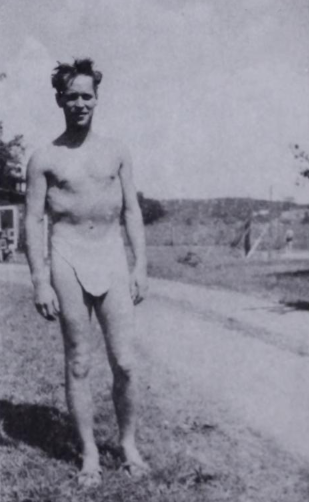
Franchot behaved more peculiarly this summer than the last. He was remarkably fine at rehearsals of Success Story, but he was rather antisocial in other ways. He drank stiffly, and carried off some other pretty good bottlemen to drink with him almost every night after rehearsals. When he came back he sometimes took delight in driving his car over the main lawn and crashing all the garden furniture left there during the day. He grew a beard, walked about in a loincloth, went shooting fairly close to the rehearsal grounds. He shied away from most of us, alternating between a distant courtesy that implied an insult, and the manner of a cagey maniac.
With all this, Franchot was always shrewd and observant. He saw what was going on. What was going on was a subtle transformation with the Group as a whole. The very air was fermenting with something that blew from we know not where, but which roused everyone to doubts, questions, wonder, eagerness, dispute. ….
The day came when Strasberg was no longer able to tolerate the disruptive ambiguity of Franchot’s behavior. He decided to have the showdown I had recommended the year before, and both us now confronted Franchot with ultimatum written on our faces. Franchot admitted at once that he had decided to quit the Group, that he was going into pictures. I do not know whether he had already made arrangements or whether our severity at this meeting finally decided him. I am inclined to believe that some of his mischievous conduct arose from an anger with himself, and some was designed to provoke us to such a discussion as we were having. Perhaps, however, he expected a gentler approach, for people like Franchot, always want evidence that they are loved. Strasberg, hurt himself, lashed forth a white-hot 'We don’t care' when Franchot disclosed his intentions. 'I know you don’t care,' Franchot answered quietly but painfully, as if to say: 'That is exactly why I wish to go.'
That day the bad news of Franchot’s resignation was announced to the Group at a special meeting addressed by Strasberg. It was the first resignation of any importance from our organization. The actors were shocked, for they appreciated Franchot’s value. Strasberg’s talk was calculated to affirm the strength and integrity of the Group, which could ill afford to keep a member whose spirit had turned against it. When the day came for Franchot to leave, he told me he was going to try Hollywood. At Tony’s, on West Fifty-second Street, he wept over his drink. …
I find it interesting that, according to Clurman, Franchot was pushed out of the Group for "disruptive ambiguity" much like he was pushed out of The Hill School as a teen for "subtle influence for disorder." And both of these punishments only led to more success for Franchot—leaving The Hill School led to success at Cornell University while leaving the Group led to success in films.

Clurman goes on to address the difficulty the Group had replacing Franchot in their plays. I think it's telling that despite his causing trouble, the other actors always appreciated Franchot's value and that Clurman was able to see that some of his rebelliousness was due to Franchot's schrewd observation of the inner shifting of the group.

Although he'd worked himself into a corner with Strasberg and Clurman, Franchot was definitely torn in leaving the Group for Hollywood and would never be able to definitely choose one over the other for the rest of his career. Actress Ruth Nelson shared in the documentary Broadway Dreamers:
I remember the night, his last Saturday night with Success Story. He came to me to say goodbye. He leaned over, kissed me, and had tears in his eyes. I said, 'Franchot, if that's the way you feel, why are you leaving?' And he said, 'Well, Ruthie, I just have to find out what it's [Hollywood] all about.'
Actors Sandy Meisner and Robert Lewis went with Franchot to Grand Central Station. As they said their goodbyes, an emotional Franchot:
...stood on the steps of the famous Twentieth Century Limited club car, teary-eyed, and as the train started to pull out of the station, he called to us, 'Keep your line.'
Walking across Forty-second Street, I turned to Sandy and observed, 'Did you hear what he said? Here we are, going back to our struggling new Group while he's off to Hollywood to make a movie with Lilyan Tashman and he tells us to keep our line.'
Said Sandy, 'He meant keep it for him.'
I think Clurman's belief that Franchot "expected a gentler approach, for people like Franchot, always want evidence that they are loved" is valid and that his statements about the emotional contrasts in Franchot's character echo those of Gloria Vanderbilt and Clifford Odets and Christopher Plummer.

Franchot, of course, would maintain an association with the Group Theatre, both publicly as an actor and privately as a benefactor. Much more on the post-1933 involvement with the Group coming soon!

Sources:
  • Clurman, Harold. The Fervent Years: The Story of the Group Theatre and the Thirties. Knopf, 1950.
  • Kramer, Joan, David Heeley, Joanne Woodward, Steve Lawson, Stella Adler, Harold Clurmaan, Cheryl Crawford, and Lee Strasberg. Broadway's Dreamers: The Legacy of the Group Theatre. New York, N.Y: PDR Productions, 1994.
  • Lewis, Robert. Slings and Arrows: Theater in My Life. Stein and Day, 1984.
  • Smith, Wendy. Real Life Drama: The Group Theatre and America, 1931-1940. Knopf, 1990.

Sunday, September 8, 2019

An Ernest Hemingway Hero

I recently came across Time is Ripe: The 1940 Journals of Clifford Odets on my local library's shelves. Franchot is mentioned a handful of times in Odets' daily diary. Unlike the brief "Franchot Tone was also there at the Mocambo" diary entries I stumble across from others in the business at that time, Odets' delves into Franchot's complicated character and Odets' own mixture of interest and frustration with Franchot.

Franchot in Dark Waters, 1944.
Scan from my collection.

On Valentine's Day 1940, Franchot and the rest of the cast from The Fifth Column stopped by to see Odets' matinee showing. Three days later, Franchot joined everyone at a "certain bad restaurant" the actors dined in every night. Odets writes:
He was ill-at-ease, tense, and obviously very lonely or he wouldn't have joined us. All of us tried to put him at ease, but he is poor table company. He wanted to go out whoring and drinking at a speakeasy (liquor after 1:00 a.m.), but was unable to find a companion. Franchot, with all his fame, money, and position, is still afraid of rejection and repudiation. He is blustery and pushing, anxious and uneasy, just like Steve Takis*, but slightly more adult; in short, he is an Ernest Hemingway hero, and that is saying the whole thing.
*Steve Takis was the main character of Odets' play Night Music, which would begin official performances shortly after this diary entry.

On March 16, 1940, Odets writes that he had just finished Stefan Zweig's essay on Casanova the night before and that it "gave me several good ideas, particularly for a play about a modern sort of Casanova to be played by a fellow like Franchot Tone. It is not the great lover element which interests me at all; the element of adventurer, swindler, fake prince among American aristocracy, etc. is where the play lies."

June 8, 1940:
At ten we [Odets, Sid Benson, Geebee] rode uptown, we three, ate a light supper at Schrafft's, saw a newsreel and two films, or part of them. One with Heifetz fiddling...the other an old film, the first F. Tone made when he went to the coast in 1932*. Very instructive. We move so fast in this country that the film, the acting style, the lighting and settings, the clothes—all are already old-fashioned. Franchot was not bored then, not blasé, but fresh and impulsive.
*I assume Odets is referring to Franchot's first film The Wiser Sex which starred Claudette Colbert, Lilyan Tashman, and Melvyn Douglas. This is the only Franchot film I have never seen. It has been preserved by AFI's National Center for Film and Video Preservation at the Library of Congress Motion Picture Conservation Center and it was shown at a film festival several years back. Unfortunately, it's not on physical media or shown on television.

On July 7th, Odets dines at the Stork Club:
There I met Burgess Meredith, Franchot Tone, and John O'Hara, and a brother-in-law together at one table. Meredith was leaving for a Western ranch vacation the next day, so they were celebrating together by getting drunk and more morose each minute. They were in moods of careful (or cautious) self-abnegation, admitting carefully that their lives were useless, that, as Franchot put it while discussing Maxie Baer, the fighter, "the thing is to look good even while you're going down." Franchot, whom I like, still a very unusual talent in the theatre, always brings out in me a certain caginess and over consideration, a real and acute discomfort.
September 29, 1940:
Every time I see Franchot Tone around town, something stirs in me. He is one of that fraternity equally at home here or in the East, drinking, sleeping around, trying to suck the marrow out of a bony friend or two who has no marrow, making a movie, looking for a play—he is too good for this sort of life; that is what touches me about him.
That September entry is the last time that Odets mentions Franchot in his 1940 journal. Odets had known Franchot since the very early days of the Group Theatre and in a later interview would remark on Franchot's talent:
Toward the end of the summer, Franchot Tone, after being quite erratic in his relationship to the company—he was a spoiled boy in many ways—decided to leave the Group, and everyone was sick. He was very gifted. The two most talented young actors I have known in the American theater in my time have been Franchot Tone and Marlon Brando, and I think Franchot was the more talented. And when he lost what he did, I think a very valuable gift was lost to the American theater. He was our leading man. It was like a beehive had lost its queen. 
Source: 
Odets, Clifford. Time Is Ripe: the 1940 Journal of Clifford Odets. Grove, 1989.
Hethmon, Robert. Days with the Group Theatre: An Interview with Clifford Odets. Michigan Quarterly Review. Volume XLI, Issue 2, Spring 2002

Wednesday, July 3, 2019

An Interesting Independence Day Display

Both Harold Clurman, in his book The Fervent Years, and Robert Lewis, in his book Slings and Arrows, recounted Franchot defiantly celebrating the 4th of July alone while he was a member of the Group Theatre in the early 1930's. Both refer to this display as being attached to Franchot's frustration with the constant "plethora of intellectual talk and classic music", but that reason seems so in contrast with everything else I've learned about him. Franchot was a fond participator in deep discussion and I can't tell you how much I've read about his enthusiasm for classical music, especially Mozart.

But Franchot's time with the Group Theatre seemed to be a complicated mixture of joyful success and feelings of alienation and I have much more to share about that subject in a future post. Perhaps Franchot was just letting off steam or drunk. Perhaps even the most devoted Mozart fan can grow weary of endless playback.  Or, perhaps, Franchot was just very enthusiastic about Independence Day. Here's what Clurman said:
On the Fourth of July, Franchot alone had decided to celebrate by shooting off fireworks. He began rather early in the day. Perhaps this was his childhood custom, perhaps it released his tension, perhaps it was his protest against what seemed to be the indifference of the others to the proprieties of this holiday. Solitary, with darkened brow, he went from place to place over the grounds and set off his firecrackers. Carnovsky and others were fond of music and played recordings of Mozart at every opportunity (except one man who played Caruso records, and Puccini). Carnovsky, no longer able to tolerate Franchot's acoustic vandalism, came out on the porch and cried: "Franchot, for God's sake, I can't stand the noise." Franchot turned and yelled: "And I can't stand your  noise"—referring to Mozart and the rest. He stamped off yelling: "I am an American." 
I have written a little bit about the Group Theatre (click here), but have some more detailed stories of Franchot's time with the Group coming soon.

Happy Independence Day! Set off some fireworks for loin-clothed Franchot the American!
Photo Source: Slings and Arrows, 1996.

Sources: 

Clurman, Harold. The Fervent Years. Harcourt. 1945.
Lewis, Robert. Slings and Arrows: Theatre in My Life. 1996.

Tuesday, July 2, 2019

Franchot Talks to Picturegoers Magazine

In 1935, Franchot talked to Picturegoers Magazine while on the set of No More Ladies:

My opinion as to why the fifteenth screen test resulted in a film contract is that in the space of those four years in New York the manufacturers of motion picture negatives had improved their product to such an extent that almost anyone could be photographed satisfactorily. In pictures, the first thing they want to do is make a person a hero. You know, broad shoulders, wavy hair and that sort of thing. I have no illusions about myself. I’m not a hero, and I can’t see what I should be made what I’m not. The other day I read a story about myself that made me human. I like that kind of stuff, because it’s sincere.There’s nothing unusual about me—I’m just an ordinary, and, I hope, normal individual.
In the film colony there is little to do besides work. People in pictures don’t relax socially to any extent. Thy work like the devil to finish one picture so they can go into another. I would like actually to work about thirty-six weeks out of the year. The remainder of the time I would rest, study, and travel. Then I would have an opportunity to enjoy life. 
Picture making is not easy—it requires a terrific amount of concentration. It requires more from a person than does working on the stage. To be a success on the screen a person must have a lot of force and drive, like Joan Crawford…I definitely intend to return to the stage, not permanently, however, I would enjoy dividing my time between the stage and screen. 

Monday, February 25, 2019

Franchot and Carole Landis


Franchot is proudly framed on Carole's table.
Franchot and actress Carole Landis met each other just a few weeks shy of Carole's divorce from Willis Hunt, Jr., which would be granted in mid-November 1940. Carole and Franchot were all smiles in the many photographs of the couple, often taken at Ciro's, published in fall 1940 and early 1941. Although she was very serious about her relationship with Franchot, Carole and Franchot both still casually dated other people in the entertainment industry.

Although both still visibly on the market, Carole apparently intimated to friends that Franchot was close to proposing or had already quietly proposed marriage. When reporters from Modern Screen magazine stopped by Carole's home, they observed a photo of Franchot signed, "Yours without protest." (Wouldn't it be nice to see that one pop up on eBay?) Still, some doubted that he had made such a commitment. Franchot was very active on the dating scene at this time and although he clearly cared about Carole, it doesn't seem like he was quite ready to jump into marriage in late 1940.


Carole described what she was looking for in a man:
I'm the happy type, by nature and by inclination. I expect men to amuse me, interest me, flatter me, spoil me, I say that if there is any heart-breaking to be done, it is a woman's privilege...if I meet the man with the qualities, he is welcome, love is welcome. But I am NOT seeking. I'm keeping my eyes and ears open, that's all. Because if you were 'in love' a couple of times when, obviously, you weren't, if you follow me—you just relax and wait. You also do a spot of figuring. I've done several spots. I've made a sort of man-map. I know now what I want in a man, what I expect of a man, what I demand of a man.

What were some of the reasons she fell so hard for Franchot? Carole shared:
Franchot Tone has a divine sense of humor. Hollywood practically turned hand-springs a few months ago over 'the change' in Franchot. Over bars, at parties, on sound stages, over the counter at Schwabs Drugstore, at the races and in print, people wondered, what's happened to Franchot? A dozen different versions were given, including one that set forth that I had changed him. Flattering, but fallacious. The real low-down is that Franchot sat himself down one night in New York, did one of those Rochester-talking-to-himself-in-the-mirror turns. He said to his reflection, 'You've a dull disposition, my boy, let's face it, let's break through and have some fun, let's go back to Hollywood, quit being snooty, laugh and make mad and merry.'
He came back to Hollywood. He broke through. But the point is that he had a sense of humor about himself. He had the very rare ability of being able to see himself as others saw him. Another nice thing about Franchot, as about Cesar [Romero], is that he is always so moderate, so restrained. No ear-marks of The Actor, not an ear-mark. I used to watch him when I first came to Hollywood, when he was still married to Joan Crawford and I'd think, what a lucky girl! I still say that any girl who gets Franchot will be a lucky girl. I think it would be very pleasant indeed to be married to Franchot...One little thing Franchot does always bowls me over when we're dining out, at Ciro's, at the Brown Derby, or wherever, and I go to the powder room, he never lets me go alone, always escorts me, always waits for me, takes me back to our table, pulls my chair out for me, and then sits down himself.  If you are in pictures, which means that your face is known, and have ever tried to battle your way through a public place, waylaid at every other table by too convivial strangers, you have some idea of what this thoughtfulness—believe me, gentlemen, this rare thoughtfulness, means...From Franchot I learned about classical music, opera. I adore men I can learn from. And they never make me feel that I don't know, never make me feel stupid or inferior. They make it seem as though we are sharing an experience together...Franchot took me to my first opera. I knew nothing about operatic music and, frankly, I expected to be bored to a welcome death. But throughout the evening, in his nice, quiet way, Franchot explained it all to me so that I was sharing the experience with him, and loving it.

According to author Eric Gans and researcher Lisa Burks, Franchot liked Carole quite a bit but felt she, nearly 14 years his junior, was "immature and coming on too strong." At some point, Franchot broke away from the relationship and shocked everyone when he suddenly eloped with Jean Wallace, who at just 18 years old was actually 4 years younger than Carole, on October 18, 1941. It has long been suspected that the ex Carole Landis talks about with reporter Gladys Hall in the article, "Glamour Girls are Suckers!" is indeed Franchot. In the interview, Carole is clearly hurting deeply from the breakup and feels betrayed. She says:
A great, terrific constant thing came into my life. A man, of course. For obvious reasons I can't use his name, but he is an actor and—it was love I felt. Real love. I knew it and I still know it...This went on for months. We were constantly together every possibly moment. I felt this, at last, was it...I lived in a dream when, suddenly, a little girl, a nonprofessional, not pretty really, clothes just so-so but not chi-chi, vivacious perhaps, but that was all, stepped in and—here I am...the minute you let a fellow know so completely that he's the whole floor show, you're sunk.
If this unnamed man is Franchot as everyone believes, then Carole, in pain, is unnecessarily cruel in her description of Franchot's wife Jean Wallace. With time, the bad feelings between Carole and Franchot disappeared and a real friendship emerged.  Franchot attended a surprise party to honor Carole's dedication to the war effort. Carole was a tireless supporter of the brave men overseas. As the actress who visited the most troops during World War II, Carole sold war bonds, entertained on multiple tours and at the Hollywood Canteen, served as an air raid warden, Aerial Nurses Corps commander, first aid instructor, and visited over two hundred bases. Carole famously documented a 1942 tour with Kay Francis, Martha Raye, and Mitzi Mayfair in her book Four Jills in a Jeep. The story of her travels was made into the 1944 film of the same name.

Although they didn't marry, Franchot and Carole remained close friends until her death. When Screen Guide and Eagle-Lion Films wanted a Christmas layout at Carole Landis's house in 1947, Carole hosted a little preview of Christmas and Franchot and his wife Jean were present. Of course, it was July when the layout was shot—with a Christmas tree by the pool and friends gathered around an outdoor Christmas feast—but it wasn't published until December 1947.

Carole, husband Horace, Jean Wallace, Betty Garrett, Larry Parks, and Franchot
celebrating Christmas in July 1947.

Franchot (under the tree) and Carole Landis directly in front. You can also see
Jean's legs to the right.

Tragically, Carole would be dead just one year after these photos were taken. On July 5, 1948, Carole was found unconscious after taking an overdose of barbiturates. She was only 29 years old. You can read a full account of her last day here: Carole Landis Official Blogspot

The website above is a fantastic resource for all information on Carole and I highly suggest it for further reading as well as the Facebook page A Comet Over Hollywood.

Sources:
  • http://carolelandisofficial.blogspot.com/
  • https://www.facebook.com/A-Comet-Over-Hollywood-1769075543417007/
  • Fleming, E.J. Fleming (2005). Carole Landis: A Tragic Life in Hollywood. McFarland and Company, 2005."What Carol Landis Demands of Men!" Screenland. October 1941.
  • Gans, Eric Lawrence. Carole Landis: A Most Beautiful Girl. Univ. Press of Mississippi, 2008.
  • "Glamour Girls are Suckers!" Photoplay. December 1941.
  • "It's Out-landis!" Modern Screen. October 1941.
  • www.mediahistoryproject.org

Tuesday, September 18, 2018

Franchot, 1905-1968

Franchot Tone 
February 27, 1905 - September 18, 1968


In 1936, Franchot shared this:
I'd like to stay with acting for the rest of my life. When I'm middle-aged—well, then I'll take middle-aged parts. And when I'm old I can always be a character actor...I wouldn't give up pictures. The stage is better, offers more opportunity for sustained moods and continued work; but it would be swell to come out to Hollywood for a part of every year, and then go back to the footlights.
It is easy to lament that Franchot did not end up with more prominent, starring roles in films throughout his entire life. I think about the big roles he didn't get that would've made a perfect fit, the awards I wish he'd been bestowed, the attention his talent deserved but never fully received. This is the wrong way to think of Franchot though.

Look at the massive amount of work he did! The words he shared with a reporter in '36 held true. He stayed with acting and had no qualms about transferring to middle-aged parts and later, character roles. In fact, Franchot seemed to relish his parts more as the years passed.

He lived the life he wanted—dividing his time between the New York stage and a California studio. He worked through professional successes and disappointments, personal triumphs and struggles, health and illness. Acting was clearly his true love and one to which he forever remained faithful.

Franchot's life is not a sad story. It's the story of a man who lived on his own terms, who didn't measure his worth on the amount of top billings he received, who continues to positively impact a woman 79 years his junior on a daily basis.


Thank you, Franchot.

Sunday, May 27, 2018

Franchot's World War II Draft Card

Today I discovered Franchot's World War II draft card on Fold3. Fold3 is an online database of historical military records that I've used often for my own family history research. Knowing Franchot didn't serve in the war, I hadn't even considered that his draft card would be there. Fold3's basic access is free but some items are limited to those with a paid subscription. Check with your local library to see if it has a subscription for patrons to use—I used my own public library to access Fold3 today! (This post is not an ad for or sponsored by Fold3. I just like to cite my sources.)

Ok, on to the record...


The card is labeled order # 1301 and serial # 272. It is dated October 16, 1940 and Franchot has added his distinctive signature at the bottom. Franchot is 35 years old and employed by Universal Pictures, Inc. at Universal City studios in Los Angeles, California. At the time, Franchot's address is 470 No (I think this stands for # here) Layton Drive in Los Angeles, California. His phone number is GL-3115—don't you wish you could just call him up and have a chat?

When I Google his address, all that gets returned is the alternate address of 470 Layton Way in Los Angeles, a plantation-style mansion designed by architect John Byers for wealthy Phillip Ilsley, who lived in it beginning in 1937. Actor Wayne Morris and his wife Leonora "Bubbles" Hornblow lived there after their marriage in 1939, but divorced soon after in 1940. I don't know how Franchot could've lived in this house at the time, logistically, but with its immaculate landscaping (it included a waterfall, tennis court, and pool) it certainly seems like the type of house Franchot might occupy, short or long term. It is probably that Google is leading me in the wrong direction since a lot of streets change over time. When he registered to vote the same year, Franchot listed his address as 10333 Wilshire Boulevard. 1940 was an interesting year for Franchot. He was fresh from his recent return to the stage and only made one film that year, the western comedy Trail of the Vigilantes. He was single and seen around town with many gorgeous and talented Hollywood ladies (including Carole Landis and Olivia deHavilland) during that time. My point is that he was playing the field in romance and his career at the time, so it is very likely that he was also not settled in one residence or another.

He lists his father as a further contact and places his father at the family home on Buffalo Avenue in Niagara Falls, New York.


On the Registrar's Report side, we get a physical description of Franchot. With mostly black and white photos available, you may have wondered about the color of his eyes...they are hazel, his hair brown, and his complexion light. He's just shy of 6 feet tall and weighs 160 pounds. A kidney scar is listed as another identifying body marker. Franchot seemed to have major kidney issues. I'm not sure if this was a medical issue independent of his drinking habit or due to it. In his book, Elia Kazan makes mention of Franchot having an issue with his kidneys (and with drinking binges) as early as the Group Theatre days of the early 1930's. I am not sure when Franchot acquired the scar, but he had additional medical issues from 1938 to 1941.

Just before his 33rd birthday, in 1938, doctors advised the ailing actor that "rest, strict diet and avoidance of all exercise" were "essential" to recovery of a non-disclosed, serious illness.

On July 24th, 1941, not even a full year after this draft card was completed, Franchot was stricken by extreme pain and had to undergo an immediate "major abdominal operation" at Good Samaritan Hospital. Following the operation, the Los Angeles Times reported that Franchot was "as good as can be expected." If the draft record had been completed in October 1941, the identifying body markings field would indicate an additional scar from that operation.

On September 9, 1941, the Los Angeles Times reported that Franchot had recently recovered and was no longer hospitalized. It said he was set to begin filming of Eadie was a Lady with Rita Hayworth and John Hubbard, a project that did not come to fruition. (Eadie was a Lady would be released in 1945 starring Ann Miller, Joe Besser, and William Wright.)


Despite completing his draft card immediately after the Selective Training and Service Act of 1940, Franchot did not serve in World War II. The records do not indicate which draft classification he received, so I am not sure if he was deferred for any reason or why he did not serve.

Franchot—who would marry Jean Wallace in 1941 and start a family—was a prominent war bond seller across the country, served on charitable committees and entertained the troops. I will write about his contributions on the homefront in another post.

Sources:
  • Clippings. The Los Angeles Times. July 5, 1937; February 11, 1938; July 26, 1941; September 9, 1941.
  • Fold3: https://www.fold3.com/title/816/wwii-draft-registration-cards
  • Kazan, Elia. Elia Kazan: A Life. New York: Knopf, 1988.
  • Paradise Leased: https://paradiseleased.wordpress.com/2011/01/03/lost-hollywood-a-swimmingly-grand-estate-in-brentwood-heights/
  • "Tone Undergoes Major Operation." Los Angeles Times. July 25, 1941.


Friday, February 23, 2018

The Gambler and His Face: Franchot Tone on his Plastic Surgery

In May 1952, Franchot was asked how he felt about his "new face." I wrote about the complicated 1951 Neal-Tone altercation that caused the need for Franchot's plastic surgery and impaired his voice last year (click here), but this is the first time I've run across Franchot making a statement about the plastic surgery to the press:
They say it's better than ever, but I liked the old one better. I'm a gambler, and gamblers sometimes lose. A man's got to live. I've had a full life, with no regrets. There was so much bad publicity, I couldn't defend it; so I've never had my day in court. I think I'll just pass it up. People all over the country tell me they're on my side. I'll settle for that. Well, you can't kill a guy for falling in love, and I've always let them make an honest man of me.
The change in his nose is very apparent in these side-by-side shots.
Source:
"The New Tone." Los Angeles Times. May 24, 1952. page 10.

Saturday, December 16, 2017

Franchot Talks to TV Guide, 1966

Franchot Tone as Daniel Freeland in Ben Casey, 1965-66.
Source: my collection.
In late 1965, Franchot granted an interview about joining the cast of Ben Casey and it appeared in the January 1, 1966 edition of TV Guide. It is my favorite of his print interviews, because it really shows that wit he possessed that all of his friends talked about in their recollections of him. I've collected some of Franchot's quotes from the interview as well as some of the interviewer's observations about him in this post. After buying a copy on eBay, I read the article and couldn't help but smile at Franchot's responses and feel emotional about his "best to come" response. Everything he says here is just so quotable! I love his reference to theater as the "feed bag" and his jokingly calling himself a "reasonable prima donna." When I read interviews of Franchot's, I always come away thinking "I really like this guy." And I think you will, too. That's why you're here, right?

On joining a television series in his 60's:
Tone flashes a smile familiar to two generations of moviegoers. "What's the use of having all this talent and not using it?" Tone says, and a network of laugh lines crinkle at the corners of his eyes. "Seriously, no plays came along and few pictures for a man my age except the odd cameo bits. I simply wanted to work."

Franchot's personality:

He has the aura of substance, the tenor of actorish dignity. A variety of books and recordings are stacked neatly in the living room, with the emphasis on Shakespeare and Mozart. "A man is happiest when his tastes are eclectic," Tone says. Only one magazine is in view, a copy of Playboy on the coffee table.

When Tone offers suggestions, [costar Vince] Edwards nods agreeably. "Fine, Franchot," Edwards says. "Whatever makes you comfortable." "I'm a very reasonable prima donna," Tone says. Edwards grins.

Both Vince and Franchot have a mutual love of horse racing. Sitting in his dressing room, Tone is usually immersed in a scratch sheet, pencil in hand. When the thoroughbreds are running, Tone and Edwards are at the track, although not together—Tone, the rich man's son, patronizes the $5 window, Edwards the $100 window.

"I'm unlucky in love. I should be lucky at gambling." But he isn't.

Gig Young, who starred with Franchot in "Oh Men! Oh Women!" told TV Guide:
Without being a fool about it, Franchot shared the limelight. He's an unselfish man, and when you say that an actor is unselfish—well, who's ever heard of an unselfish actor?

Another actor who chose to remain anonymous commented:
Tone has so much charm he makes people forget he's as self-centered as anyone in this business. Tone does what is best for Tone.

Franchot's Thoughts on Awards:
They are good for the people who give them and the people who get them and that's what awards are good for. (The interviewer noted Franchot was "properly sardonic" on the subject.)

Franchot's Thoughts on Marriage:
Marriage is very good for the children.

Franchot's Thoughts on Acting:
Everything I know about acting I learned from Lee Strasberg. At the Group, I learned Strasberg's variant on the Stanislavsky System—that's S-y-s-t-e-m, not Method. Method actors lack discipline. System actors are disciplined. I'm a pretty good actor today only because I've always renewed myself at the feedbag—the theater.

His Pride:
I'm proud that I've still got the best to come. I'm proud of "Strange Interlude" and "Uncle Vanya" and "Bicycle Ride to Nevada," which the critics roasted. I'm proud of some of the movies I was in. I'm proud of a half-hour GE Theater on Charles Steinmetz. I'm proud of my Mark Twain on a Playhouse 90. I'm proud of "The Old Cowboy" on The Virginian. And I'm going to be proud of Ben Casey.

Source:
"Who Has Ever Had a Better Time?" TV Guide. January 1, 1966. 12-14.

Thursday, October 12, 2017

Franchot Talks of Uncle Vanya

In October 1957, Franchot talked to drama editor and critic Lewis Funke for Theatre Arts Monthly. Franchot explained, in detail, his reasons for filming, producing, and co-directing a version of Uncle Vanya. The play was earning phenomenal reviews and Franchot felt it was worthwhile to capture the production for eternity. I've written about the film before (here) and it is top-notch. Franchot is completely wonderful in the role. In light of his costar and fourth wife Dolores Dorn-Heft's comments about Franchot's ultimate disappointment and deterioration over the film's reception (here), the transcribed interview in which Franchot is very hopeful and eager may leave you with a tinge of heartache for him. When it was released, the film received rave reviews from critics, but failed to be a commercial success. It cost Franchot a lot of money and he was saddened that his performance didn't garner any awards or individual acclaim. Although Franchot could see that films were changing and was absolutely correct to see that it was the right time to create an art-house film for intelligent audiences, he failed to foresee that audiences would even more heavily embrace a film like Uncle Vanya as time went on. He was ahead of his time in a lot of ways. Uncle Vanya is now on DVD and is praised for its nuanced performances. I think Franchot would be pleased and proud that Uncle Vanya is now out in the world in the hands of those who appreciate it.


Here's what Franchot had to say about this endeavor in 1957:

You might say that I was driven by a wish to immortalize our production. I don't know exactly when the wish was born, but I do know that once it was, I could not put it away. I kept thinking what a shame it would be for the play to end just because it had run its course on Fourth Street. It was so good, the ensemble playing was so superb, and Stark Young's translation was so beautiful and fresh that I couldn't put the thought out of my mind.
Then suddenly it occurred to me that the play could and ought to be put on film just the way we were doing it on the stage, with some changes, of course, to avoid the danger of its becoming a static thing on the screen. That, you know, is the great pitfall in trying to make an exact copy from the stage.


Up until comparatively recently, of course, the idea of putting a play such as this on film would have been pretty foolhardy. The market potential would not have warranted the financial risk. But there has been tremendous growth of the art-film houses throughout the country which can only be attributed to the maturing artistic taste that is everywhere notable among our people. There was a time when you could count the number of art houses in New York on one hand, and the number throughout the country was equally minute. Although there are no firm figures at present, it is estimated that there are now over four hundred of these little houses across the country catering to that discriminating clientele that is seeking better and more intelligent fare than they can find on their television sets or in their neighborhood movie palaces.
But even with this knowledge, I still was not in a position to take the risk until I had really professional advice. I called upon my old friend Arthur Krim, who used to be the lawyer for the Group Theatre when I belonged to it, and who now is the president of United Artists. He saw the play and assured me that with the proper budget, I might hope to break even and perhaps make a little money. That did it.

We didn't want to have anyone else's mind or anyone else's creativity super imposed on or interfering with the play. We realized that for a motion picture it would be necessary to get more action into the telling of the story than there was on the stage. But we felt that whatever action we wanted we could get from the play itself. By following Chekhov's directions and his writing we could move the action around up a staircase, around a room, in the garden. This we believed would be sufficient to give the film the necessary fluidity.
Yes, there have been a few cuts. But I don't think anyone is going to really mind those decisions. They have been made only where we found that Chekhov was somewhat repetitions. For instance, playwrights have to contend with intermission and when their plays resume they are bound to reiterate exposition points. This repetition has been eliminated because in pictures once you've made a statement you can believe that the audience will not forget it.


It's one of the biggest gambles of my life. But I cannot recall when I received more gratification from an undertaking. This is the first time in America that anyone has put Chekhov on film. Call it a great financial risk, a noble experiment or what you will. But if we've succeeded in duplicating what we had on 4th street, there will be no greater thrill for me. It surely would have been a terrible waste to lose forever George Voskovec's Uncle Vanya, Clarendon Derwent's Serebriakoff, Geraldine Hiken's Telegin, Mary Perry's Marina, Peggy McCay's Sonia and Shirley Gale's Maria Vasilievna. And, although we have lost Signe Hasso's Elena, we have Dolores Dorn-Heft, giving what I think is another beautiful portrait. Who knows? We may wind up among the archive films of the Museum of Modern Art.

Source: Funke, Lewis. "Uncle Vanya." Theatre Arts Monthly. October 1957.

Saturday, September 23, 2017

Jean Dalrymple on Franchot and The Country Girl

In the fall of 1966, Jean Dalrymple had secured Franchot and Jennifer Jones as the leads in an upcoming production of The Country Girl. In addition to The Country Girl, Jean had also planned The Rose Tattoo (starring Maureen Stapleton) and Elizabeth the Queen for the fall season for City Center. Jean recalled:
To have it all go as planned was too much to expect. Just the week before rehearsals for The Country Girl were to start, Franchot went into the hospital for a routine checkup. A day later his doctor called me with tragic news. Franchot would be in the hospital for several weeks. A tumor had been discovered in one of his lungs.
My first impulse was to cancel the play, but Jennifer Jones had already come on from California and Lee Strasberg, although as shaken by the terrible news as I was, said he would personally find a replacement. Then Franchot himself called me from the hospital and said in a voice choked with emotion and tinged with his usual irony, "The show must go on, you know."
Although Franchot sadly missed out on The Country Girl (wouldn't he have been absolutely fantastic in that role?), he would soldier through the treatments and pain, never giving up on his professional projects. Between 1966 and his death in 1968, Franchot continued to appear in television and also did a play and a movie.

Source:
Dalrymple, Jean. From the Last Row. New York: JT White, 1975.

Friday, September 15, 2017

Reflecting on Franchot this September

Franchot in the 1930's. Source: my collection.

September 18th marks the 49th anniversary of Franchot's passing from lung cancer. Though our lifetimes didn't coincide, Franchot, for a handful of years now, has been a major part of mine.

This summer as part of a reading challenge, I read seven film-related biographies—on Dolores del Rio, Lupe Velez, Judy Holliday, Mary Martin, Glenn Ford, Dana Andrews, and Lew Ayres. I enjoyed them all and I found I admired all of the subjects for one aspect or another. The books inspired me to watch more of these actors' works and truly appreciate them in a new light. Recently, I was having a conversation about my readings and pondered the reasons why, despite the accomplishments and intriguing lives of other stars, they do not grab me the way Franchot has. Even if a full biographical book on Franchot was published by someone and I read it, I feel like my hunger for researching him would remain unquenched. I never hit that point of believing my examination of Franchot is complete. I've been actively researching for several years now and I have so many unanswered questions and gaps in his timeline. But I love the hunt! There's no better feeling in this world than to stumble across the one photo or interview you never expected to uncover.

But it's not just the thrill of research that keeps me tethered to Franchot—it's the man himself, of course. I remain fascinated by his life and his work. Like many film fans, I've had phases of intense devotion throughout my life. There was my childhood and pre-teen fascination with Shirley Temple and Doris Day which transformed into a teenage obsession with what I'd term the "Hollywood Big Hitters": Marilyn Monroe, James Dean, Audrey Hepburn, and Natalie Wood. My college years were spent delving into books on Greta Garbo and Ava Gardner and Rita Hayworth. As an adult, the people who've interested me the most are Franchot, Loretta Young, Sylvia Sidney and Warren William. So yes, I've traveled through the experience of researching one star or another, but other than Natalie Wood and Loretta Young—who have remained and I feel always will remain lifelong fixations for me—Franchot is the star that I cannot escape (don't worry, it's a prison of total happiness!) And I've come to the conclusion that there are several reasons as to why:

Screen Quality

In my opinion, he possessed a different screen quality than other male actors of that time. His performances speak to me in a distinctive way that those of his contemporaries fail to do. There's a gentle and steadfast quality in his performances and unmatched sincerity in his delivery of his characters. I believe in every single character he played and find them compelling. This is especially true in films like Gentlemen Are Born, The Bride Wore Red, and Three Comrades. I've never personally identified with the performances of another male actor of that generation until Franchot came into my life.

Polarity in Career Choices

The polarity in his career choices can be astounding. Franchot expressed that he felt most at home on the New York stage and received more critical acclaim and professional respect in that area. In interviews, he said he liked being a working character actor and that he wished to do realistic, gritty plays. Franchot was never quite comfortable with the publicity angle of Hollywood and was rather private. In spite of all this, Franchot left the Group Theatre in order to pursue a very public Hollywood career. In the early interviews, Franchot continued to say he would return to the stage and would form no lasting ties in Hollywood. But the truth is, Hollywood always had his heart. The movie star lifestyle reeled him back to films time and time again, even the lower budget and lower publicized ones.

His Personality
There's a kindness and tenderness in Franchot as a person. You can hear it in the words of his well-articulated interviews and in the reflective memories of those who knew him. Those who knew him seemed to like him and respect him. They enjoyed working with him and commented on how modest Franchot was about his own talent—and they talked of what a natural talent he had. Despite growing up in a successful, wealthy family, Franchot identified with the everyman. He supported causes that protected the people who did not have the fortune or status to protect themselves.

He's a Survivor

Although he was a quiet, private man who enjoyed classical music, reading, and would rather be fishing and hunting in the Canadian woods than anywhere else, a nightlife of beautiful (sometimes notorious) women, scotch, and dancing was also a major pastime in Franchot's life. He's an interesting case to me, because he was an intricate human being with conflicting needs and wants. He didn't want publicity, but he engaged in one of the most highly publicized relationships (i.e. trainwreck) in Hollywood with Barbara Payton.  He could be incredibly self-destructive both personally (with his romantic liasons and heavy drinking) and professionally (accepting roles in B-movies that further typecast him instead of demanding important roles in substantial films.) Yet, he was a survivor. Despite being blacklisted and sometimes ridiculed and often misunderstood, Franchot kept working. He maintained his dignity and elegance through everything. He worked up until his death and he left an abundance of amazingly well-done performances for future generations. And it's his perseverance that, I think, keeps me permanently attached. I admire Franchot for not letting any disappointments tear him down.  There were bumps in the road, but he continued to dedicate himself to his craft. In interviews he did in the 1960's, you never get the sense that Franchot has lost touch. He constantly says that he is so excited for the opportunities he has and that he's continuously working on his performances. Franchot comes across as thrilled to be a character actor on television. I like that. Despite wealth and fame, Franchot never adopted a superiority complex, never threw power in other's faces, and never felt like he was too good to learn and to improve.

He Wouldn't Mind It?

True, Franchot wasn't crazy about publicity and he was modest about himself. But I feel like he would appreciate my dedication. And I sense that older Franchot was more open to publicity than younger Franchot. In a 1966 interview with Janet Roach, Franchot was delighted to talk and said:
I could talk for hours about the tricks, but nobody asks me.
The first time I read that statement, it made me feel incredibly sad and it's stayed with me. More people should've interviewed him, should've asked him to share his thoughts in those later years. He seemed willing and ready to share his tricks of the trade and I regret that no one thought to pursue him on the record. I am happy that this blog does belatedly attempt to finally get Franchot on the record. I am by no means trying to assert that I am the biggest and best Franchot devotee out there, because I've met some wonderful people who share this common interest. But I do enjoy what I'm doing with this blog and how much I've learned about this dynamic man in the process. I like to think Franchot would get a kick out of it.

Franchot in the 1960's. Source: my collection.

In concluding all the reasons why Franchot has captured me, I'd like to share again how actor Christopher Plummer characterized him. It's the description that fits the Franchot I've encountered and includes all of those anomalies in his being that make him such an interesting study:
Franchot had a weakness for the movies and a penchant for domineering, glamorous women...He seemed to search for this kind of self-destructive alliance, and alliance that could not but help inflict certain pain. Indeed, Franchot Tone was a handsome, sensitive, highly educated and tremendously talented gentleman who was, nevertheless, motivated and driven by pain. His hard living had somewhat diminished his former brilliance, but every so often his work showed strong evidence of great depth and nobility of spirit...His sense of humor, as one might guess, was seeringly self-deprecating, drawn as always from this inexplicable inner torment. These vulnerable qualities were to make his Chekovian performances (Uncle Vanya and A Moon for the Misbegotten), both of which I later saw, so memorable—a rare combination of lightness and poignancy...we shared an unspoken bond.  
We were both romantics—incurable to the last—and our separate upbringings shared the same confusion of identity. He may have seen in me, occasionally, his younger self. I'm not sure and I wouldn't wish it on him; but I saw in him someone I could perhaps aspire to; not the hidden sad, pained man that was part of Franchot but the part he couldn't conceal, no matter how hard he tried, the part that was refined, noble and infinitely kind—the man of golden promise.
I never lived when he lived, but a day doesn't go by that I'm not "Franchot-ing" whether it's reading about him or watching him. There's an eternal bittersweet feeling that lingers around him. Some dreams were unrealized, but the body of work he left behind is superb. I miss him.