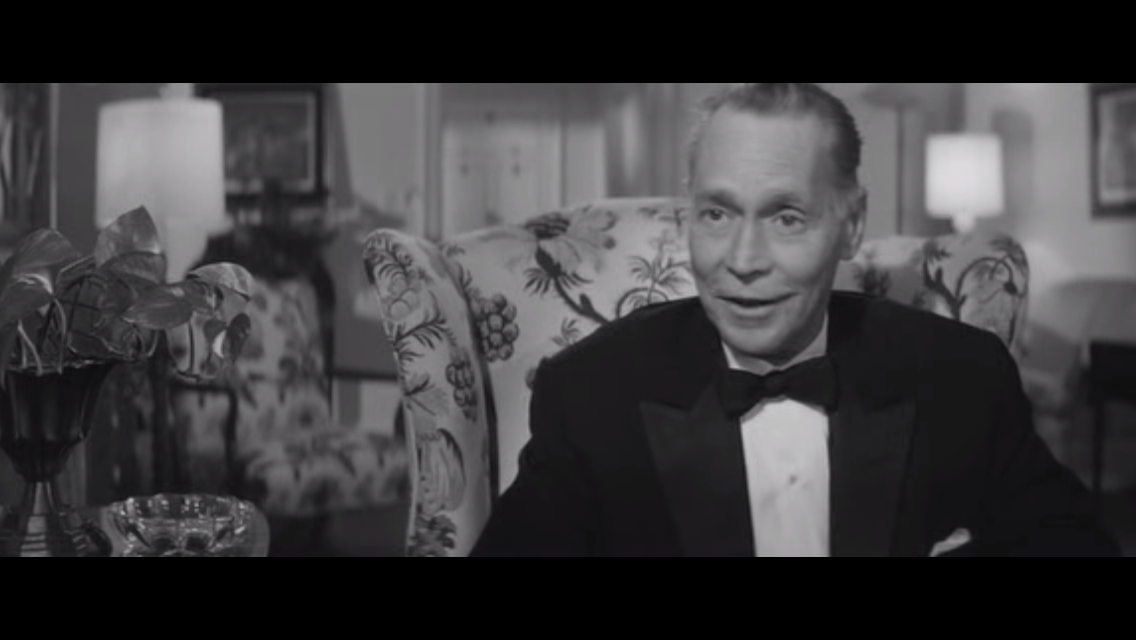
With a runtime of just one hour, Straight is the Way packs a lot of Franchot into a very short amount of time. I have always had a soft spot for this film, but most reviewers have not held the same opinion as me. I should admit that Franchot is in nearly every scene of this film, plus he is young and quite beautiful in it, and I know that those factors play a part in my positive assessment. Franchot didn't get to carry many films during this time period. He was typically cast as the love interest with a small story who supports the main actress (Joan Crawford, Jean Harlow, Bette Davis) with a big story during his early years in Hollywood. It's nice to watch a film whose plot revolves completely around Tone's character. The plot may be a bit flimsy, but I think it's a nice story with a solid cast, nevertheless.
Straight is the Way is a remake of the 1928 film Four Walls which starred John Gilbert and a young Joan Crawford—what a neat coincidence! Sadly, I believe that original film, which was based on a George Abbott play of the same name, is now lost.
First, let's look at the film itself, then we will get to the reviews.
Straight is the Way opens with Momma Horowitz (May Robson) anxiously awaiting the arrival of her son. She is so overwhelmed by her emotions that she can barely keep her eyes from tearing up and her hands from shaking. Bertha (Karen Morley) cannot contain her excitement either because her childhood friend Benny Horowitz (Franchot Tone) is coming home after a five-year stint in prison. Benny returns and shares that although he disliked being locked up, he survived by realizing "you stand anything if you have to...you get to feeling you wanna smash the walls down and then after awhile you begin to realize it's not the walls. It's something inside that holds you prisoner. It wasn't so bad. I got along fine. I was president of the welfare league."
Benny promises his mother that he has no plans to ever return to jail again, but she's devastated and terrified when Benny immediately goes out to the street to say hello to former friends who are on the wrong side of the law. Benny learns that while he was in prison his buddy Monk (Jack La Rue) took Benny's old girlfriend Shirley (Gladys George) and became the leader of a criminal organization he's named the East Side Political and Social Club.
When Shirley comes around ready to rekindle a love affair, Benny rejects her:
Well, you're all wrong, Shirley. You can go back to Monk. I don't want ya. You don't mean nothin' to me. Listen, I'm free now and I'm going to stay free—all of me, inside and out. Nothing's ever gonna get hold of me again, ya got it?
Throughout the film, there is much emphasis placed on the fact that Benny is a Jewish man and that this is a Jewish neighborhood. There is a great deal of celebration surrounding the Sabbath in its scenes. Franchot received criticism for playing a Jewish man. A Silver Screen reviewer remarked, 'If Franchot looks like a Horowitz, then I look like an Adonis." In a separate review within the pages of Silver Screen, readers read, "You'll die laughing when we tell you who plays the nice Jewish boy who calls his Mater "Momma"—that elegant gentleman Franchot Tone."
Benny struggles to re-enter the workforce and grows weary of being treated like a criminal in his hometown. Every one is trying to match him with Bertha, but he feels she is too good and pure for him. He's desperate to relocate to the west and start fresh, but he's offered a mechanic job in his old neighborhood. Thrilled to be clocking in and out and bringing home an honest living, Benny defends his employer and makes an enemy of the mob when he stands up to Monk and his gang, who have been intimidating and stealing from his employer.
Benny resists temptation when he turns down an offer to take over Monk's position, but continues to struggle where Shirley is concerned. Will he return to the life that landed him in jail in the first place? Or will he continue on the straight path to moral and physical freedom?
On-set Stories
Cal York noted that Jack LaRue was originally cast in the part of Monk in the stage production, but it was decided he looked too young and Paul Muni was cast instead.
Silver Screen included this on set story:
Reviews
Silver Screen said the film was simply not hot. It gave the film a cool rating of 35 degrees and wondered, "Why?...Why a studio ever saw fit to produce it in the first place is something that we can't understand..." Silver Screen felt that Franchot and Karen Morley were miscast and that the only actor who managed to "get by" was May Robson.
Photoplay was kinder in their assessment. The magazine called it a "powerfully constructed drama" and urged "All you doubters, come and see Franchot Tone give a performance, because he can and does!" Photoplay Magazine (December 1934) included this sweet photo of May Robson holding her great grandaughter.
Motion Picture Reviews only rated it fair, but praised Robson, writing that she "provides a very human and sympathetic appeal as the mother and does much toward making the action vivid though the tempo is often slow." Motion Picture Reviews summed up with a statement that the "value of the picture as entertainment depends on taste."
Based on that statement, I might have bad taste, but I enjoy this film. It's quick, it's simple, it's not going to win any awards—but I really, really like it.
Straight is the Way has not been released on DVD, but it does occasionally pop up on Turner Classic Movies and online video sites.
Sources: "Cal York's Monthly Broadcast from Hollywood." Photoplay. 1934. "Straight is the Way." Silver Screen. October 1934. "Straight is the Way." Photoplay. October 1934. "Straight is the Way." Motion Picture Reviews. 1934.
She Knew All the Answers is a lighthearted romantic comedy starring Franchot Tone and Joan Bennett. Released in 1941, the film is directed by Richard Wallace, who would team up with Tone and Bennett again a year later for the war comedy The Wife Takes a Flyer. Neither film has been released commercially on DVD and I'm not sure if that will ever be something slated for the future at all, but I would love to see a Bennett/Tone double feature DVD one day. In addition to these two early 40's films, Franchot and Joan would go on to costar in a 1957 episode of Playhouse 90 entitled The Thundering Wave.
In She Knew All the Answers, we are first introduced to playboy Randy Bradford (John Hubbard) and chorus girl Gloria Winters (Joan Bennett), both eager to elope. There's just one problem standing in their way and that problem's name is Mark Willows. Willows (Franchot Tone) was Randy's father's partner in a lucrative financial firm on Wall Street, and was appointed Randy's guardian when his father died. As guardian, Mark gets approval over the woman Randy marries and if he doesn't approve, Randy loses his millions. Mark is a mild-mannered, conventional man who doesn't approve of Gloria's chorus girl status and nixes their plans.
Gloria knows that Randy will never make it as a working class man and she's not willing to be a working class wife, so she hatches a plan. She will get a job—under the name of a roommate—as the switchboard operator at Willows' office long enough for him to sign a letter of recommendation for her, then she will use that signed letter to marry Randy without consequence. Expecting an older, unattractive guardian, Gloria is surprised to find that Mark Willows is a young, attractive man—albeit, a reserved, bespectacled one. Although focused on stocks and investments, Mark is clearly befuddled by his blossoming attraction to Catherine Long (Gloria's assumed name.)
Beginning to feel confident with the switchboard and around her coworkers, Gloria—unaware of Wall Street lingo—accidentally spreads false news about the firm causing Mark to lose a large amount of investments. Mark fires her, then, after her suggestion for a solution is successful, visits her apartment to ask her to return to the firm. This is the scene where many men would've caught on to Gloria's tricks, but Mark is gullible. Randy is hiding in the kitchen while the real Catherine Long, Gloria's roommate played by the infallible Eve Arden, feigns a disability to substantiate Gloria's lies.
Randy sees that his guardian is falling for Gloria and has a prank call placed to the restaurant where Mark and Gloria are dining one evening. Mark decides to get revenge and talks Randy into staying in the office all night in order to "save the business." Gloria's eyes light up when she realizes that the typically straight-laced Mark, whom she's convinced to ditch the glasses, is up to mischief. As Randy waits by the phone all night, Mark and Gloria go to Coney Island and act like total goofballs. This is my favorite part of the film! They pose for silly pictures, ride the Tunnel of Love, eat cotton candy, and both Franchot and Joan are really adorable in these scenes. They fall for each other, but then Mark learns the truth about Gloria and her scheme. In the final scenes, an unusual dream sequence for all three main characters follows leading to a wedding in which those dream alter egos call the shots.
The film was lukewarm with critics. Bosley Crowther warned audiences that it was an "inconsequential little comedy," which was actually much kinder than he'd be a year later when he deemed The Wife Takes a Flyer a "painfully labored comedy." She Knew All the Answers would be neither Franchot nor Joan's most successful comedy, but they, as evidenced in their incredibly expressive faces throughout, embrace the lightness of the picture. It's a joy to watch from start to finish and the two stars are very well-matched in their comedic timing. I hate to call it a "cute movie," but it just is. I watched it again this week when I was ill with a virus, and—even though the quality of my old copy leaves much to be desired—it proved to be the fantastic spoonful of sugar I required.
Franchot and Joan shared not only these films, but also the same birthday. As I wrote about a few weeks ago, Franchot and Joan celebrated their birthdays together two years in a row—with surprise cakes for each other on the set of this film in '41 and by cohosting a massive party for servicemen with Feb. 27 birthdays a year later in '42.
Finally, a pal who has been a kind supporter of my Franchot efforts (and antics) happens to be an out-of-this-world knowledgeable and passionate expert on all things Joan Bennett (as well as some other fantastic film ladies) and recently devoted a website to Joan B. at http://www.joanbennettfan.com. Check it out!
Sources: Crowther, Bosley. "The Screen in Review." The New York Times. June 20, 1941. Crowther, Bosley. "The Screen." The New York Times. .June 19, 1942.
Beyond Desire cast. Source: Theatre Arts Monthly/scan from my collection.
Beyond Desire opened at Theatre Four in New York City on October 10, 1967. Unfortunately, the play was not a hit and closed just five days later on October 15th. The play, written by Constance Loux and based on Pierre La Mure's novel, was produced and directed by Franchot's friend and frequent collaborator Jean Dalrymple. The cast included Franchot Tone, Betsy von Furstenberg, Richard Sterne, Jay Barney, Mary Bell, Norman Budd, Jo Flores Chase, Richard Kuss, Andrew Plamondon, Jane Marla Robbins, John Scanlan, Ethel Smith, Ben Yaffee, and Jay Velie.
Seemingly plagued with issues from the start, Beyond Desire's opening date had been postponed and it ran for only seven previews and eight performances before closing. The New York Times reported that Franchot would be both narrating and performing a separate role in the play, but from all accounts, it appears that Franchot, with star billing, only performed as the play's on-stage narrator. (I wonder if this was just the part as intended, if Franchot wanted to lend his name to this production, or if his sitting to the side as narrator had something to do with his cancer diagnosis.)
The play was based on the life of composer Felix Mendelssohn. Dan Sullivan, for the New York Times, reviewed the play this way:
"Beyond Desire" might well be titled "Beyond Recognition."...romantic slush, and worse than that, stale romantic slush...the play is a collection of Lines You Thought You'd Heard the Last Of, lines you thought they'd never dare use again.
Regarding Franchot, Sullivan remarked:
Franchot Tone has star billing, but only sits to one side of the stage, trying to tie together the 50 or so scenes with some kind of coherent narration.
The negative reviews and swift run of the play surely were a disappointment to Franchot and director Jean Dalrymple, since Beyond Desire was the first play they chose to produce at Theatre Four. You see Theatre Four had just recently been acquired by Ms. Dalrymple and Franchot, longtime friends and colleagues.
Just two months prior to Beyond Desire's opening, Jean and Franchot partnered to purchase the theater for a price between $200,000-500,000 (that's a minimum of 1 million plus today.) Theatre Four had first been a church, before David Ross transformed the property to include a theater in the 60's. Jean and Franchot planned to produce plays and musicals in their new theater.
Owning a theater had been a lifelong dream for Franchot and this must have been a happy career milestone for him. Dolores Dorn, Franchot's costar in Uncle Vanya and fourth wife, talked about this aspiration in her memoir (my original post on that is here.) On their very first date at a French restaurant in 1956, Franchot confided in Dolores that his dream was to eventually own his own theater. Franchot told her that his vision for his theater was to be a home for plays with real issues and that he was influenced by his time with the original Group Theatre in the early 30's.
Sadly, Franchot would die of lung cancer just a little over a year after acquiring the theater. I have not been able to track down what became of the theater immediately following his death, but I'll assume that it remained in Jean Dalrymple's possession for the time being. At some point, it became known as the Julia Miles Theatre and known as the home to the Women's Project and Productions. Citidex describes the theater as a "small space with under 200 seats is located just north of Manhattan's Theatre District."
Another blow discovered in my search: It looks like Franchot's theater at 424 West 55th has since been demolished to make room for an affordable housing building. In a 2014 article for Curbed New York, Zoe Rosenberg reported that the lot was formerly the site of a "three-story church with a 3,000 square foot theater" which sold for over 8 million in 2013.
Although the first play "Beyond Desire" wasn't well-received, I can only imagine what might have been had Franchot not passed away at the age of 63 just a year later. I can picture a future Franchot, in his late 60's through his 80's even, stepping into the role of respected director and producer of hard-hitting plays presented in the theater he co-owned with Dalrymple. I envision an aged Tone mentoring young actors and possibly teaching his own acting classes there.
I've been reading Dalrymple's memoirs which are focused solely on her work with City Center and, because of this focus, do not mention Theatre Four. However, there are some nice passages about Franchot at City Center that I'll share soon.
Sources: "'Beyond Desire Closes.'"The New York Times. October 16, 1967. pg. 56. "Franchot Tone in Dual Role." The New York Times. August 29, 1967. pg. 26. "Jean Dalrymple Buys a Theater: Franchot Tone is Partner in Off-Broadway Venture." The New York Times. August 3, 1967. Lortel Archives: http://www.lortel.org/Archives/Production/3334 Sullivan, Dan. "Theater: Mendelssohn in a Flat Key." The New York Times. October 11, 1967. pg. 36. Lasson, Robert and David Eynon. "The Poll's the Thing." The New York Times. October 8, 1967. pg. X1. Rosenberg, Zoe. "Small Structure to Replace Church on West 55th Street." Curbed New York. "Theatre Four." www.citidex.com "Two Plays Set New Dates." The New York Times. September 25, 1967. pg. 55.
Hope for the Best ran for 117 performances
between February 7, 1945 and May 19, 1945. Produced by Jean Dalrymple and Marc Connelly, the play was first housed at the Fulton Theatre and then in late April, moved to the Royal Theatre. Writer William McCleery's plot revolved around a newspaper writer who is dissatisfied with only covering gossip and is encouraged by a young woman to pursue more groundbreaking territory. Although his fiancée prefers him not to "rock the boat," the main character attempts to investigate and report on American politics.
Franchot Tone starred as the writer and was supported by a cast of Leo Bulgakov, Jane Wyatt, Jack Hartley, Doro Merande, Joan Wetmore, and Paul Potter.
Hope for the Best. Source: scan from my collection.
Theatre Arts Monthly reviewed the play in April 1945. Rosamond Gilder wrote:
In Franchot Tone, the producers, Jean Dalrymple and Marc Connelly—and Mr. Connelly as director—
have found a convincing as well as a winning interpreter of the leading role. Mr Tone, last seen as a ‘round actor’ in Ernest Hemingway’s The Fifth Column, proves that he is still a skillful craftsman in the theatre in spite of his protracted dallying with the screen. He has balance and proportion in his acting, precise timing, a nice sense of humor. One of the hilarious moments in the play is the scene in which the columnist, about to launch forth on the new type of writing he is so eager to undertake, bogs down under the subtle discouragements administered by his dark angel. Mr. Tone sits alone on the stage in front of his typewriter; absorbed, intent, concentrated. His fingers dash over the keys, the little bell rings a cheerful note, he slams the carrier back with a masterful flip. Then doubt creeps into his mind. He stops, re-reads the paragraph, types on, tears the sheet out of the machine, puts a new one in, starts again. The tapping goes more and more slowly, becomes uneven, hesitant. The jubilant song of the keys has turned into a disheartened pecking; Mr. Tone’s very spine wilts, his hair stands on end, his face seems drained of vitality. The curtain goes down on a dogged pounding of keys that presages no good.
The New York Times was not as glowing in their review of Mr. Tone's performance. In his February 8th review, Lewis Nichols wondered if Franchot was the best actor for the part. Nichols' wrote:
He is easy and likable, of course, and he manages a vague, shy quality which is all right part of the time. However...in several scenes, he is shy to the point of cuteness.
Hope for the Best. Source: scan from my collection.
Hope for the Best: Source: New York Times clipping
Franchot with members of the Mandingo cast.
Source: Billy Rose Theatre Division, The New York Public Library.
"Mandingo. [1961]" The New York Public Library Digital Collections.
http://digitalcollections.nypl.org/items/bc27eacb-6f1c-465e-e040-e00a1806652a
Mandingo opened on May 22, 1961 at the Lyceum Theatre, but closed after just eight performances five days later on May 27th. Written by Jack Kirkland and based on the novel by Kyle Onstott, Mandingo was set on an Alabama plantation in 1832. The play was directed by Louis MacMillan and starred Franchot Tone, Dennis Hopper, and, in her Broadway debut, Brooke Hayward. Full cast included Duke Farley, Georgia Burke, Clark Morgan, Philip Huston, Vinie Burrows, Maurishka Ferro, Arnold Moore, Rockne Tarkington, Fran Bennett, Verta Smart, Arnold Soboloff, John A. Topa, and Coley Wallace.
On March 9th, the New York Times suggested that Franchot might play a part in Mandingo and by March 23rd, Franchot had signed a contract to star in the play. Mandingo is often cited in biographical examinations of Dennis Hopper and Brooke Hayward, because the two became a couple during the production and later wed. Hayward would go on to call it a "potboiler" that "quite rightly closed after a week."
After opening night, N.Y. Times reviewer Howard Taubman wrote:
To a world painfully aware of the anguish of racial tension a play like "Mandingo" can only seem like a crude, sensationalized effort to capitalize on a newsworthy theme...It may well be that he [original author Kyle Onstott] wishes to say something compassionate and purging about the misery of slaves and the malevolence of the slave owners. But what emerges is a group of stereotyped characters taking part in noisome affairs...Franchot Tone, who has an honorable record of worthier things, snorts, wheezes and blusters his accomplished way through the role of Mr. Maxwell...In a time when insight and wisdom are desperately wanted, "Mandingo" offers only a shabby, coarse, surface treatment of an agonizing theme.
In the play, Maxwell (Tone) is a menacing slave owner who treats the slaves on his property with cruelty. His son Hammond (Hopper) does not agree with his father's ways and faces Maxwell's wrath as well. The story moves from one shocking scene to another, each featuring violence and sex (including rape and incest.)
I am surprised that despite the overwhelmingly negative response to the play's theme and the brief run due to this, Hollywood made a commercially successful movie version of Mandingo starring James Mason in 1975. A 1976 sequel Drum followed.
Candid backstage shot of Franchot with costars Maurishka Ferro and Verta Smart. Source: JET, June 1, 1961.
Sources:
Hayward, Brooke. "Once Upon a Time in L.A." Vanity Fair. April 10, 2010.
Photo that accompanied reviews of The Dirty Old Man
In 1964, Franchot starred in Lewis John Carlino's play "The Dirty Old Man." The play was presented along with Carlino's "Sarah and the Sax" under the title Doubletalk. Doubletalk, which earned Carlino the Vernon Rice Award, ran for 16 performances from May 4 to May 17, 1964 at the Theatre de Lys. Now the Lucille Lortel Theatre, the Theatre de Lys is located at 121 Christopher Street in New York City.
In the play, Franchot stars as the old man (the character is not given a name.) A recluse living alone, the old man embraces the solitude of nature as he comes to terms with his aging body. Despite issues with his heart, the old man hikes the cliff near his secluded house each day. He is content to peacefully journal all that he sees around him.
One day, returning to his cabin, the old man stumbles upon two teenagers making out. Chuck (Gregory Rozakis) runs out, but Mary (Amy Taubin) stays behind after the old man assures her the boy will come back within an hour. As they wait, the young woman and old man introduce themselves and find that despite the discrepancy in their ages and lifestyles, there is much that they understand about and relate to each other. Concerned because he is experiencing pain due to his heart condition and seeing the youthful spirit behind his eyes, Mary asks if she can kiss the man. Chuck returns, and interpreting the kiss as an attack by the old man, violently beats him. The play ends with the old man feeling beaten down, literally by the physical punches and figuratively by the cruel passing of time.
Franchot received positive reviews about his role. Jack Gaver wrote:
Franchot Tone gives a moving performance in a touching little play called "The Dirty Old Man," which Cheryl Crawford and Roger L. Stevens presented at the De Lys Theatre Monday night...Tone hasn't been seen to such advantage around here in several years. His is a completely understanding performance and Carlino is indebted to his interpretation under the affectionate direction of Cyril Simon. Amy Taubin is a good match for Tone. Her teen-ager portrayal is so real that it is almost frightening. Gregory Rozakis does well the little he has to do as the boy.
In their book The One-Act Play Companion, Colin Dolley and Rex Walford deem the play a "deeply affecting story." As of this writing, I have not found any photos from the staging of the play or any playbills promoting it. I'm sure they are available, I just haven't tracked them down yet. You can read a bit of the play online through Google Books here.
Source: Carlino, Lewis John. "The Dirty Old Man." Dramatists Play Service, Inc., 1964. "The Dirty Old Man." Stage Plays. https://www.stageplays.com/products/the_dirty_old_man/Lewis%20John%20Carlino Dolley, Colin and Rex Walford. The One-Act Play Companion: A Guide to Plays, Playwrights, and Performance. YEAR. Gaver, Jack. "Tone is Moving in 'Dirty Old Man'." St. Petersburg Times. May 6, 1964.
When I learned of Pop Culture Reverie's timely Hail to the Chief Blogathon, I knew I had to write about Franchot Tone's portrayal of the fictional U.S. president in Otto Preminger's 1962 drama Advise & Consent. Last costarring with Bing Crosby and Jane Wyman in 1951's Capra film Here Comes the Groom, Advise & Consent marked Franchot's first major studio film in 11 years. (He starred in the independently produced film Uncle Vanya in 1957.) Although he'd been consistently working in television and theatre productions throughout the 50's and 60's, Advise and Consent was touted as Franchot's "comeback" film. Some consider Franchot's presidential performance to be the best of his career. Although I enjoy far too many of Franchot's films to choose only one, I would say it's definitely a top contender.
If one is to have a comeback film, I can't think of a better role or film. Directed by Otto Preminger and written by Wendell Mayes, the censor-breaking film was based on the popular and controversial novel of the same name by Allen Drury. You couldn't dream up a better cast: Lew Ayres is VP and Walter Pidgeon is senate majority leader, Henry Fonda as secretary of state nominee Robert Leffingwell, Charles Laughton as Senator Cooley, Don Murray as Senator Anderson, and Peter Lawford as Senator Smith. Gene Tierney and Meredith Burgess complete the cast in small, but effective roles.
With a runtime of over 2 hours, Advise & Consent is a twisting masterpiece that exposes the complicated relationships between and actions of honest and deceitful members of politics. For the purpose of this post, I am focusing on the treatment of the President and Franchot Tone's portrayal of that character.
As the film opens we see the headline "Leffingwell Picked for Secretary of State" boldly standing out on a newspaper front. This is not only news to the public, but to the senators who had agreed upon a list of suitable candidates for the position. None being Leffingwell, of course.
Senate majority leader Robert Munson (Walter Pidgeon) is on the phone to the president immediately. The president (Franchot Tone), calmly ingesting some pills with his morning coffee at his desk, explains that the former secretary of state has been dead for two weeks and the appointment cannot wait any longer.
"I had to get it done," the president states. When Munson questions his choice of Leffingwell who has "more enemies in congress than anyone in government," the president responds that he knows he's taken a risk, but that he thinks it will result in "creative statemanship."
"Maybe that's why I want him. He doesn't waste his time on trifles."
From the beginning of the film, we base our opinion on the fictional president (who is never given a surname, but later on in a single moment of the film is addressed as"Russ") on Munson's reactions. Playing the part of the trustworthy, morally-upstanding, and experienced leader, Pidgeon's Munson shows confidence when we should and likewise, expresses doubt when we begin to feel it. When Munson tells another senator that he will support the president all he can, the viewer feels that there's good reason. As Munson briefly pauses and adds "right now," we get a sense that there's an urgency to this support. Munson's reaction lets us know that perhaps this bold, party-splitting decision does not reflect the past actions of the president.
The president expects resistance, but does not foresee the total opposition from a cranky and plotting Senator Steve Cooley (Laughton) and straight-laced, firm Senator Brigham Anderson (Murray). When Cooley exposes communist ties in Leffingwell's past, Anderson heads the subcommittee in its investigation. In front of the committee, Leffingwell (Fonda) commits perjury.
When he reveals his perjury to the president and asks him to withdraw the nomination, the president is visibly stunned. In his role, Franchot's face freezes before he must sit back silently in his seat processing this confession. Realizing action must take place, the president, furiously smoking a cigarette, begins to pace the room. Leffingwell reveals that although he was never a member of the Communist party, he did attend some meetings out of curiosity as a young man. The president is silently pacing as he hears the explanation. The president never asks for more information. He simply asks, "Anybody else know you lied?" and when Leffingwell responds that one person knows the truth, the president with his back to the camera asks, "Will he talk?"
It's evident in the president's response that he's hoping to sweep the entire incident under the rug. Although a political loner, Leffingwell is consistently shown as a typically honest man who lies because he knows that any Communist association can ruin one's career. It is clear that Cooley has uncovered the one and only stain on Leffingwell's reputation. Still firmly believing in Leffingwell, the president refuses to withdraw his nomination. When that one person who knows Leffingwell lied does indeed talk, the president publicly shames Senators Cooley and Anderson in order to prove how strongly he supports his nominee.
Opening his speech in front of the White House Correspondents Association, the president astounds everyone when he goes off-script and declares that he will break the standard "No Reporters" rule and encourages reporters to get out their pencils and notepads. Smiling, the president, in highly undiplomatic form, then calls out his opposition Senators Cooley and Anderson. The president states:
This is your story...The President is standing by his nominee despite Senator Cooley's windstorm and Brigham Anderson's tunneling. You can tell your readers the president hasn't changed his mind about the nominee one fraction of an inch. He's going to fight for that confirmation no matter what.
As he literally names Cooley and Anderson the collective Big Bad Wolf, the president sets up a narrative that Leffingwell is the innocent victim. Tone plays this scene with an interesting combination of playfulness and complete menace. He charmingly grins as he pretty much declares a personal war against the senators who disagree with him.
After the speech is over, a smiling and swaggering president meets with Anderson and Munson privately. Like a child who knows he's been naughty, but doesn't understand why he everyones taking it so hard, the president smirks at Senator Anderson, "Sore at me, Brigham?"
When Anderson responds that he's merely puzzled, the president confesses that he's angry that Anderson is holding up Leffingwell's confirmation when there are enough votes on the floor to pass him through. A man of principle, Anderson cannot endorse a candidate who lies under oath, and the following exchange occurs:
President: Aren't you interested in why he lied? Anderson: I'm not completely unsympathetic. I just think that... President: You think that he should let himself be ruined just because he flirted with Communism a long time ago? Anderson: But the point is he should've told the committee that he had flirted with communism instead of lying about it on the stand. President: Well, maybe there's nothing in your young life you'd like to conceal but we're not always that fortunate. We have to make the best of our mistakes. That's all Leffingwell has done. As the leader of our party, I'm asking you. Let me judge the man. Anderson: Mr. President, I don't want to wreck his life. I don't want to deprive you of his services in some other office. But in this case, his confirmation as secretary of state, I am bound by my duty to my committee.
Anderson: Mr. President, I'm sorry, but your arguments won't wash with me. President: My prestige is riding on this nomination. The prestige of this country, Senator Anderson. By God, that oughta wash. Or don't you know we're in trouble in the big world outside that little subcommittee of yours?
When Anderson replies that he will not back down, the president, infuriated, storms out of the room.
Again we, the viewers, look to the reliable Robert Munson to settle our feelings about the aggressive and insistent president we've just witnessed. Munson says:
I guess it is inconsistent, but I've come along way with him ever since we were green congressmen together. He's pulled us through 6 hard years of crisis. He's tired, Brig, and he's ill. I love the man. I guess I can stretch my responsibility a little, enough to help him.
Munson's affirmation that the president hasn't always been such an unpliable leader, that this behavior is not common for him, and that he is unwell make the president a more sympathetic character.
Just minutes after we see the president make his remark that unlike Anderson, most people have actions in their youth that they'd like to keep secret, a blackmailer calls Anderson's home threatening to reveal a past indiscretion. Timing-wise, this couldn't be more perfect. This happens to Anderson directly after being publicly and privately attacked by the president of the United States. You cannot help but wonder whether the president, with his headstrong dedication to the nomination, could be responsible for something so under-handed. As I watched, I continued wondering whether a president, fictional or real, could get away with such a dirty play. *spoiler* Anderson is so desperate to keep a previous same-sex relationship quiet that he is driven to suicide. It's a devastating moment and I remember being stunned the first time I watched the film.
Vice President Harley Hudson and Robert Munson meet with the president on a dark dock to share the tragic news. Munson, again a kind of representative of the viewer throughout the film, must ask what we are all wondering. It's been discovered that a sleazy, manipulative senator Van Ackerman was behind the vicious blackmail of Anderson, but Munson can't help but add, "What I don't know is he alone in it. If he is alone in it, it becomes a senate matter, for the senate to handle in its own way."
The president asks, "And if Van Ackerman isn't alone?" before realizing that the suspicion is being cast on him. The president sees it in Munson and Hudson's eyes. Sees the doubt. Sees the fear. Sees the hurt. And we, in turn, see a genuine reaction from Tone's president. He lets his guard down to express raw disbelief:
Is that what they think of me on the Hill? Is that what you think of me, Bobby? As God as my witness, Harley, I know nothing.
When Munson relaxes after witnessing the president's candid reaction, we know that we can stop wondering about it, too. When he warns that suspicion may arise if he immediately promotes Leffingwell, Tone's character responds:
The president is always suspect in some quarters because people are suspicious of power. Can't be chided by that. I'm sorry about Brig Anderson. Don't misunderstand me. I wish he were alive and happy. He's dead. Morning's coming and I still need a secretary of state. The situation hasn't changed except now you can bring Leffingwell to the floor for a vote. You've got the votes committed, Bobby. Use them.
After he dismisses the Vice President (everyone dismisses the kind, disrespected VP throughout the film, but that's a post for another blogger to tackle), the president turns to Munson with an unexpected confession:
Bobby? I do want to confirm a suspicion to you. Maybe it'll help you understand why I want Leffingwell so badly...
I'm going fast. Nothing left inside here that's working anymore. Leffingwell can take a firm grip on everything I've built up in foreign policy. Not let it all fall to pieces. Harley can't. You know he can't...I haven't any time to run a school for presidents! I haven't any time for anything. I guess I've been wrong in many, many things. I don't suppose history will have much good to say of me. I can't dwell on that. I've done my best.
To this vulnerable intimation, Munson sincerely replies:
You're one of the great presidents, Russ.
The president's pending death is what is driving him to fill this position. He's desperate to continue his legacy, desperate not to lose any of the progress he's made in politics. He knows that Leffingwell is the man to continue the path and doesn't want to risk another man gaining the job.
Urgency is key to Franchot's part in this film. Although the film is lengthy and there are some segments of rather dry dialogue, there is a constant reminder that this decision needs to be made in a hurry. In the first scene featuring the president, he is telling Munson that he's announced the controversial nomination because he "had to get it done." The president wants Leffingwell because he "doesn't waste his time..." And in his final scene with Munson, the president uses a similar hurried vocabulary. Instead of saying, "I'm dying," Tone's character says, "I'm going fast...I haven't any time...I haven't any time for anything...I can't dwell on that."
The president knows he cannot dwell on the reputation he's gained since the Leffingwell announcement. He only knows that he must push the nomination through. It will be his final act as the leader of the country and he knows it. He's a powerful man and does not want to leave the future up to chance. He wants the secretary of state to be his decision, the final decision of his career.
I think you have to realize that this is a man who does not want to be remembered for dying in the middle of his second term. He wants to be remembered as a president who made progress in foreign relations and who paved the way for future progress with his appointment of Leffingwell. This is the last time for the president to define his legacy and make an active decision in power. He is all too aware of the disease conquering his body and he is desperate for one last stand. When you realize this as a viewer, I believe it softens the edges on the stubborn, aggressive politician we see at the correspondents' speech and in the private meeting with Senator Anderson. The urgency to fulfill this last act before leaving his legacy up to the history books is what drives Franchot's president to take such an unorthodox approach. Franchot's president is not a revered leader, but a flesh-and-bone, flawed human being.
*spoiler*Despite all of his efforts and the tragic event that occurs, the president is not able to secure the vote in time. We hear but do not see the president collapse, before the voting on the floor is complete. The eternally put-upon and doubted Harley Hudson, making a bold move as the new president, halts proceedings so that he can choose his own secretary of state.
The Novel
I have not read the original Advise & Consent novel on which the movie was based. However, from what I've read about the book, the president within its pages is implicated in the blackmail scheme. In the book, apparently the president supplies Van Ackerman a damning photo of Anderson. It is explained that the president doesn't think that Van Ackerman will actually use it and does not expect Anderson's reaction to it. None of this happens in the film version unless we are being unknowingly led, by the president's convincing denial and Munson's steadfast support, to believe differently. (Although I did think the first call to Anderson's house sounded a bit like Franchot's gravelly voice, so you can sleuth it out and see if I've completely been duped by the fictional president and his friend Bobby Munson!)
Response to the Film
Preminger designed a 20-second color theatrical trailer for Advise & Consent to be shown at screenings of his film Exodus. According to Box Office Magazine, pre-production work had just begun so this was the first instance of a theatrical trailer being released far in advance of a release date.
Here is the official 4 minute-long trailer with a behind-the-scenes look. (If the embedded video doesn't play, click here.)
Film Bulletin called Advise & Consent a film of distinction. It noted that the film would:
anger some, please others, intrigue all. It has been unfolded in an intelligent, informative, and engrossing manner, and thanks to Preminger's skill as a film maker, the bold aspects have been presented with good taste and reasonable consideration of the national welfare...What makes 'Advise and Consent' so noteworthy is that its solid dramatic merits actually overshadow the many controversial aspects. Movies dealing with political life usually have leaned toward the bizarre and bombastic. This does not. It has a quality of seeming factuality and dramatic validity.
The Bulletin singled out Franchot's lifelong friends Charles Laughton and Burgess Meredith for their performances and noted that Franchot gave a "fine delination" as the "strong-willed, seriously ill President."
Never very kind to Tone as a general rule, New York Times reviewer Bosley Crowther reviewed the "sassy, stinging" film this way:
Mr. Preminger and Wendell Mayes, his writer, taking their cue from Mr. Drury's book, have loaded their drama with rascals to show the types in Washington. Their intense and deliberate projection of a cynical attitude toward the actions of politicians extends right up to the President of the United States, whom they frankly portray in this fiction as a man of peculiar principles. He is made (in a tasteless portrayal of a sick, testy man by Franchot Tone) to be tolerant of cheap conniving and the telling of lies under oath.
Weeks ago, I was researching this topic in old magazine and newspaper articles, and I came across a mention of Franchot's pride in the film. The article said that Franchot was so proud of Advise & Consent that he flew in his two sons to an early screening of it. Unfortunately, I was in a hurry and didn't save the article. I've tried duplicating my search, but no luck so far.
Thank you for checking out my take on Franchot's U.S. President in Advise & Consent. Please head over to Pop Culture Reverie to read other great posts in the Hail-to-the-Chief Blogathon.
Next up in my own Franchot & Politics series, I'll be covering the 1936 political film The Gorgeous Hussy. Additional posts I've written in my Franchot & Politics series include:
Sources: "20-Second Trailer Ready on Preminger's 'Advise'." Box Office. August 7, 1961. 17. "'Advise & Consent' Provocative, Controversial and Good Drama." Film Bulletin. May 28, 1962. 11.
"Screen: 'Advise and Consent' Opens:Movie on Washington Is at Two Theatres." The New York Times. June 7, 1962.