Showing posts with label mystery. Show all posts

Sunday, January 13, 2019

The Making of the Man on the Eiffel Tower


The Man on the Eiffel Tower, produced by Franchot and often noted as one of his favorite films, was the first feature film shot entirely in color in France. Director of photography Stanley Cortez spoke with American Cinematographer about how shooting only in Ansco Color following the war created challenges:
The two studios which we used Billancourt and Joinville had been occupied by the Germans during the war. When they retreated, they sacked both studios of every available piece of equipment, leaving only the bare walls. It has been a heartbreaking job ever since for the gallant French technicians who are trying to refurnish their studios with the modern equipment necessary to full scale motion picture production.
Because there were no Ansco labs in Europe at the time and sending film to the United States for development would've been too costly, The Man on The Eiffel Tower was shot—with a Debrie Super Parvo camera—without lighting and makeup tests.

The cast and crew encountered additional issues. A coal shortage in France meant that there were days spent without electricity. Cortez elaborated:
Happily, the two days that Billancourt studios were without power, Joinville studios, several miles distant, had it; so on those days we would transport our camera, lighting equipment, and any necessary props or sets to Joinville and work there—returning to Billancourt when the rationing edict darkened the stages at Joinville.
Despite the setbacks, Cortez said that Franchot and coproducer Irving Allen "were most cooperative and considerate at all times."

Cortez was pleased with the final results:
I feel that we have given Ansco Color film the acid test, having put it through a major production under all sorts of conditions. It is safe to predict that Ansco Color film will really come into its own as a medium for feature film production once The Man on the Eiffel Tower is released.
Watching the film, you'll be struck by the numerous French locations that are captured in each scene. The mystery plays out in cafes, streets, flats, and, of course, the Eiffel Tower. The city is a major part of the plot and as American Cinematographer stated, the film can also be considered a "travelogue type of documentation of Paris." The city is even listed in the film's cast of characters.

The New York Times felt that the film was "largely composed of subdued excitements" and did not praise its actors:
...City of Light was never lovelier than as the Ansco-colored background for this manhunt and, what is more pertinent, it very often makes the other principals look like spear carriers. In losing their hearts to the Eiffel Tower, the Seine, the boulevards and Montparnasse, the producers and the director have given some distinction to an otherwise routine adventure...Although this short tour is, by and large, a delight, the same cannot be said for the rest of the cast. They don't seem to be straining, but their efforts can't be counted as outstanding. 
Franchot made The Man on the Eiffel Tower with some of his favorite people. Franchot's close friends Charles Laughton and Burgess Meredith were the principal actors along with Franchot. Meredith directed the film. Though their marriage was ending at the time, Franchot's wife Jean Wallace also starred.

I do agree that some of the scenes are subdued, but it's an interesting film, a different role for Franchot, with enough thrilling elements to keep me entertained. It has fallen into the public domain, and here it is in its entirety:


Sources:
 "Filming the Man on the Eiffel Tower." American Cinematographer. February 1949. p 46

"The Screen in Review; 'The Man on the Eiffel Tower,' From Novel by Simenon, Opens at the Criterion." The New York Times. January 30, 1950.

Sunday, October 28, 2018

Piecing together the technical story of Jigsaw

In late 1948, the publication American Cinematographer revealed the unique method in which Jigsaw was recorded. Jigsaw differed from the majority of American films being made at the time and was able to use a small budget to its advantage.
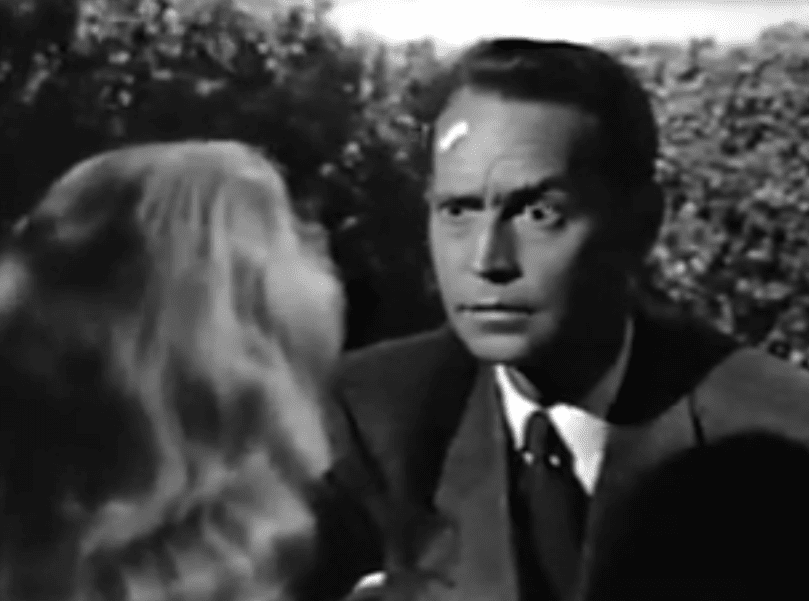
A film noir about a district attorney whose investigation into a suicide leads to a much more sinister plot involving political extremists,  Jigsaw starred Franchot, Jean Wallace, Myron McCormick, and Marc Lawrence. The film was made on a small budget, but what it lacked in budget it made up for in a Who's Who of cameo appearances. It featured cameos by Henry Fonda, John Garfield, Marlene Dietrich, Marsha Hunt, and others.

American Cinematographer praised Don Malkames, director of photography, for his skill at creating a lighting quality expected in studio films without fancy equipment and special-made sets. Journalist Norman Keane wrote:
This production demonstrates that feature films can be photographed in natural settings and locations...The natural locations were used because they afforded economy in production. Not a single set was built for the entire picture. Even the props were those found on the locations. The sites and locales used included interior of the Brooklyn Museum, a Fifth Avenue pet shop, a prominent night club, its dressing rooms, a large restaurant of unique design, an apartment house interior, elevators, and a warehouse...Every set was a challenge...none of the luxury lighting equipment of Hollywood studios. He [Don Malkames] had to get around the limitations of low ceilings of the apartment in which a great deal of the action took place, of the fixed walls of narrow halls and of elevators, and of the immovable fixtures, furniture, etc., which he invariably found in such locations as the pet shop. Before starting to shoot the picture, he had considered using mostly photo spot lamps and R-2 photofloods, but he found that even after building a number of barn doors and hangers for use with these lights, they would not give the precise lighting control necessary. 
Malkames used Mole-Richardson light spots, "inky dinks" for key lighting, and "150 watt broads for fill in light." Malkames secured lighting to ceiling beams to give scenes a more natural look and photographed the entire film with a fast lens in "exceptionally low key." He also used shafts of light to enhance the more suspenseful scenes.

Franchot said:
It is doubtful that there are many cameramen who could achieve the excellent quality of lighting that Malkames did, considering the lighting equipment he had to work with and the limitations of his sets.
Keane's article also uncovered another interesting element to Jigsaw's photography. The film was recorded entirely without sound!
Another thing which greatly simplified the photography was the absence of sound equipment—especially the mike boom which, under the lighting conditions used...most certainly would have involved unwanted shadows...It was the belief of the producers Lee and Danziger, based on long experience of dubbing foreign versions, that it is possible to get greater dramatic feeling into the dialogue when it is post-recorded and dubbed in after the picture is cut.
After the film was recorded, the cast reassembled at the recording studio. As scenes were projected on a screen, Franchot, Jean, and the rest of the cast spoke their lines. Other sounds such as the ringing of telephones, footsteps and so on were also recorded at that time. 

The cast and crew were excited to think of how this method would be studied by future producers and students of low-budget movies. They also thought it would prove a successful method for television movies in the future.

I knew the film was low-budget and that the producers, director, and Franchot himself took pride in its originality, but I had no idea of the lengths they went with natural lighting and post-filming dubbing. After learning how much the film was praised for its lighting and how the crew felt it would be studied by film students and television producers, I am even more frustrated that it fell into public domain. As a public domain title, the film has been neglected and is in bad shape. All of the copies you watch online and even the DVD I own are such poor quality in sight and sound. Can you imagine if we could see it in its original theatrical glory?

I rewatched the film after reading the American Cinematographer article and took notice of all the lighting tricks and was impressed by the effortlessly seamed dubbed video. I've always felt this was a very good performance of Franchot's (I wish he'd made more film noirs like this and I Love Trouble) and I like Jean's femme fatale character as well.

Here's the full movie on the Internet Archive. (If the embedded video doesn't play, click here.)


Source:

Keane, Norman. "'Jigsaw' Filmed Without Sound or Sets." American Cinematographer. December 1948.

Sunday, September 10, 2017

One New York Night (1935)

One New York Night is a 1935 mystery-comedy directed by Jack Conway and starring Franchot Tone, Una Merkel, Conrad Nagel, Harvey Stephens, Steffi Duna, and Henry Kolker. The film's tagline was "Fun - Romance - Mystery - It's all of these rolled into one merrily exciting entertainment!"

We are introduced to several characters in the lobby of the Hotel Diplomat and a man named Mr. Carlisle appears to be involved with everyone. A couple approaches Mr. Carlisle demanding that he right the wrong he has done them. It appears that Carlisle has backed out of a stock deal and hurt the finances of a former partner. A well-dressed man named Kent works for Carlisle and agrees to meet him in room 309 later that evening. A gorgeous countess is also there to meet with Carlisle, but is desperate that her fiancée not find out. A man wanders around the lobby with his invisible dog looking for his invisible plane. Two men watch the comings and goings of the Hotel Diplomat until they notice the "tip off" that indicates a deal is on. All the while, Phoebe (Una Merkel) witnesses everything while running a very busy hotel switchboard.


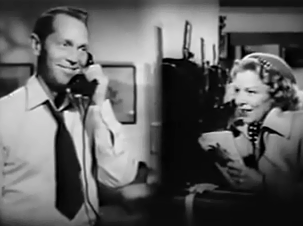
Amidst this Grand Hotel-esque bustle, Foxhall Ridgeway (Franchot Tone) arrives. Old Foxy is a Wyoming rancher there for a "room with lots of windows and a shower." When asked his business, Foxhall answers "women." Foxhall is frustrated when Phoebe bumps into him and then blames him for it. Soon though, the rancher and the switchboard operator become fast friends. Foxy tells Phoebe that he came to the hotel in a "very friendly spirit" and that he was there in New York to "corral a girl." In addition to the countess whom he briefly spies in the lobby, Foxy has three good wifely prospects written down in a notepad and asks Phoebe to get them on the phone. Excited, Foxy remarks, "I've been in New York twenty minutes, here I am going right into action. Pretty good, I say!"


Prospect 1 is married. Prospect 2 is expecting a baby. Prospect 3 has disconnected her phone.

Phoebe can nearly hide her contentment. Foxy is oblivious to her attraction to him, because to him, blondes are just "alright," not "dynamic" like brunettes. With a slow cowboy drawl and large eyes that express his incredulity at the chaos of the big city, Franchot plays Foxy perfectly. It's a role that, had it been made in the late 30's, could've ended up a Jimmy Stewart vehicle. But I'm so glad it's Franchot's. He blends the naïve cowboy persona with that of a man who, when faced with a murder in an adjoining room, takes charge of the situation. And that's exactly what happens. Mr. Carlisle's body is discovered and then mysteriously vanishes. When he tries to alert others, Foxhall is either ignored or threatened with silence. His only sidekick in the investigation is Phoebe, who abandons her seat at the switchboard to help Foxy track down the murderer.


Although he is quick in action, old Foxy still can't believe he's gotten mixed up in this mess. In that slow, warm drawl, Foxy protests, "I didn't come to New York to look for bodies and bracelets! I came here to find a girl. And I haven't even had my supper yet." Of course, viewers can see that Foxy is unknowingly telling this to the perfect girl for him, Phoebe. Eager to return to his ranch, he proudly boasts, "Say if all my cows were lined up nose to tail, they'd reach all the way from Columbus Circle to Albany."

Both Franchot and Una's characters are tremendously endearing and you find yourself rooting for them to find the killer and for Foxy to realize that Phoebe is the girl for him. The film is short (just 71 minutes) and there's a chance you'll figure out the murderer before Foxhall, but it is a truly enjoyable little whodunit—more for the fun teaming of Una and Franchot than anything.


One New York Night is not yet available on DVD, but it does play on TCM from time to time and has occasionally popped up on Youtube.

Monday, May 8, 2017

Final Performance (1965)

Franchot starred in Final Performance, episode 14 of The Alfred Hitchcock Hour's third season, in 1965. The episode aired on January 18th and costarred Sharon Farrell and Roger Perry. Although the show doesn't get as much airtime as Franchot's Twilight Zone and Hitchcock Presents episodes, you may still be lucky enough to catch this one on television. (For example, I know that the American broadcast station Me-TV airs Alfred Hitchcock Hour weeknights at 1 a.m. at the moment.)

Cliff (Roger Perry) is a film writer on his way to Hollywood, but is pulled over by a policeman after he is seen speeding through a small town and picking up a teen girl named Rosie (Sharon Farrell). Although Rosie was hitchhiking, she lies and says that Cliff forced her into the car.

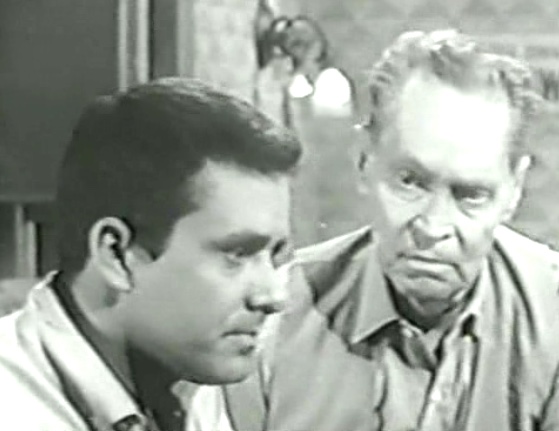
Rudy (Franchot Tone) is spinning bowls at the diner when Cliff comes in. This is a small town and Rudy says that no one ever stops at his diner and cabins unless their car breaks down. It’s no time at all before Rudy begins telling the out-of-towner that he was once Rudolph the Great and knew all the big stars. He has even named his cabins after stars and assigns Cliff to the Al Jolson cabin.


Cliff is surprised when Rosie comes out of the backroom to lead him to his cabin. When they are alone, Rosie apologizes for lying to the cop, but said she didn’t want to get into trouble because Rudy “looks after” her. A suspecting Rudy comes looking for Rosie, and from his cabin, Cliff witnesses Rudy possessively grab her wrist and lead her back to the diner.

Concerned, Cliff follows and Rudy is quick to entertain him with vaudeville stories, even showing Cliff his own cabin full of photos of Rudy with bygone celebrities. Franchot fans will notice that the photo of Rudy as a cowboy is a publicity photo for Franchot’s 1940 film Trail of the Vigilantes. The conversation about his past as an entertainer causes Rudy to explain that he arrived in this small town and owned the diner after his traveling fair ended here. Rudy was once married to another performer Maggie, but she has since passed away. Together, they raised Rosie after Rosie’s own parents perished in a fire.


It’s apparent (and quite disturbingly so) that Rudy views Rosie as a replacement for his wife and is grooming her for marriage. Indeed, when Rosie comes into the room, Rudy announces that she’ll be his bride as soon as she’s 18. Understandably, Rosie is uncomfortable around him and tries to squirm out of Rudy’s grip and out of his line of sight at every possible chance. Cliff, too, is visibly uncomfortable around Rudy and disapproving of his interest in Rosie. As the creepy older man eager to make a young girl he raised into a wife and living a life far removed from the present, Franchot turns in a performance that will make your skin crawl. He gets it just right: the desperation to be a star, frustration with the new generation, and utter psychotic obsession with a young woman. As Rudy, Franchot is slimy and pathetic and cruel and pitiful.

In another scene, Rudy asks Cliff if he thinks that a woman who flirts with other men deserves punishment:
Don’t ya think she deserves some kind of punishment?...Opportunity comes at the strangest time so you wait and you wait and you practice and you’re ready for it. You don’t run around like a chicken with its head off just to satisfy some anxious woman. No. You wait. You work in a diner like this even, if necessary, and you get ready for it. And if you can’t wait, and you can’t sit still, and they can’t stop playing around with other men, you don’t deserve what ya got, do ya? Well, do ya?
No, no. No, sir, Mr. Allen, because if you don’t appreciate what ya got, ya don’t deserve any of it. I tried to tell that to Maggie. I tried to tell her…I got my Rosie now. She’s gonna wait. She’s gonna wear this dress…My Rosie’s very pretty, isn’t she?...How pretty?....Pretty enough for you?...And spoken for, too!


If you've not seen much of Franchot's later work, you may be surprised at his appearance. Franchot looks much older than his years here and in most of his 60's work. This difference in appearance (and his voice, for that matter) can be attributed to a combination of heavy smoking, heavy drinking, and his facial reconstruction surgery from the Payton affair. I'm not sure of the exact year that he was diagnosed with lung cancer. I've heard varying accounts, but it may also be that he was already showing the signs of the cancer that would take his life three years later.

Throughout the show, Rudy teases that he has a speciality act that will blow Cliff away. We hear about it throughout the episode, but Rudy always stops short of performing it saying that he wants to practice and get it just right.

Rosie’s dying to get out of town before the marriage. She hates when Rudy touches her. When he tries to kiss her, she runs to Cliff causing more jealousy on Rudy’s part.

Cliff walks in on Rudy and Rosie doing an old-fashioned vaudeville routine in their “theatre”, an empty barn/tent. The policeman is there as their only audience member. After a dance number, Cliff painfully watches them perform an outdated comedy routine. Proud and in his element, Rudy is clearly delusional to think that this form of entertainment will draw in modern audiences.

After the show, Rudy threateningly tells Cliff that he should leave soon and warns him to keep away from Rosie. But in an odd change of heart, Rudy later asks Cliff to stay and write a new routine for him.When Cliff declines the offer, Rudy is enraged and spouts off a hateful speech about the new generation and their lack of appreciation for the old way of doing things. When Cliff returns to his room, a terrified Rosie, living in a world of male dominance and unable to save herself, is there waiting.
Cliff, I’m afraid. I’m afraid every time I’m near him!

Later, when he goes to leave and sees how depressed and miserable Rosie is, Cliff decides to secretly take her away from Rudy. When he returns to pick her up, Cliff is greeted by Rudy alone and Rudy is finally ready to perform his specialty act for him.

The long-awaited performance is eerie and shuddersome, and an ending that will remain with you long after it is finished.

Saturday, January 14, 2017

I Love Trouble (1948)

I Love Trouble is a swell little detective noir starring Franchot Tone as Stuart Bailey, a good-natured, witty private detective who is hired by politician Ralph Johnston to investigate Johnston's wife. Also starring Glenda Farrell, Janet Blair, and Adele Jergens, the film was based on the book Double Take by Roy Huggins. You may be familiar with the character of Stuart Bailey since actor Efrem Zimbalist, Jr. reprised the role on television in 77 Sunset Strip.


Franchot appeared to be enthusiastic about I Love Trouble. He said:
I don’t even use rough stuff when I corner the murderer. I use my wits instead. I go about solving this murder in strictly a mental way. Just like the detectives in real life. I’m keeping my face tan with a sun lamp. My only concession to the traditional screen dick is to wear a suit that doesn’t fit. Well, it fits but not the wonderful way my clothes in the playboy pictures did.
Tone also talked about the story's writer Roy Huggins:
He operated a statistics gathering office for factories to help them reconvert. After they reconverted, he told his staff their last job would be to reconvert him. They gathered a lot of figures and discovered the boss could make the most money with the least effort writing mysteries
 
 
Because the film fell into the public domain, it is readily available online on most video sites. Unfortunately, the picture quality is not very good. There are even brief moments when the screen is black and the scene lost. Please watch the film anyway! It is a well-written, well-acted mystery that will hook you despite the film's quality. Franchot gives a convincing and entertaining performance as the investigator with a keen eye for clues and pretty ladies.

In the film, Bailey thinks he's uncovering the mysterious past of a politician's missing wife. He soon finds that no one and nothing is what it seems. As he chases leads, Bailey begins to believe that he's the one who is actually being followed. Is he setting the trap or falling into one? I've embedded the full video at the end of this post so that you can watch the film in its entirety.


If you are unable to see the embedded video below, you can access the movie on Youtube and Internet Archive.


Sources:
Mosby, Aline. "Franchot Tone to Play Flicker Role of Good-Natured Detective." Herald-Journal. June 1, 1947.
http://www.thrillingdetective.com/bailey.html

Wednesday, August 5, 2015

The Man on the Eiffel Tower (1949)


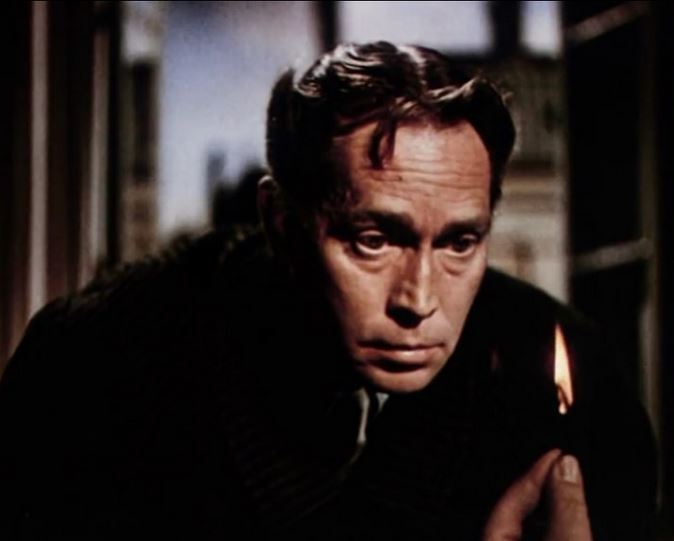
The Man on the Eiffel Tower stands out among Franchot's filmography for many reasons. First, it is a film that Franchot cited as one of his favorites. Second, it is the only film of his in color. Third, it features his second wife and mother of his children, Jean Wallace (yet they were either separated or divorced at the time of filming). Fourth, it was filmed with his pals Burgess Meredith and Charles Laughton. And fifth, it gave Franchot the opportunity to play a disheveled, quietly plotting killer.
Jean Wallace
Truthfully, I did not appreciate this movie the first time I watched it. I had come off a string of Franchot's 40s light romantic comedies and the plot of Eiffel Tower was a bit more complicated to follow. Also, I first watched a spotty quality copy with bad audio on Youtube, so I struggled to make out all the dialogue and was distracted by the rough cut. Later, I found a better version on Moving Image Archive and watched the film over in its entirety. (Just a note, because this film now falls under public domain, there really is no pristine copy. I've included links to the ones available online at the end of this post). On my second viewing, I enjoyed the The Man on the Eiffel Tower for the unique thriller that it is. My advice to you is don't write it off just because it hasn't been restored and it's not your typical glossy Hollywood mystery. The film has a clever plot, great cast, and amazing color views of Paris in the late 1940s.


In the movie, Bill Kirby (Robert Hutton) and his girlfriend Edna (played by Jean Wallace) confess to Bill's wife that they have been having an affair. In a cafe, Bill talks about his wealthy aunt and how her death could benefit his and Edna's future.

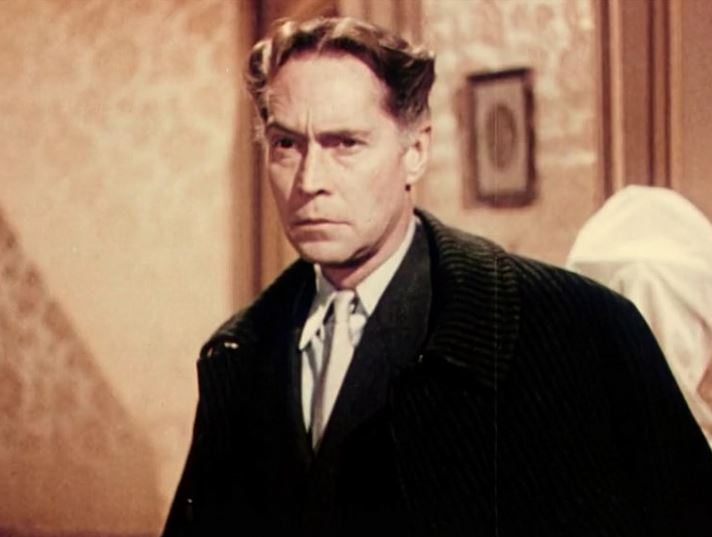
Johann Radek (Franchot Tone) is a sly, kooky character dining across the cafe. Radek passes a note to Mr. Kirby, offering to murder the wealthy aunt.
Meanwhile, the film's director Burgess Meredith stars as Joseph Heurtin, a quiet, hard-working man whose wife does nothing but belittle him. Heurtin decides to break in to and steal from Kirby's aunt's house, and unwittingly walks into a murder scene. When Heurtin loses his thick glasses (very similar to Meredith's Twilight Zone "Time Enough at Last" spectacles), the murderer Radek helps him home.

Because his glasses are left at the scene, Heurtin is first implicated in the murder. Heurtin helps the police identify Radek, but Radek is so sneaky and clever that he is able to taunt the police. Charles Laughton is brilliant as the lead inspector working to bait and catch Radek.
             
Franchot was 44 years old when The Man on the Eiffel Tower was filmed and the film, in my eyes, is his transition from romantic lead to interesting character actor. Although Franchot had played a killer once before in 1944's Phantom Lady, Eiffel Tower is where we first see Franchot's face (a bit more lined with wrinkles and wisdom) taking on the characteristics that he would display in his television work. His hair and clothes are somewhat disheveled and his eyes are full of mischief.
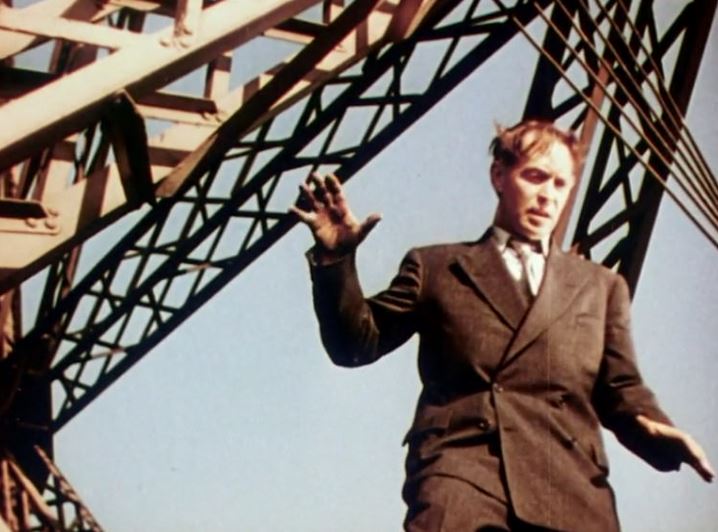
One of my favorite scenes is the exciting Eiffel Tower climb at the end of the film. Radek attempts to resist arrest by climbing the Tower, but Heurtin and the Inspector are close behind. The cityscape is visually stunning and the scene itself will have you on the edge of your seat!


You can watch The Man on the Eiffel Tower on Youtube or at the Moving Image Archive. There is also a DVD available on Amazon.