Showing posts with label interview of FT. Show all posts

Tuesday, June 16, 2020

Franchot Visits Birmingham, Alabama

Photo of Franchot that
accompanied the article.

In February 1950 Franchot traveled to Birmingham, Alabama to promote The Man on the Eiffel Tower. It was a whirlwind one-day press tour of the city including multiple newspaper and radio interviews, a special luncheon at the Downtown Club, a cocktail party at Tutwiler Hotel where his suite was located and ended the evening by making a personal appearance at the Linley Heflin Unit Mardi Gras Ball which was held in the Municipal Auditorium. By midnight, Franchot was on a plane to New York where he was slated for business meetings with friend and TMotET director Burgess Meredith.

With Birmingham press, Franchot shared that he felt his youngest son Jeff might become an actor. Franchot added that Jeff enjoyed "mugging" and always put on a great show every Christmas that his aunt Karol (Jean Wallace's younger sister and only a child herself) would direct in front of the family Christmas tree.

On producing The Man on the Eiffel Tower, Franchot said:

Production, I like, because a producer can assure himself of more interesting parts. You'll like Man on the Eiffel Tower. It's not a mystery but a suspense picture. And Charles Laughton's not the villain. I am!

Interestingly, Franchot shared that his business meetings with Burgess Meredith in New York were to plan for their next film. Burgess was set to direct and Franchot would produce and act in a film version of the novel The Song of the Flea. They planned to begin filming it in London within a year or two. A film adaptation of The Song of the Flea never happened (perhaps due to the Payton love affair and the events that it caused.)  I have a special fondness for Franchot's work as a producer (The Man on the Eiffel Tower, Uncle Vanya) and co-director (Uncle Vanya) so it is a shame this other opportunity never came to fruition. It not only would've been a creative venture for Franchot, but he would've also enjoyed working with best friend Burgess Meredith on it. The Song of the Flea was written by British novelist Gerald Kersh whose most famous work Night and the City was made into a 1950 film starring Richard Widmark and again as a 1992 film starring Robert de Niro. I cannot find any proof that The Song of the Flea, which focused on a writer struggling to succeed, was ever adapted for film.

You can read more about The Man on the Eiffel Tower here .

Source:
Caldwell, Lily May. "Franchot Tone Visits Here, Talks of Kindness." The Birmingham News. February 18, 1950.

Thursday, April 30, 2020

Franchot on Understanding the Acting Profession

Franchot over breakfast. Source: Elmira Star-Gazette.
Reporter Peggy Gallagher interviewed Franchot over breakfast on his first morning in Elmira, New York. He was due to give a presentation on Mark Twain at Elmira College that evening. When asked if he was comfortable portraying older men or father figures, Franchot assured that he felt very comfortable in the role and proudly talked of his sons Pat and Jeff:

And, the rascals! They both want to be actors...A useless profession! Unless you thoroughly understand it, of course. But, I don't see that they'll ever work their way out. They're thoroughly soaked in theater. 

Franchot went on to explain that although he'd prefer "physics, law, chemistry" for his sons, he would not have chosen a different life for himself.

But, that's what I mean—I understand it. Let me explain it this way: entertainment, as a function of escape for the human race, has been in its best times a signpost to the greater aspirations of which the human race is capable...how's that sound for 9:30 in the morning?

When Gallagher pressed for more meaning, Franchot answered:

It means the entertainment business makes dreams real—and it's the dreams of man which have made our world possible.

Franchot went on to share that he preferred the theater over film because of the "immediate relationship with the audience."

And when asked about the high point of his career, Franchot insisted that his high point was still to come.

There was a very wonderful book by the author, Christopher Morley, about a cocker spaniel named Mr. Gissing. Mr. Gissing lived in a valley. He kept looking at the hillside and at the blue beyond. He decided he wanted to climb the hill and find out where the blue began. But when he reached the top, doggone if he didn't find another hill!

The novel that Franchot refers to is Where the Blue Begins and was first published in 1922 and its author also penned the 1939 novel Kitty Foyle, which was brought to the screen with Ginger Rogers in the title role in 1940.

Franchot talked quite a bit with Elmira reporters (here's what he said about politics) and there is more to come about his presentation on Mark Twain!

Source:
Gallagher, Peggy. "Franchot to Give Twain Tone." Elmira Star-Gazette. October 14, 1960.

Tuesday, April 21, 2020

Franchot on Politics

Franchot Tone 1960
Franchot found himself in a sea of reporters and fans when he landed at an airport in Elmira, New York in 1960. Franchot asked them to gather in the airport waiting room, where reporter Mary Lee Morken said he "wrapped the crowd around him like a cloak" and answered questions. When Franchot was asked by a newsman whether or not he had ever participated in political work, Franchot responded:

I was one of the members of the Hollywood Democratic Committee. We were quite active. Melvyn Douglas and lot of others—I can't remember now. It was back about 1940. I think we were quite influential in breaking up—well, let me put it this way. We helped elect Olson, who was the first Democratic governor elected in California in 50 years. We helped break the way for Gov. Warren, one of the finest statesmen of our times.

When someone asked whether actors should even be "mixed up" in politics, Franchot is described as bristling and answering disdainfully:

I think every citizen should be 'mixed up' in politics.

Another person in the crowd broke the tension by asking Franchot if he'd consider playing Abraham Lincoln. Franchot made the crowd laugh when he answered:

I'd be afraid to play Lincoln. Any actor who plays Lincoln is never happy until they shoot him.

Franchot granted multiple interviews during his visit to Elmira College where he was speaking on Mark Twain and his performance as Twain in the television production The Shape of the River. I will be sharing more of Franchot's quotes from this trip as well as details of his itinerary over the next week.

Click here for previous posts on Franchot and politics.

Source:
Morken, Mary Lee. "Actor Long Acquainted with Twain." Elmira Advertiser. October 14, 1960. 

Tuesday, July 2, 2019

Franchot Talks to Picturegoers Magazine

In 1935, Franchot talked to Picturegoers Magazine while on the set of No More Ladies:

My opinion as to why the fifteenth screen test resulted in a film contract is that in the space of those four years in New York the manufacturers of motion picture negatives had improved their product to such an extent that almost anyone could be photographed satisfactorily. In pictures, the first thing they want to do is make a person a hero. You know, broad shoulders, wavy hair and that sort of thing. I have no illusions about myself. I’m not a hero, and I can’t see what I should be made what I’m not. The other day I read a story about myself that made me human. I like that kind of stuff, because it’s sincere.There’s nothing unusual about me—I’m just an ordinary, and, I hope, normal individual.
In the film colony there is little to do besides work. People in pictures don’t relax socially to any extent. Thy work like the devil to finish one picture so they can go into another. I would like actually to work about thirty-six weeks out of the year. The remainder of the time I would rest, study, and travel. Then I would have an opportunity to enjoy life. 
Picture making is not easy—it requires a terrific amount of concentration. It requires more from a person than does working on the stage. To be a success on the screen a person must have a lot of force and drive, like Joan Crawford…I definitely intend to return to the stage, not permanently, however, I would enjoy dividing my time between the stage and screen. 

Monday, January 22, 2018

Joining Ben Casey in 1965 and Harry Landers' Take on Franchot

In December, I shared Franchot's interview with TV Guide (here.) That interview was conducted after Franchot joined the cast of Ben Casey and was published in January 1966. The previous year (on June 23, 1965) Franchot talked to reporter Bob Thomas, for Thomas' Movie-TV Talk column, about accepting the role of Dr. Daniel Freeland. Franchot was visiting his brother Jerry in Florida when he received the call that Bing Crosby Productions wanted him to step in as a new character after veteran actor Sam Jaffe left the show. According to Franchot, Jaffe (who costarred with Franchot in the play The Gentle People decades before) noticed that his option had been picked up days late which freed him of his contractual obligations to the show. Franchot said:
I grew a beard for the play; They'll have to take me and the beard or not at all...I had refused a series for years because I wanted to remain in New York to be near the theater. But lately there haven't been enough plays worth doing. I turned down more guest shots on television than I accepted. Parts in films were few and small in nature—cameo shots, they are called.
I like my profession. Since there is not enough work elsewhere, I can work at it here, where I have a chance to test my abilities. It's better to know that you have a challenge than to sit on your rear and wait.
On returning to California to film the show:
There was a lot of froth in those days or maybe I was frothier then. Anyway, the froth seems to be separating. There are still those who hang out at the Whisky A-Go-Go and the Pink Pussycat. But the real people don't go to those places. There is plenty for them to do in the cultural vein. California is no longer the 'cultural desert' we used to say it was.
Actor Harry Landers died in October of last year. Landers played Dr. Ted Hoffman on Ben Casey from 1961 to 1966 and was also well-known for his film and commercial appearances. In 2010, Stephen Bowie, of the Classic TV History Blog, interviewed Mr. Landers and shared it on that blog in 2011. The interview is in-depth and Landers is very forthcoming. Among other things, he talks about his work on Ben Casey and describes in detail the strengths and weaknesses of his costars—including Ben Casey star Vince Edwards and Franchot Tone.

Landers brings up Franchot before Bowie asks about him and remembers Franchot as "brilliant...amazing....marvelous, compassionate, bright guy" and also a "total alcoholic." Landers talks about how Franchot kept to himself and was at first slow to relate to the cast, handled on-set dalliances, ruined his car, and how his drinking began to affect the staging of the episodes Landers directed. Landers clearly admired and respected Franchot as a man and actor, and was amused by the incidents Franchot's drinking caused. The interview is a must-read so please head over to The Classic TV History Blog and read Mr. Bowie's full interview with Harry Landers (click here.)

Sources:
Bowie, Stephen. "An Interview with Harry Landers. The Classic TV History Blog. https://classictvhistory.wordpress.com/2011/05/31/an-interview-with-harry-landers/

Thomas, Bob. "Franchot Tone Happy for Chance to be a Regular on 'Ben Casey'." Daytona Beach Morning Journal. June 23, 1966.

Saturday, December 16, 2017

Franchot Talks to TV Guide, 1966

Franchot Tone as Daniel Freeland in Ben Casey, 1965-66.
Source: my collection.
In late 1965, Franchot granted an interview about joining the cast of Ben Casey and it appeared in the January 1, 1966 edition of TV Guide. It is my favorite of his print interviews, because it really shows that wit he possessed that all of his friends talked about in their recollections of him. I've collected some of Franchot's quotes from the interview as well as some of the interviewer's observations about him in this post. After buying a copy on eBay, I read the article and couldn't help but smile at Franchot's responses and feel emotional about his "best to come" response. Everything he says here is just so quotable! I love his reference to theater as the "feed bag" and his jokingly calling himself a "reasonable prima donna." When I read interviews of Franchot's, I always come away thinking "I really like this guy." And I think you will, too. That's why you're here, right?

On joining a television series in his 60's:
Tone flashes a smile familiar to two generations of moviegoers. "What's the use of having all this talent and not using it?" Tone says, and a network of laugh lines crinkle at the corners of his eyes. "Seriously, no plays came along and few pictures for a man my age except the odd cameo bits. I simply wanted to work."

Franchot's personality:

He has the aura of substance, the tenor of actorish dignity. A variety of books and recordings are stacked neatly in the living room, with the emphasis on Shakespeare and Mozart. "A man is happiest when his tastes are eclectic," Tone says. Only one magazine is in view, a copy of Playboy on the coffee table.

When Tone offers suggestions, [costar Vince] Edwards nods agreeably. "Fine, Franchot," Edwards says. "Whatever makes you comfortable." "I'm a very reasonable prima donna," Tone says. Edwards grins.

Both Vince and Franchot have a mutual love of horse racing. Sitting in his dressing room, Tone is usually immersed in a scratch sheet, pencil in hand. When the thoroughbreds are running, Tone and Edwards are at the track, although not together—Tone, the rich man's son, patronizes the $5 window, Edwards the $100 window.

"I'm unlucky in love. I should be lucky at gambling." But he isn't.

Gig Young, who starred with Franchot in "Oh Men! Oh Women!" told TV Guide:
Without being a fool about it, Franchot shared the limelight. He's an unselfish man, and when you say that an actor is unselfish—well, who's ever heard of an unselfish actor?

Another actor who chose to remain anonymous commented:
Tone has so much charm he makes people forget he's as self-centered as anyone in this business. Tone does what is best for Tone.

Franchot's Thoughts on Awards:
They are good for the people who give them and the people who get them and that's what awards are good for. (The interviewer noted Franchot was "properly sardonic" on the subject.)

Franchot's Thoughts on Marriage:
Marriage is very good for the children.

Franchot's Thoughts on Acting:
Everything I know about acting I learned from Lee Strasberg. At the Group, I learned Strasberg's variant on the Stanislavsky System—that's S-y-s-t-e-m, not Method. Method actors lack discipline. System actors are disciplined. I'm a pretty good actor today only because I've always renewed myself at the feedbag—the theater.

His Pride:
I'm proud that I've still got the best to come. I'm proud of "Strange Interlude" and "Uncle Vanya" and "Bicycle Ride to Nevada," which the critics roasted. I'm proud of some of the movies I was in. I'm proud of a half-hour GE Theater on Charles Steinmetz. I'm proud of my Mark Twain on a Playhouse 90. I'm proud of "The Old Cowboy" on The Virginian. And I'm going to be proud of Ben Casey.

Source:
"Who Has Ever Had a Better Time?" TV Guide. January 1, 1966. 12-14.

Thursday, October 12, 2017

Franchot Talks of Uncle Vanya

In October 1957, Franchot talked to drama editor and critic Lewis Funke for Theatre Arts Monthly. Franchot explained, in detail, his reasons for filming, producing, and co-directing a version of Uncle Vanya. The play was earning phenomenal reviews and Franchot felt it was worthwhile to capture the production for eternity. I've written about the film before (here) and it is top-notch. Franchot is completely wonderful in the role. In light of his costar and fourth wife Dolores Dorn-Heft's comments about Franchot's ultimate disappointment and deterioration over the film's reception (here), the transcribed interview in which Franchot is very hopeful and eager may leave you with a tinge of heartache for him. When it was released, the film received rave reviews from critics, but failed to be a commercial success. It cost Franchot a lot of money and he was saddened that his performance didn't garner any awards or individual acclaim. Although Franchot could see that films were changing and was absolutely correct to see that it was the right time to create an art-house film for intelligent audiences, he failed to foresee that audiences would even more heavily embrace a film like Uncle Vanya as time went on. He was ahead of his time in a lot of ways. Uncle Vanya is now on DVD and is praised for its nuanced performances. I think Franchot would be pleased and proud that Uncle Vanya is now out in the world in the hands of those who appreciate it.


Here's what Franchot had to say about this endeavor in 1957:

You might say that I was driven by a wish to immortalize our production. I don't know exactly when the wish was born, but I do know that once it was, I could not put it away. I kept thinking what a shame it would be for the play to end just because it had run its course on Fourth Street. It was so good, the ensemble playing was so superb, and Stark Young's translation was so beautiful and fresh that I couldn't put the thought out of my mind.
Then suddenly it occurred to me that the play could and ought to be put on film just the way we were doing it on the stage, with some changes, of course, to avoid the danger of its becoming a static thing on the screen. That, you know, is the great pitfall in trying to make an exact copy from the stage.


Up until comparatively recently, of course, the idea of putting a play such as this on film would have been pretty foolhardy. The market potential would not have warranted the financial risk. But there has been tremendous growth of the art-film houses throughout the country which can only be attributed to the maturing artistic taste that is everywhere notable among our people. There was a time when you could count the number of art houses in New York on one hand, and the number throughout the country was equally minute. Although there are no firm figures at present, it is estimated that there are now over four hundred of these little houses across the country catering to that discriminating clientele that is seeking better and more intelligent fare than they can find on their television sets or in their neighborhood movie palaces.
But even with this knowledge, I still was not in a position to take the risk until I had really professional advice. I called upon my old friend Arthur Krim, who used to be the lawyer for the Group Theatre when I belonged to it, and who now is the president of United Artists. He saw the play and assured me that with the proper budget, I might hope to break even and perhaps make a little money. That did it.

We didn't want to have anyone else's mind or anyone else's creativity super imposed on or interfering with the play. We realized that for a motion picture it would be necessary to get more action into the telling of the story than there was on the stage. But we felt that whatever action we wanted we could get from the play itself. By following Chekhov's directions and his writing we could move the action around up a staircase, around a room, in the garden. This we believed would be sufficient to give the film the necessary fluidity.
Yes, there have been a few cuts. But I don't think anyone is going to really mind those decisions. They have been made only where we found that Chekhov was somewhat repetitions. For instance, playwrights have to contend with intermission and when their plays resume they are bound to reiterate exposition points. This repetition has been eliminated because in pictures once you've made a statement you can believe that the audience will not forget it.


It's one of the biggest gambles of my life. But I cannot recall when I received more gratification from an undertaking. This is the first time in America that anyone has put Chekhov on film. Call it a great financial risk, a noble experiment or what you will. But if we've succeeded in duplicating what we had on 4th street, there will be no greater thrill for me. It surely would have been a terrible waste to lose forever George Voskovec's Uncle Vanya, Clarendon Derwent's Serebriakoff, Geraldine Hiken's Telegin, Mary Perry's Marina, Peggy McCay's Sonia and Shirley Gale's Maria Vasilievna. And, although we have lost Signe Hasso's Elena, we have Dolores Dorn-Heft, giving what I think is another beautiful portrait. Who knows? We may wind up among the archive films of the Museum of Modern Art.

Source: Funke, Lewis. "Uncle Vanya." Theatre Arts Monthly. October 1957.

Tuesday, March 21, 2017

Franchot on Joan's Humor, Talent, and Feminist Example

Joan. Dancing Lady, 1933.
Franchot continues his conversation with Jack Jamison on his love for Joan:
And then, of course, there's her sense of humor. You can always tell if a person really has a sense of humor by his willingness to let himself seem ridiculous. Joan loves to be caught looking 'silly,' so that people will laugh.
Sometimes at the end of a scene, while the cameras are still turning, she makes a face or lets her mouth hang open. Then when she goes into the projection room to see the rushes, she too laughs at the foolish picture of herself. It isn't loud, insincere laughter—the kind of laughter so many people use to cover a situation which embarrasses them. Nor is it the kind of laughter that seems to say, 'See what a good sport I am?' It's more a snicker, like a youngster's, but very real. She honestly loves to kid herself.
She loves to kid other people, too, but never cruelly—always gently. Once when we were making a picture together, I was supposed to do a swimming scene. Joan went to the director and asked anxiously, 'The tank isn't deep, is it?'
'Sure! Ten feet or so.' The director replied. 'Why?'
'Mr. Tone can't swim.'
'Can't he swim at all?'
'Well,' she said. 'He can do the breast-stroke a little.'
She had them nearly crazy, explaining that I'd look silly if I couldn't do a crawl stroke, wondering if they could get a shallow tank so I could just wade, arranging for me to stay up all night and learn strokes. Then after they were all wild, she broke down and told them that I really could swim, after all.
But there is something even more important than a sense of humor—especially in a woman. And that is good taste. Joan's taste is exquisite. Like her intelligence, it is instinctive. While William Haines gets the credit for decorating her beautiful home, Joan, as a matter of fact, did a great deal of the actual choosing.
And her taste is as creative as it is discriminating. I've even heard her make suggestions to Adrian when he was planning clothes for her. They must have been good suggestions, because Adrian followed them.
Incidentally, Joan's wardrobe is stunning because she has good taste and not because she spends large sums of money on clothes. Undoubtedly one of the best-dressed girls in pictures, she spends far less for clothes than many another feminine stars. Recently, when complimented on a lovely new outfit, Joan winked and said, 'Last year's suit. New scarf and new hat, that's all.'
Most important is her taste in people. I have never, and there is not a single exception, found a soul she liked whom I didn't like, too. In choosing her friends, accomplishment—what they've done—means nothing to her. She's interested in what they are. If what they are helped them to do something, that is another matter. But popular acclaim, fame, popularity—they mean nothing to her. They two qualities Joan looks for in a person are sincerity and self-reliance.
And then, last but not least, there is Joan's talent. She has temperament. Her emotions are quick and full. She's angry when she's angry, gay when she's gay. I think she is one of the most vivid personalities on the screen or stage today. And I think that, with her determination, she is going to become one of the greatest artists America has ever produced. She herself believes she is only beginning now.
I believe Joan Crawford would have achieved outstanding success in any profession she chose for herself. She is the perfect example for feminists to point to in maintaining that the sexes are capable of equal achievement. With her shrewd, clear, quick thinking, she would make a marvelous business woman. With her executive powers and ability at handling people, she could go far in politics. With her sympathy and intelligent understanding for other people's troubles, she would be ideal for social service. Every child she meets falls in love with her—she ought to be a wonderful teacher. That girl could do anything!
Part One: Franchot on Joan's Intelligence and Beauty

Source:
Jamison, Jack. "'I'd Rather Know Joan Than Anybody Else' says Franchot Tone." Photoplay Magazine. November 1933.

Monday, March 20, 2017

Franchot on Joan's Intelligence and Beauty

In 1933, in the very early days of their relationship, Franchot talked to a reporter about the reasons Joan fascinated him:
I'd rather know Joan Crawford than anybody else I know. And I have any number of reasons. In the first place, Joan is more intelligent than most people. Joan has what the French call l'intelligence de coeur, or intelligence of the heart. It is a human and sympathetic intelligence, the power of learning by putting herself in the other person's place. But it is more than that, too. It is the power of giving meaning to every new experience by relating it to a past experience. When Joan comes in contact with something new, she instantly coordinates it with the rest of her knowledge. Therefore, Joan is intelligent in a deep and understanding way.
She is receptive to every new idea. There are some people who make a pose of being receptive and brag about being 'open-minded.' Not so with Joan. She never accepts anything just because it is new, or because she wants to prove she is broad-minded. But she examines everything with an open mind, then chooses that which she considers worthwhile. And she has an instinctive mental judgment which helps her pick the wheat from the chaff. For example, Joan honestly believes that she knows nothing about acting, and is just beginning to learn. And yet, when we talk about the stage, when I tell her things that happened to me when I was on the New York stage, little tricks of technique that I saw actors use there—she can pick the good ones from the bad ones instantly. She knows at once what would be right for pictures and what would be wrong.
Then there is Joan Crawford's beauty. I hardly need mention that. But a fascinating thing about her beauty—and a thing you don't realize until you know her personally—is that she is beautiful in two distinct and different ways. One the screen her beauty is formal. It gives you the impression of a classic statue. It might be sculptured, that head of hers. But you don't really appreciate her beauty until you see her without her make-up. Sometimes when you're traveling in a foreign country you suddenly come across a woman who literally makes you catch your breath. If you're in Bavaria you find yourself saying, 'Here is the perfect type of Bavarian beauty.' Well, seeing Joan as she really is, so fresh-looking, with that clean-scrubbed look of hers, you say: 'Here is the perfect type of American beauty.' And her freckles are a part of it.
I think the first time I became aware of her great beauty was once when I had been asked to her house for lunch. She was in the back yard taking a sun bath. She came in, her hair rumpled, and oil all over her face and arms. And she was beautiful! Beauty like hers is a real thing. You can't mistake it!
Part two on Joan's humor, talent, and business sense coming tomorrow!

Source:
Jamison, Jack. "'I'd Rather Know Joan Than Anybody Else' says Franchot Tone." Photoplay Magazine. November 1933.

Saturday, February 25, 2017

Franchot Tells On Himself: Vintage Magazine Articles

 
In the 1930's, writer and later press agent Jerry Asher wrote many articles on Franchot for fan magazines. I have mixed feelings about Jerry Asher, who became incredibly and exaggeratedly gossipy as time passed and later made some pretty damaging claims about the private lives of both his once confidante Joan and his one-time friend Franchot. (I am researching the validity of some of Asher's statements and will go more in detail about all of this later, but I'm always mistrustful of "friends" who make themselves readily available for any public opportunity to divulge very private details.) No matter my feelings of Asher's future behavior, back in the 1930's, he could be depended upon to publish quality magazine articles on Franchot. In Franchot Tells On Himself, Franchot divulged the many things he disliked about himself, personally and professionally:
I dislike my so-called ease of manner. I dislike it on the screen and I dislike it in real life. It stands in the way of my creating a character on the screen instead of just playing myself over and over again. If I'm portraying strong, true emotions, instead of giving subtle indications of what the emotion might be, it stands in the way of my ever doing any really fine work, such as in Shakespearean tales. Some day I hope to go beyond it. Of course, it's fine for those Park Avenue playboys I've done to death. I dislike that kind of part intensely. I've played so many, people actually think I'm that kind of smug chap. I agree with them, and if I weren't so lazy, I'd have done something about it long ago.
Speaking of laziness, this is another thing I dislike about myself. For instance, I put off writing letters for weeks at a time. I hate to delegate them to some one else, especially my fan mail. It takes about four or five hours a week to do it, but somehow I seldom get around to it. But when I do write or send photographs, I send them myself. I feel it is cheating to let some one fake my signature, so at least I do it right when it is done.
My family back in Niagara Falls likes to hear from me every week. A few hastily written lines to let them know I am well is all they expect. But I put off writing, and then have to go to the expense of a long-distance call, when a three-cent stamp would have done the work.
People may think I'm conceited, but that doesn't prevent me from disliking my looks in general. The first thing that hits my eye when I see myself on the screen is my big Adam's apple. Can you imagine a surprised-looking turtle with a huge lump in its throat? Well, that's exactly the way I look to myself.
I dislike my superficial knowledge of a great many things, and my lack of real knowledge of any particular one. I dislike it because it gives the impression of being well read and intellectual. The truth is, I went to college and happen to have a good memory for stray facts, which gives me a superficial knowledge of a great many things.
Generations of a legal family behind me have made me pedantic. I dislike this in myself. I argue about dates, exaggeration of facts, wrong descriptions, et cetera. Often they are not important and the inaccuracy usually makes better conversation. But so many of my ancestors were lawyers that it has made me a stickler for the exact statement about everything.
I think there's too much vanity in my general make-up. If I weren't so vain I'd make those playboy roles mean something as in 'Dancing Lady' and 'Reckless.' But vanity kept me from doing anything unusual with these roles. I thought it was more important to look well. If I hadn't been so vain, I could have played the parts drunk and disheveled and really kept myself in character. Vanity enters into it when I talk with people. Somehow I never can bring myself to admit my superficial knowledge, even if I only have a vague idea what we are discussing.
At heart I am timid. But I dislike myself for being that way. I am an actor, and people expect me to be colorful, self-assured and amusing. I feel they expect these things, and they should be carried off with a flourish and an air. When I feel some one looking at me I get terribly self-conscious.
I dislike myself for not living up to my screen personality. I haven't a right to do this to the people who go to see me. I really should have an act. It would be much more intriguing and interesting. It's easy to put on an act on the screen, but off the screen there just isn't any act. I know it's disappointing, but I can't help it.
One of my pet dislikes is that I am such a sane fellow. I don't want to be sane, but I'm so colorless I just never think of crazy things to do. I don't seem to have that magnificent abandon that makes a man suddenly make up his mind to jump in a plane and fly to Alaska, or go tramping off to some desert to dig for gold. If I contemplated giving way to an impulse, I'd first figure out how long it would take, and which would be the best way to do it.
Source:
Asher, Jerry. "Franchot Tells on Himself." Picture Play Magazine. 1935.

Friday, February 24, 2017

Franchot Thaws: Vintage Magazine Articles


When reporter Madeline Glass was assigned an interview with Franchot Tone for Picture Play Magazine in 1935, she was less than enthused. Glass had heard rumors that Franchot was haughty, disagreeable, and uncooperative. After her face-to-face meeting with a friendly Franchot on the set of Reckless, Glass shared her suspicion that "innate shyness has caused him to take refuge from argus-eyed reporters behind a barrier of aloofness. He strikes me as being a person whom one must know more than casually before his lurking friendliness can adequately manifest itself."

During their conversation, Franchot broached many subjects.

On his wealthy upbringing:
No, I've never been in want of material things. Sometimes I wish that life hadn't been so easy for me. A few hard knocks would have been beneficial, I think. At times I wonder how I would react if disaster did overtake me. I might crack up because of no previous experience in dealing with severe trials.


On rumors that he'd been difficult to work with on the set of Lives of a Bengal Lancer:
That was the only time I've asserted myself since coming to Hollywood, and my work in the production has proved to be the best I've done in pictures. Some of my dialogue was poor, so I changed it. I also insisted on doing some of my scenes the way that I felt would be most effective. I wouldn't work on Sunday as my contract stipulated that I need not.
On his love of the theater:
I like picture work, but I can do better acting on the stage. There's more opportunity to create characterizations in a medium where one studies and rehearses a role for weeks. Pictures are made too rapidly for one to get a genuine understanding of the part one plays. Too much is left to chance. On the stage a role is developed gradually. In the end one has a complete characterization.
Source:
Glass, Madeline. "Franchot Thaws." Picture Play Magazine. April 1935.

Thursday, February 23, 2017

The Winning Mr. Tone: Vintage Magazine Articles

I've transcribed one of my favorite articles on/interviews with Franchot that was conducted by Edmund Douglas for Silver Screen Magazine in May 1935. In it, Franchot discusses his struggles with his public image and film career.


The Winning Mr. Tone
by Edmund Douglas
Silver Screen-May 1935

The whole trouble with most stories about Franchot Tone is that they never give him a chance. He is not an easy person to interview—or to know—and most of the stories about him have unconsciously, I am sure, made him out as pretty dull. He isn't dull. He has a quiet rippling humor, as I discovered to my cost.

Not long ago I visited a set where he was working. In reporting the activities on the set, I wrote "I can never quite figure Franchot out. He always speaks civilly, sometimes even pleasantly—and that is all. You never know whether he likes you or whether he doesn't and the idea of just sitting down for a chat with Franchot would never occur to you. Or, at least, not to me."

A few weeks later, I encountered him at our tailor's. "Hello," he grinned. "Sit down and have a chat!"

I think I was the first writer to meet him on his arrival in Hollywood. A mutual friend took me to his beach home one day. He was a swell fellow then. Today, two and a half years later, he is still a swell fellow.

Conversation revealed that his real love was the theatre. "I've been in a number of plays in New York," he confessed, "but I've never been in a hit. I want to be in a successful stage play."

"Why did you come out here then?" I inquired.

"The money mostly. At any rate, I have a clause in my contract which gives me an option at the end of a year, too. The studio, of course, can let me go at the end of the year if they don't want me. But on the other hand, if I don't like pictures I can let them go. I can't go to work for another studio but I can go back to the stage. I figure in pictures I'll either be a quick flop or a sudden star. A year should be long enough to tell the story."

Today he is neither a quick flop nor a star. And he is still in pictures. "How come?" I asked.

Franchot grinned. "Oh shucks, Ed. When the year was up I didn't want to leave Hollywood. I had friends here."

"Do you feel you're any nearer stardom now?" I persisted.

He smiled ruefully. "Look, what's happened to me: when I first came out here I had about six stories in the motion picture magazines. You did one that I liked. That was done out of friendship. The other five were written because I was a newcomer—as one would write about a newly discovered freak.

Then I met Joan Crawford and immediately there was another cycle of stories—this time about 'Joan and Franchot.' I hated that. I feel flattered, of course, when I see my name linked with hers. Who wouldn't? But I don't think those stories were fair to her—or to me. Joan has worked like the devil to attain the position she has. I think it's a cheap way to gain publicity to try to do it on the strength of a friendship with someone who happens to have a big name. Her fans resent it. As far as I'm concerned, I feel a little ashamed every time I see an interview purporting to be about myself but which is, in reality, about my friendship with her, because I know down in my heart that if it hadn't been for that friendship the story would never have been written."
 
"Why did you give out those interviews?" I asked bluntly.
 
"I didn't. At least, when the appointments were arranged nothing was intimated about the writers wanting to talk to me about Joan. The first time or two they asked what I thought of her and I suppose I let my enthusiasm run away with my tongue. I didn't know they intended using that stuff. I hadn't had a great many interviews and up to that time all they had used was chiefly biographical data. but after a couple of those stories broke I got wise and refused to talk about her. If you've noticed, the subsequent stories had darned few quotes in them. They were mostly written about us and consisted chiefly of speculation on the part of the writers.
 
People have intimated that I'm riding the crest on the strength of my friendship with her and its attendant publicity. That hurts. I don't think Fox borrowed me for the lead in The World Moves On or Warner Brothers for Gentlemen Are Born or Twentieth Century for Moulin Rouge or Paramount for Lives of a Bengal Lancer because I happen to be friendly with her.
 
I don't want to succeed whether in pictures or in magazines as a freak (which the first cycle of stories made me out to be) or in someone else's reflected limelight (as the second cycle implied.)
 
This may sound conceited but I don't intend it that way. I'm discussing myself as though I were a barrel of apples I was trying to sell the public. I feel that I have something to offer the screen. If I can ever develop a personality in which I feel thoroughly at ease I believe the public will accept me in it and that I can make it fit almost any part in which they cast me.

So far, I haven't been able to find that personality and I don't believe it is to be found among the rich young men in dress shirts I have so far been required to play."
 
"Why not?" I demanded. "Don't interesting things ever happen to rich young men in dress shirts and pants? Anyhow, it's the kind of life with which you're most thoroughly acquainted and you're not guessing what you're doing."
 
"Wait a minute," Franchot protested. "Answering your last remark first, it isn't the only kind of life with which I'm acquainted. I can't remember the time, before I came out here, that I didn't spend the summer months in the woods, hobnobbing with wood-cutters, Indians, and Canadian guides, etc. I know as much about those phases of life as I do about drawing rooms. The biggest personal success I had in New York was as a cowboy in 'Green Grow the Lilacs.' Stage producers never felt that I was the ideal type for the man-about-town.
 
Now, coming to your first question, 'Don't interesting things happen to rich young men'—I suppose they do. But I think in any situation involving a rich young man there is almost certain to be some other character involved in the same situation who is more interesting."
 
"Suppose the whole play involves only rich people?" I went on obstinately.
 
"There are only thirty-six dramatic situations," Franchot explained patiently. "It is quite possible that a rich young man might be interesting in one or several of those situations but if characters from some other walk of life were dumped into the same situations I think they would be infinitely more interesting.
 
Don't get me wrong. I'm not one of those fanatics who is always yelling for a chance to prove his versatility and yapping about being 'typed.' I lay no claims to being versatile. All I want is to find that personality I spoke about and I'll be perfectly contented to go on playing it to the end of the chapter."
 
"You said you haven't been able to find it so far," I observed. "Have you made any progress in your search for it?"
 
"I don't know," he admitted. "I've never liked myself in anything I've seen myself do on the screen. That goes without exception, up to the time of "Lives of a Bengal Lancer.' I saw the preview of the picture and, at least, I didn't have to cringe.
 
There has been a lot of talk and a lot written about my not wanting to do that part. It's true, I didn't. But I had good reasons. Originally it was written for a Ronald Colman type. Then it was changed to fit Henry Wilcoxin. When the studio decided not to have him do it, it was rewritten as a silly-ass Englishman. I'm not a silly-ass Englishman and I said I couldn't play the part that way. One of the executives at Paramount assured me it would be rewritten—but it never was. We changed it on the set as we went along, trying to revamp the dialogue so I could speak the lines as if I meant them.
 
And let me tell you here and now that I have never worked with a finer director than Henry Hathaway, who did that picture. The picture is finished and released, he is on one lot and I'm on another so it isn't a question of trying to curry favor. I think he is one of the few really fine directors the screen has and he should be among the top few.

But I'm getting pretty far afield. I was supposed to be talking about my publicity—the first cycle and the second cycle of stories. Lately the stories about Joan and me have died down. I hope the subject has been exhausted. I haven't had more than one or two stories in the past six months. I hope when, or rather if, the next cycle starts there will be some interest in me as an actor and a personality."

Franchot's hopes are going to bear fruit. In "Lives of a Bengal Lancer" you see what he can do with a good part when he gets one. And it's plenty. I do not know whether that is the personality he has been seeking—in fact, I doubt it—but it is one that is going to establish him on the screen as a definite entity about whom the public will want to know more, rather than as a newcomer or a satellite.


Wednesday, November 16, 2016

Franchot on French Film Finances

When reporter Harmon W. Nichols interviewed Franchot about the production of The Man on the Eiffel Tower, Franchot tried to explain the film’s financial situation. Nichols said a patient Franchot “hemmed and hawed and he drew pictures on the tablecloth,” and finally, Nichols asked Franchot himself to write the article. Here’s what Franchot wrote:
The interesting thing about the financing of The Man on the Eiffel Tower is that because of making it in Paris with a French co-producer, a large part of the cost of the production was paid for in French francs instead of American dollars. These francs could be recouped from almost all countries where American motion picture earnings are blocked. The French have trade agreements with almost every country in the world, which permit them to repatriate to France the foreign earnings of any picture made in France.
The advantage of this picture is that all these countries which will not permit conversion of picture earnings into dollars, will permit the earnings of this one (because it was made in France) to be converted into Francs. The French co-producer of the picture will recoup his investment from countries that an American producer cannot look to at the present time. And the result will be that a large part of the cost of making the picture will be for receipts in countries from which a Hollywood production cannot expect to receive the benefits of his earnings.
Source:
Nichols, Harmon W. "Franchot Tone Gives Lessons about Finance." Star News. February 13, 1950.

Monday, May 16, 2016

The Actor's Angle

In February 1939, Franchot delivered a speech, in a series called "The Making of a Motion Picture," for the National Board of Review Conference. Others making speeches in the series included Screen Writer's Guild president Dudley Nichols, MGM costume designer Ladislaus Czettel,  Capitol Theatre musical director David Mendoza, RKO Eastern talent scout Marion Robertson, and sound director Reeve O. Strock.

In May, the National Board of Review Magazine featured Franchot's speech in full. The entire speech is really interesting and can be read online (link at bottom of this post). At the end of his speech, Franchot took questions from the audience. Here are his responses to those questions:

Q: Can you tell me whether you feel more relaxed on the legitimate stage than you do before the camera?
A: I feel more relaxed on the legitimate stage because, after all, on the legitimate stage the actor carries all the burden of creation at the time of performance. He need have no fears of what may happen to his performance, because it is right there. It is much easier to relax with the results immediate, than when they are quite a way off, and in the hands of so many other people.

Q: If an actor has a strong feeling about the emotion of a picture, is he allowed to express that when it is contrary to the director's idea? Suppose you were asked to do a performance in a way that you did not feel was the right one, would you be allowed to suggest a change?
A: Yes, of course. Often scenes are shot two or three different ways. If a director feels very strongly that the scene should be shot as one emotion, and the actor feels strongly that it should not be, it depends on the bargaining power of the actor. However, the directors that I have met are generally very willing to take suggestions from actors as to their feeling about their parts. If there is a disagreement the director will very often shoot the scene two different ways. One or the other will be junked in the cutting room.

Q: Could you tell us something of the difference between stage acting and screen acting?
A: Well, I do not think there is much difference, except in the question of continuity and the contact with an audience. The latter is a great stimulation, and may often cause a variety in performance which one would not get away from an audience. The stage has much more of a feeling of spontaneity about it because of the audience, because of peculiar factors, of which I know nothing, but which make themselves apparent in a difference in audiences. For instance, on the stage, a Thursday matinee audience is an entirely different entity from a Saturday night audience. This makes you act differently. You get a feeling from the audience. You begin to feel what particular angles of the character they like, what particular angles of the play they like. It is sometimes impossible to change your performance, to do it minutely, but still importantly. As for technique I believe the same problems apply on both stage and screen.

Q: How much ad libbing are you allowed when you are appearing before the cameras and on the stage?
A: I would say not. Perhaps there is more ad libbing for the camera. Very often in the heat of a performance and as a result of quick preparation, the actor will come out with better lines than were intended, but very often you will find that the lines, as given, are much better than anything anybody can ad lib.

Q: Do you like acting in New York better than in Hollywood?
A: I cannot say that I do, no. I would hate to be cut off from any part of the entertainment business. In fact, what I am looking for is a little bit of variety.

Q: Is there any role that you played that you like particularly well, and why?
A: Well, I was in Hollywood six years, and made 36 pictures, and it would be awfully hard to choose one out of those. I had three or four parts that I liked very much. I liked Mutiny on the Bounty, Bengal Lancer, and a little number called Love on the Run. That was really my favorite picture.

Source: Tone, Franchot. "The Actor's Work." National Board of Review Magazine. May 1939. p. 4-8. Available in the Media History Digital Library.

Tuesday, February 23, 2016

Franchot Tone's Early Life in Niagara Falls

Franchot was born on February 27, 1905 in Niagara Falls, New York. His father Frank Jerome Tone was the Works Manager and President of the Carborundum Company and made many scientific and technological contributions. There's an impressive bio on Frank J. Tone here. Franchot's mother was Gertrude Franchot Tone and he had an older brother named Frank Jerome "Jerry" Tone.

Franchot as a boy.
This photo originally appeared in a 1930s fan magazine.
I saved it, but I cannot find the original article in my files today.
It's somewhere in the Media History Digital Library database. http://lantern.mediahist.org/
 

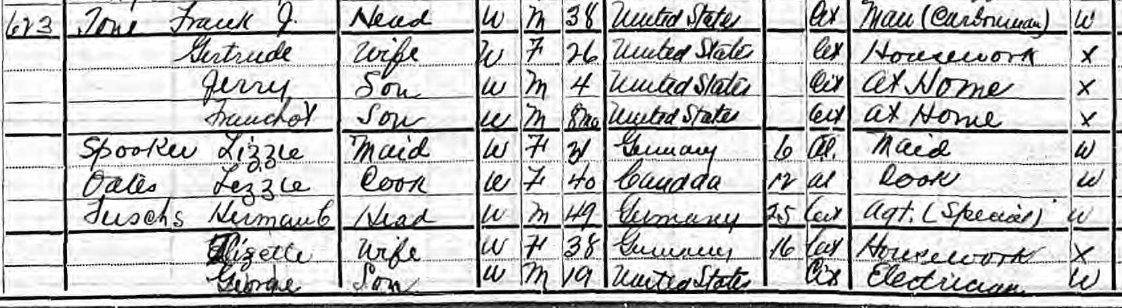
The 1905 New York Census shows an 8 month old baby Franchot living with his father Frank J., mother Gertrude, and brother Jerry at 613 Buffalo Avenue in Niagara Falls, New York. Franchot would later describe his street as the "main residential street of Niagara Falls" running from "the Falls and passes the Shredded Wheat factory. This is one of the points of interests for visiting tourists, so this particular street carried a lot of traffic". Also in the house are Lizzie Spooker, a German maid, and Lizzie Oates, a Canadian cook. The state census also shows a Tusch family and does not give them a separate street number. Herman Tusch is a special agent (am I reading that right?), so I'm not sure if or how he is connected to the Tones. There are other Tuschs at residences near the Tones, so I don't know if this is a census error or if the Tuschs indeed lived in the Tone residence.
1905 New York Census, www.ancestry.com
 
The 1915 New York Census shows the Tone family on the same street, but with a different street number. Frank J. Tone is still the head of the Carborundum Company, with wife Gertrude, 13-year-old Frank J. "Jerry", and 9-year-old Franchot. In their household at this time is an English maid named Georgiana Pittman and an Irish cook named Anna H. Ryan. In this census, there are many Franchot households around the Tone residence (Franchot being Gertrude Tone's maiden name).
1915 New York Census, www.ancestry.com
In the article, "I've Always Been a Show-Off" attributed to Franchot and published in Hollywood Magazine in 1935, Franchot shared the following childhood memories:

I can remember when I was only four years old. I was taken to a summer resort in the Canadian woods. Some boys were trying to spear fish and I was watching them. Suddenly I looked up, and there was a beautiful little girl standing a few feet away. Immediately I grabbed a spear and tried to show how good I was. Instead, I went in head first. Of course, I was too young to know how to swim and actually I was going down for the third time when my nurse came along and jumped in after me. She couldn't swim either but she managed to hold me up until help came...
 Another time I remember when some new people moved in next door to us. They had a boy just about my age and, of course, I was curious to know what he was like. He played in his yard and I played in mine. I kept watching him out of the corner of my eye, but whenever he looked over, I would assume the most innocent air of indifference. One day a truckload of coal arrived. The boy next door completely ignored me by concentrating on the man emptying the coal into the basement. I had a new bicycle, so I ran and jumped on it. I pedaled furiously and tried to do all sorts of fancy tricks. Then something happened. The wheel gave a sudden twist and I found myself sitting in the middle of the coal-chute.

Sources:
  • Tone, Franchot. "I've Always Been a Show-Off". Hollywood Magazine. June 1935. Page 23, 55.
  • New York State Archives; Albany, New York; State Population Census Schedules, 1915; Election District: 01; Assembly District: 02; City: Niagara Falls Ward 02; County: Niagara; Page: 21
  • New York State Archives; Albany, New York; State Population Census Schedules, 1905; Election District: E.D. 02; City: Niagara Falls Ward 01; County: Niagara; Page: 11

Sunday, February 21, 2016

On Publicity Leaps and the Crawford-Tone Theatre

Even though Katharine Hepburn had apparently ordered that all reporters be kept off the set of Quality Street, Franchot smuggled Ben Maddox of Screenland into his dressing room. Maddox reported that Franchot was "secretly amused at such temperament".  With Maddox, Franchot shared:

This mold I've had to pour myself into is a fierce one to take.  What can I do? When I got my contract with Metro, before I'd even stepped onto the train, a leading columnist announced me as a society playboy whose chief objective was backing shows! Well, I had more surprises. I arrived here to be nearly typed as a stuffed shirt hero. Next I learned that all that interviewers really wanted from me was data on Joan. There's no one I'd rather discuss, but not publicly. It's presumptuous of me; anyway, I've no desire to cash in on her success! Out here they're so anxious for fancy scoops that they leap to amazing conclusions. They leap so fast and frequently that after a bit I figured, "Oh, what's the use of denying that dizzy tale? Another whopper will be circulating in its place next week!"
Franchot then illustrated his point by talking about the theatre at the Crawford-Tone residence:

For instance, that myth about the little theatre we have in our garden should be exploded. It is not for Joan to learn stage acting in, and never was so intended! I've read that it was built so I could teach her the technique of the footlights. That's a sample of the incredible situations I've been in since I've been here. Joan doesn't require any special coaching from me or anyone else to be able to act on the stage. She is an actress. And she couldn't do much emoting in that theatre of ours, despite the touching tale that was printed of horrible stage-fright when she made her debut the other evening — before our customary 'gathering of intellectuals.' They're another joke, incidentally. We have interesting friends, but none of us claim to be "intellectuals"! To get this matter of the theatre straightened out once and for all, when the swimming pool was put in Joan designed a bathhouse for one side and a small, matching theatre for the other. Just a theatre where movies could be run. The widely touted stage is nothing more than a raised platform, elevated so that our sound machine will go underneath it!
Joan & Franchot's Brentwood Home. Source: www.ebay.com


Saturday, February 20, 2016

On Pizza and Grape Juice

In 1966, Franchot starred in a production of The Bird, the Bear, and the Actress at the Eugene O'Neill Memorial Theatre Center in Waterford, Connecticut. Janet Roach, a local reporter for the New Day newspaper, interviewed Franchot. In the first part of the article, Franchot talks about the play and how happy he is to be performing in it. The last half of the article takes an odd, but delightful turn. It focuses on Franchot's frustration for vending machines and his dedicated supply of grape juice. Here's an excerpt from the article:

Tone deems "one New London pizza house well worth visiting more than once.
'Just give me plain mozzarella,' says Tone, banishing with the flip of a hand any suggestion of more exotic variations.
The pizza place is just one of Tone's answers to the camping-out atmosphere pervading the three-week work session at the former Palmer Mansion.
'I'm an old hand at this. I could talk for hours about the tricks, but nobody asks me.' The actor reached for a chilled container of grape juice as he spoke. 'For instance, most people would carry a bottle opener for this sort of thing. But after a while I discovered a room key will do just as well.'
The grape juice itself is the product of many frustrated trips to theatre soft drink machines.
'There's nothing more frustrating,' Tone said, 'You run all the way down the stairs with a dime clutched between your fingers. You put it in the slot and it goes all the way to the bottom and lands in the coin return.'
That experience prompted the resourceful actor to invest in a small cooler and some plastic glasses which he carries in his car.
'I have to phone down for the ice and go shopping for the juice,' Tone says, but the effort answers the challenge of camping out."
I love how serious Franchot is about his grape juice. It's an amusing little exchange, but it also illustrates the everyday, regular guy in Franchot. His life was not all champagne and tuxedo tails as some commentators would have you believe. He was a working actor on the road, learning lines and fighting soda machines, and eating a slice of pizza at a local joint.  Franchot says he could talk for hours about his tricks as an "old hand" in the theater business, but mentions that no one ever asks him. How I wish they would have asked him! At this stage in his life, he seemed willing to share his opinions on a variety of subjects and I would love to be able to hear them.

Source: Roach, Janet. "Perfectionist Franchot Tone 'Sacrifices' Own Shirt for Play." The Day. New London, Connecticut. August 5, 1966. Page 12.

Monday, August 3, 2015

Franchot Tone on His Career

Since I've had my own gray hair and wrinkles, producers have been willing to recognize me as a character actor. 
There was a long spell in Hollywood where I appeared in nothing but bad romantic comedies. They were 'dress suit roles.' Acting talent didn't matter. The important thing was to have a good tailor. That was in the days before a dissatisfied movie star was free to refuse to work at something he didn't like and take a suspension. Maybe it's just as well because I'd have been under suspension more often than not if I had had any option to exercise.
I was a leading man making an outrageous salary. But I was jealous of character actors with three-line bit roles. At least, they enjoyed their work. 
Most actors pay too much attention to the size of a role anyway. One good, biting scene is worth more than hours of drivel. Well, I got older, and eventually I reached a point where I looked ridiculous bounding through a bay window with a tennis raquet in my hands. I went into television at a time when the industry was hungry for movie names. I could be demanding. For instance, when one video producer offered me the romantic lead in a murder mystery, I held out for the role of the killer—a marvelous psychopathic character—and got it.
                                                    -Franchot Tone

Source: Gaver, Jack. "Franchot Tone is Happy in TV Character Roles." Schenectady Gazette. 18 October 1962. Page 20.