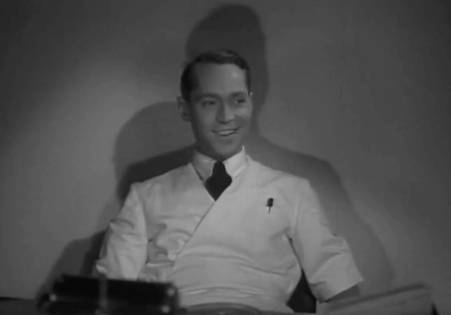
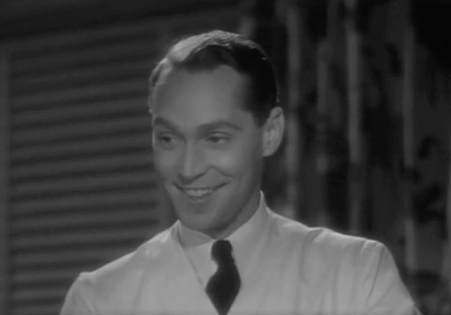
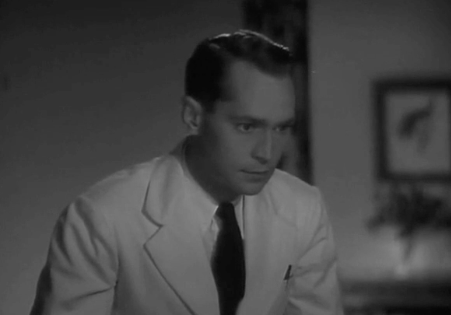
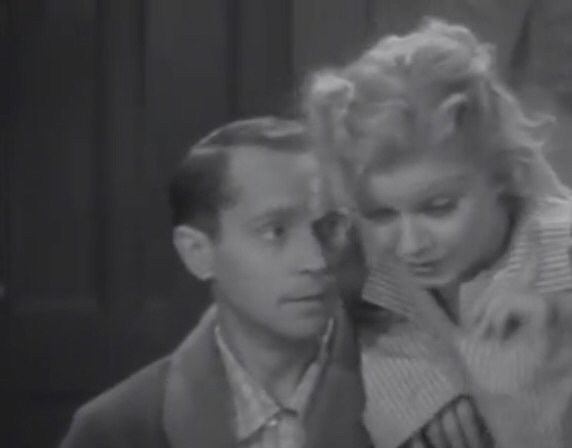
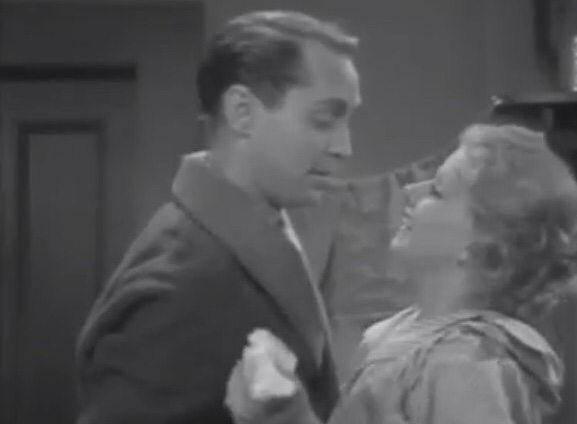
Franchot over breakfast. Source: Elmira Star-Gazette.
Reporter Peggy Gallagher interviewed Franchot over breakfast on his first morning in Elmira, New York. He was due to give a presentation on Mark Twain at Elmira College that evening. When asked if he was comfortable portraying older men or father figures, Franchot assured that he felt very comfortable in the role and proudly talked of his sons Pat and Jeff:
And, the rascals! They both want to be actors...A useless profession! Unless you thoroughly understand it, of course. But, I don't see that they'll ever work their way out. They're thoroughly soaked in theater.
Franchot went on to explain that although he'd prefer "physics, law, chemistry" for his sons, he would not have chosen a different life for himself.
But, that's what I mean—I understand it. Let me explain it this way: entertainment, as a function of escape for the human race, has been in its best times a signpost to the greater aspirations of which the human race is capable...how's that sound for 9:30 in the morning?
When Gallagher pressed for more meaning, Franchot answered:
It means the entertainment business makes dreams real—and it's the dreams of man which have made our world possible.
Franchot went on to share that he preferred the theater over film because of the "immediate relationship with the audience."
And when asked about the high point of his career, Franchot insisted that his high point was still to come.
There was a very wonderful book by the author, Christopher Morley, about a cocker spaniel named Mr. Gissing. Mr. Gissing lived in a valley. He kept looking at the hillside and at the blue beyond. He decided he wanted to climb the hill and find out where the blue began. But when he reached the top, doggone if he didn't find another hill!
The novel that Franchot refers to is Where the Blue Begins and was first published in 1922 and its author also penned the 1939 novel Kitty Foyle, which was brought to the screen with Ginger Rogers in the title role in 1940.
Franchot talked quite a bit with Elmira reporters (here's what he said about politics) and there is more to come about his presentation on Mark Twain!
Source: Gallagher, Peggy. "Franchot to Give Twain Tone." Elmira Star-Gazette. October 14, 1960.
Cheers! This past week marked five years since the first post on Finding Franchot. I've had a wonderful five years connecting with other fans and learning so much about Franchot in the process. Having this space available to share Franchot facts has been such a positive thing in my life and I hope reading it has been positive for you. Thank you!
In the last six months I've made some additional pages on the blog that may not be readily apparent if you're using a mobile device so I wanted to point those out in this post. For several years I also had a separate fansite where I uploaded photos and a timeline and life history of Franchot. This past year I decided to merge all of that information here in one place on the original blog. It seemed silly to be paying for a separate website when I was mostly utilizing this free blog for my posts and I realized I could host all of those pages here on the blog in a quality way. So now it's all in one place, easier for me to keep up with, and I can spend the money I save from not paying for a website to buying more Franchot photos (always a perk!).
Obviously, there are my regular blog posts here, but there are also the following pages:
If you were wondering where the fansite went, it's just moved its home to this original space. I have more information and photos to add to these pages and I'll continue to do so. Thanks for your support and patience!
Franchot found himself in a sea of reporters and fans when he landed at an airport in Elmira, New York in 1960. Franchot asked them to gather in the airport waiting room, where reporter Mary Lee Morken said he "wrapped the crowd around him like a cloak" and answered questions. When Franchot was asked by a newsman whether or not he had ever participated in political work, Franchot responded:
I was one of the members of the Hollywood Democratic Committee. We were quite active. Melvyn Douglas and lot of others—I can't remember now. It was back about 1940. I think we were quite influential in breaking up—well, let me put it this way. We helped elect Olson, who was the first Democratic governor elected in California in 50 years. We helped break the way for Gov. Warren, one of the finest statesmen of our times.
When someone asked whether actors should even be "mixed up" in politics, Franchot is described as bristling and answering disdainfully:
I think every citizen should be 'mixed up' in politics.
Another person in the crowd broke the tension by asking Franchot if he'd consider playing Abraham Lincoln. Franchot made the crowd laugh when he answered:
I'd be afraid to play Lincoln. Any actor who plays Lincoln is never happy until they shoot him.
Franchot granted multiple interviews during his visit to Elmira College where he was speaking on Mark Twain and his performance as Twain in the television production The Shape of the River. I will be sharing more of Franchot's quotes from this trip as well as details of his itinerary over the next week.
Directed by George B. Seitz and starring Franchot Tone, Maureen O'Sullivan and Virginia Bruce, the medical drama Between Two Women premiered to American audiences on July 9, 1937.
Between Two Women is one of my favorite Franchot movies and I keep hoping it is going to be released on DVD by Warner Archive. It deserves a quality DVD release. It is a great romantic drama, well acted by all of its cast, and Franchot particularly shines in this role.
The film received positive reviews from the fan magazines at the time. Hollywood Magazine said that it was "smoothly directed...a convincing story of the loves, desires and heartaches of those who minister to humanity...[Tone, Bruce, O'Sullivan] have never appeared to better advantage than in this powerful drama." Photoplay called it, "unusually exciting and realistic...Franchot Tone brings all his ability to the role...Splendid." Silver Screen devoted an entire article to the film and its story. While I will not spoil the final events of the film, the film summary that follows will include some plot spoilers.
Silver Screen Magazine. August 1937.
Allan Meighan (Franchot Tone) is a studious, conscientious intern in a large hospital. He's referred to by one patient as the "strong, silent man who saved my life." Claire Donahue (Maureen O'Sullivan) is a nursing intern who is promoted to head surgical nurse. Allan and Claire are good friends and enjoy working together.
Allan has a few more weeks until he will begin residency. He's applied to his current hospital but hasn't received word yet. After intern Tony Woolcott refuses to go to an accident scene, Allan goes instead. When he has to amputate an arm to save the life of a man trapped in rubble, Allan is named resident at the hospital.
Claire's husband Tom is an alcoholic who can't keep his job and hits his wife. He often stops by the hospital to ask for money from Claire. Claire makes excuses, "He only drinks because he's discouraged because he feels licked."
Socialite Patricia "Pat" Sloan (Virginia Bruce) crashes her car due to passing out from a ruptured appendix. Allan performs surgery and requests Claire "the best nurse he knows" for night duty. Patricia makes eyes at Allan as soon as she wakes from the anesthesia and notices how uncomfortable Claire becomes by it.
Tony Woolcott (Leonard Penn), a wealthy intern who recklessly drinks on the job and has no care for humanity, has eyes for Pat, but Pat desires to be the bride of Dr. Meighan. Allan warns her that he doesn't make enough money to get married. She makes an agreement that he buy necessities and she'll add a few luxuries with her own money.
Allan falls in love with Pat but fears that he won't make her happy.When Claire walks into the hospital room, Pat announces that they are engaged. Claire is shocked. She cries alone as she walks the hospital hallways.
There are already cracks showing in the marriage immediately after the honeymoon when Pat is less than thrilled about living in a modest home. They clearly are attracted to each other but Allan's first duty is to the hospital and Pat does not want his attention divided. Allan is called away from each social engagement they attend because he's needed in surgery. With each call, Pat grows more resentful.
When Allan starts to ignore his duty to the hospital to please Pat, he begins missing out on big professional opportunities and growth for himself as a surgeon. Allan questions Claire about why she stays with a drunk and Claire responds, "You see, I've adjusted my life to Tom. You still haven't adjusted yours to Patricia."
I'm going to stop here with the summary because the last half of the film has several huge moments that change the direction of Allan's plans and stir different feelings in his heart. It's a moving, unassuming film that hooks me every time I watch it. It comes on television every so often, but I'm hoping Warner Archive realizes what a gem this movie is and releases it soon.
Sources: Silver Screen Magazine. August 1937. Photoplay. September 1937. Hollywood. September 1937. Modern Screen. March 1938.
If you are home due to the pandemic and want to distract your mind with some Franchot Tone performances, I have the list for you!
Franchot on The Internet Archive (FREE)
Twelve Angry Men (tv): Link
Wagon Train: The Malachi Hobart Story (tv): Link
The Man on the Eiffel Tower (film): Link
I Love Trouble (film): Link
Jigsaw (film): Link
Lost Honeymoon (film): Link
Tales of Tomorrow: Diamond Lens (tv): Link
*I had not realized that Diamond Lens was added this year until I began working on this post and I am overjoyed! I have not seen this episode before and cannot wait to watch it today.
Franchot on Daily Motion (FREE)
Alfred Hitchcock Hour: Final Performance (tv): Link
Franchot on Hulu (with subscription; www.hulu.com)
Twilight Zone: The Silence (tv)
Alfred Hitchcock Presents: The Impossible Dream (tv)
Franchot on Amazon Prime Video (with subscription; www.amazon.com/Prime-Video)
I Love Trouble (film)
This list certainly does not include everything on the internet, but there should be enough here to keep your mind occupied and your heart happy. Take care of yourselves!
Franchot made appearances on quite a few variety, entertainment, and game shows in the 1950's. He also did two brief spots on Playhouse 90 and Sizeman and Son to plug the next week's episode in 1955-56. IMDb lists the following shows featuring Franchot as himself:
The Milton Berle Show
Perry Como's Kraft Music Hall
Saturday Night Revue with Jack Carter
General Electric Guest House
The Name's the Same
The Ed Sullivan Show
The Cassini Show
The Colgate Comedy Hour
Igor Cassini's Million Dollar Showcase
The Arthur Murray Party
I know that there are more appearances than what IMDb includes, because Franchot hosted a 1959 A Salute to the American Theater production that is not listed there.
I wish I could write that all of these episodes had been lovingly saved and restored for us to enjoy, but that is not the case. I've been searching for years and have only been able to view one of Franchot's personal appearances so far. I think many (especially the Dumont Network shows) are probably permanently lost, but I know that some are likely included in archive collections—more on that below. There are a few that I believe may actually pop up somewhere online in the future if we're lucky...perhaps one will appear at the very end of this post! Let's work backwards from 1959!
Franchot on A Salute to the American Theatre
This production was listed as being available to rent in kinescope form in the Jewish Audio-visual Review published in 1966. Since I know copies were circulated at least 7 years after it first aired, I'm hopeful this program is out there waiting to be discovered. Here is that vintage listing in full:
A Salute to the American Theatre, an edited kinescope, based on the original one-hour program by CBS/TV, in cooperation with the Anti-Defamation League of B'nai B'rith, 1959, scrips by Elliot Baker, narrated by Franchot Tone, 45 minutes. Rental price on request. Distributed by Anti-Defamation League of B'nai B'rith.
Content: Presents excerpts of outstanding dramatic and musical plays whose theme is freedom and anti-discrimination.
Evaluation: "A Salute to the American Theatre" constitutes a fine anthology of dramatic presentations of social problems. In addition to showing how the theatre has been alert to its responsibility of dealing with grave issues of the day, this kinescope provides the viewer with good entertainment. While the transitions from one play to another are abrupt, at times, and the treatment of some of the issues is not always adequate, given a good discussion leader, "A Salute to the American Theatre" can be used effectively as program material. This program is recommended for high school-adult groups of all religious denominations.
Franchot hosted this entire production and also read a speech from "Abe Lincoln in Illinois." I have a newspaper clipping photo of Franchot hosting this, but I cannot find it...as soon as I find that file I will add it to this post.
Franchot on The Arthur Murray Party
Franchot appeared on The Arthur Murray Party three times! In season 3, episode 6, Franchot and his wife Barbara Payton appeared together in a production that also featured singer Kitty Kallen, dancer William Callahan, and the Ray Carter Orchestra. This episode aired on February 10th, 1952.
Franchot returned on July 15, 1957, for season 8, episode 14. This star-studded episode also included Errol Flynn, Farley Granger, June Lockhart, and Cornelia Otis Skinner. Featured dancers were Rod Alexander and William H. Vaux.
Franchot's third and final appearance at the party was for season 9, episode 1 on September 29, 1958. Franchot and Susan Strasberg were promoting their latest play. Teresa Brewer, Ricardo Montalban, and Dan Dailey were also on hand. Featured dancers were Martel and Mignon and William H. Vaux.
The Library of Congress has thirteen of the episodes in their archives and there are a handful of clips, mostly featuring singer Johnnie Ray, from the show on Youtube. As far as I know, the Franchot episodes are not part of the surviving collection.
Franchot on Igor Cassini's Million Dollar Showcase and The Cassini Show
Franchot was a guest on the eighth episode of the first season of Igor Cassini's Million Dollar Showcase. His interview on this talk show was broadcast on December 9, 1955. The show only aired from 1955-1956 and its host was a popular gossip columnist whose column appeared in Hearst newspapers across the nation.
Just a year before this appearance, Franchot was featured on The Cassini Show which was really just the same talk show format with a more succinct name. On April 25, 1954, Franchot, John Drew Barrymore, Arthur Blake, and Geraldine Page were just several of the names that audiences at home were able to see on their tv sets.
Since these shows were part of the Dumont Network, they are most likely lost unless a collector is stowing them away somewhere. The Dumont Network library was mostly destroyed in 1958 and then the surviving archival material was dumped into the New York bay in the 1970's. The horror! So many Franchot gems discarded.
Franchot on The Colgate Comedy Hour
Franchot and costar Gloria Vanderbilt performed for hosts Jerry Lewis and Gordon MacRae on The Colgate Comedy Hour in late January 1955. Franchot and Gloria performed a scene from the play The Time of Your Life.
Colgate Comedy Hour was a variety show that aired from 1950 to 1955 and was hosted by Eddie Cantor, Dean Martin and Jerry Lewis and Abbott & Costello, among others. The show lost viewers as The Ed Sullivan Show gained favor. Not all episodes survived and those that exist are typically poor quality duplicates that came from the original kinescopes. Some have been released on DVD or posted online, but I've yet to see the Franchot episode.
Franchot on The Ed Sullivan Show
Franchot, Gig Young, and Betsy von Furstenberg performed scenes from the theater comedy hit Oh, Men! Oh, Women! on Ed Sullivan's Toast of the Town. The episode aired on January 17, 1954. This one is probably in an archive, possibly the Paley.
Getty Images has photos from this episode here and here.
Franchot on The Name's the Same
I feel like this episode is possibly out there somewhere! The Name's the Same was a 1951-1955 game show in the vein of What's My Line. Contestants shared their name with a celebrity and the panelists would ask a series of yes/no questions to try to guess the name. A few years ago the episodes aired on both Game Show Network and Buzzr Network. Not all episodes are surviving and I'm not sure if Franchot's show (which aired on August 25, 1953) was saved, but I'm hoping a collector out there has it. A Youtube user even posted many of the 1953 episodes, but, sadly, not Franchot's. The Paley Center has some episodes in their archives, but I haven't located Franchot's.
On this particular episode, the host was Robert Q. Lewis and the panelists included Carl Reiner, Joan Alexander and Bill Stern.
Franchot on General Electric Guest House
Franchot popped on General Electric Guest House on July 29, 1951. Durward Kirby hosted and the guests included Melville Cooper, Ginny Simms, Ogden Nash, and Franchot. The Guest House aired over 10 episodes and served as a summer replacement for The Fred Waring Show in 1951. On each episode, four celebrities participated in a trivia game about the entertainment industry.
The Paley Center has a few of the episodes in their archives, but I haven't placed Franchot's yet.
Franchot on The Saturday Night Revue with Jack Carter
On March 4, 1950, Franchot stopped by The Saturday Night Revue to talk with host Jack Carter.
Cass Daley, Don Ameche, The Step Brothers, and Gertrude Niesen were also on hand for the entertainment.
This show aired weekly in 1950 and 1951 and was vaudeville-inspired. The Paley Center has some of these episodes but I've yet to see an entry for this particular episode.
Franchot on Perry Como's Kraft Music Hall/The Chesterfield Supper Club
Franchot Tone and his best friend Burgess Meredith appeared on Perry Como's Kraft Music Hall on February 5, 1950. This is also listed as The Chesterfield Supper Club in the Paley Center's archives, where it exists! Franchot and Burgess were there to promote their film The Man on the Eiffel Tower. They were dressed as gangsters as they talked with host Perry Como. Also appearing on this episode were Ethel Waters and the Fontane Sisters.
This long-running show entertained audiences from 1947 to 1967.
Franchot on The Milton Berle Show
Franchot stopped by The Milton Berle Show on January 31, 1950. Franchot appeared in a comedy skit with Milton and comedic actress Pert Kelton and, shared with the intent of educational and entertainment purposes only, here it is!
If you cannot see the embedded video, you can watch it on my Youtube channel here. Enjoy!
The 115th anniversary of Franchot's birth is coming up in just a few days, on February 27th. Happy Birthday, Mr. Tone. I hope you know how much love you receive here.
Suzy (Jean Harlow) is a chorus girl who convinces her pal Maisie (Inez Courtney) that she can easily seduce a wealthy man into a relationship and that love can naturally follow. On a foggy day in London, Suzy falls in front of a car driven by a chauffeur and with Terry Moore (not the actress, ha! Franchot's character) in the backseat. Suzy assumes the car belongs to Terry and that he is wealthy.
When he invites her to the derby, Suzy confesses to the maid that she will absolutely marry Terry. Terry pulls up in a decidedly cheaper automobile than the Rolls Royce, and Suzy realizes Terry is not the millionaire she assumed he was. Although not wealthy, Terry is hard to resist. He's an intelligent triple threat: inventor, engineer, and pilot. He's sweet to Suzy and completely falling in love with her. Suzy agrees to marry Terry, but their marriage is short-lived; showing off his work in the lab, Terry and Suzy accidentally cross the path of a German spy (Benita Hume).
Terry is shot, his shooter flees, and Suzy is accused of murder by the landlady. Devastated by the death of her new husband and threatened with a murder charge, Suzy escapes to Paris where her friend Maisie is now living and starts fresh.
As World War I begins, Suzy works as a singer in a bar, meeting wealthy pilot Andre (Cary Grant). Andre charms and marries Suzy, but he is not a faithful husband when he returns to the front. Suzy finds herself spending most of her time with Andre's father Baron Charville (Lewis Stone) and desperately missing Andre.
Next up is a necessary plot spoiler for this post, but I promise it is not a spoiler of the film's ending.
When Andre is wounded and hospitalized, Suzy visits him and there in the hospital room is...
Terry!
Terry was terribly wounded by the earlier shooting, but he survived unbeknownst to Suzy who fled the scene so abruptly. Suzy is shocked to see her husband standing in front of her. Terry, understandably, feels abandoned and betrayed by Suzy, but neither of them share their past with Andre. Terry has been inventing new fighter planes for Andre to pilot and is close to him. Meanwhile, a mysterious woman appears in Andre's life.
Suzy must decide whether she will stay with the wealthy man whom she loves but cannot trust or turn to her former husband Terry for whom she still feels deeply...unless an irrevocable event makes this decision for her.
This is my second favorite of Jean and Franchot's pairings (the first is The Girl from Missouri) and sadly it was their last chance to work together before Jean's untimely death the following year. The acting they do in Terry's apartment come across as effortless and casual; you completely believe that these two are becoming close friends and falling for one another. Jean is adorable in her borrowed pajamas from Terry's closet and her hair up and messy.
My only criticism is that Franchot drops his character's Irish accent occasionally throughout the film, but I find that pretty typical with most American movie stars taking on accents in 1930's films. Cary Grant is the playboy pilot (it's kind of a surprise that Franchot didn't end up with that role since he was so often typecast as the wealthy playboy) who is loved by both Suzy and Terry. Lewis Stone is fabulous as always as the father figure.
Suzy is available on DVD, but often out of print or only available via Warner Archive's Jean Harlow box set.