Saturday, August 8, 2020

Today We Live (1933)

Today We Live is Franchot's second film (the first being The Wiser Sex) and his first film with Joan Crawford. With an all-star cast of Joan, Franchot, Robert Young and Gary Cooper, the World War I melodrama is directed by Howard Hawks and is based on a story by William Faulkner. As is the case with many movies of this era, the fashion is more 1933 and not so much 1916. Also, the majority of the characters are English and the film is set in England, but the accents are decidedly American despite the use of common English phrases. Again, a pretty common practice in films of the day but I know some viewers who really dislike this.

Franchot and Joan play brother and sister yet their chemistry onscreen already speaks volumes. Joan's character looks at Franchot's character just as lovingly and longingly as she does her actual two love interests. Franchot's character is the confidante and protector, the one steadfast thing in the unsteady life of Joan's character.

Film Summary

American Richard Bogard (Gary Cooper) arrives in England in 1916 and visits the Smith house just as Diana (Joan Crawford) receives news that her father has died in action. Distraught, Diana says she is without hope or faith and fears for her brother's safety as her brother Ronnie (Franchot Tone) and her neighbor Claude (Robert Young) reminisce about Mr. Smith and announce that they have just five more hours until they must report for duty. 

Ronnie confides in his sister that their childhood friend and neighbor Claude plans to propose to Diana. The three of them have a rationed dinner where Diana agrees to marry Claude with Ronnie's blessing.


While her loved ones are fighting in the war, the family's American guest Bogard spends more time with Diana and they realize that they have fallen in love with each other. Bogard decides to enlist in the war to fight for England and honor the woman he loves. A distraught Diana has now lost her father and has to contend with the fact that the lives of the three men she cares for are all now in danger.


Ronnie comes back injured but on the mend and Claude returns as in love with Diana as ever. Not wanting to hurt a soldier, Diana asks her brother for advice and understanding in a tender, lovely scene between Joan and Franchot. In an equally tender scene, Ronnie must share that Diana's true love Bogard has died in action.

Joan is wonderfully effective as a woman left lonely and bereaved by war. Despite this, she puts on a brave face and soldiers through it all, putting her own emotions aside and aiding the war effort. She is the beacon of strength for her brother and her fiancee. Before Claude is sent off on a dangerous assignment, Diana marries him. After he survives the mission, Claude and Diana break the news to Ronnie, who has long suspected and supported it.


And the next scene is a shock. Bogard, reported to have been deceased, is on the family's doorstep. I will not spoil the remainder of the film for you. The rest of the film is full of love, heartbreak, death and hope as well as some quite lengthy battle scenes.

Franchot's character Ronnie is the binding force and voice of reason for all characters and with the skills he applies to the role, it is easy to see why both Gary Cooper and Joan Crawford would praise him as the most talented, underrated actor for the rest of their lives.

Publicity

Franchot received a good amount of publicity build-up in fan magazines for his early role in Today We Live. Although Franchot's first film The Wiser Sex is the only film I've not seen, it is still available at the Library of Congress and reportedly his role is very small. Today We Live was his real break into the business it seems and, of course, the film that introduced him to Joan, a woman whom he would love for the rest of his life. Here are just a few of the various photos and publicity pieces that accompanied the film's release.
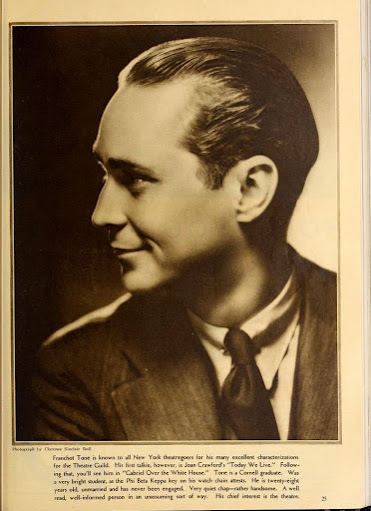
Modern Screen, 1933.

Photoplay, 1933
Photoplay, 1933.


Modern Screen, 1933.


The New Movie Magazine reviewed the film stating:
Joan belongs in pictures of this type; that's what you're going to say when you see her. She can do all that a star is asked to do, and she does; but when she has a real story, with clever character actors around her, shading her role with the sympathy and humor that it needs—then Miss Crawford can supply some of the finest entertainment that is available in motion picture theaters today.

Today We Live is on DVD from Warner Archive and can be purchased through most online DVD retailers. 


Tuesday, June 16, 2020

Franchot Visits Birmingham, Alabama

Photo of Franchot that
accompanied the article.

In February 1950 Franchot traveled to Birmingham, Alabama to promote The Man on the Eiffel Tower. It was a whirlwind one-day press tour of the city including multiple newspaper and radio interviews, a special luncheon at the Downtown Club, a cocktail party at Tutwiler Hotel where his suite was located and ended the evening by making a personal appearance at the Linley Heflin Unit Mardi Gras Ball which was held in the Municipal Auditorium. By midnight, Franchot was on a plane to New York where he was slated for business meetings with friend and TMotET director Burgess Meredith.

With Birmingham press, Franchot shared that he felt his youngest son Jeff might become an actor. Franchot added that Jeff enjoyed "mugging" and always put on a great show every Christmas that his aunt Karol (Jean Wallace's younger sister and only a child herself) would direct in front of the family Christmas tree.

On producing The Man on the Eiffel Tower, Franchot said:

Production, I like, because a producer can assure himself of more interesting parts. You'll like Man on the Eiffel Tower. It's not a mystery but a suspense picture. And Charles Laughton's not the villain. I am!

Interestingly, Franchot shared that his business meetings with Burgess Meredith in New York were to plan for their next film. Burgess was set to direct and Franchot would produce and act in a film version of the novel The Song of the Flea. They planned to begin filming it in London within a year or two. A film adaptation of The Song of the Flea never happened (perhaps due to the Payton love affair and the events that it caused.)  I have a special fondness for Franchot's work as a producer (The Man on the Eiffel Tower, Uncle Vanya) and co-director (Uncle Vanya) so it is a shame this other opportunity never came to fruition. It not only would've been a creative venture for Franchot, but he would've also enjoyed working with best friend Burgess Meredith on it. The Song of the Flea was written by British novelist Gerald Kersh whose most famous work Night and the City was made into a 1950 film starring Richard Widmark and again as a 1992 film starring Robert de Niro. I cannot find any proof that The Song of the Flea, which focused on a writer struggling to succeed, was ever adapted for film.

You can read more about The Man on the Eiffel Tower here .

Source:
Caldwell, Lily May. "Franchot Tone Visits Here, Talks of Kindness." The Birmingham News. February 18, 1950.

Sunday, May 10, 2020

Franchot headlines the Mark Twain Festival

Franchot's lecture was the highlight of the Mark Twain Festival that took place at Elmira College from October 12th to October 14th, 1960. Franchot's presentation was titled "An Actor's Approach to Mark Twain" and was scheduled for 8:30 p.m. on Friday, October 14th at the Emerson Building auditorium.

Ad for Franchot's lecture. Source: Elmira Telegraph. October 9, 1960.

Franchot was requested for the lecture after gaining rave reviews for his performance as Mark Twain in Horton Foote's "The Shape of the River," which aired as a Playhouse 90 production on May 2, 1960.  Interestingly enough, the Playhouse 90 production that set Franchot up for this particular lecture was about Mark Twain preparing for the lecture circuit! Twain's niece said about Franchot, "He seemed more like my uncle than any of the many Mark Twain impersonators I have seen." Before the event, it was publicized that Horton Foote would accompany him, but I cannot locate any proof that Foote definitely attended. He's not mentioned in any of the interviews or articles about the presentation, so I'm not sure if he visited with Franchot or not.


The Shape of the River, 1960. Source: my collection.

Franchot started off his presentation by joking that the audience should bear with him as he spoke "from the top" of his head and that if everyone stayed until the end he would return the admission fee. It was later disclosed that Franchot generously returned both the admission fees and his lecture fee.

Franchot described how he prepared to play Mark Twain in "The Shape of the River" before reading Twain's "Roughing It." Next, Franchot read part of Susan Twain's essay on her father that explained how Mark Twain stopped going to church because "he couldn't bear to hear anyone else talk but him." After this essay, Franchot joked that once he knew that fact about Twain "all I had to do was let the ham in me out." Franchot also read from Twain's "The Mysterious Stranger" and "Jumping Frog of Calaveras County."

Franchot then showed several clips of Mark Twain, played recorded imitations and finally, played a recording of his very first rehearsal imitating Twain. In addition to the readings and conversation, Franchot screened clips of his television portrayal as Mark Twain.

500 people attended Franchot's lecture and called it "smooth...flawlessly imitating...eloquent speech."

Franchot at Mark Twain's grave in Elmira.
Source: Elmira Advertiser. October 15, 1960.

Franchot at Mark Twain's monument.
Source: Elmira Star-Gazette. October 14, 1960.

Before his presentation, Franchot took the time to pay his respects to Mark Twain. He chatted with reporters and citizens over breakfast at the Mark Twain Hotel, brought flowers to and visited the author's grave, and toured the author's study with Elmira College president Dr. J. Ralph Murray.

Franchot and Dr. J. Ralph Murray at the Mark Twain Study.
Source: Elmira Star-Gazette, October 14, 1960.
Franchot had arrived in Elmira the night before his presentation, on Thursday, October 13th. Reporters and fans met him at the airport. One fan handed him a tiny piece of paper and asked for an autograph for his son. Seeing the size of the paper, Franchot joked, "Well, your son must be a very little boy!" Franchot signed the small paper and was proud of his handiwork. When he finished, he remarked, "There! I could have gotten it on the head of a pin."

Franchot was questioned about the speech he was due to deliver the following night. What would he say on stage? Franchot encouraged the crowd to "come up to the college to hear my speech and you'll find out what I'm going to say. Everything I'm going to say will be completely ad lib. I haven't anything prepared—I think a lecture loses its freshness if it's prepared."

One spectator didn't seem to understand the notion of ad lib and caught Franchot off guard when he asked, "How long does it take to prepare an ad lib speech?" Franchot laughed and responded, "Well, you've got to think about it for a long time."

Members of the Thomas A. Edison High School Thespis club were able to enjoy breakfast with Franchot while he was in town and called him "delightful." Elmira resident Helen Brown asked reporter Peggy Gallagher to relay to Franchot Tone that she loved him to which Franchot replied, "That's one thing I never get tired of hearing."

For further reading and two more photos of Franchot at Elmira, you can read about what he said on politics here and what he said about choosing the acting profession here.

Sources:
"Appearing at Elmira College..." Elmira Telegraph. October 9, 1960.
Bannister, Sharon and John Gardner. "Edison Bits." Elmira Star-Gazette. October 23, 1960.
"College Taps Tone for Twain Festival." Elmira Star-Gazette. October 2, 1960.
"Franchot Tone Draws 500 for Mark Twain Festival." Elmira Advertiser. October 15, 1960.
Gallagher, Peggy. "Evenin' Neighbor!" Elmira Star-Gazette. October 17, 1960.
Gallagher, Peggy. "Franchot to Give Twain Tone." Elmira Star-Gazette. October 14, 1960.
Morken, Mary Lee. "Actor Long Acquainted with Twain." Elmira Advertiser. October 14, 1960.

Thursday, April 30, 2020

Franchot on Understanding the Acting Profession

Franchot over breakfast. Source: Elmira Star-Gazette.
Reporter Peggy Gallagher interviewed Franchot over breakfast on his first morning in Elmira, New York. He was due to give a presentation on Mark Twain at Elmira College that evening. When asked if he was comfortable portraying older men or father figures, Franchot assured that he felt very comfortable in the role and proudly talked of his sons Pat and Jeff:

And, the rascals! They both want to be actors...A useless profession! Unless you thoroughly understand it, of course. But, I don't see that they'll ever work their way out. They're thoroughly soaked in theater. 

Franchot went on to explain that although he'd prefer "physics, law, chemistry" for his sons, he would not have chosen a different life for himself.

But, that's what I mean—I understand it. Let me explain it this way: entertainment, as a function of escape for the human race, has been in its best times a signpost to the greater aspirations of which the human race is capable...how's that sound for 9:30 in the morning?

When Gallagher pressed for more meaning, Franchot answered:

It means the entertainment business makes dreams real—and it's the dreams of man which have made our world possible.

Franchot went on to share that he preferred the theater over film because of the "immediate relationship with the audience."

And when asked about the high point of his career, Franchot insisted that his high point was still to come.

There was a very wonderful book by the author, Christopher Morley, about a cocker spaniel named Mr. Gissing. Mr. Gissing lived in a valley. He kept looking at the hillside and at the blue beyond. He decided he wanted to climb the hill and find out where the blue began. But when he reached the top, doggone if he didn't find another hill!

The novel that Franchot refers to is Where the Blue Begins and was first published in 1922 and its author also penned the 1939 novel Kitty Foyle, which was brought to the screen with Ginger Rogers in the title role in 1940.

Franchot talked quite a bit with Elmira reporters (here's what he said about politics) and there is more to come about his presentation on Mark Twain!

Source:
Gallagher, Peggy. "Franchot to Give Twain Tone." Elmira Star-Gazette. October 14, 1960.

Saturday, April 25, 2020

Five Year Anniversary

Cheers! This past week marked five years since the first post on Finding Franchot. I've had a wonderful five years connecting with other fans and learning so much about Franchot in the process. Having this space available to share Franchot facts has been such a positive thing in my life and I hope reading it has been positive for you. Thank you!

In the last six months I've made some additional pages on the blog that may not be readily apparent if you're using a mobile device so I wanted to point those out in this post. For several years I also had a separate fansite where I uploaded photos and a timeline and life history of Franchot. This past year I decided to merge all of that information here in one place on the original blog. It seemed silly to be paying for a separate website when I was mostly utilizing this free blog for my posts and I realized I could host all of those pages here on the blog in a quality way. So now it's all in one place, easier for me to keep up with, and I can spend the money I save from not paying for a website to buying more Franchot photos (always a perk!).

Obviously, there are my regular blog posts here, but there are also the following pages:

Photos - where I've posted all my scanned photos of Franchot and newspaper clipping photos


Timeline and Facts - where I've posted a timeline of Franchot's life, fast facts, his obituary and a biographical sketch


Quotes - where I've posted statements made by Franchot and by other notable people about Franchot


Family - where I've posted photos and links to information about Franchot's parents, brother, ancestors, wives, and sons


Filmography - where I've posted summaries, links to detailed blog posts and photos for Franchot's movies


Theater - where I've posted play titles with photos and links to detailed blog posts for Franchot's theater work


TV & Radio - where I've posted titles with photos and links to detailed blog posts for Franchot's television and radio work


If you were wondering where the fansite went, it's just moved its home to this original space. I have more information and photos to add to these pages and I'll continue to do so. Thanks for your support and patience! 

Tuesday, April 21, 2020

Franchot on Politics

Franchot Tone 1960
Franchot found himself in a sea of reporters and fans when he landed at an airport in Elmira, New York in 1960. Franchot asked them to gather in the airport waiting room, where reporter Mary Lee Morken said he "wrapped the crowd around him like a cloak" and answered questions. When Franchot was asked by a newsman whether or not he had ever participated in political work, Franchot responded:

I was one of the members of the Hollywood Democratic Committee. We were quite active. Melvyn Douglas and lot of others—I can't remember now. It was back about 1940. I think we were quite influential in breaking up—well, let me put it this way. We helped elect Olson, who was the first Democratic governor elected in California in 50 years. We helped break the way for Gov. Warren, one of the finest statesmen of our times.

When someone asked whether actors should even be "mixed up" in politics, Franchot is described as bristling and answering disdainfully:

I think every citizen should be 'mixed up' in politics.

Another person in the crowd broke the tension by asking Franchot if he'd consider playing Abraham Lincoln. Franchot made the crowd laugh when he answered:

I'd be afraid to play Lincoln. Any actor who plays Lincoln is never happy until they shoot him.

Franchot granted multiple interviews during his visit to Elmira College where he was speaking on Mark Twain and his performance as Twain in the television production The Shape of the River. I will be sharing more of Franchot's quotes from this trip as well as details of his itinerary over the next week.

Click here for previous posts on Franchot and politics.

Source:
Morken, Mary Lee. "Actor Long Acquainted with Twain." Elmira Advertiser. October 14, 1960. 

Wednesday, April 1, 2020

Between Two Women (1937)


Directed by George B. Seitz and starring Franchot Tone, Maureen O'Sullivan and Virginia Bruce, the medical drama Between Two Women premiered to American audiences on July 9, 1937.

Between Two Women is one of my favorite Franchot movies and I keep hoping it is going to be released on DVD by Warner Archive. It deserves a quality DVD release. It is a great romantic drama, well acted by all of its cast, and Franchot particularly shines in this role.

The film received positive reviews from the fan magazines at the time. Hollywood Magazine said that it was "smoothly directed...a convincing story of the loves, desires and heartaches of those who minister to humanity...[Tone, Bruce, O'Sullivan] have never appeared to better advantage than in this powerful drama." Photoplay called it, "unusually exciting and realistic...Franchot Tone brings all his ability to the role...Splendid." Silver Screen devoted an entire article to the film and its story.
While I will not spoil the final events of the film, the film summary that follows will include some plot spoilers.

Silver Screen Magazine. August 1937.

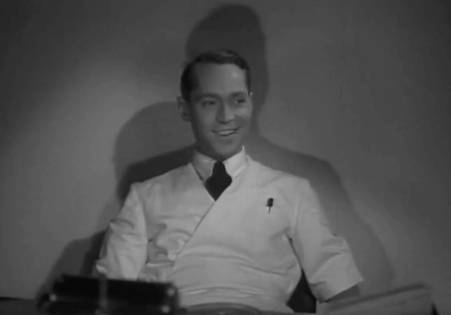
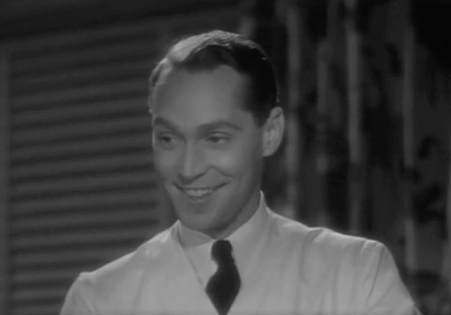
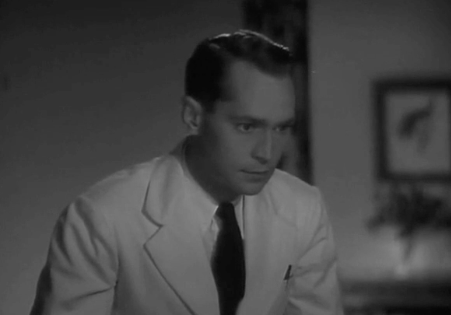
Allan Meighan (Franchot Tone) is a studious, conscientious intern in a large hospital. He's referred to by one patient as the "strong, silent man who saved my life." Claire Donahue (Maureen O'Sullivan) is a nursing intern who is promoted to head surgical nurse. Allan and Claire are good friends and enjoy working together.


Allan has a few more weeks until he will begin residency. He's applied to his current hospital but hasn't received word yet. After intern Tony Woolcott refuses to go to an accident scene, Allan goes instead. When he has to amputate an arm to save the life of a man trapped in rubble, Allan is named resident at the hospital.

Claire's husband Tom is an alcoholic who can't keep his job and hits his wife. He often stops by the hospital to ask for money from Claire. Claire makes excuses, "He only drinks because he's discouraged because he feels licked."


Socialite Patricia "Pat" Sloan (Virginia Bruce) crashes her car due to passing out from a ruptured appendix. Allan performs surgery and requests Claire "the best nurse he knows" for night duty. Patricia makes eyes at Allan as soon as she wakes from the anesthesia and notices how uncomfortable Claire becomes by it.

Tony Woolcott (Leonard Penn), a wealthy intern who recklessly drinks on the job and has no care for humanity, has eyes for Pat, but Pat desires to be the bride of Dr. Meighan. Allan warns her that he doesn't make enough money to get married. She makes an agreement that he buy necessities and she'll add a few luxuries with her own money.

Allan falls in love with Pat but fears that he won't make her happy.When Claire walks into the hospital room, Pat announces that they are engaged. Claire is shocked. She cries alone as she walks the hospital hallways.


There are already cracks showing in the marriage immediately after the honeymoon when Pat is less than thrilled about living in a modest home. They clearly are attracted to each other but Allan's first duty is to the hospital and Pat does not want his attention divided. Allan is called away from each social engagement they attend because he's needed in surgery. With each call, Pat grows more resentful.

When Allan starts to ignore his duty to the hospital to please Pat, he begins missing out on big professional opportunities and growth for himself as a surgeon. Allan questions Claire about why she stays with a drunk and Claire responds, "You see, I've adjusted my life to Tom. You still haven't adjusted yours to Patricia."


I'm going to stop here with the summary because the last half of the film has several huge moments that change the direction of Allan's plans and stir different feelings in his heart. It's a moving, unassuming film that hooks me every time I watch it. It comes on television every so often, but I'm hoping Warner Archive realizes what a gem this movie is and releases it soon.


Sources:
Silver Screen Magazine. August 1937.
Photoplay. September 1937.
Hollywood. September 1937.
Modern Screen. March 1938.