Thursday, April 20, 2017

Three Loves Has Nancy (1938)

My film choice for the Franchot Tone Blogathon is the 1938 comedy Three Loves Has Nancy. It's not the best film Franchot ever made. It's not the best performance he ever gave. He doesn't even receive first lead in it.  But it’s a good one and a sentimental favorite of mine and the film that transformed me into a viewer who thought "Oh, Franchot Tone, yeah, I've probably seen him in a few films" to "Who is this Franchot Tone? I must know everything about him and watch everything he's ever done and then blog about it!"

Source: www.ha.com
Three Loves Has Nancy stars Robert Montgomery, Janet Gaynor, Franchot, Guy Kibbee, Claire Dodd, Reginald Owen, and Charley Grapewin. Director Robert Thorpe had previously directed two 1937 films featuring Franchot: Man-Proof and Love is a Headache.

Malcolm (Robert Montgomery) is a best-selling author who embarks on a book tour in order to escape the clutches of his girlfriend Vivian (Claire Dodd). Robert (Franchot Tone) is Malcolm's frequently drunken publisher and next-door neighbor who suggests the idea of a tour after watching Malcolm's previous break-up attempts fail to materialize. Waiting in line at one of Malcolm’s rural stops is fresh-faced, innocent, country bumpkin Nancy (Janet Gaynor). When Nancy informs him that it happens to be her wedding day as he’s signing the book, Malcolm thinks (and we hear Montgomery’s voiceover) that Nancy is a devoted fan whose life is so pathetic she will treasure this signed book her entire life. He quickly finds out differently. Nancy gives him a piece of her mind and one thing you’ll discover about this film is that Nancy always seems to be giving someone a piece of her mind. Sheltered? Yes. Shy? No, sir. Nancy confesses that she has no use for the book, doesn’t own the copy he’s signing, has never read it, has never heard of him, and wouldn’t spend a penny on it. Then off Nancy goes to marry George as Malcolm receives word from Robert that his unwanted girlfriend Vivian is preoccupied and it’s safe to return home.
Malcolm is surprised to see a jilted Nancy in the train’s dining car and offended when she doesn’t instantly recognize him and also, when she laughs as passengers assume they are married. Nancy talks nonstop as a bewildered Malcolm looks on. After a purse mishap (a running gag throughout the film), Malcolm and Nancy, there to search for her runaway groom George, end up at a party in his NYC apartment. Nancy decides Malcolm needs home-cooked meals and stays on at his apartment until she finds George. Although her constant meddling frustrates him to no end, Malcolm agrees to the arrangement to keep Vivian away and because he believes Nancy will prove to be good fodder for a new book.
Franchot Tone and Janet Gaynor in Three Loves Has Nancy. Source: original from my collection

As the playful, mostly inebriated publisher-next-door, Franchot’s character Robert provides a lot of laughs. Actually, what’s great about this film is that everyone provides a lot of laughs. There’s not one actor carrying the film’s funny scenes. All three headliners are equally funny in their roles and work very well as a trio. Enjoying the three-square meals a day that Nancy provides, Robert rivals Malcolm for her attention. He starts to fall for Nancy and the steadiness her presence gives his life. Still, Robert has a lot of tricks up his sleeve. In this role, Franchot gets to do a lot of physical comedy (like sleepwalking and trying to catch an imaginary eagle) and as Malcolm’s sarcastic, witty friend, utters lines like, “You know it’s funny. I drink and you’re drunk.”
Three Loves Has Nancy is overflowing with witty one-liners from all of its characters. Malcolm’s rejected girlfriend says at the party, “I had a lovely evening. This wasn’t it.” It’s just an enjoyable comedy all around. When Malcolm takes her to an upscale restaurant, a safety-conscious Nancy puts out the fire that’s grilling the evening’s meal. She publishes a newspaper ad for George and is surprised when scores of men show up at the apartment. Of course, Nancy’s solution is not to turn them away but to feed them all, to which Franchot names her the “Florence Nightingale of the Skillet.”
A favorite scene of mine is when butler William quits after Nancy calls him dishonest. Speaking of this character assassination to his employer Malcolm, you begin to notice all that William is wearing…layers of Malcolm’s clothing which William claims he was taking as “souvenirs.”
It’s clear to the audience that Malcolm is slowly falling for Nancy’s homespun charms, but he is slow to realize the fact himself. Sober since her arrival, Robert proposes immediately, calling Nancy the “first genuine person who’s ever come into my life.”  It takes the jealousy he feels about Robert’s proposal to make Malcolm question his own feelings about Nancy.
Hilarity ensues! Nancy’s backwoods family shows up (with unbeatable performances by Guy Kibbee and Charley Grapewin), Robert’s snooty wealthy parents appear, a psychologist called Pieface throws his expertise in, and then runaway groom George surfaces. You will not be disappointed. The final scenes are laugh-out-loud funny and fitting to the rest of the film.

Franchot and Janet in Three Loves Has Nancy. Source: original photo from my collection.
Now comes a very personal story explaining my particular attachment to the film. Years ago, I first discovered Three Loves Has Nancy on the TCM app on my iPad. I was very ill and struggling to come to terms with a recent diagnosis of Lupus. Especially in those early days when none of my treatment plans were successful, I was bed-ridden a lot of the time. I’d like to go ahead and say here that in the years since, I have found medications that are working for me, keeping me stabilized, and, although I still require a good amount of bedrest when I’m not working, I’m feeling much stronger these days and living a full, happy life! But that particular night years ago, I was truly struggling physically and emotionally. I needed a light comedy to make me laugh and take my mind off myself.

I chose Three Loves Has Nancy because it starred Janet Gaynor, whom I’ve always liked. I watched the movie once, chuckling throughout, and completely forgetting everything else. And although I believe that all three stars are equally matched in it, it was Franchot Tone who grabbed my attention from the very beginning. I remember just being mesmerized by his manner of speaking and rich voice, his physical presence (the cocked eyebrow, slow grin, and comedic movements), and his entire delivery. I was waiting for his scenes and wishing he’d had more. This was not the first time I saw Franchot. I realized later, while frantically scouring the internet for information about him, that I’d watched him in Jean Harlow movies and Joan Crawford movies and Honeymoon with Shirley Temple. But I never actually saw him.  He was there all the time, but for some reason, my eyes were not focused on him until the night I watched Three Loves Has Nancy. After watching it and then researching the film and Mr. Tone for a long while after, I was thinking of all the great lines and cute moments and ended up re-watching the film from start to finish immediately.

Three Loves Has Nancy will always have a special place in my heart. It provided the perfect escape for me on a night when I desperately needed the smiles and laughter it contains. It is the film that forced me to take another look at Franchot Tone. I’ve been madly researching and watching him since that viewing. I would come to find that as much as I loved Three Loves Has Nancy, it was just a hint of what Franchot could do. There were tons of sensitive and nuanced performances waiting for me in Franchot’s film and television work. Three Loves Has Nancy started it all—my appreciation of an under-appreciated actor, my fascination with his life, and my need to dedicate a permanent online space for him.

I hope you enjoy the Franchot Tone Blogathon this weekend!

Monday, April 17, 2017

Gatineau Treasure

Last year, I wrote about Franchot's ties to the Gatineau region of Quebec. Franchot always spoke fondly of his time outdoors fishing on the Thirty-One Mile lakes, hunting in the woods, and relaxing in his cabin there. Franchot escaped his hectic life in Hollywood by returning to this region and shared its beauty with all four wives, spending several of his honeymoons here. It's easily one of my favorite aspects of Franchot's life to research, because it's so in contrast to the gentleman role in which he was often typecast and because it seems like such a joyous place for him. My original detailed post on the Tone family cabin and Franchot's visits can be found here. Franchot's fourth wife Dolores Dorn described her honeymoon there and I wrote about that here.

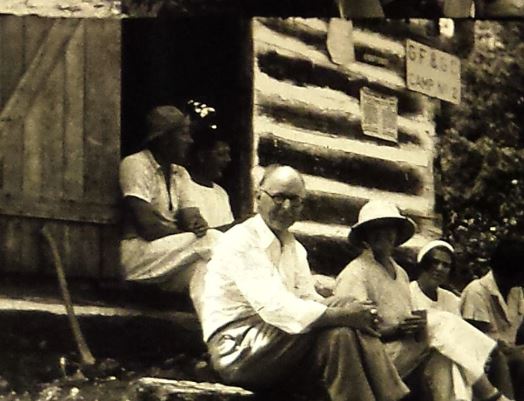
Recently, multiple 16 mm film of home movies belonging to Franchot's brother, Jerry, were up for auction on eBay. Most of the film was dedicated to Jerry's family with glimpses of Franchot's parents here and there. I didn't see any indication that Franchot would appear in most of the reels. Then, I saw one small preview picture of a 1938 reel from Gatineau and there he was with a huge grin on his face fishing from a boat. There was also a separate film of Gatineau from 1935, but I doubted Franchot would pop up there because '35 was a busy year for him. I bid on both despite the fact that I have no means to play or transfer 16 mm film. My plan was to find a way to transfer the film to digital, so that I could share the videos here. I bid as high as I felt I could, but a more competitive bidder took it home instead. eBay can be quite an emotional roller coaster! Ever since the auction ended, I've gone back and forth between devastation that I didn't bid just a little bit higher and relief that I didn't bid above my means.

Sadly, I didn't win but my hope is that the person who did win was either 1. Franchot's family (and if so, I apologize for the bidding war!) 2. a library or archive or  3. a fan like me who plans to transfer the film for others to enjoy.

I did, however, save the preview shots that were posted on eBay and they give a wonderful view of life at Franchot's family cabin in Canada!

From the 1938 color reel:
Franchot fishing. I love this candid shot!


Franchot with his father Frank J. Tone


Franchot's father Frank J. Tone and brother Jerry
 
I did not see any indication that Franchot appears in the '35 film, but it still gives a wonderful view of what vacation life was like for the Tones there. From the 1935 black and white reel:


Franchot's father Frank J. Tone with other family members


Don't forget that my Franchot Tone Blogathon happens later this week! Check back this weekend for great entries on Mr. Tone from multiple bloggers.

Saturday, March 25, 2017

Franchot & Bette: 2nd Annual Bette Davis Blogathon

Earlier this week, I shared a conversation on Joan that Franchot had with a reporter in 1933. During the conversation, he praised Joan for her talent, warmth, humor, and power. In that way that Joan Crawford and Bette Davis always seem to be connected to one another in print, film, and new television shows, it happens that In the Good Old Days of Classic Hollywood's Bette Davis Blogathon falls on this week, too. And as much as he adored Joan, Franchot also happened to admire Bette.

Franchot and Bette only made one film together, 1935's Dangerous. I actually wrote about Dangerous in detail for Crystal's Bette Davis Blogathon last year (read here) as well as their almost-second pairing in Old Acquaintance (post here), so I thought I'd focus on their personal relationship this time around.

Source: Modern Screen, 1937.


Dangerous and the Bette-Franchot Attraction

Source: Hollywood Magazine, 1936.

During the filming of Dangerous, Franchot was seriously dating Joan. Bette was immediately smitten with Franchot upon meeting him and said:
When I was filming Dangerous in 1935, I had a crush on my costar, Franchot Tone. Everything about him reflected his elegance, from his name to his manners. He had a great deal going for him, including Miss Joan Crawford. He was madly in love with her. They met each day for lunch. After lunch, he would return to the set, his face covered with lipstick. He made sure we all knew it was Crawford's lipstick. I was jealous, of course.
Harry Joe Brown claimed that he once walked in on Franchot and Bette in a compromising situation in her dressing room and this act is what many cite as the catalyst for a lifelong Davis-Crawford feud. According to legend, she was so worried that Franchot was falling for Bette that Joan quickly started planning to wed him herself. I don't know how valid any of these statements are, but it's not hard at all for me to believe that Franchot would've been attracted and intrigued by Bette, or acted on these feelings. To me, it's probable that he was and did.  But it is hard for me to believe that Joan would've married Franchot purely out of film set jealousy. After all, Franchot was a frequent costar to another high-profile, glamorous, and intriguing actress, Jean Harlow. If Joan's marital decisions had been ruled by jealousy, she would've been wed to Franchot as early as 1933 or 1934.


Source: Screenland Magazine, 1936.
It's clear that Bette fell for Franchot hard and hoped he felt the same way. Actress Joan Blondell recalled:
I was on the lot doing a picture when Bette came to see me, all soft and dewy-eyed, which was not her usual manner, believe me. She was in love, she told me, with her leading man Franchot Tone. I was amused. I thought she was kidding. After all, she was married to that sweet guy, Ham, the musician. And, furthermore, I didn't think she went in for that sort of thing—for soundstage romances. It's not that she was a Holy Mary; she wasn't. Her career always came first. So I kidded with her, saying that we all get crushes on our leading men from time to time and they passed...Bette got very angry with me. She said, 'Joan! I am not a schoolgirl. I don't get crushes. I am in love with Franchot, and I think he's in love with me.' I said something lame, like 'Give it time, honey,' although I was really thinking, 'Boy! If Joan Crawford gets wind of this, there is going to be war.'
Friends Bette and Joan Blondell with Dick Powell and Arthur Farnsworth in 1941. Source: Hollywood Magazine.

I think that it is telling that a 79-year-old Bette devoted a paragraph to Franchot in her 1987 memoir, This n' That. That memoir was a sparse one, so to take the time to address how she felt about him during that brief time leads me to think that her feelings for Franchot were not briefly felt at all, but perhaps still being felt 50 years later.

I have not watched Feud yet, so I'm curious how the writers of that show incorporate the Franchot link between Joan and Bette, if at all. Often Franchot is cited as the reason Joan and Bette feuded, but there's always more to a complex relationship than one moment in time.

At the end of Dangerous, Joan walked away with Franchot and Bette walked away with a famous little man named Oscar at the 1936 Academy Awards. According to reports, at the ceremony Franchot jumped up out of his seat, applauded loudly and beamed with pride at his former leading lady.

For more great posts on Bette Davis, head over to In the Good Old Days of Classic Hollywood!

Sources:
  • Considine, Shaun. Bette and Joan: The Divine Feud. New York: Sphere, 1990.602402
  • Davis, Bette, and Mickey Herskowitz. This 'n That. New York: Putnam's, 1987.

Tuesday, March 21, 2017

Franchot on Joan's Humor, Talent, and Feminist Example

Joan. Dancing Lady, 1933.
Franchot continues his conversation with Jack Jamison on his love for Joan:
And then, of course, there's her sense of humor. You can always tell if a person really has a sense of humor by his willingness to let himself seem ridiculous. Joan loves to be caught looking 'silly,' so that people will laugh.
Sometimes at the end of a scene, while the cameras are still turning, she makes a face or lets her mouth hang open. Then when she goes into the projection room to see the rushes, she too laughs at the foolish picture of herself. It isn't loud, insincere laughter—the kind of laughter so many people use to cover a situation which embarrasses them. Nor is it the kind of laughter that seems to say, 'See what a good sport I am?' It's more a snicker, like a youngster's, but very real. She honestly loves to kid herself.
She loves to kid other people, too, but never cruelly—always gently. Once when we were making a picture together, I was supposed to do a swimming scene. Joan went to the director and asked anxiously, 'The tank isn't deep, is it?'
'Sure! Ten feet or so.' The director replied. 'Why?'
'Mr. Tone can't swim.'
'Can't he swim at all?'
'Well,' she said. 'He can do the breast-stroke a little.'
She had them nearly crazy, explaining that I'd look silly if I couldn't do a crawl stroke, wondering if they could get a shallow tank so I could just wade, arranging for me to stay up all night and learn strokes. Then after they were all wild, she broke down and told them that I really could swim, after all.
But there is something even more important than a sense of humor—especially in a woman. And that is good taste. Joan's taste is exquisite. Like her intelligence, it is instinctive. While William Haines gets the credit for decorating her beautiful home, Joan, as a matter of fact, did a great deal of the actual choosing.
And her taste is as creative as it is discriminating. I've even heard her make suggestions to Adrian when he was planning clothes for her. They must have been good suggestions, because Adrian followed them.
Incidentally, Joan's wardrobe is stunning because she has good taste and not because she spends large sums of money on clothes. Undoubtedly one of the best-dressed girls in pictures, she spends far less for clothes than many another feminine stars. Recently, when complimented on a lovely new outfit, Joan winked and said, 'Last year's suit. New scarf and new hat, that's all.'
Most important is her taste in people. I have never, and there is not a single exception, found a soul she liked whom I didn't like, too. In choosing her friends, accomplishment—what they've done—means nothing to her. She's interested in what they are. If what they are helped them to do something, that is another matter. But popular acclaim, fame, popularity—they mean nothing to her. They two qualities Joan looks for in a person are sincerity and self-reliance.
And then, last but not least, there is Joan's talent. She has temperament. Her emotions are quick and full. She's angry when she's angry, gay when she's gay. I think she is one of the most vivid personalities on the screen or stage today. And I think that, with her determination, she is going to become one of the greatest artists America has ever produced. She herself believes she is only beginning now.
I believe Joan Crawford would have achieved outstanding success in any profession she chose for herself. She is the perfect example for feminists to point to in maintaining that the sexes are capable of equal achievement. With her shrewd, clear, quick thinking, she would make a marvelous business woman. With her executive powers and ability at handling people, she could go far in politics. With her sympathy and intelligent understanding for other people's troubles, she would be ideal for social service. Every child she meets falls in love with her—she ought to be a wonderful teacher. That girl could do anything!
Part One: Franchot on Joan's Intelligence and Beauty

Source:
Jamison, Jack. "'I'd Rather Know Joan Than Anybody Else' says Franchot Tone." Photoplay Magazine. November 1933.

Monday, March 20, 2017

Franchot on Joan's Intelligence and Beauty

In 1933, in the very early days of their relationship, Franchot talked to a reporter about the reasons Joan fascinated him:
I'd rather know Joan Crawford than anybody else I know. And I have any number of reasons. In the first place, Joan is more intelligent than most people. Joan has what the French call l'intelligence de coeur, or intelligence of the heart. It is a human and sympathetic intelligence, the power of learning by putting herself in the other person's place. But it is more than that, too. It is the power of giving meaning to every new experience by relating it to a past experience. When Joan comes in contact with something new, she instantly coordinates it with the rest of her knowledge. Therefore, Joan is intelligent in a deep and understanding way.
She is receptive to every new idea. There are some people who make a pose of being receptive and brag about being 'open-minded.' Not so with Joan. She never accepts anything just because it is new, or because she wants to prove she is broad-minded. But she examines everything with an open mind, then chooses that which she considers worthwhile. And she has an instinctive mental judgment which helps her pick the wheat from the chaff. For example, Joan honestly believes that she knows nothing about acting, and is just beginning to learn. And yet, when we talk about the stage, when I tell her things that happened to me when I was on the New York stage, little tricks of technique that I saw actors use there—she can pick the good ones from the bad ones instantly. She knows at once what would be right for pictures and what would be wrong.
Then there is Joan Crawford's beauty. I hardly need mention that. But a fascinating thing about her beauty—and a thing you don't realize until you know her personally—is that she is beautiful in two distinct and different ways. One the screen her beauty is formal. It gives you the impression of a classic statue. It might be sculptured, that head of hers. But you don't really appreciate her beauty until you see her without her make-up. Sometimes when you're traveling in a foreign country you suddenly come across a woman who literally makes you catch your breath. If you're in Bavaria you find yourself saying, 'Here is the perfect type of Bavarian beauty.' Well, seeing Joan as she really is, so fresh-looking, with that clean-scrubbed look of hers, you say: 'Here is the perfect type of American beauty.' And her freckles are a part of it.
I think the first time I became aware of her great beauty was once when I had been asked to her house for lunch. She was in the back yard taking a sun bath. She came in, her hair rumpled, and oil all over her face and arms. And she was beautiful! Beauty like hers is a real thing. You can't mistake it!
Part two on Joan's humor, talent, and business sense coming tomorrow!

Source:
Jamison, Jack. "'I'd Rather Know Joan Than Anybody Else' says Franchot Tone." Photoplay Magazine. November 1933.

Monday, March 13, 2017

Mandingo (1961)

Franchot with members of the Mandingo cast.
Source: Billy Rose Theatre Division, The New York Public Library.
"Mandingo. [1961]" The New York Public Library Digital Collections.
        http://digitalcollections.nypl.org/items/bc27eacb-6f1c-465e-e040-e00a1806652a

Mandingo opened on May 22, 1961 at the Lyceum Theatre, but closed after just eight performances five days later on May 27th. Written by Jack Kirkland and based on the novel by Kyle Onstott, Mandingo was set on an Alabama plantation in 1832. The play was directed by Louis MacMillan and starred Franchot Tone, Dennis Hopper, and, in her Broadway debut, Brooke Hayward. Full cast included Duke Farley, Georgia Burke, Clark Morgan, Philip Huston, Vinie Burrows, Maurishka Ferro, Arnold Moore, Rockne Tarkington, Fran Bennett, Verta Smart, Arnold Soboloff, John A. Topa, and Coley Wallace.

On March 9th, the New York Times suggested that Franchot might play a part in Mandingo and by March 23rd, Franchot had signed a contract to star in the play. Mandingo is often cited in biographical examinations of Dennis Hopper and Brooke Hayward, because the two became a couple during the production and later wed. Hayward would go on to call it a "potboiler" that "quite rightly closed after a week."


After opening night, N.Y. Times reviewer Howard Taubman wrote:
To a world painfully aware of the anguish of racial tension a play like "Mandingo" can only seem like a crude, sensationalized effort to capitalize on a newsworthy theme...It may well be that he [original author Kyle Onstott] wishes to say something compassionate and purging about the misery of slaves and the malevolence of the slave owners. But what emerges is a group of stereotyped characters taking part in noisome affairs...Franchot Tone, who has an honorable record of worthier things, snorts, wheezes and blusters his accomplished way through the role of Mr. Maxwell...In a time when insight and wisdom are desperately wanted, "Mandingo" offers only a shabby, coarse, surface treatment of an agonizing theme.
In the play, Maxwell (Tone) is a menacing slave owner who treats the slaves on his property with cruelty. His son Hammond (Hopper) does not agree with his father's ways and faces Maxwell's wrath as well. The story moves from one shocking scene to another, each featuring violence and sex (including rape and incest.)

I am surprised that despite the overwhelmingly negative response to the play's theme and the brief run due to this, Hollywood made a commercially successful movie version of Mandingo starring James Mason in 1975. A 1976 sequel Drum followed.

Candid backstage shot of Franchot with costars Maurishka Ferro and Verta Smart. Source: JET, June 1, 1961.

Sources:

Friday, March 3, 2017

John Garfield Blogathon

I am happy to be participating in Phyllis Loves Classic Movies' John Garfield Blogathon since John and Franchot were good friends with similar career interests. Garfield has been a favorite of mine ever since he stole my fourteen-year-old heart when I first watched Four Daughters.

The Group Theatre

Franchot and John both got their start on the New York stage and honed their skills in the Group Theatre. Franchot was one of the Group's original members when Harold Clurman, Cheryl Crawford, and Lee Strasberg formed the Group Theatre with the hope of presenting plays that featured believable characters who spread important real-world messages through their thought-provoking scripts. Franchot actually starred in the group's very first production The House of Connelly in 1931 and the plays that followed that year and in 1932. Franchot used his own money to finance much of the group's work and was a firm believer in its essentiality to modern theater. In fact, when Franchot first pursued a film career in Hollywood in 1933, his main intent was to earn a lot of money quickly and eventually return to the Group with the additional funds. But he immediately fell in love with Joan and—despite sporadic statements that he may permanently return to a solely theatrical career—Franchot never fully abandoned Hollywood.

John joined the Group after Franchot physically left it (I say this because Franchot always morally and financially supported the Theatre.) John was a student of method acting at the American Laboratory Theatre, which included Group Theatre founders Strasberg, Crawford, and Clurman. John gained critical success in Lost Boy in 1932. After an apprenticeship, John was accepted as a member of the newly named "The Group," but, like Franchot, was drawn to Hollywood. Unlike Franchot, John's first film Four Daughters garnered him immediate acclaim and an Oscar nomination. Despite his obvious talent, John, like Franchot, was soon relegated to quickly churned out, pleasant films. But John fought back against the studios much harder than Franchot ever did. While Franchot was never able to recapture the early critical success of his mid-1930's work, John's lasting success came in the 40's with films like Destination Tokyo, The Postman Always Rings Twice, Humoresque, and Gentlemen's Agreement. I went through a period where I watched every single one of Garfield's films, and I cannot think of one performance that did not impress me.

In spite of their success, some Group members made both John and Franchot feel guilty for leaving to pursue opportunities in Hollywood. In later interviews, some group members shared that they felt that Hollywood had put John and Franchot’s focus on money, women, and alcohol, and interfered with their ability to produce quality work. (In my opinion, the two actors were able to balance their dedication to the craft with their extracurricular pleasures quite successfully.) This frustration with Franchot and John for pursuing film careers makes better sense when you realize that one of the Group's main objectives was to be a cooperative ensemble and an emphasis was placed on the good of the group, not the pursuit of fame by one individual.

For more information on the Group Theatre and both actors' involvement, I highly recommend the full-length American Masters documentary on the Group Theatre that the Stella Adler Studio of Acting posted on Youtube:

Friendship in the 1940's

In the early 40's, Franchot and John were involved in many of the same wartime support efforts. They both worked hard to support their fellow men overseas by serving on multiple war effort committees, making public appearances, and selling war bonds.

In Hollywood, John and Franchot were prominent board members of the Screen Actors Guild and participated in meetings until September 15, 1946 when they had to resign due to a new “conflict of interest” by-law. Also resigning were Robert Montgomery, James Cagney, Dick Powell, Harpo Marx, and Dennis O’Keefe.

Another connection I find interesting is that John's 1941 film Out of the Fog was based on Franchot's 1939 play The Gentle People and, in these productions, John and Franchot played the same role.

In 1945, Franchot and John returned to New York to discuss future theatre plans
with their former Group Theatre leaders. Film Daily. November 12, 1945.

Variety. November 1945.

Their similar career beginnings, current involvement in important causes, and enjoyment of a good time brought Franchot and John together as friends. They were frequently seen out together in bars and restaurants with a drink in one hand and a pretty lady not far from reach. Sherry Davis recalled that her grandfather, actor Robert Davis named his son Franchot because of his friendship with Tone. Robert Davis, Franchot, and John would gallivant around the nightspots drinking heavily, until young Franchot Davis was sent by his mother Myra to fetch them home.

John and Franchot on the set of Jigsaw, 1949.

In 1949, John made a cameo in his pal Franchot's noir Jigsaw. That film (a good one, in my opinion!) is in the public domain and can be viewed in full on Youtube here.


The Blacklist

The promise of the 30's and fun of the 40's were no match for the HUAAC who attacked John and Franchot—both public about their liberal beliefs—in the late 40's and early 50's. Although Franchot was publicly cleared by the Dies committee early on, he was softly but purposely blacklisted throughout the 50's. (You can read a more in-depth post on Franchot's blacklisting here.) Obviously, John was more publicly and viciously attacked by the House Committee. John refused to name names when he was forced to testify and as a result, was blacklisted by the major studios. But the blacklist damaged more than his career. It destroyed his health and led to his tragic death of a heart attack at only 39 years old.

Thank you Phyllis for hosting the John Garfield Blogathon! For some great Garfield reading, please head over to Phyllis Loves Classic Movies for the full roster.

Sources:
  • Kramer, Joan, David Heeley, Joanne Woodward, Steve Lawson, Stella Adler, Harold Clurmaan, Cheryl Crawford, and Lee Strasberg. Broadway's Dreamers: The Legacy of the Group Theatre. New York, N.Y: PDR Productions, 1994.
  • Gelman, Howard. The Films of John Garfield. Citadel Press, 1975.
  • Hirsch, Foster. A Method to their Madness: The History of the Actors Studio. Da Capo Press, 2001.
  • Kazan, Elia. Elia Kazan: A Life. New York: Knopf, 1988.
  • Lasseter, Don. Body Double. Kensington, 2002.
  • Media Lantern Digital History Project: http://lantern.mediahist.org/
  • SAG: www.sagaftra.org
  • Smith, Wendy. Real Life Drama: The Group Theatre and America, 1931-1940; New York: Knopf, 1990.