Friday, September 8, 2017

Beyond Desire and a Theater of His Own

Beyond Desire cast. Source: Theatre Arts Monthly/scan from my collection.

Beyond Desire opened at Theatre Four in New York City on October 10, 1967. Unfortunately, the play was not a hit and closed just five days later on October 15th. The play, written by Constance Loux and based on Pierre La Mure's novel, was produced and directed by Franchot's friend and frequent collaborator Jean Dalrymple. The cast included Franchot Tone, Betsy von Furstenberg, Richard Sterne, Jay Barney, Mary Bell, Norman Budd, Jo Flores Chase, Richard Kuss, Andrew Plamondon, Jane Marla Robbins, John Scanlan, Ethel Smith, Ben Yaffee, and Jay Velie.

Seemingly plagued with issues from the start, Beyond Desire's opening date had been postponed and it ran for only seven previews and eight performances before closing. The New York Times reported that Franchot would be both narrating and performing a separate role in the play, but from all accounts, it appears that Franchot, with star billing, only performed as the play's on-stage narrator. (I wonder if this was just the part as intended, if Franchot wanted to lend his name to this production, or if his sitting to the side as narrator had something to do with his cancer diagnosis.)

The play was based on the life of composer Felix Mendelssohn. Dan Sullivan, for the New York Times, reviewed the play this way:
"Beyond Desire" might well be titled "Beyond Recognition."...romantic slush, and worse than that, stale romantic slush...the play is a collection of Lines You Thought You'd Heard the Last Of, lines you thought they'd never dare use again.
Regarding Franchot, Sullivan remarked:
Franchot Tone has star billing, but only sits to one side of the stage, trying to tie together the 50 or so scenes with some kind of coherent narration.

The negative reviews and swift run of the play surely were a disappointment to Franchot and director Jean Dalrymple, since Beyond Desire was the first play they chose to produce at Theatre Four. You see Theatre Four had just recently been acquired by Ms. Dalrymple and Franchot, longtime friends and colleagues.

Just two months prior to Beyond Desire's opening, Jean and Franchot partnered to purchase the theater for a price between $200,000-500,000 (that's a minimum of 1 million plus today.) Theatre Four had first been a church, before David Ross transformed the property to include a theater in the 60's. Jean and Franchot planned to produce plays and musicals in their new theater.

Owning a theater had been a lifelong dream for Franchot and this must have been a happy career milestone for him. Dolores Dorn, Franchot's costar in Uncle Vanya and fourth wife, talked about this aspiration in her memoir (my original post on that is here.) On their very first date at a French restaurant in 1956, Franchot confided in Dolores that his dream was to eventually own his own theater. Franchot told her that his vision for his theater was to be a home for plays with real issues and that he was influenced by his time with the original Group Theatre in the early 30's.

Sadly, Franchot would die of lung cancer just a little over a year after acquiring the theater. I have not been able to track down what became of the theater immediately following his death, but I'll assume that it remained in Jean Dalrymple's possession for the time being. At some point, it became known as the Julia Miles Theatre and known as the home to the Women's Project and Productions. Citidex describes the theater as a "small space with under 200 seats is located just north of Manhattan's Theatre District."

Another blow discovered in my search: It looks like Franchot's theater at 424 West 55th has since been demolished to make room for an affordable housing building.  In a 2014 article for Curbed New York, Zoe Rosenberg reported that the lot was formerly the site of a "three-story church with a 3,000 square foot theater" which sold for over 8 million in 2013.

Although the first play "Beyond Desire" wasn't well-received, I can only imagine what might have been had Franchot not passed away at the age of 63 just a year later. I can picture a future Franchot, in his late 60's through his 80's even, stepping into the role of respected director and producer of hard-hitting plays presented in the theater he co-owned with Dalrymple. I envision an aged Tone mentoring young actors and possibly teaching his own acting classes there.

I've been reading Dalrymple's memoirs which are focused solely on her work with City Center and, because of this focus, do not mention Theatre Four. However, there are some nice passages about Franchot at City Center that I'll share soon.

Sources: "'Beyond Desire Closes.'"The New York Times. October 16, 1967. pg. 56.
"Franchot Tone in Dual Role." The New York Times. August 29, 1967. pg. 26.
"Jean Dalrymple Buys a Theater: Franchot Tone is Partner in Off-Broadway Venture." The New York Times. August 3, 1967.
Lortel Archives:
http://www.lortel.org/Archives/Production/3334
Sullivan, Dan. "Theater: Mendelssohn in a Flat Key." The New York Times. October 11, 1967. pg. 36.
Lasson, Robert and David Eynon. "The Poll's the Thing." The New York Times. October 8, 1967. pg. X1.
Rosenberg, Zoe. "Small Structure to Replace Church on West 55th Street." Curbed New York.
"Theatre Four."
www.citidex.com
"Two Plays Set New Dates." The New York Times. September 25, 1967. pg. 55.

Friday, August 25, 2017

Pamp in the 1925 Cornelian

A few years ago I shared Franchot's senior photo from Cornell University's 1927 yearbook (shared here again lower in this post.) Today I stumbled upon a group photo that includes Franchot in the 1925 yearbook!

I know it's small, but Franchot is second row from the bottom and third from the left in this Alpha Delta Phi photo from 1925.
 
Here's an enlarged view of Franchot with classmates.
 
And here's 20 year old Franchot alone.
And resharing in case you missed it in an earlier post, here's Franchot two years later at 22 and a senior in college.
 

The 1925-1927 yearbooks shed light on Franchot's activities at Cornell University. Classmates used the nickname of "Pamp" for Franchot. This nickname was also reported in an early 30's fan magazine. Here's the story of how Franchot came to be Pamp, according to The New Movie Magazine:
He's Pamp because a kid cousin, Betty Franchot, couldn't negotiate the double consonants of Franchot and dogged her handsome young relative's footsteps piping 'Pampo...Pampo!'
'Sounds like a cocker-spaniel or something!' cracked another cousin and watched to see if Franchot would wince. Not a twitch. The kid could take it! So the clan graciously elided the nickname to "Pamp" and it's stuck.

He was a member of Alpha Delta Phi, Phi Beta Kappa, Phi Kappa Phi, and Kappa Beta Phi. Franchot was also active in the Sphinx Head society, Book and Bowl, Savage Club, and Dramatic Club. After years as an active member, Franchot served as the President of the Dramatic Club in his senior year. There are some very small photos of students acting in plays throughout the yearbooks, but I have been unable to identify Franchot in any of those photographs. I'm sure he's there somewhere and if I am able to spot him, I'll share those later.

Any new photo of Franchot is exciting to me and the non-Hollywood ones are even rarer. I'm hoping careful inspection of these yearbooks might lead me to spy Franchot hidden away in other group photos.

Monday, August 7, 2017

TCM Celebrates Franchot Tone on August 8th!

TCM is featuring Franchot during their Summer of the Stars schedule! Tuesday, August 8th (tomorrow!) will be all Franchot, all day. Can you think of anything better? Although sadly I don't have TCM at the moment (I cut cable earlier this year to save a bit of money and promptly spent all that money on Franchot memorabilia), I am still out-of-this-world grateful that they are giving Franchot the recognition he deserves, introducing his films to new and old fans alike, and including some fantastic rarities in the line-up.

Obviously, if you have a DVR or are at home, watch them all! It's an uncommon treat to have Franchot playing on television an entire day. But if you must be choosy with which ones you watch, I thought a guide from one Franchot fan to another might be useful. Below you'll see the times (all Eastern times) each film is playing, plus a little info about each film and the links to summaries and posts I've posted in the last 2 years (links may contain movie spoilers.).

Due to DVD availability and infrequent television showings (which I note below), there are several that you absolutely don't want to miss.

Today We Live
6:00 a.m.: Today We Live (1933)
Watch it if...you want to see one of Franchot's earliest films and his first pairing with future wife Joan Crawford. This is a romantic drama set in World War I. However, don't expect to see Franchot and Joan's first onscreen kiss—they're brother and sister in this picture!
On DVD? Yes, thanks to Warner Archive.

Dangerous

8:00 a.m.: Dangerous (1935)
Watch it if...you're looking for romantic drama (and Bette Davis' character certainly brings the drama!) with palpable onscreen chemistry between its stars. Bette won an Academy Award for her performance in this film and it's one I find myself watching over and over. I've written about this film twice before: my summary with screencaps can be found here and my entry on Dangerous (with gifs!) for the Bette Davis blogathon can be found here.
On DVD? Yes, thanks to Warner Archive.

Exclusive Story

9:30 a.m.: Exclusive Story (1936)
Watch it if...you like seeing good guys (in this film, newspapermen and an attorney) battle the bad guys (racketeers) to protect their community. Exclusive Story may be the weakest film in the lineup, but it's still a worthwhile watch. It's a film that I quite enjoy. I've written a summary with screencaps on this blog: my post is here
On DVD? Yes, thanks to Warner Archive.

Fast and Furious

10:45 a.m.: Fast and Furious (1939)
Watch it if...you want to laugh your face off! Franchot and Ann Sothern are hilarious in this one. It's a little detective story in the vein of The Thin Man series and a lot of fun to watch. It was one of the first films I highlighted on this blog: that full summary is here
On DVD? Yes, again thanks to Warner Archive.

The Wife Takes a Flyer

12:15 p.m.: The Wife Takes a Flyer (1942)
Watch it if...you don't want to miss your chance to see this rarely shown film. This one never plays on television and has not been commercially released on DVD. It is a funny movie set in World War II starring Franchot and Joan Bennett as love interests. It's a bit of a goofy comedy, but you absolutely need to watch it. This one doesn't come around that often and Franchot has some very funny bits in it. A couple of his scenes make me laugh so hard I have to rewind them to watch again.
On DVD? This one has not been commercially released on DVD. Take advantage of this opportunity to watch it on tv if you can!
Uncle Vanya

1:45 p.m.: Uncle Vanya (1958)
Watch it if...you want to see the closest thing to Franchot performing on stage as you can. This is one of my favorite Franchot performances. Uncle Vanya was a labor of love for Franchot. He produced it and distributed it with his own money and spent sleepless days and nights filming the film version while at the same time starring in the theater production. This is Franchot the actor. This is a production he was proud of. This is a must see. I have written about my love for this film and Franchot's performance in it before: that post is here.
On DVD? Yes, thanks to VCI Entertainment.
Five Graves to Cairo

3:30 p.m.: Five Graves to Cairo (1943)
Watch it if...you are a Billy Wilder fan who wants to see what Franchot can do with an espionage thriller set in the war. This is a very well-written script and well-produced film. I highly recommend this one for Franchot's performance. It is a top quality film that he was given among a sea of B films in the 1940's.
On DVD? Yes, thanks to TCM.

Mutiny on the Bounty

5:30 p.m.: Mutiny on the Bounty (1935)
Watch it if...you want to see the performance that earned Franchot a Best Actor Oscar nomination and an incredible action adventure film. This part truly showcases Franchot's strengths as an actor and it's no wonder his performance was recognized.
On DVD? Yes, thanks to Warner Brothers.
The King Steps Out

8:00 p.m.: The King Steps Out (1936)
Watch it if...you've never seen Franchot with curly hair, ha! I don't consider this the strongest film on the bill, but it's an interesting part for Franchot and he looks wonderful in his royal garb. This is mostly a vehicle for operatic soprano Grace Moore so expect many songs. I wrote about this movie for the Royalty on Film Blogathon. My post is here.
On DVD? No, this one has not been commercially released, so take advantage of this opportunity to see it.
The Unguarded Hour

9:45 p.m.: The Unguarded Hour (1936)
Watch it if...you're into sophisticated dramas with witty dialogue. I love The Unguarded Hour! I've heard from some people that they feel this film is too talky and too dry, but I feel the opposite. I find it mysterious and engrossing and glamorous with a nice twist at the end. Anyone who knows me knows that Franchot and Loretta Young are my favorites and so this film (and Midnight Mary, of course) are treasures to me. I've written about The Unguarded Hour once before: you can read that
here.
On DVD? Yes, thanks to Warner Archive.

Gentlemen Are Born

11:30 p.m.: Gentlemen Are Born (1934)
Watch it if...you want to see Franchot as part of an ensemble cast, each character trying to make the hard transition from optimistic college students to facing the bleak world that presents itself post-graduation. I first saw this on TCM a while back and it is unbelievably undervalued. What a film! This is an absolute must see, in my opinion. I wrote about it last year: that post is here.
On DVD? No, do not miss your chance to see this!
Quality Street

1:00 a.m.: Quality Street (1937)
Watch it if...you enjoy period pieces, understated romances, and Katharine Hepburn. I really like this one. I don't know that it is for everybody, because it can feel a little slow-paced—but I find I enjoy it more and discover new moments that I missed with each viewing. Plus, Franchot is quite handsome here (that's sort of always the case though, isn't it?) I've not written about this one before, but I will be for an upcoming Spencer Tracy and Katharine Hepburn Blogathon this fall.
On DVD? Yes, thanks to Warner Archive.
The Girl from Missouri

2:45 a.m.: The Girl from Missouri (1934)
Watch it if...you enjoy the Tone-Harlow pairings and like to see a wealthy playboy defying his father for a poor girl he loves. This one is my favorite of the Tone-Harlow films and I adore Lionel Barrymore in the part of Franchot's father.
On DVD? Yes, thanks to Warner Archive.
Between Two Women

4:15 a.m.: Between Two Women (1937)
Watch it if...you are a fan of a tried-and-true romance and because it is a unique opportunity to see this film. This is a predicable romantic triangle, but it's also dreamy and passionate and one of my favorite films. Franchot plays an honest, hardworking doctor who is torn between a society glamour girl and an already-married, sweet nurse. I truly love this one and feel it's a must-see.
On DVD? No, watch it! You must!

I hope everyone who is able will enjoy Franchot day! For those of us without access to TCM, it may be a good day to pull out our favorite Franchot DVD in celebration. Again, I'm so happy TCM is highlighting this much deserved actor who never seems to get his due.

If anyone has newly discovered Franchot and this blog, welcome! Hope you check back for more!

Saturday, July 29, 2017

Irving Thalberg's Support and Ultimate Surrender of Franchot's Career

Irving Thalberg began his film career immediately following his high school graduation. While still a teen, Thalberg became a secretary for Universal and remained there until 1924, when the promise of a more lucrative salary drew him to Louis B. Mayer and MGM. There, Thalberg helped to turn (some would argue that he alone turned) the studio into the powerhouse it became in the late 1920's through the 1940's. He had a knack for knowing the public's tastes and expertly creating stars out of MGM's players, yet yearned for a studio that created only solid, important films.

Prone to illness since childhood, Thalberg's immune system was as weak as his mind was strong. He was forced to take an extended rest after a heart attack in 1932 and during this time, Mayer demoted him from production supervisor to unit producer. From 1933 to his untimely death in 1936, Thalberg produced some of MGM's most successful films. During this period, the "Boy Wonder"—as he was termed by his colleagues—would fight for Franchot Tone, but would ultimately fail to convince Louis B. Mayer of Tone's worth.

In a letter written in October 1933, Irving writes of his initial push for support of Franchot and his defeat by Mayer:
I made a request of Louis, inasmuch as Franchot Tone was dissatisfied with the treatment he had been receiving and was insisting on abrogating his contract, that I be permitted to take him over for a certain length of time. Since he's been with us, he's been used only in bits and means nothing, and I believed I would be rendering the company a great service in taking over this man, meaning nothing, and making him into a star—which I felt I could do. Louis couldn't see it—and rather than press the matter, I dropped it completely.
In this letter, Irving expresses frustration over MGM executives' "demoralized and uninspired" attitude and their readiness to produce "juvenile, immature" films instead of taking the time to focus on their talent (like Tone) and the scripts represented.

Irving expected Franchot's contract to include an availability clause that would give him first rights to Franchot and other artists he believed in. Despite his calls to MGM's legal department, Irving lost this contract dispute and other producers and studios were able to use Franchot first—further alienating Franchot from the more mature, star-making films Irving may have had in mind.

Thalberg, of course, bought and produced Mutiny on the Bounty, which would be a huge success for MGM and win Best Picture at the Academy Awards. Mutiny on the Bounty turned out to be Franchot's most successful film and would earn him esteem in the film community in addition to a Best Actor nomination. Even though Irving lost control over Franchot's image and career, he does deserve credit for helping to land Franchot in this career-defining role. It provided the perfect character in which Franchot could show his unique acting skills to his advantage. (Strangely though, Franchot was not Thalberg's first choice for Byam. It was offered to Franchot after Cary Grant turned it down.) In 1947, Franchot would tell the Saturday Evening Post that he knew Mutiny on the Bounty would be an important film because Irving was "behind the wheel."

1935 should have been a pivotal career year for Franchot. He starred in three films with Oscar nominations in that year alone: Mutiny, Dangerous, and The Lives of a Bengal Lancer. I'm certain that these opportunities made Franchot feel that his career was on the right path and that he'd be offered more substantial parts in the future. However, 1936—the year Irving Thalberg died—only brought more second leads for Franchot. Following his Oscar nomination, MGM placed him right back as a supporting actor in vehicles for Joan Crawford, Jean Harlow, Clark Gable, and Cary Grant. I enjoy his '36 films, but I'm sure they are not what Franchot had in mind for himself following such success the previous year.

I can only wonder what may have become of Franchot's career had Irving Thalberg survived and gained his previous power at MGM. I only wish that Irving had fought harder for Franchot and his rights to him in 1933. Had Irving been able to have his say in the pictures Franchot starred from 1933 on, Franchot's popularity and lasting legacy today may have looked very different. I feel like Irving had a keen eye for an actor's strengths and—had he fought harder against Mayer early on and Franchot fought harder for himself—could've placed Franchot in the right films to build him up as an actor and as a more prominent star.

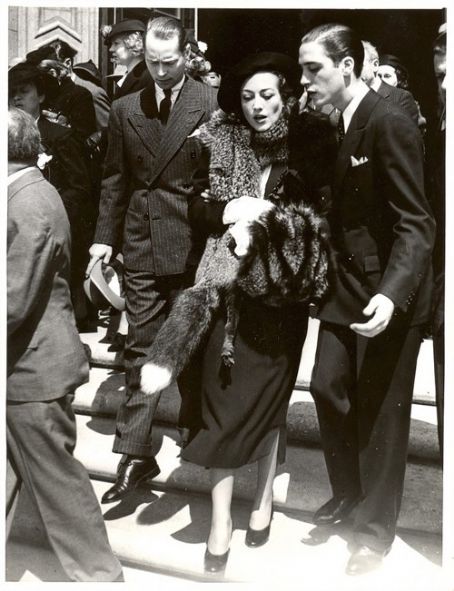
Franchot and Joan at Irving's funeral. Source: sangfroidwoolf.tumblr.com
Sources:
  • Crowther, Bosley. Hollywood Rajah: The Life and Times of Louis B. Mayer. Dell, 1960. p. 241.
  • "Irving G. Thalberg." TCM. http://www.tcm.com/tcmdb/person/190595%7C73388/Irving-G-Thalberg/
  • Tone, Franchot. “The Role I Liked Best,” Saturday Evening Post, June 7, 1947, p. 132
  • Viera, Mark. Irving Thalberg: Boy Wonder to Producer Prince. University of California Press. 2010. p. 182-183.

Wednesday, July 26, 2017

A Candid Apology

To any faithful readers out there in the world, I apologize that this blog has not been regularly updated this summer. Due to personal/professional scheduling reasons, I did not have the time I so desperately wanted to research Mr. Tone in June and July. Now that August is around the corner, I should be able to return to my previous habit of posting at least once per week and after quite a hiatus, have already signed up to participate in a blogathon (always a fun way to discover classic film enthusiasts and their blogs) this September.

I'm currently working on a post for later this week, but wanted to go ahead and share something today. Enjoy this assortment of clipping candids and check back this weekend for a real post!


Franchot with the Stooges


Backstage on the set of The Gentle People


With Joan


Franchot and Deanna on the set of Nice Girl


Franchot dining with Virginia Bruce
Franchot with Jean Wallace


With Martha Raye

Wednesday, July 12, 2017

Franchot: A Wealthy, but Sensitive Comrade

Three Comrades. Source: www.ha.com
Sonia Lee, in a July 1938 piece on the stars of Three Comrades for Hollywood Magazine, was impressed at how well Franchot Tone, Robert Taylor, and Robert Young created "the illusion of being products of the same world, the same thought, and the same troubled times" when they all had come from such different backgrounds and represented such different types in Hollywood. These distinct types Lee described as follows:

Franchot—the idealist, the man with the philosophical turn of mind; the cultured product of New England, whose reserve and balance has not been lessened by fame and fortune.
Robert Taylor—the Horatio Alger hero, if there ever was one. A youngster who achieved world adulation overnight, became king of a million feminine hearts, but still retained the liking and respect of the men who know him.
Robert Young—the enthusiastic lad to whom fame came slowly; who worked for what he has achieved over a period of years, who is similar in many respects to ambitious men his age in every walk of life.
If you have not yet watched Three Comrades, you must find it. I agree with Lee when she writes that Tone, Taylor, and Young play their scenes with "tenderness and integrity. They make the story unfold vividly and brilliantly. They make of friendship a tangible thing." I enjoy Franchot's films so much that I don't know that I will ever be able to definitively state which one contains his best performance. I find that I toss up Lives of a Bengal Lancer, Uncle Vanya, Mutiny on the Bounty, Man on the Eiffel Tower, The Bride Wore Red, Advise and Consent, Gentlemen are Born, The Stranger's Return, and Three Comrades as the many contenders for Franchot's best performance as an actor. Each time I watch Three Comrades, I find myself ready to announce it as THE finest performance of his career. The part of the sensitive mechanic who feels a brotherly need to take care of those around him is the perfect role to highlight Franchot's strengths as an actor. I wrote a film summary with screen captures back in 2015 which you can find here.

Franchot in a rare color portrait. Scanned from my collection.

In her examination of the film's male stars, Lee shares this personality sketch of Franchot:
By the very nature of his character, Hollywood knows Franchot least of these three. He is sensitive and intuitive. He is not one of those hale and hearty individuals who slaps a person on the back on short acquaintance, tells the story of his life, or reveals his cherished thoughts at the drop of a hat. As a matter of fact, his sole complaint about the business of being an actor is that the private affairs of a player become the property of the world at large. The one thing which made his courtship of Joan Crawford less than ideal was the minute report of its progress in the public press.
His circle of intimates is small. Robert Taylor and Barbara Stanwyck are frequently on the guest list of those attending the charming dinners given by Mr. and Mrs. Franchot Tone, when they entertain a famous musician, a world-renowned savant, or others who have distinction outside the Hollywood world.With the exception of the reception Joan and Franchot gave for Leopold Stokowski, they have never entertained on  a large scale. That is in keeping with the graceful, gracious background of Franchot's. Son of an important figure in America's business world, his childhood was serene, his education comprehensive.
He attended private schools here and abroad. He had tutors during the time when family travels made school attendance impossible. He is a graduate of Cornell University. He has been awarded the Phi Beta Kappa key—the mark of scholastic excellence. Franchot Tone is serious and studious—with deep, untapped wells of reserve. He makes friendships slowly, but once his allegiance is given, it is lasting and loyal.
Few know him, for he is not an easy person to know well. But his brilliant mind, his deep understanding of human nature, his fine artistry as an actor have achieved for him a deep respect in Hollywood, which is unmixed by envy or resentment. His interests are wide. Books, the progress of the theatre, music, new trends in thoughts and world events, engage his attention. He takes his life and his work seriously, but not himself.
Lee's assessment of Franchot rehashes the same "wealthy son with an impressive education and cultured background" story that we read time and time again, and it's true, of course. But I love the description of his personality as being sensitive and guarded and how he accrued respect among his peers in Hollywood. These are facts about Franchot that many of his colleagues have shared about him as well. My favorite part of the article is that last sentence, "He takes his life and his work seriously, but not himself." What a perfect way to describe Franchot's attitude in 11 words! In my research, I've seen evidence of this many times. Franchot cared about his career (even if his career choices did seem inconsistent to others and at times, even to me) but seemed to remain this down-to-earth guy who never boasted about his talents—he actually comes across as quite self-deprecating in interviews—and had strong beliefs about human rights and political matters and stuck to his convictions, and who—apart from his out-of-character publicity whirlwind with Barbara Payton—maintained his private life, a life he lived and enjoyed to the fullest.

Source:
Lee, Sonia."Three Comrades—On the Screen and Off." Hollywood. July 1938.

Friday, June 30, 2017

Hope for the Best (1945)

Hope for the Best ran for 117 performances between February 7, 1945 and May 19, 1945. Produced by Jean Dalrymple and Marc Connelly, the play was first housed at the Fulton Theatre and then in late April, moved to the Royal Theatre. Writer William McCleery's plot revolved around a newspaper writer who is dissatisfied with only covering gossip and is encouraged by a young woman to pursue more groundbreaking territory. Although his fiancée prefers him not to "rock the boat," the main character attempts to investigate and report on American politics.

Franchot Tone starred as the writer and was supported by a cast of Leo Bulgakov, Jane Wyatt, Jack Hartley, Doro Merande, Joan Wetmore, and Paul Potter.

Hope for the Best. Source: scan from my collection.

Theatre Arts Monthly reviewed the play in April 1945. Rosamond Gilder wrote:
In Franchot Tone, the producers, Jean Dalrymple and Marc Connelly—and Mr. Connelly as director— have found a convincing as well as a winning interpreter of the leading role. Mr Tone, last seen as a ‘round actor’ in Ernest Hemingway’s The Fifth Column, proves that he is still a skillful craftsman in the theatre in spite of his protracted dallying with the screen. He has balance and proportion in his acting, precise timing, a nice sense of humor. One of the hilarious moments in the play is the scene in which the columnist, about to launch forth on the new type of writing he is so eager to undertake, bogs down under the subtle discouragements administered by his dark angel. Mr. Tone sits alone on the stage in front of his typewriter; absorbed, intent, concentrated. His fingers dash over the keys, the little bell rings a cheerful note, he slams the carrier back with a masterful flip. Then doubt creeps into his mind. He stops, re-reads the paragraph, types on, tears the sheet out of the machine, puts a new one in, starts again. The tapping goes more and more slowly, becomes uneven, hesitant. The jubilant song of the keys has turned into a disheartened pecking; Mr. Tone’s very spine wilts, his hair stands on end, his face seems drained of vitality. The curtain goes down on a dogged pounding of keys that presages no good.
The New York Times was not as glowing in their review of Mr. Tone's performance. In his February 8th review, Lewis Nichols wondered if Franchot was the best actor for the part. Nichols' wrote:
He is easy and likable, of course, and he manages a vague, shy quality which is all right part of the time. However...in several scenes, he is shy to the point of cuteness.
Hope for the Best. Source: scan from my collection.

Hope for the Best: Source: New York Times clipping

Sources:
Gilder, Rosamond. "Foxhole Critics. Broadway in Review." Theatre Arts. April 1945. 
Internet Broadway Database: https://www.ibdb.com/broadway-production/hope-for-the-best-1672
Nichols, Lewis. "The Play." The New York Times. February 8, 1945.
Playbill Vault: http://www.playbill.com/production/hope-for-the-best-fulton-theatre-vault-0000004538